What Is Vana Protocol Data Sovereignty Dao Token Guide 2026
— By Whatsertrade in Tutorials
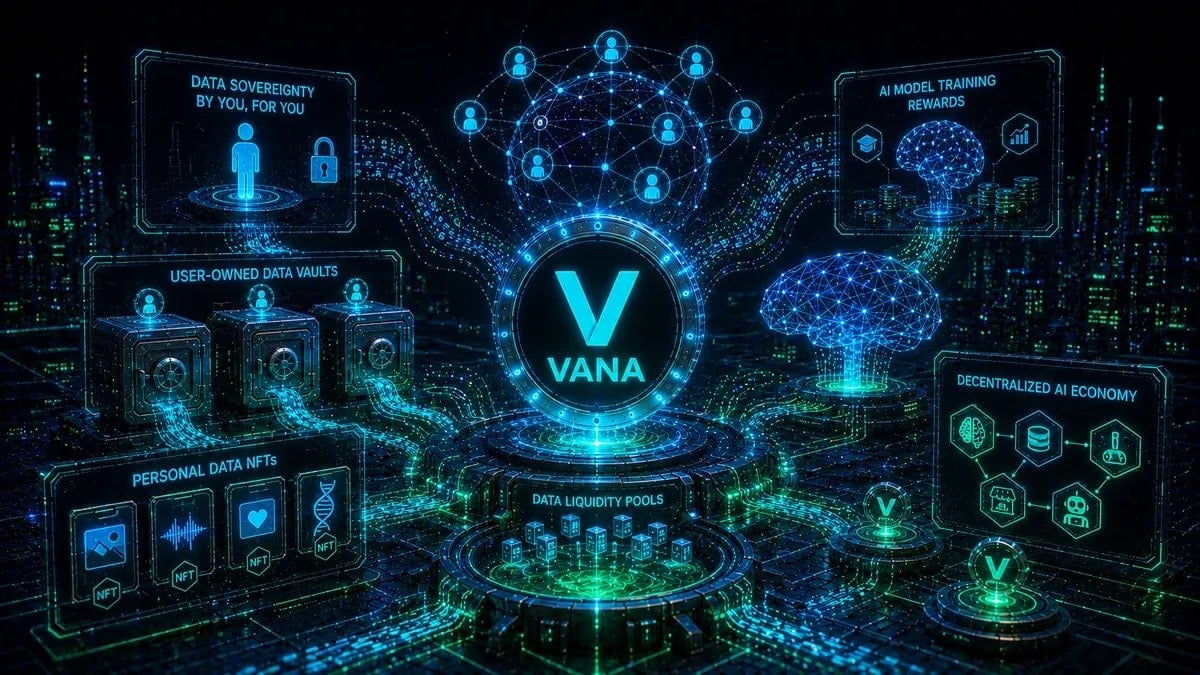
What Is Vana (VANA)? Data Sovereignty Protocol + DataDAOs Guide 2026 Every time you scroll a social feed, prompt an AI assistant, click an article, or sign a wa
What Is Vana (VANA)? Data Sovereignty Protocol + DataDAOs Guide 2026
Every time you scroll a social feed, prompt an AI assistant, click an article, or sign a wallet transaction, you generate data that gets harvested, packaged, and sold to the AI companies building the next wave of large language models. That data is the asset class of the decade. Pricing estimates for the global pool of tokenized user data have climbed past one hundred and eighty billion dollars in extractable value, and almost none flows back to those who produced it. Vana is the layer one blockchain trying to invert that arrangement.
Vana is an EVM compatible layer one network purpose built for data sovereignty. Instead of users surrendering raw data to centralized platforms in exchange for free services, Vana lets users contribute encrypted data to collective pools called DataDAOs, where ownership, governance, and revenue distribution are handled on chain. Artificial intelligence companies that want access to that data pay in VANA tokens, which are burned at the point of access, creating a deflationary feedback loop tied directly to AI demand for high quality training corpora.
The project was founded by Anna Kazlauskas and Art Abal, two MIT researchers who spent years studying the economics of data extraction inside large platforms. Their thesis is straightforward. If data is the new oil, then the people producing it should be the ones owning the wells, setting the price, and earning the royalties. Mainnet launched in 2024 with a one hundred and twenty million token total supply, a proof of contribution consensus mechanism, and a personal server architecture that gives every user a private execution environment for their own data.
This evergreen guide explains, in plain language, what Vana is in 2026, how DataDAOs actually work, what the VANA token does economically, who built the protocol, how it compares against adjacent data and AI plays like Ocean Protocol, Sahara AI, and Grass, and what investors and contributors should understand before participating. We cover the technical architecture, the tokenomics, the founders, the proof of contribution mechanism, and the realistic risks heading deeper into the second half of the decade.
Featured Snippet
Vana is an EVM compatible layer one blockchain for user owned data, launched in 2024 by MIT founders Anna Kazlauskas and Art Abal. Users contribute encrypted personal data to collective pools called DataDAOs, governed and monetized on chain. The native VANA token, capped at one hundred and twenty million supply, is used for gas, validator staking, governance, and is burned by AI companies that pay to access aggregated datasets. More than one million users contributed data in the network's first year, building the largest user owned data asset class on chain.
Before we go deeper, a quick orientation. Vana is not a memecoin, not an AI agent token, and not a generic layer two scaling solution. It is a vertically focused layer one network that treats data as a first class on chain primitive. If you are already comfortable with how Ethereum works as a settlement layer, our companion piece on Ethereum and EVM compatibility for beginners gives the foundation you will need to understand why Vana chose to be EVM aligned rather than building a fully custom virtual machine from scratch.
The deeper context for why Vana exists at all sits inside the broader debate about data ownership in the AI era. Companies like OpenAI, Anthropic, Google, Meta, and Microsoft consume enormous quantities of human generated data to train models that, in turn, generate revenue measured in tens of billions of dollars per year. The producers of that training data, regular internet users, see none of that revenue. Vana is one of the most rigorously engineered attempts to route around that imbalance using cryptographic primitives, decentralized governance, and a token economy aligned with data quality rather than data volume.

Why Data Sovereignty Became a Crypto Category
The category of data sovereignty in crypto did not emerge from a marketing slide. It emerged from a structural problem that the artificial intelligence boom made impossible to ignore. Training a frontier large language model requires terabytes of high quality text, audio, image, and behavioral data. Until recently, that data was sourced through opaque scraping pipelines, undisclosed platform licensing deals, and outright copyright disputes. The producers, the writers, posters, photographers, and ordinary users whose digital exhaust made the models possible, were never asked, never paid, and never given a vote on how their contribution was used.
Vana's bet is that a parallel system can be built where users contribute data voluntarily, retain cryptographic control, pool it into thematic DataDAOs, and capture a proportional share of revenue when AI companies license that data. The mechanism that makes this credible is the combination of personal server environments that keep raw data private, proof of contribution that scores quality and uniqueness, and native data exchange contracts that handle pricing, licensing, and revenue distribution without an intermediary. For context on the neighbors, our Ocean Protocol guide, Sahara AI breakdown, and Grass DePIN explainer cover each project in detail.
Who Built Vana and Why It Came Out of MIT
Vana was founded by Anna Kazlauskas and Art Abal, both MIT trained researchers whose work has centered on the political economy of data. Kazlauskas had previously built early infrastructure for letting users bring their own data into machine learning models, and Abal contributed research and policy experience that informed how data ownership frameworks could be made legally legible to regulators in the United States and European Union. The pairing matters because Vana is one of the few projects in the category with both the technical specificity to engineer cryptographic data ownership and the policy fluency to engage seriously with the legal frameworks that govern personal data.
The intellectual seed for Vana traces back to MIT research on a future in which people, rather than platforms, own the data they generate. Around that thesis the founders assembled a team, raised funding from prominent crypto and venture investors, and built the first iteration of what would launch as mainnet in 2024. Vana is not a quick narrative play. It is a multi year engineering effort backed by founders whose academic interest in data sovereignty predates the AI hype cycle by several years, and the whitepaper reads more like an applied cryptography and mechanism design paper than typical crypto marketing material.
How Vana Actually Works Architecturally
At the architectural level, Vana is an EVM compatible layer one blockchain. Smart contracts written in Solidity deploy on Vana with minimal modification, developer tooling like Hardhat, Foundry, and Remix works out of the box, and Ethereum compatible wallets can be configured for Vana with a network addition. The choice to remain EVM aligned was deliberate. It dramatically lowers friction for builders deploying DataDAO contracts, data licensing logic, and revenue distribution flows without learning a new virtual machine.
On top of that base layer sit the three primitives that make Vana distinctive. The personal server environment is a private execution context controlled by the user where raw data lives, encrypted under the user's keys, and only leaves in derived, privacy preserving forms when explicitly authorized. The DataDAO is an on chain collective where users contribute access to their personal data, pool that contribution with thousands or millions of others, and govern collectively how the resulting dataset is licensed and monetized. The native data exchange contract is the on chain mechanism that handles licensing, payment, and revenue routing whenever an external party, typically an AI company, wants to access a dataset. Together these primitives invert the standard data extraction flow. The user retains the raw data, the DataDAO owns the collectively governed asset, and AI buyers receive a license to a dataset whose composition, quality scoring, and revenue split are all transparent on chain.
DataDAOs Explained Without Jargon
A DataDAO is the most important concept in the Vana ecosystem, and it is worth slowing down to define it precisely. A DataDAO is a smart contract based collective that aggregates a specific category of user contributed data, governs that aggregation through token holder voting, and monetizes the resulting dataset through licensing deals with external buyers. The output is split among contributors, governance token holders, and the protocol itself according to rules encoded on chain.
A concrete example helps. Imagine a DataDAO focused on consumer financial behavior. Thousands of users opt in, contribute encrypted transaction patterns from their personal server environments, and earn DataDAO specific tokens that represent both their share of the dataset and their governance rights. An AI company building a fraud detection model wants access to this aggregated, anonymized dataset. It pays in VANA, which is partly burned at the network level and partly distributed to the DataDAO treasury, where it gets routed to contributors and DataDAO governance token holders according to the contract logic.
The result is that the value generated by collective data finally lands with the people who produced it, mediated by a transparent smart contract rather than by a platform that captures the margin. If you are coming from outside crypto, the closest mental analogue is a cooperative, except that membership is verified cryptographically, voting is enforced on chain, and the revenue split is automated rather than reliant on management discretion. For deeper grounding on the governance side of this concept, our companion explainer on decentralized autonomous organizations covers the broader DAO framework that DataDAOs extend.
DLP Tokens and the Layered Token Architecture
Vana operates with a two layer token model that is essential to understand before holding or evaluating the protocol. At the network level sits VANA, the gas token, validator staking asset, and governance currency for the protocol as a whole. At the DataDAO level sit DLP specific tokens, where DLP stands for Data Liquidity Pool. Each individual DataDAO can issue its own DLP token, which represents membership, governance, and a claim on that DataDAO's revenue specifically.
This layered structure mirrors how Ethereum hosts thousands of independent ERC twenty tokens on top of its native ETH asset, but with a meaningful difference. DLP tokens are not arbitrary issuances. They are tied to verified, on chain governed datasets with proof of contribution scoring, and their economic value is directly linked to demand from AI companies for the underlying data. A DLP token for a high quality, in demand dataset behaves very differently from a DLP token for a niche or low quality pool, and Vana's protocol design surfaces these differences through its scoring mechanisms.
For investors, this two layer model means there are two distinct exposure types. Holding VANA itself is a bet on the overall network, on validator economics, on aggregate AI demand for Vana hosted datasets, and on the burn mechanism that retires VANA each time data is accessed. Holding a specific DLP token is a more concentrated bet on the success of one particular DataDAO. Both can coexist in a portfolio, but they are very different instruments with very different risk profiles, and confusing the two has been a frequent source of misanalysis from outside observers.
VANA Token Utility and Tokenomics
VANA, the native asset of the Vana network, has four distinct utility functions, each anchored in a specific protocol mechanic. The first is gas. Every transaction on Vana, whether a DataDAO governance vote, a personal server attestation, a data exchange license, or a simple token transfer, requires VANA to pay for execution. The second is validator staking. Vana operates with a proof of contribution based consensus that integrates validator staking, and validators must lock VANA to participate, securing the network and earning yield in return. The third is governance. Holders of VANA vote on protocol level upgrades, treasury usage, fee parameters, and the broader direction of the network. The fourth, and arguably the most important from a valuation standpoint, is the burn mechanism. When an AI company accesses a Vana hosted dataset, a portion of the VANA paid for that access is permanently retired from circulation. The more demand AI companies have for the network's data, the more VANA gets burned over time.
The total supply of VANA is capped at one hundred and twenty million tokens, which is unusually small for a layer one in the post 2024 era and is a deliberate design choice. A smaller supply makes the burn mechanism more meaningful per unit of demand, and it gives each token a larger claim on aggregate network activity. The distribution across team, ecosystem, treasury, public sale, and validator rewards follows industry standard practices with multi year vesting schedules, and the specific allocations are detailed in the official Vana documentation.
From a market structure standpoint, the combination of a low fixed supply, a real utility surface, and a deflationary burn mechanism tied to actual network usage gives VANA a tokenomics profile that is easier to model than most layer ones. The valuation question reduces to a small number of variables. How fast does aggregate data licensing revenue grow? What share of that revenue gets routed to the burn? How does validator demand evolve as more DataDAOs come online? Investors who like clean fundamental models tend to find Vana more analytically tractable than projects with sprawling, undefined token roles. For background on how validator staking works in general, our staking crypto guide covers the broader mechanism in detail.
Proof of Contribution and How Data Gets Scored
One of the harder problems in any decentralized data network is determining which contributions are valuable, which are mediocre, and which are outright spam or attempts to game the system. Vana addresses this through a mechanism called proof of contribution. Proof of contribution scores each piece of contributed data along multiple dimensions, including uniqueness relative to existing data in the pool, quality based on validation rules specific to the DataDAO, and consistency with the contributor's prior submissions and on chain reputation.
The scoring runs partly inside the user's personal server environment, where raw data can be analyzed locally without exposing it, and partly through DataDAO level validators who confirm aggregate quality without ever seeing the underlying raw data. Contributions that score well receive proportionally larger allocations of DLP tokens. Contributions that score poorly or that are flagged as duplicative or low quality receive reduced or zero allocation. The cumulative effect is that the DataDAO's overall dataset trends toward higher quality over time, which in turn makes the data more valuable to AI buyers, which feeds back into demand for VANA at the access point.
This is also where Vana diverges sharply from older models that paid users a flat rate per data submission. A flat rate model creates an incentive to flood the system with low quality data, which is exactly what destroyed earlier attempts at user pays data markets. Proof of contribution explicitly aligns incentives with the buyer's quality preferences, which is the harder but more durable design.
Mainnet Launch and the First Year Metrics
Vana mainnet launched in 2024 after an extended testnet phase that validated the proof of contribution scoring, the DataDAO governance flow, and the personal server attestation cycle under production conditions. Within the first year of operation, more than one million users contributed data into Vana hosted DataDAOs, representing one of the largest single year aggregations of user contributed on chain data in crypto history.
The hundred and eighty billion dollar figure frequently cited around Vana refers to the estimated total addressable value of tokenized user data as an asset class, not to current revenue or market capitalization. It is a thesis level number that quantifies the opportunity Vana is trying to capture. Actual progress is measured in more concrete terms, including active DataDAOs, the volume of licensing transactions, cumulative VANA burned, validator count, and developer ecosystem growth around the personal server SDK. Serious investors track the cadence of new DataDAO launches, the diversity of dataset categories, the share of revenue routed to the burn versus validators and treasury, and the realized average revenue per active contributor. Those are the numbers that answer whether Vana is converting its architectural advantages into measurable network value.

Vana Timeline From MIT Research to Mainnet
Anna Kazlauskas and Art Abal begin research at MIT on the political economy of user data and the technical primitives that could enable user owned data systems.
Initial Vana concept formalized. Early prototypes of personal server environments and DataDAO smart contracts begin development with seed funding from crypto and AI focused investors.
Vana testnet launches with proof of contribution scoring and EVM compatibility. First wave of DataDAO experiments runs on testnet with thousands of beta contributors.
Vana mainnet launches with the VANA token live, the one hundred and twenty million supply cap encoded, and the first cohort of production DataDAOs onboarded.
VANA token listings expand across major centralized exchanges. Cumulative contributor count crosses one million users in the first year of operation.
DataDAO ecosystem expands across consumer behavior, social media, financial signals, health and fitness, and creative content categories. First high profile AI company licensing deals processed through the exchange contracts.
Vana sits as one of the most established data sovereignty layer ones, with a maturing DataDAO economy, ongoing VANA burns from AI access fees, and growing developer adoption around the personal server SDK.
Personal Server Environments and Privacy Guarantees
The personal server is the user side primitive that makes the rest of Vana credible. Every user has a private execution environment that holds raw data under their own cryptographic keys, running locally, in a trusted execution environment, or in a cloud instance the user controls. Raw data never leaves the personal server in cleartext. What leaves is always either an encrypted ciphertext, a privacy preserving derived value, or an attestation about a property of the data.
This design has two consequences that matter. It gives users a credible technical guarantee that contributing to a DataDAO does not expose underlying personal data to anyone, including Vana itself, the DataDAO governance, or the AI buyer. And it shifts the locus of compliance with data protection regimes like the European Union's General Data Protection Regulation and similar United States state frameworks. When users control the keys to their own raw data, the legal framing of data sales changes meaningfully. For technical readers, the personal server is also where most of the heavy proof of contribution computation happens. Quality scoring, uniqueness analysis, and data validation run locally and emit only zero knowledge or commitment style attestations to the chain, keeping the on chain footprint lightweight while preserving security.
Native Data Exchange Contracts and the AI Buyer Flow
The native data exchange contracts are the on chain mechanism through which AI companies pay for and access Vana hosted datasets. When an AI company, whether a frontier lab, an enterprise builder, or an open source research collective, wants to license a dataset from a Vana DataDAO, it interacts directly with the exchange contract. The contract verifies the buyer, accepts VANA payment, executes the agreed split between the burn pool, the DataDAO treasury, and protocol level fees, and grants a license under the terms encoded in the agreement.
The license is enforced through cryptographic access controls plus the structural fact that the buyer never receives raw individual data. Instead, the buyer gets access to aggregated, anonymized, or privacy preserving derivations of the underlying contributions, with the form depending on the DataDAO's governance choices. From an economic standpoint, the exchange contract is where Vana's value accrues. The aggregate flow of VANA paid into these contracts, multiplied by the share routed to the burn, is the most direct fundamental input into the long term valuation case, and informed investors watching Vana over multi year horizons typically track this flow as the single most important on chain metric.

Vana Compared With Ocean Protocol, Sahara AI, and Grass
Understanding Vana well requires placing it against the most cited adjacent projects in the data plus AI segment. None of these comparisons are zero sum. The category is large enough that multiple winners can coexist, and several of these projects have complementary rather than directly competitive positioning. The point of the comparison is to clarify where Vana actually sits.
Ocean Protocol is the oldest project in the decentralized data category, having pioneered the concept of data tokens and a decentralized marketplace for buying and selling data assets. Ocean is closer to a marketplace plus tokenization layer that runs on top of multiple base chains, while Vana is a vertically integrated layer one that anchors on user contributed data and DataDAO governance. Ocean is broader in dataset type. Vana is more opinionated about user side ownership and proof of contribution scoring. The two can theoretically interoperate, and informed observers often treat them as occupying adjacent corners of the same overall design space rather than as direct substitutes.
Sahara AI targets the broader decentralized AI stack, including data labeling, model training, and inference, with its own layer one infrastructure and a token economy aligned to AI workloads end to end. Sahara is wider in scope than Vana but less focused on the specific question of user data sovereignty. A common framing among informed allocators is that Sahara competes for the AI compute and labeling spend while Vana competes for the AI training data spend, with the two projects occupying complementary positions on the artificial intelligence value chain.
Grass targets decentralized residential bandwidth, letting users rent unused internet capacity to AI companies that need to scrape and index the public web at scale. Grass is closer to a DePIN play, decentralized physical infrastructure, where Vana is closer to a data ownership and governance play. Grass turns idle network capacity into a yield stream. Vana turns personal data into a governed asset class. They address different bottlenecks in the same broader AI supply chain, and informed portfolios sometimes hold both for that reason.
If you want a clean mental model, Vana is the data sovereignty specialist. Ocean is the data marketplace generalist. Sahara is the full stack AI infrastructure play. Grass is the bandwidth DePIN. Each has merits, each has trade offs, and the right exposure depends on which part of the AI plus crypto thesis you believe in most.
Use Cases Already Live on Vana
By 2026, Vana hosts DataDAOs across consumer behavior such as anonymized social and shopping patterns, financial signals such as on chain wallet activity and trading behavior, health and fitness data from wearables, creative content including writing samples and image prompts, and conversational data from voluntarily contributed chat histories. Each category carries different risk profiles, revenue potentials, and regulatory implications. Health data, for example, carries substantially higher compliance overhead than shopping behavior but commands materially higher prices per record from AI buyers building healthcare models.
For builders, the implication is that Vana is less a single marketplace and more a platform for launching domain specific data economies. A developer with domain expertise in a dataset type can launch a DataDAO targeted at that domain, attract contributors, structure the governance and economics, and capture the spread between user side compensation and AI buyer demand. The complete developer flow is documented in Vana's official SDK guides.
How Vana Fits the Broader AI Plus Crypto Thesis
The thesis behind Vana is part of a larger argument about how AI and crypto will interact this decade. The core claim is that AI systems need three categories of resources at scale and each has a credible decentralization play. Compute, where projects like Render and io.net target distributed GPU capacity. Data, where Vana, Ocean, and similar projects target user owned training data. And agency, where AI agents on crypto rails target autonomous economic actors that need wallets, identities, and payment rails.
Vana sits squarely in the data category and is one of its most engineering forward representatives. The bet for holders is not that Vana wins the entire AI plus crypto narrative, but that the data sub category will be a substantial slice of overall AI economic activity and that Vana's architectural choices position it to capture a meaningful share. That is a more grounded thesis than the maximalist pitch and does not require Vana to be the only winner to deliver returns. Informed allocators typically treat the category as a thematic bucket rather than isolated single name bets, with Vana often paired against complementary AI compute and agent infrastructure exposures.
Real Risks Vana Investors Should Take Seriously
Vana is technically credible and strategically clear, but it carries several real risks that should sit front and center in any honest analysis.
The first risk is adoption velocity. VANA value depends on AI companies actually licensing data through Vana DataDAOs at meaningful volume. If frontier labs continue sourcing training data through traditional licensing, scraping, and proprietary partnerships, the demand side of Vana's economic loop remains thin regardless of how many users contribute. Watching the cadence and size of licensing transactions through the exchange contracts is the right way to evaluate this risk over time.
The second risk is regulatory. Decentralized data marketplaces touch some of the most heavily regulated areas in technology, including European Union data protection law, United States state privacy frameworks, and sector specific rules around health, financial, and biometric data. Vana's architecture is designed with these frameworks in mind, but the legal interpretation of user owned data sold through DAOs is still being established, and adverse interpretations could constrain growth in specific verticals.
The third risk is competition. Ocean Protocol, Sahara AI, Grass, and a growing list of newer entrants are each pursuing different angles on overlapping problems, and the eventual winners may consolidate share in ways hard to predict from a 2026 vantage point. The fourth risk is operational. Vana users are exposed to phishing, fake DataDAO contracts, impostor airdrops, and address poisoning attacks. Our guide on avoiding crypto address poisoning scams is required reading for anyone contributing data, claiming DLP allocations, or staking VANA. The fifth is execution. Multi year layer one networks live or die on engineering cadence, validator decentralization, ecosystem growth, and the team's ability to navigate technical migrations. Vana's MIT origin mitigates this risk relative to many peers, but pedigree does not eliminate it.
Vana Pros and Cons at a Glance
PROS
Vertically focused layer one with clear category positioning around user owned data and DataDAOs.
Low fixed total supply of one hundred and twenty million VANA tokens, paired with a real burn mechanism tied to AI access demand.
EVM compatibility lowers developer friction and lets existing Ethereum tooling deploy with minimal adaptation.
Research grade founding team out of MIT with academic and policy depth in data economics.
One million plus first year contributors, demonstrating that the contributor side of the marketplace can scale.
CONS
Demand side maturity depends on AI companies actually licensing data through Vana at meaningful volume, which is still developing.
Regulatory framework for user owned data marketplaces is still being established in major jurisdictions.
Competitive landscape with Ocean Protocol, Sahara AI, Grass, and newer entrants pursuing overlapping problems.
Two layer VANA plus DLP token architecture adds complexity that retail investors often misread.
Multi year vesting schedules mean future supply unlocks will continue through the second half of the decade.
Best Practices For Anyone Engaging With Vana
Whether you participate in Vana as a data contributor, a DLP token holder, a VANA holder, or a developer building DataDAOs, a few discipline rules separate sustainable participation from costly mistakes. None of this is investment advice. It is operational hygiene.
Read the DataDAO terms before contributing. Every DataDAO has its own governance, revenue split, data quality requirements, and treatment of contributor rights. The economics of contributing to a high quality, well governed DataDAO are very different from a niche or experimental one, and the differences matter for both privacy and earnings.
Verify the contract address every single time. Imposter Vana contracts and fake DataDAO entry points appear regularly across crypto, and copy paste mistakes are common. Cross reference the official Vana documentation, the block explorer, and a trusted analytics dashboard before connecting a wallet. Our walkthrough on verifying tokens and pairs on DEXTools covers the exact verification workflow for VANA and DLP tokens.
Separate contributor wallets from staking wallets from long term holding wallets. The wallet you use to contribute data interacts with many contracts and accumulates approvals. The wallet you use to stake VANA should be separate. The wallet holding your long term position should be a hardware wallet, isolated from daily on chain activity. This hygiene is doubly important on a network where wallets touch personal data flows.
Size positions assuming realistic outcomes, not maximalist ones. Vana's thesis is credible but unproven at scale, and the data sovereignty category will play out over years, not months. Investors who treat VANA as a five to ten year thematic position with appropriate sizing have a different experience from those treating it as a quick rotation. For the broader framework on portfolio construction around thematic exposures, our DeFi guide covers the basics. Stay current on regulatory developments affecting the data category. The legal interpretation of user owned data sold through DAOs is one of the most actively evolving areas in technology law, and changes can move the fundamentals of every project in the segment.
Frequently Asked Questions About Vana
1. What is Vana in one sentence?
Vana is an EVM compatible layer one blockchain for user owned data, where users contribute encrypted personal data to on chain collectives called DataDAOs that license aggregated datasets to AI companies in exchange for VANA payments.
2. Who founded Vana?
Vana was founded by Anna Kazlauskas and Art Abal, both MIT trained researchers with backgrounds in the political economy of data and the engineering of user owned data systems. Their academic work on data ownership predates the recent AI hype cycle.
3. What is a DataDAO?
A DataDAO is a smart contract based collective that aggregates a specific category of user contributed data, governs that aggregation through token holder voting, and licenses the resulting dataset to AI buyers. Revenue is routed on chain to contributors, governance token holders, and the protocol.
4. What does the VANA token do?
VANA serves four roles. It is the gas token of the network, it is the validator staking asset, it is the protocol level governance token, and it is the asset that AI companies pay and partially burn when accessing Vana hosted datasets.
5. What is the total supply of VANA?
VANA has a fixed total supply capped at one hundred and twenty million tokens, distributed across team, ecosystem, treasury, public sale, and validator rewards with multi year vesting schedules.
6. When did Vana mainnet launch?
Vana mainnet launched in 2024 after an extended testnet phase. Within the first year of operation, more than one million users had contributed data into Vana hosted DataDAOs.
7. What is proof of contribution?
Proof of contribution is Vana's mechanism for scoring each piece of contributed data along uniqueness, quality, and consistency dimensions. Higher scoring contributions receive proportionally larger DLP token allocations, aligning contributor incentives with dataset quality.
8. What are DLP tokens?
DLP, or Data Liquidity Pool, tokens are DataDAO specific tokens that represent membership, governance rights, and a claim on a particular DataDAO's revenue. They sit one layer above VANA in Vana's two layer token architecture.
9. How is Vana different from Ocean Protocol?
Ocean Protocol is a decentralized data marketplace and tokenization layer running on top of multiple base chains. Vana is a vertically integrated layer one focused on user owned data and DataDAO governance. Ocean is broader and more marketplace shaped. Vana is more opinionated about user side ownership.
10. How is Vana different from Sahara AI and Grass?
Sahara AI targets the broader decentralized AI stack including training, inference, and labeling. Grass targets decentralized residential bandwidth for AI web scraping. Vana specifically targets user owned training data and the DataDAO governance layer around it.
11. What are the main risks of Vana?
The main risks are adoption velocity on the AI buyer side, regulatory uncertainty around user owned data marketplaces, competition from adjacent projects, complexity of the two layer token architecture, and ongoing supply unlocks through multi year vesting schedules.
12. Is VANA a good investment in 2026?
VANA is a thematic data sovereignty bet with credible architecture and a clear category position. Whether it suits any individual depends on risk tolerance, time horizon, and overall portfolio context. It can be appropriate as a small to moderate thematic position for investors who believe in the user owned data thesis. It is not appropriate as a core holding for risk averse investors. This guide is informational and not financial advice.
Final Thoughts On Vana Heading Into The Rest Of The Cycle
Vana is one of the more intellectually serious projects in the entire AI plus crypto category. Its origin is not a marketing exercise. It is the productization of years of MIT research on the political economy of data, executed by founders with both the engineering depth and the policy fluency to engage with one of the most consequential questions in technology. The category it sits in, user owned data for the AI era, is among the largest opportunity surfaces in the artificial intelligence economy, with an addressable market measured in hundreds of billions of dollars.
The architecture is coherent. EVM compatibility lowers builder friction. The DataDAO primitive turns scattered individual data into governed collective assets. The personal server environment gives users a credible privacy guarantee. Proof of contribution aligns incentives with quality rather than volume. The native data exchange contracts make the buyer flow legible. The two layer VANA plus DLP model gives both protocol and DataDAO level exposure. The one hundred and twenty million supply cap and the burn mechanism create a tokenomics profile that is unusually clean to model.
None of that guarantees market success. The hardest variable is demand. AI companies have to license meaningful volumes through Vana for the economic loop to compound. Regulatory frameworks have to evolve in ways that accommodate user owned data marketplaces. Competition has to settle in a way that leaves Vana with a defensible share. Each is plausible. None is certain.
For new investors in 2026, the right frame is patient and grounded. This is not a memecoin and not a quick rotation. It is a multi year thematic exposure to a credible attempt at restructuring how value flows in the data economy. Treated as a small to moderate thematic position with appropriate sizing, alongside complementary plays in decentralized data marketplaces, decentralized AI infrastructure, and AI bandwidth DePIN, Vana can be a coherent part of a portfolio aligned with the user owned data thesis. Do the homework, verify contracts, track network metrics, and remember that the underlying question, who owns the data that trains the future, is among the most important of the decade.
Related Guides
- What Is Ocean Protocol (OCEAN)? The Decentralized Data Marketplace Powering AI in 2026
- What Is Snapshot: Complete DAO Governance Voting Guide (2026)
- What Is a DAO: Complete Guide to Decentralized Autonomous Organizations (2026)
- How Do DAOs Work? Governance, Treasury and Voting Explained (2026)
- Governance Quorum vs Whale Voting: How DAO Control Risk Affects Tokenholders