Are Crypto Loans Taxable? Collateral and Liquidation Rules

Borrowing against your crypto can unlock non-taxable liquidity, but market drops and liquidations can trigger sudden tax bills. Learn how the IRS views debt.
Do Crypto Loans Trigger Tax? Borrowing, Collateral, and Liquidation Rules
Crypto loans provide a capital-efficient way to access short-term liquidity without selling digital assets. For long-term holders, high-net-worth treasuries, and market allocators, liquidating native crypto positions is often highly suboptimal, as it eliminates potential upside exposure to future market growth and may trigger immediate, costly capital gains tax obligations.
To bypass this friction, participants frequently turn to centralized and decentralized credit platforms to borrow funds against their portfolios.
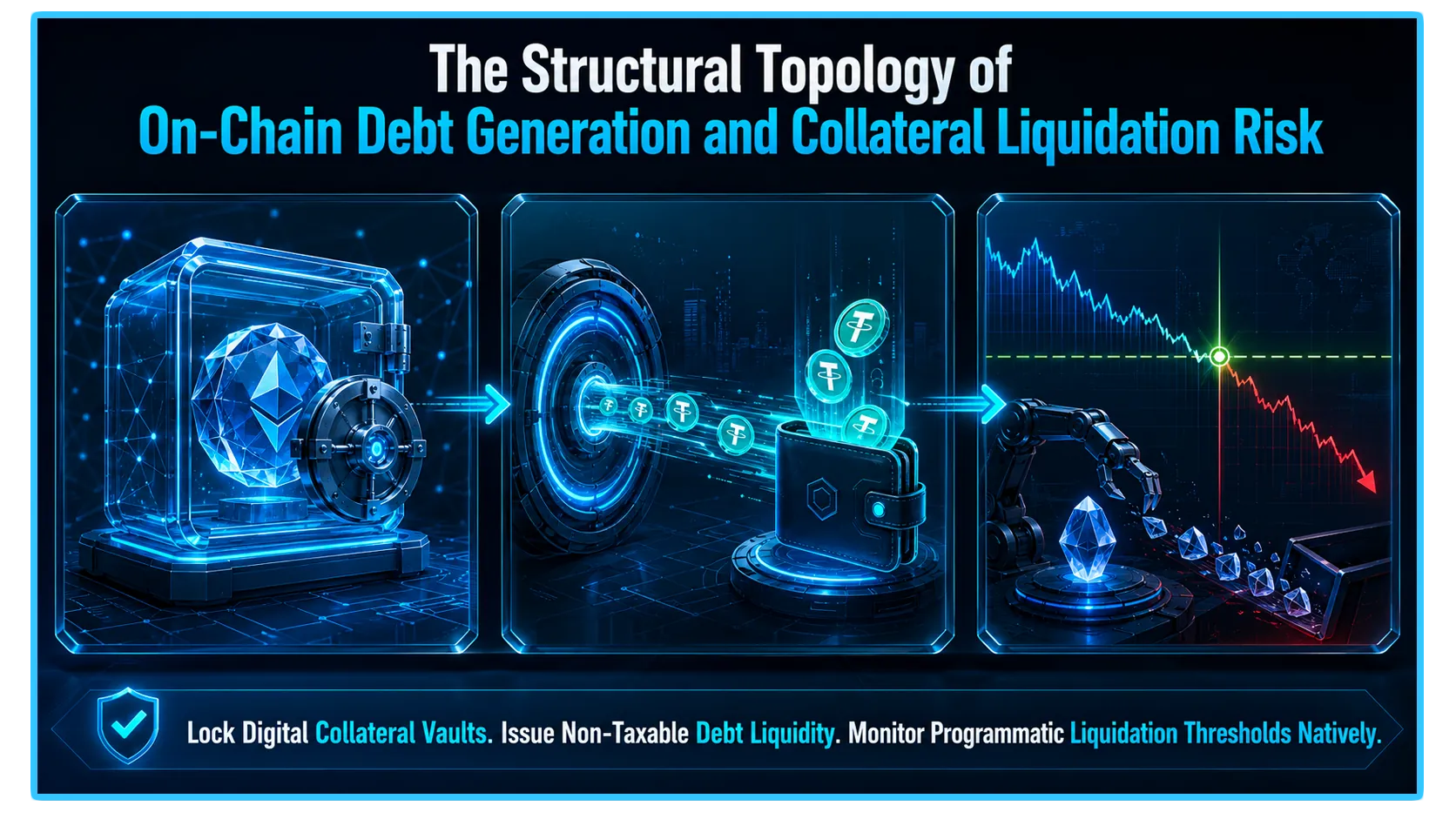
- By locking up their digital assets as underlying collateral, investors can instantly draw stablecoins or fiat cash to fund real-world operations or secondary market maneuvers. However, assuming that debt generation remains permanently shielded from tax regulatory enforcement is a critical mistake. If you navigate on-chain lending protocols blindly, sudden market volatility, token conversions, and algorithmic pool liquidations can trap you under unexpected, severe tax liabilities.
1. The Core Paradigm: Borrowing vs. Selling Property
- To analyze your credit positions through the lens of global tax compliance, you must look at how regulatory bodies like the Internal Revenue Service (IRS) explicitly classify digital assets. Under current tax frameworks, cryptocurrencies are defined strictly as property, not currency. Therefore, general tax principles governing property-backed debts apply here.
- When you take out a standard cryptocurrency loan, the transaction itself does not constitute a taxable disposal event. The protocol recognizes the borrowed funds as a clear financial liability that you are legally required to repay.
- Because you haven't sold your underlying property or surrendered true tax ownership to a secondary buyer, no capital gains are realized at the moment of debt inception. You are simply accessing liquid capital backed by the equity value of your locked estate.
2. The Smart Contract Switch: The DeFi Collateral Debate
- While centralized lending venues (CeFi) maintain clean escrow paths where you deposit raw tokens and receive debt directly, decentralized finance (DeFi) platforms introduce an intricate architectural gray area.
- When you deposit assets like Ether (ETH) into automated liquidity vaults like Aave or Compound, the underlying smart contract doesn't just hold your tokens in a static folder. It issues a secondary token back to your wallet (such as an aToken or cToken) to represent your explicit yield-bearing share of that credit pool.
This architectural mechanism triggers a major debate among crypto-focused Certified Public Accountants (CPAs):
The Conservative Interpretation: Because tax authorities assert that exchanging one cryptocurrency for another constitutes a reportable disposal event, converting raw ETH into a distinct cETH receipt token could technically be classified as a taxable crypto-to-crypto trade. Under this approach, you would owe capital gains tax immediately upon funding the vault if your underlying collateral had appreciated since its acquisition date.
The Aggressive/Functional Interpretation: This perspective argues that the receipt token functions purely as an on-chain digital escrow voucher, proving your right to reclaim your original locked capital. Because the economic intent is a non-recourse security deposit rather than a true transfer of ownership rights, proponents argue it should remain entirely non-taxable until an actual exit or liquidation occurs.
3. The Diagnostic Grid: Lending Risk and Tax Traps
To maintain a clean structural overview of how your borrowing and collateral adjustments map out across global compliance sheets, evaluate the primary categories organized inside this optimized layout:
4. The Liquidation Trap: The Involuntary Disposal Event
- The most devastating financial blow an on-chain borrower can experience is an automated smart contract liquidation event during a severe market drawdown. If the spot market value of your collateral asset plummets and breaches the platform's mandatory Loan-to-Value (LTV) safety boundary, the protocol’s public liquidator bots instantly execute a programmatic margin call.
The smart contract automatically seizes your locked collateral and dumps it onto secondary decentralized exchanges to buy back the stablecoins needed to repair the pool’s debt deficit.
The Severe Tax Double-Whammy: Many market participants assume that because a liquidation is an automated, forced event executed entirely by autonomous software code without their manual consent, it carries zero tax implications. This is an absolute illusion.
The IRS and global revenue systems view an automated liquidation exactly like a standard market sale.
- When the protocol sells your tokens to cover your debt liability, you have formally disposed of your property. You are legally required to calculate your capital gains or losses by contrasting the fair market value of the tokens at the precise block timestamp of liquidation against your original historical cost basis.
- If you originally acquired your collateral tokens years ago at a very cheap price, you will find yourself hit with an immense, immediate tax bill, even though your portfolio equity was completely wiped out by the liquidation event.
5. Real-Time Telemetry and Pre-Flight Diagnostics via DEXTools
- Successfully utilizing crypto credit models allows you to optimize your capital velocity and bypass early asset realization penalties. However, keeping your loan books safe from catastrophic liquidation events demands continuous look-through tracking of market depth and order-book resiliency. If you monitor your loan health relying purely on slow, lagging application dashboards without verifying active pool density and volume velocity first, your vaults can easily be swept by sudden price cascades.
- DEXTools provides the critical analytical data infrastructure needed to perform these diagnostic verifications in real-time. Before locking up large capital blocks as vault collateral or adjusting your debt leverage parameters, paste your collateral token's contract address straight into the advanced DEXTools Pair Explorer.
- Reviewing live transaction velocity, checking aggregate pool locks, and checking looking-through wallet movements allows you to immediately evaluate the actual health of your asset markets. Maintaining a flawless, real-time read on liquidity depth ensures that your credit health parameters remain completely optimized, keeping your digital wealth securely insulated from sudden pool collapses on the open web.
You can access DEXTools here and start trading today!
Aave vs Compound: DeFi Lending Protocols Compared (2026) Whale Buy or Exit Liquidity? How to Read Big Swaps Without Blindly Copying Whales Collateral Factor, LTV and Liquidation Threshold in DeFi Lending Realized Price: On-Chain Cost BasisDisclaimer: This article is for informational purposes only and does not constitute investment advice, financial advice, trading advice, or any other kind of advice. DEXTools does not recommend buying, selling, or holding any cryptocurrency or token. Users should conduct their own research and consult with a qualified financial advisor before making any investment decisions. Cryptocurrency investments are volatile and high-risk. DEXTools is not responsible for any losses incurred.