Aster vs Lighter vs GRVT: Hyperliquid Challengers Ranked

Hyperliquid owns the on-chain derivatives crown, but the landscape is shifting. We rank and deconstruct the technical architectures of Aster, Lighter, and GRVT.
Aster vs Lighter vs GRVT
- The decentralized perpetual futures (perp DEX) market has consolidated into an infrastructure race. Hyperliquid pioneered this paradigm shift, leveraging a bespoke Layer 1 appchain and its proprietary HyperBFT consensus engine to capture a near-monopoly on on-chain trading volumes. For capital allocators and high-frequency traders, finding alternative execution environments isn't just about chasing airdrop incentives: it is a mandatory exercise in diversifying counterparty and smart contract risk.
- To Mount a viable challenge against a dominant incumbent, a platform cannot simply deploy a standard copy-paste smart contract pool. It requires custom execution layers, optimized zero-knowledge circuits, or highly specialized hybrid order books.
- Three primary contenders have stepped into the arena to challenge this market positioning: Lighter Protocol, GRVT (Gravity), and Aster DEX. Each project deploys a fundamentally distinct architectural thesis to solve the trade-offs of speed, liquidity fragmentation, and regulatory compliance. This technical teardown ranks and evaluates these platforms to determine which protocol possesses the structural infrastructure to compete at scale.
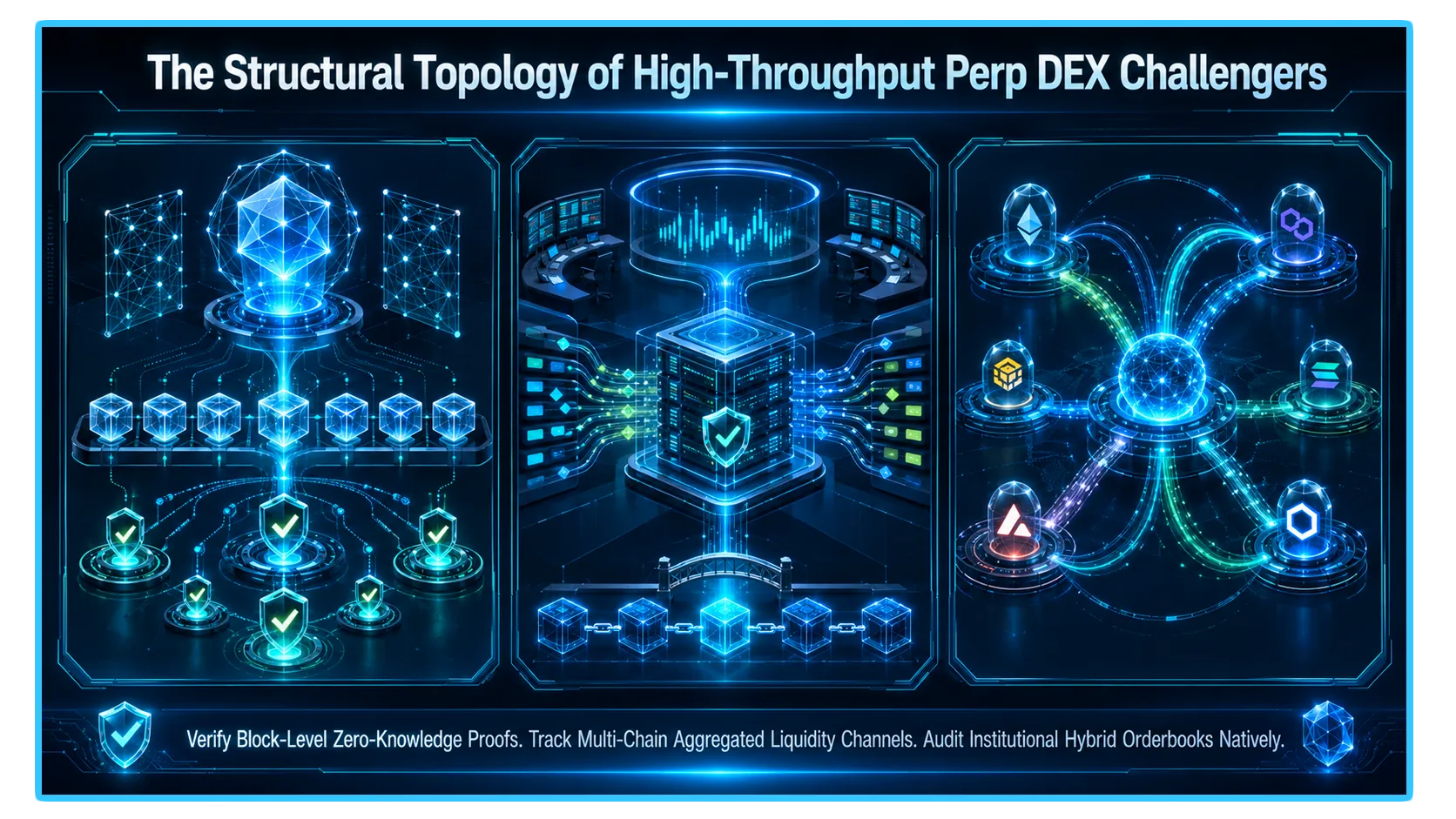
1. The Architectural Matrix: Comparing the Challengers
To evaluate how these platforms intend to capture market share, analyze the core structural paradigms defining their underlying settlement and matching layers:
| Exchange Platform | Protocol Core Paradigm |
| Lighter Protocol | Pure On-Chain App-Specific zk-Rollup (L2) |
| GRVT Exchange | Licensed Hybrid Exchange (Off-Chain Match / On-Chain Settle) |
| Aster DEX | Multi-Chain Unified Liquidity Layer |
2. Definitive Rankings: The Hyperliquid Challengers
Rank 1: Lighter Protocol (The Pure Decentralization Powerhouse)
Lighter Protocol claims the top spot as the most structurally formidable challenger to Hyperliquid's on-chain trading model. Operating as an application-specific zero-knowledge rollup (zk-rollup) that settles directly to the Ethereum mainnet, Lighter handles tens of billions in monthly volume.
The ZK Edge: While Hyperliquid relies on its own consensus validators, Lighter utilizes custom zero-knowledge circuits (built via Plonky2 frameworks) to prove the mathematical finality of every single order book match, margin adjustment, and account liquidation natively on-chain.
The Cost Profile: To eliminate user onboarding friction, Lighter charges zero maker and taker fees for standard accounts, subsidizing the execution costs through its institutional staking vaults. This aggressive alignment of fee-free trading paired with Ethereum-level security makes it an incredibly powerful infrastructure layer.
Rank 2: GRVT (The Institutional Hybrid Network)
GRVT (pronounced "Gravity") secures the second position by targeting a completely different market segment: institutional allocators and regulated trading entities. GRVT functions as a Hybrid Exchange (HEX) built as an official Hyperchain within the zkSync ecosystem.
Sub-10ms Execution: By decoupling order matching from the blockchain ledger, GRVT processes trades through an ultra-fast off-chain matching engine, hitting sub-10ms latency metrics that rival traditional centralized platforms. The final execution hashes are subsequently settled transparently on-chain via zero-knowledge proofs.
The Compliance Shield: Unlike its purely permissionless counterparts, GRVT incorporates mandatory KYC compliance and holds official financial licenses. While this separates it from anonymous retail users, it gives the platform a massive advantage in absorbing the trillions in institutional capital that is legally blocked from interacting with unverified networks.
Rank 3: Aster DEX (The Cross-Chain Aggregator)
Aster DEX enters the rankings as a highly flexible user-experience layer. Born from a high-profile structural merger between Astherus and APX Finance, Aster focuses explicitly on eradicating liquidity fragmentation across isolated blockchain layers.
Bridge-Free Trading: Traditional platforms force you to manually execute cross-chain token transfers to fund a trading account. Aster bypasses this hurdle by building a unified liquidity architecture. Traders can open high-leverage perpetual positions (up to 1001x on specific modes) directly using assets resting on alternative networks without executing manual bridges.
Dual-Mode System: To capture both casual participants and quantitative desks, Aster splits its interface into a streamlined, single-click "Simple Mode" and a data-dense, orderbook-driven "Pro Mode," maximizing its onboarding surface area.
3. Real-Time Security Verification via DEXTools Telemetry
- Executing high-leverage perpetual contracts across emergent derivatives layers requires continuous, independent validation of underlying asset backing and spot market health. While a platform's internal matching engine handles simulated perpetual pricing, verifying the authentic spot depth, liquidity pool thickness, and contract deployment metrics of the collateral assets on decentralized venues is the only method to safeguard your treasury from sudden de-pegging events or oracle execution failures.
- DEXTools provides the vital data infrastructure needed to perform these multi-chain diagnostics in real-time. By utilizing advanced pair explorers, live transaction logs, and look-through wallet telemetry across alternative layer ecosystems, market participants can independently track the structural health of underlying assets before executing leveraged derivative trades.
- Cross-referencing your perpetual trading choices with live on-chain metrics ensures your risk parameters remain fully optimized, allowing you to intercept market inefficiencies safely while keeping your capital secure.
Disclaimer: This article is for informational purposes only and does not constitute investment advice, financial advice, trading advice, or any other kind of advice. DEXTools does not recommend buying, selling, or holding any cryptocurrency or token. Users should conduct their own research and consult with a qualified financial advisor before making any investment decisions. Cryptocurrency investments are volatile and high-risk. DEXTools is not responsible for any losses incurred.