GRVT vs Hyperliquid: Hybrid Perp DEX vs Onchain L1
— By AliceOnChain in Tutorials

An advanced comparison between GRVT's hybrid architecture and Hyperliquid's native Layer 1 infrastructure, analyzing liquidity, execution, and risk management for derivatives traders.
GRVT vs Hyperliquid: Hybrid Perp DEX vs Onchain L1
The evolution of decentralized derivatives has shifted from simple automated market maker (AMM) models to complex, high-throughput architectures capable of competing with centralized exchanges (CEXs). For intermediate traders and on-chain analysts, navigating this landscape requires a deep understanding of the structural differences between competing platforms. When evaluating the current market landscape, analyzing the grvt vs hyperliquid paradigm highlights two fundamentally different infrastructure designs built to achieve scalability, capital efficiency, and security.
Two prominent models leading this paradigm shift are GRVT and Hyperliquid. While both platforms target the high-growth perpetual swaps market, this comparative breakdown of a hybrid perp dex vs onchain l1 framework explores how their design choices impact liquidity, execution speed, and on-chain monitoring.
Understanding the Architectural Divergence
To evaluate the trading environments of these networks, one must first analyze the underlying ledger and execution mechanics that power each protocol.
GRVT: The Hybrid Validium Model
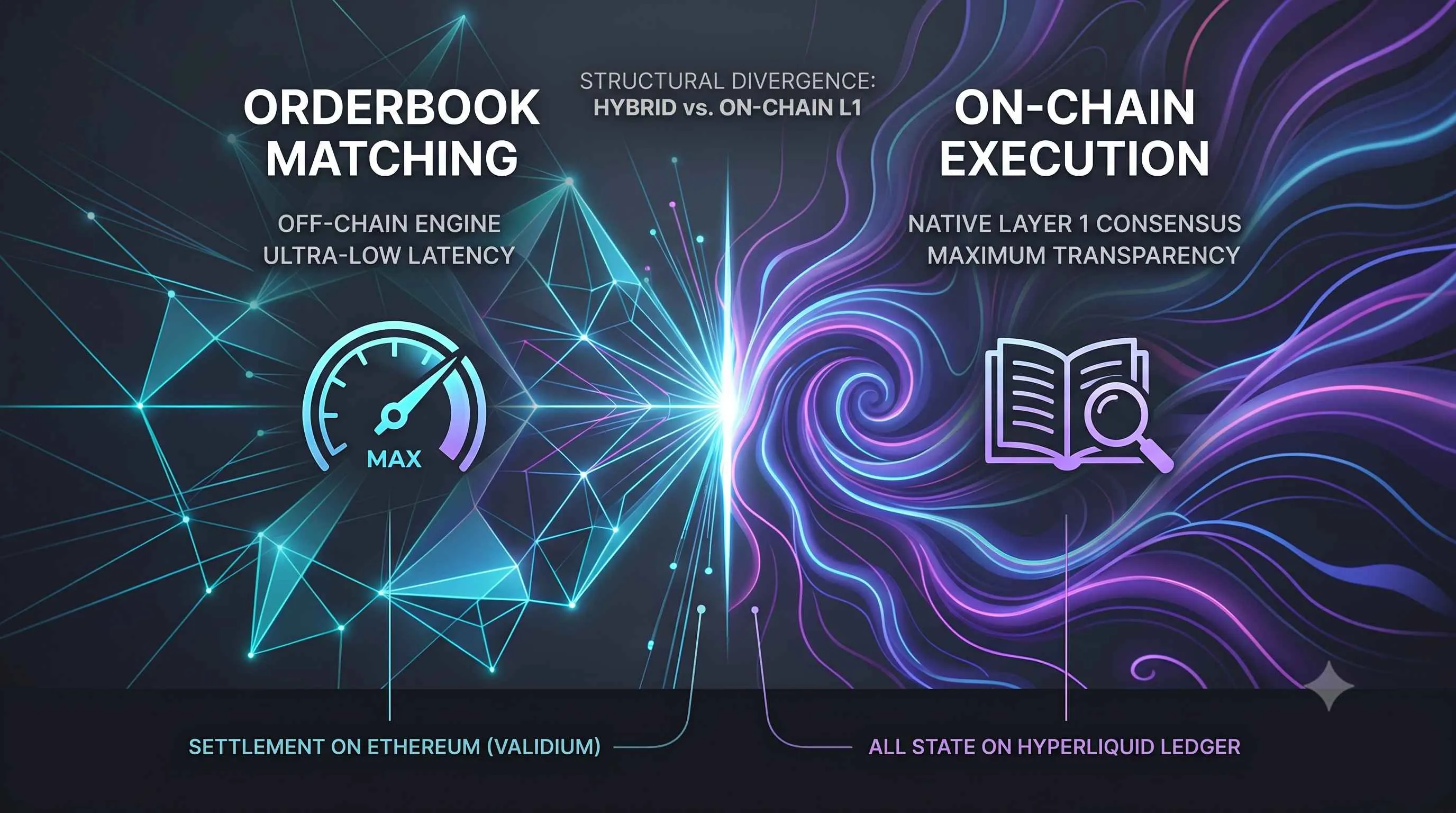
GRVT operates as a hybrid exchange, blending the performance metrics of a centralized order book with the self-custodial security of blockchain infrastructure. Built as a Hyperchain utilizing zkSync’s ZK Stack technology, GRVT employs a Validium configuration.
In this setup, trade matching occurs off-chain via a high-performance central limit order book (CLOB) engine, while settlement and custody remain strictly on-chain. By separating the execution layer from the data availability layer, the platform minimizes latency and eliminates gas fees for order placement and cancellations. This hybrid perp dex approach seeks to replicate the user experience of a CEX while preserving cryptographic verification of user assets.
Hyperliquid: The Monolithic App-Chain L1
Conversely, Hyperliquid functions as a purpose-built, standalone Layer 1 blockchain optimized specifically for financial derivatives. Instead of relying on external scaling solutions or off-chain matching components, Hyperliquid processes its entire order book, matching engine, and settlement mechanism natively on-chain.
Using a highly optimized, custom consensus mechanism, the network achieves sub-second block times and substantial throughput. Every order submission, cancellation, and liquidation is a state transition recorded directly on the Hyperliquid ledger, providing absolute transparency regarding state changes and sequence ordering. This onchain l1 model removes the need for centralized intermediaries entirely.
Liquidity Dynamics and Order Book Execution
For active derivatives traders, the specific infrastructure choices dictate liquidity depth, slippage, and the efficiency of market-making strategies.
Order Matching and Latency
The structural division in the grvt vs hyperliquid debate becomes apparent when analyzing order execution under high-volatility conditions. GRVT's off-chain matching engine allows institutional market makers to deploy high-frequency trading (HFT) strategies without confronting the constraints of block times. This can result in tighter bid-ask spreads during standard market conditions.
Hyperliquid, by keeping the order book entirely on-chain, relies on its native consensus speed. While it introduces minimal deterministic latency compared to an off-chain engine, it offers absolute cryptographic visibility into the mempool and state transitions. For traders utilizing advanced execution scripts, this transparency minimizes the risk of asymmetric informational advantages often associated with off-chain matchers.
Capital Efficiency and Collateral Management
Collateral optimization varies significantly between these two paradigms:
Cross-Margining Systems: Both platforms implement cross-margining to maximize capital utility, allowing profits from one position to collateralize losses in another.
Liquidation Mechanisms: Hyperliquid utilizes a native, decentralized liquidation engine backed by a protocol insurance fund. GRVT leverages a tiered liquidation structure that prioritizes liquidators via API integration before resorting to socialized loss mitigation.
On-Chain Liquidity Tracking: Traders can monitor capital flows across these platforms by utilizing specialized tools. For instance, evaluating historical volume trends and monitoring the asset pools feeding into these ecosystems via the DEXTools Pair Explorer provides critical insight into which infrastructure attracts deeper organic liquidity over prolonged market cycles.
On-Chain Analysis and Market Sentiment Metrics
Evaluating user adoption and protocol health requires looking past surface-level volume and inspecting granular on-chain metrics across both ecosystems.
Analyzing Volume and Holder Distribution
Raw trading volume can sometimes present an incomplete picture due to programmatic wash trading or incentivized volume generation. When analyzing the traction of grvt vs hyperliquid, analysts must cross-reference volume figures with holder distribution metrics to evaluate the authenticity of protocol growth.
Using advanced analytical features like DEXTools Holder Analysis and Bubblemaps allows traders to scrutinize token distribution patterns of underlying native assets or ecosystem tokens. High concentration of supply within a few interconnected wallets may indicate systemic centralization risks, whereas a decentralized, broad distribution often signals a healthier, community-driven network effect.
Monitoring Whale Activity and Volatility
Large capital allocations, or whale movements, frequently precede significant shifts in market structure. On-chain analysts look for specific signals to assess broader market positioning:
Whale Wallets: Tracking the behavior of significant market participants using DEXTools Top Traders gives insight into institutional accumulation or distribution phases.
RSI Divergence: Combining on-chain flow analysis with classical technical indicators, such as identifying a relative strength index (RSI) divergence on asset charts, helps traders spot potential exhaustion in market trends.
Volatility Management: Sudden spikes in volatility often coincide with massive liquidations on leveraged perp venues. Setting precise DEXTools Price Alerts allows traders to receive real-time notifications when an asset breaks key support or resistance levels, facilitating timely risk mitigation.
Step-by-Step Framework for Evaluating Perp Platforms
To systematically determine whether a hybrid perp dex vs onchain l1 architecture aligns with your trading objectives, consider the following structural evaluation process.
Step 1: Assess Custody and Counterparty Risk
Examine the smart contract architecture governing user funds. On GRVT, verify the cryptographic exit mechanisms that allow asset retrieval if the off-chain sequencer experiences downtime. On Hyperliquid, monitor the validator set structure to evaluate the decentralization of the L1 consensus mechanism.
Step 2: Analyze Order Book Depth and Slippage
Before executing size-heavy positions, analyze the order book depth at varying price percentages. Observe how the spread behaves during macroeconomic data releases or unexpected market expansions. Deep order books with minimal slippage indicate robust market-maker commitments.
Step 3: Audit Network Fees and Transaction Costs
Calculate the total cost of execution, including trading fees, funding rates, and network gas fees. While GRVT minimizes gas costs due to its off-chain matching design, Hyperliquid charges nominal native gas fees for on-chain state changes, which must be factored into high-frequency algorithmic models.
Step 4: Cross-Reference with External On-Chain Data
Validate internal platform metrics by checking independent data aggregators. Utilize DEXTools Charts to compare spot asset pairs against perpetual contract pricing, looking for persistent premiums or discounts that may signal market inefficiencies or impending funding rate rebalancing.
Structural Comparison: Hybrid vs. Layer 1
When evaluating the operational profile of these platforms, distinct trade-offs appear across key infrastructure vectors.
Data Availability and Transparency
Hyperliquid offers complete transparency; every order submission and cancellation is auditable on the public ledger. This mitigates concerns regarding front-running by the platform operator. GRVT, while utilizing zero-knowledge proofs to validate state transitions on-chain, keeps individual order history off-chain until settlement, prioritizing user privacy at the expense of absolute public auditability.
Security and Decentralization Scalability
GRVT’s reliance on the ZK Stack ensures that even if the off-chain infrastructure fails, users retain the capability to force withdraw assets via Ethereum Layer 1, providing strong security guarantees. Hyperliquid relies on the economic security of its own validator network. Its resilience depends entirely on the decentralization and cryptographic robustness of its native L1 consensus protocol. Observing how capital splits in the grvt vs hyperliquid ecosystem helps illustrate the market's current preference between ZK-backed security and independent L1 consensus.
Conclusion: Balancing Performance and Decentralization
The choice between grvt vs hyperliquid ultimately depends on a trader's specific operational priorities. GRVT offers a sophisticated environment for institutional and retail traders who favor high-performance CLOB execution, zero gas fees, and enhanced privacy features, without sacrificing self-custody. Hyperliquid provides a highly transparent, fully on-chain ecosystem suitable for users who prioritize absolute decentralization, public auditability, and direct interaction with a dedicated financial Layer 1.
Successful navigation of these decentralized derivatives markets requires continuous monitoring of structural health, volume validity, and liquidity shifts. By integrating advanced tracking infrastructure, such as DEXTools Liquidity Tracking and real-time chart analysis, into their workflow, traders can successfully interpret on-chain signals, manage systemic volatility, and optimize their capital allocation across competing DeFi architectures.
AMM vs Order Book DEXs: Crypto Trade DynamicsWhat Is Vertex Protocol: Hybrid Perp DEX & Ink Move 2026
Hyperliquid L1 Explained: HyperBFT, On-Chain Order Book and Market Design
Aster Chain: Privacy-First Layer-1 Blockchain for Decentralized Derivatives Trading
Disclaimer: This article is for informational purposes only and does not constitute investment advice, financial advice, trading advice, or any other kind of advice. DEXTools does not recommend buying, selling, or holding any cryptocurrency or token. Users should conduct their own research and consult with a qualified financial advisor before making any investment decisions. Cryptocurrency investments are volatile and high-risk. DEXTools is not responsible for any losses incurred.