Bitcoin Wrapped on Other Chains: WBTC vs. cbBTC vs. tBTC
Smart contract networks cannot run native Bitcoin. We break down the differences between centralized corporate storage, federated custody, and threshold math for wrapping BTC on-chain.
The Interoperability Conflict: Importing a Trillion-Dollar Asset into Programmable Layers
- Bitcoin commands the deepest liquidity and strongest monetary premium in the digital asset landscape. However, its native blockchain features a highly specialized, non-Turing-complete scripting language that lacks the native capability to process complex, multi-party smart contracts. Consequently, the multi-billion-dollar decentralized finance (DeFi) architectures flourishing on Ethereum, Solana, and various Layer 2 scaling networks are decoupled from Bitcoin's primary capital pool.
- To bridge this gap, developers rely on tokenized variants known as Wrapped Bitcoin. These tokens act as synthetic mirrors, locking native BTC in specialized reserves while minting an equivalent 1:1 asset representation on highly programmable alternative ledgers. However, importing Bitcoin into alternative layers introduces a critical trade-off: users must swap the absolute algorithmic assurances of the native Bitcoin network for a spectrum of third-party custodial arrangements, multi-chain security models, and dynamic counterparty risks.
1. The Custody Architecture: Centralized Entities vs. Mathematical Thresholds
The core structural divide setting wrapped Bitcoin variations apart centers entirely on how the underlying native BTC collateral is stored, audited, and released.
Custodial and Corporate Infrastructure
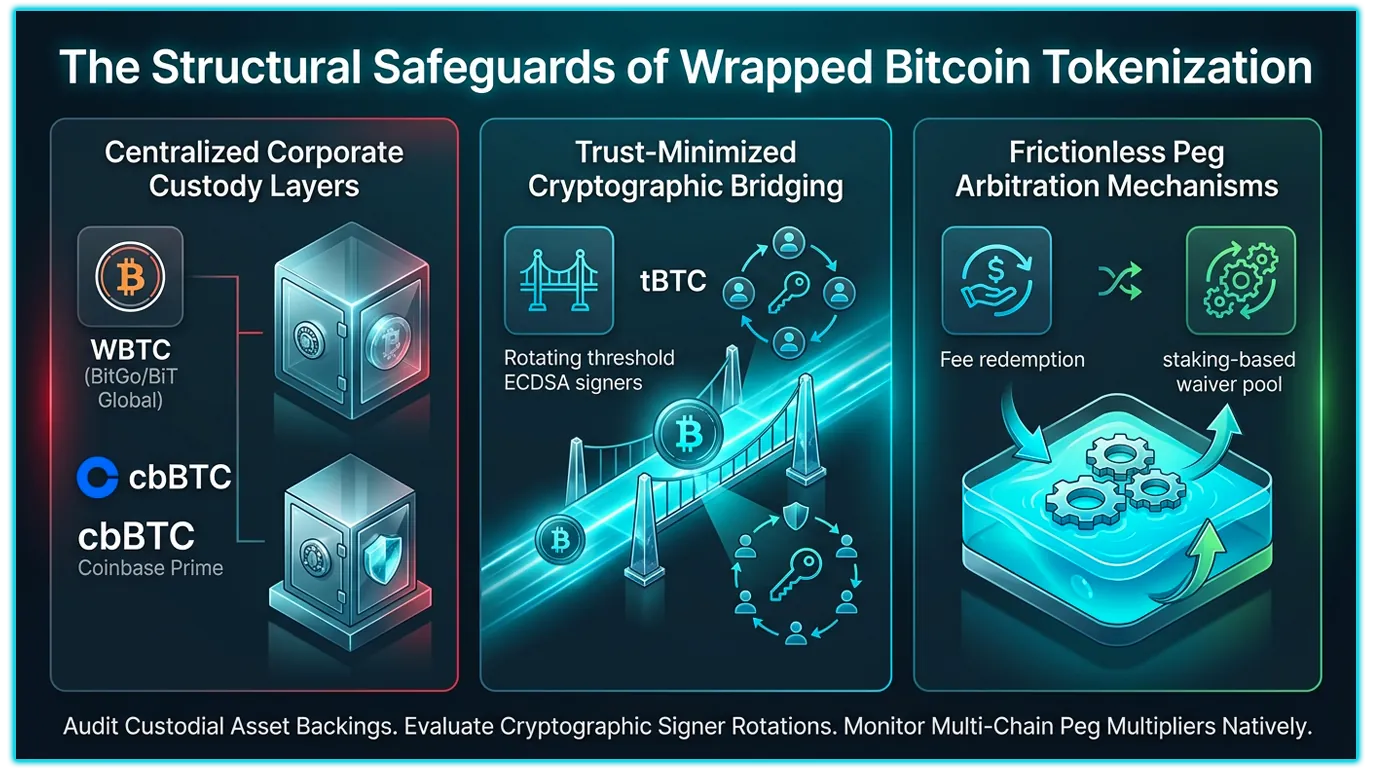
Wrapped Bitcoin (WBTC): As the historical pioneer of the wrapped asset market, WBTC runs a federated custody structure managed by BitGo alongside its cross-jurisdictional joint venture partner BiT Global. Native BTC is secured inside physical, multi-signature institutional cold-storage vaults. Only a vetted network of authorized merchants can deposit BTC to trigger token mints or return WBTC to initiate programmatic destructions.
Coinbase Wrapped Bitcoin (cbBTC): Launched as a highly institutional, centralized competitor, cbBTC bypasses federated merchant layers entirely. Coinbase holds the underlying BTC collateral directly inside its corporate Coinbase Prime custody vaults: the same institutional setup trusted by major spot ETF issuers. Minting and redemptions execute seamlessly for qualified exchange clients and in-app retail accounts in supported regions.
The Cryptographic Alternative
Threshold Network (tBTC): Rejecting centralized or corporate custodians, tBTC utilizes a fully decentralized, trust-minimized bridging model backed by threshold cryptography. Control of the underlying BTC is mathematically distributed across a rotating network of independent, collateralized node operators. The protocol relies on Elliptic Curve Digital Signature Algorithm (ECDSA threshold signers) to manage the Bitcoin address vaults. No single signer, node, or corporate board member can unilaterally access, freeze, or alter user funds.
2. Depeg Vulnerabilities and Systemic Counterparty Risks
Every wrapped asset carries an inherent risk of breaking its 1:1 price peg with native Bitcoin. However, the exact triggers that can cause a depeg vary based on the token's technical setup.
Custodial Insolvency and Sovereign Risks
- For custodial variations like WBTC and cbBTC, the primary hazard stems from traditional counterparty risk and regulatory vulnerability. If a centralized entity faces internal financial distress, is hit with international sanctions, or encounters regulatory asset-freezing orders from sovereign agencies, the physical Bitcoin backing the wrapped tokens could become legally entangled or permanently inaccessible, breaking the peg on secondary markets.
- A prime example occurred when control of WBTC shifted toward a joint venture involving Justin Sun, prompting noticeable market shifts as entities like Coinbase delisted WBTC over governance concerns.
Cryptographic Attack Surfaces and Economic Security
- For decentralized architectures like tBTC, risk profiles shift from legal jurisdictions to raw smart contract security and mathematical alignment. A critical software bug or an economic attack vector targeting the signature rotation framework could result in catastrophic collateral loss.
- An example of this resilience occurred on May 18, 2026, when a malicious actor attempted an invalid, uncollateralized tBTC mint. The protocol's core mathematical safeguards successfully detected and blocked the attack, ensuring no user funds were ever placed at risk. As a precaution against heightened malicious activity across the wider Web3 space, the Threshold DAO temporarily suspended its automated Optimistic Minting pipeline, routing creations through its strict liquidation mechanism and temporarily raising processing windows to 6-7 hours to preserve capital security.
3. Multi-Chain Footprints and Deep DeFi Integrations
The utility of a wrapped asset is directly determined by its supported network footprints and the depth of its lending integrations across decentralized financial ecosystems.
WBTC Market Domination: Despite structural competition, WBTC remains the dominant liquidity layer with an active supply in the $10 billion+ range. It operates across Ethereum, major Layer 2 networks (Arbitrum, Optimism, Base), Solana, Tron, and Polygon. It serves as a foundational collateral tier inside tier-1 money markets like Aave, Morpho, Curve, and Sky.
cbBTC Ecosystem Scale: Scaling rapidly into the $3 billion+ range, cbBTC has established itself as the default choice on Coinbase's L2 network, Base, while capturing notable market shares on Ethereum and Solana. It features deep collateral integrations across Base and Ethereum deployments of Aave, Compound, and Morpho.
tBTC Trustless Extension: Command an active capitalization in the $500 million+ bracket, tBTC serves as the premier decentralized option across Ethereum, Arbitrum, Optimism, Base, and Polygon. It is integrated as a trust-minimized alternative across Curve pools and targeted Aave isolated lending tiers.
4. Fee Frameworks and Arbitrage Friction
Moving native capital across wrapped bridges introduces specific execution costs that can create minor discounts or premiums relative to native spot market rates.
Custodial Pricing Paths
Coinbase implements zero explicit minting or wrapping fee structures for standard retail and institutional accounts migrating between native BTC and cbBTC. WBTC operations involve variable processing fees determined dynamically by the individual authorized merchants handling the physical escrow settlements.
Decentralized Staking Waivers
- While minting tBTC through Threshold’s mathematical pipeline remains entirely free, the system implements a baseline 20-basis-point (0.20%) redemption fee to ensure long-term protocol sustainability and fund node maintenance. Historically, this charge introduced minor arbitrage drag, occasionally causing tBTC to trade at a slight discount on secondary automated market makers.
- To completely resolve this friction, Threshold introduced stake-based fee waivers. Under this model, market participants can offset their bridging costs by staking the network's native token ($T$). For every 100,000 $T$ staked over a rolling 30-day window, users can waive up to 0.001 tBTC in redemption fees, enabling clean, fee-less arbitrage loops that keep the asset tightly pegged to native spot prices.
Wrapped Bitcoin Performance and Security Matrix
| Metric | Wrapped Bitcoin (WBTC) | Coinbase BTC (cbBTC) | Threshold Bitcoin (tBTC) |
| Custody Style | Federated Multi-Sig | Corporate Isolated Vaults | Cryptographic Node Signers |
| Core Auditor | BitGo / BiT Global | Coinbase Prime | Threshold Cryptography / DAO |
| Approx. Supply | $10\text{B}+$ | $3\text{B}+$ | $500\text{M}+$ |
| Primary Risk | Counterparty / Legal Seizure | Centralized Exchange Lockup | Smart Contract Defect / Exploit |
| Minting Cost | Merchant Dependent | 0% Flat Fee | 0% Mint / 0.20% Redeem (Waiverable) |
5. Monitoring Wrapped Bitcoin Markets via DEXTools Telemetry
- As wrapped Bitcoin assets expand their multi-chain footprints and drive liquidity across localized money markets, tracking deep pool balances, volume parameters, and smart contract health rankings across decentralized venues is critical for risk management. Sourcing analytics through advanced decentralized charting architectures like DEXTools gives market participants an essential universal platform to monitor live token behaviors, evaluate pool depths, and inspect contract parameters across all public execution networks.
- By leveraging core features like the Pair Explorer, Live New Pairs dashboard, and the integrated Trade Story or Top Traders diagnostic tools, technical traders can seamlessly audit localized volume trends, track large whale wallet capital reallocations via the Big Swap Explorer, and check automated contract safety scores before initiating any on-chain interactions, ensuring your hardened hardware setup interacts safely with verified market venues.
- You can access DEXTools here and start trading today!
Disclaimer: This article is for informational purposes only and does not constitute investment advice, financial advice, trading advice, or any other kind of advice. DEXTools does not recommend buying, selling, or holding any cryptocurrency or token. Users should conduct their own research and consult with a qualified financial advisor before making any investment decisions. Cryptocurrency investments are volatile and high-risk. DEXTools is not responsible for any losses incurred.
The Impermanence of Wrapped Bitcoin: Unwrapping and Redemption Risks
While the utility of wrapped Bitcoin is undeniable, offering BTC holders access to DeFi ecosystems and enhanced programmability, it's crucial to understand the process of unwrapping and the associated risks. The "unwrapping" of a token like WBTC or cbBTC essentially means redeeming the underlying native Bitcoin. This process is not always instantaneous or permissionless, and its ease can vary significantly depending on the wrapping mechanism employed.
For centralized solutions like WBTC, the redemption process typically involves interacting with the custodian or a designated merchant. This introduces counterparty risk and potential delays, as the redemption is subject to the operational hours, policies, and liquidity of the centralized entity. Federated systems like tBTC aim to decentralize this, but still rely on a network of signers whose incentives and availability are key to a smooth unwrapping experience. The ultimate goal is to return to the native Bitcoin blockchain, which requires the wrapped token to be burned and the original BTC to be released.
Practical Considerations for Unwrapping
- Understand the specific redemption mechanism for your wrapped BTC token. Is it centralized, federated, or threshold-based?
- Be aware of any potential fees associated with unwrapping, which can be charged by custodians, merchants, or network participants.
- Consider the liquidity and operational hours of the redemption service. Large redemptions might require more time to process.
- Assess the counterparty risk for centralized wrapped tokens. The financial health and trustworthiness of the custodian are paramount.
- Verify the availability of sufficient underlying BTC reserves. While audits are common, a lack of transparency or a solvency crisis could impact redemption.
- Keep abreast of any network congestion or gas fees on the destination blockchain (Bitcoin) which could affect the final transfer time.
Related Guides
- What Is Wrapped Bitcoin (WBTC)? Uses, Risks and WBTC vs BTC (2026)
- What Is Wrapped Solana (wSOL) and When Should You Use It?
- What Is Wrapped Asset Risk in Crypto? Guide 2026
- What Is SushiSwap (SUSHI)? The Multichain DEX on 40+ Chains Explained (2026 Guide)
- What Is a Wrapped Token: Complete Crypto Guide (2026)
Frequently Asked Questions
What is wrapped Bitcoin?
Wrapped Bitcoin is a token on another blockchain that represents Bitcoin held in custody or locked elsewhere. It lets Bitcoin's value be used in smart-contract ecosystems that cannot run native Bitcoin.
What is the difference between WBTC, cbBTC, and tBTC?
They are different wrapped Bitcoin implementations that vary in how the underlying BTC is held and trusted, ranging from centralized custody to more decentralized or threshold-based approaches. The main differences come down to custody model and trust assumptions.
Why is wrapped Bitcoin needed on other chains?
Most smart-contract networks cannot directly process native Bitcoin transactions. Wrapping creates a compatible token so Bitcoin value can participate in lending, trading, and other on-chain applications.
What are the risks of using wrapped Bitcoin?
Risks include trusting the custodian or mechanism holding the underlying BTC, smart-contract vulnerabilities, and potential loss of the peg if redemption fails. The risk profile depends on how decentralized and transparent the wrapping model is.