RWA Risks Explained: Custody, Legal and Regulatory Guide
— By AliceOnChain in Tutorials

Tokenizing real-world assets brings institutional liquidity to DeFi, but it introduces unique legal bottlenecks, custody challenges, and regulatory friction. This advanced guide breaks down how to navigate and audit RWA risks on-chain.
RWA Risks Explained: Custody, Legal and Regulatory
The intersection of traditional finance (TradFi) and decentralized finance (DeFi) has found its most promising narrative in Real World Asset (RWA) tokenization. By migrating tangible assets-such as sovereign debt, real estate, commodities, and private credit-onto blockchain rails, the digital asset ecosystem unlocks unprecedented liquidity, fractional ownership, and 24/7 composability. However, translating a physical or legally binding off-chain asset into a digital token is not a frictionless process. To navigate this space safely, investors must have fundamental RWA risks explained through the lens of custody structural vulnerabilities, legal bottlenecks, and regulatory friction. Unlike pure-play crypto assets like Bitcoin or Ethereum, which rely entirely on deterministic on-chain consensus, tokenized real-world assets are fundamentally bound to local jurisdictions, physical infrastructure, and traditional legal frameworks.
For on-chain analysts and advanced traders, evaluating an RWA protocol requires looking far beyond simple smart contract metrics or liquidity pool depth. To safely navigate this sector, market participants must understand the structural vulnerabilities inherent to tokenized assets. When we look at various RWA risks explained by industry analysts, the core vulnerabilities almost always trace back to how physical ownership is mapped onto a blockchain. This guide analyzes the core custody, legal, and regulatory risks associated with RWAs and details how to implement robust on-chain auditing frameworks using DEXTools.
1. The Custody Dilemma: Bridging the Off-Chain Void
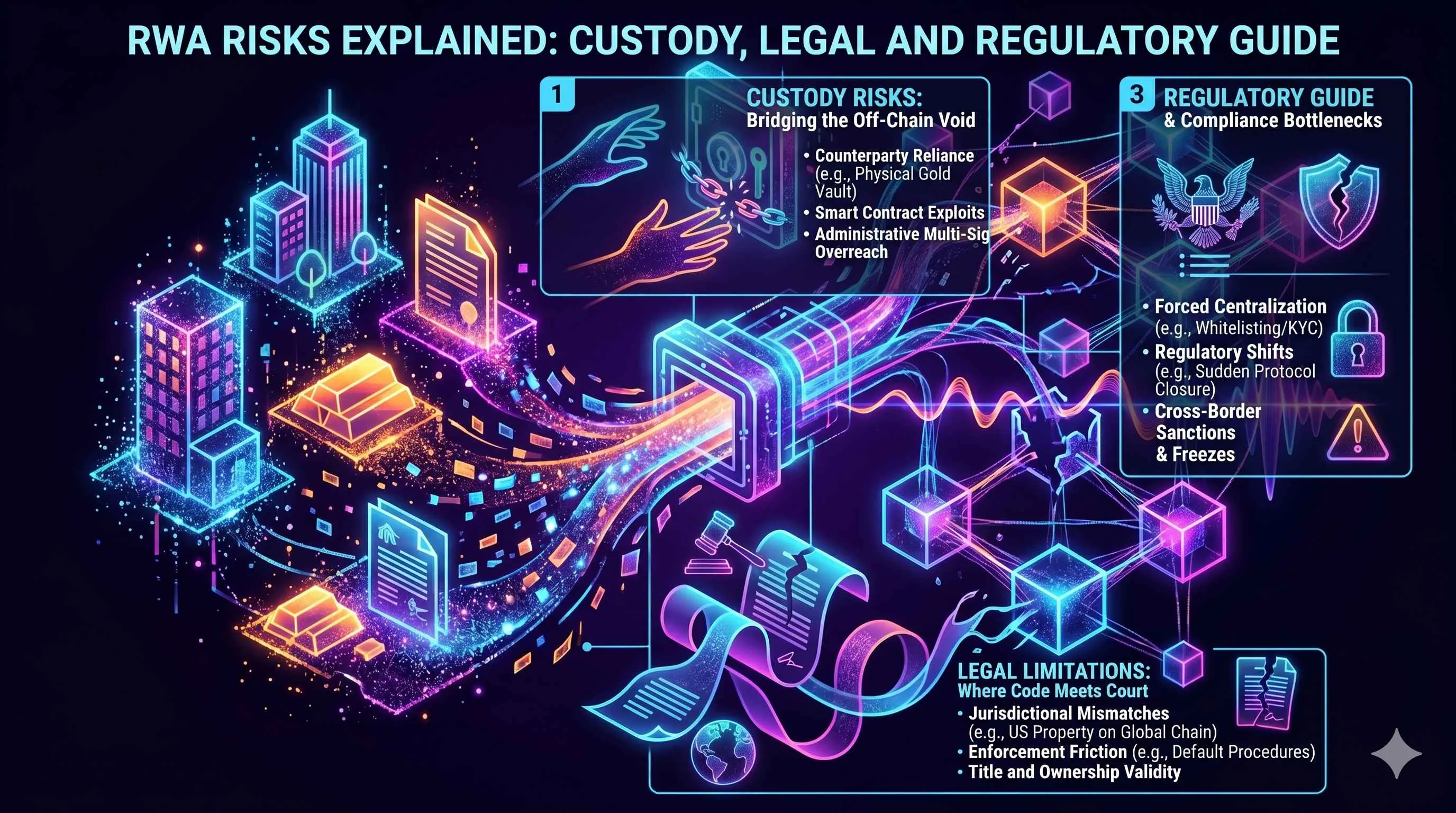
In pure DeFi, the axiom "not your keys, not your coins" dictates asset ownership. With Real World Assets, this paradigm shifts entirely. An RWA token is essentially a digital receipt or a claim right on an underlying asset that exists somewhere in the physical world. This introduces a structural vulnerability: the decoupling of token ownership from physical custody. Having custody-related RWA risks explained clearly means acknowledging that the underlying collateral is always managed by a traditional third party rather than code.
Counterparty and Trustee Reliance
When you trade tokenized gold or US Treasury bills on-chain, the physical gold sits in a commercial vault, and the securities are held by a regulated traditional custodian or trustee. The RWA token issuer acts as the middleman managing this relationship. If the custodian faces insolvency, faces legal seizures, or acts fraudulently, the on-chain token can rapidly lose its peg or become entirely untradeable.
Traders must scrutinize the legal architecture of the issuing vehicle to understand the specific asset-backed RWA risks explained in the protocol's documentation. Is the asset held by a Special Purpose Vehicle (SPV) that isolates the underlying collateral from the issuer’s operational balance sheet? If not, a bankruptcy of the parent company could tie up the underlying assets in traditional court proceedings for years, rendering the on-chain tokens functionally worthless.
Smart Contract and Technical Custody Risks
Beyond the physical vaults, RWA protocols rely on smart contracts to handle minting, burning, and yield distribution. These contracts often incorporate advanced features, such as administrative multi-sig wallets with "blacklist" and "force transfer" capabilities. While these mechanisms are necessary to comply with traditional legal demands (such as responding to a court order to freeze assets), they introduce immense centralized risk.
An exploit of the protocol’s admin keys could allow malicious actors to wipe out user balances or drain liquidity pools. When monitoring these assets on the DEXTools Pair Explorer, sudden changes in contract configurations or unusual mint/burn volumes often signal underlying administrative or technical friction. Having these technical RWA risks explained helps traders set up proactive alerts before capital is locked up.
2. Legal Boundaries and Enforcement Friction
A smart contract is a piece of code executed by a decentralized network. A legal contract is an agreement enforced by courts backed by state authority. When these two systems clash, traditional law always takes precedence over code execution, which highlights why we need legal RWA risks explained in deep practical terms.
The Jurisdictional Mismatch
Real estate tokenization perfectly illustrates this conflict. If an RWA protocol tokenizes a commercial building, ownership of the token may change hands fifty times a day among globally distributed DeFi users. However, local property registries and real estate laws do not recognize automated blockchain transfers as valid titles of ownership. The on-chain token transfers in seconds across global liquidity pools, while the stationary physical object remains tied to a specific local jurisdiction and subject to property courts.
Without a bulletproof legal wrapper-typically structured around shares of an LLC that owns the property-the token holders have zero legal recourse to claim the physical asset or its rental income. If the property management company defaults or mismanages the estate, international token holders face a virtually impossible task when trying to litigate across borders. This mismatch is one of the most critical structural RWA risks explained by regulatory experts today.
Bankruptcy Remoteness and Claim Rights
In a typical DeFi liquidation, a smart contract automatically sells collateral when a loan-to-value ratio is breached. In RWA private credit protocols, if an off-chain corporate borrower defaults on their loan, the smart contract cannot automatically liquidate the borrower's physical factories or inventory.
Instead, the protocol must initiate traditional collection processes, debt restructuring, or bankruptcy litigation in local courts. This process can take months or years, during which the on-chain token's price action will suffer severe volatility and deep discounts relative to its net asset value (NAV).
3. Regulatory Uncertainty and Compliance Bottlenecks
The regulatory landscape for RWAs is highly fragmented and undergoing continuous evolution globally. Because RWAs frequently track yield-bearing instruments, commodities, or real estate shares, regulatory bodies like the SEC in the United States often classify these tokens as securities. When looking at compliance-related RWA risks explained by legal counsels, the threat of sudden protocol closure is always a top priority.
Forced Centralization via KYC/AML Whitelisting
To prevent unauthorized secondary market trading, most institutional RWA issuers implement mandatory Know Your Customer (KYC) and Anti-Money Laundering (AML) checks directly at the smart contract level. This means that even if an RWA token is pooled on a decentralized exchange, a user cannot buy, sell, or provide liquidity unless their wallet address is explicitly added to the protocol’s permissioned whitelist.
For retail traders, this creates massive liquidity bottlenecks. If a protocol suddenly tightens its geographical restrictions due to shifting regulatory policies, entire cohorts of users may find themselves unable to exit their positions on-chain. This structural vulnerability frequently causes fragmented price action across pools, where non-compliant or legacy pools trade at steep discounts due to a lack of buying pressure from verified participants.
Cross-Border Sanctions and Compliance Overhead
Because the underlying assets reside in physical jurisdictions, RWA protocols must strictly adhere to international sanction lists. If a wallet associated with an RWA liquidity pool is flagged or interacts with a sanctioned address, issuers are legally obligated to execute emergency freeze functions. This capability fundamentally breaks the censorship-resistant narrative of DeFi and exposes passive liquidity providers to sudden capital lockups, showcasing the regulatory enforcement angle of how RWA risks are explained in real-world scenarios.
4. Advanced On-Chain Auditing Framework for RWAs
Given the layered risks associated with real-world tokenization, advanced traders cannot rely solely on the marketing materials or face-value audit reports provided by RWA protocols. A rigorous on-chain investigation is mandatory to see these real-world asset RWA risks explained through live data.
Step 1: Evaluating Liquidity Depth and Price Action Stability
When analyzing an RWA pair on DEXTools, the first line of defense is assessing the structural stability of the liquidity pool. Pure crypto tokens rely on speculative demand, but RWA tokens should closely track their underlying asset value.
Slippage and Depth: Analyze the ratio between the total locked liquidity and the daily trading volume. A thin liquidity pool means that even moderate selling pressure from a single whale can cause severe price deviations from the underlying asset's real-world value.
Price Alerts for De-pegging: Utilize DEXTools Price Alerts to track structural anomalies. For instance, if a tokenized US Treasury bill token drops below its net asset value on the open market, it usually points to smart contract security concerns, unexpected regulatory lockups, or systemic issues with the issuer's off-chain redemption pipeline.
Step 2: Monitoring Holder Distribution and Whales
A highly concentrated token distribution introduces significant market risk, particularly for assets tied to real-world legal entities.
Holder Analysis: Use the DEXTools tokenomics tools to evaluate the distribution among token holders. If a handful of un-vetted wallets control the vast majority of the circulating supply, they possess the power to exhaust the on-chain liquidity pools instantly.
Tracking Whales and Insiders: Monitor real-time transaction feeds to observe if early institutional allocators or the protocol's operational wallets are systematically offloading tokens. Sudden, large-scale transfers to centralized exchange deposit addresses or cross-chain bridges often precede public announcements of regulatory or legal complications.
Step 3: Verifying Proof of Reserves and Collateralization
Unlike traditional DeFi protocols where assets are fully transparent on public ledgers, RWAs require continuous external verification.
Oracle Dependency: Ensure the protocol utilizes reliable, decentralized oracles to feed real-world asset valuations on-chain. Outdated or easily manipulated oracle feeds can lead to bad debt within lending protocols utilizing RWAs as collateral.
On-Chain Attestations: Top-tier RWA projects integrate automated, cryptographic Proof of Reserves (PoR) feeds provided by independent, regulated auditing firms. Traders should verify that these on-chain attestations update frequently and match the total supply of tokens circulating in the market. Having these systemic RWA risks explained via transparent reserve tracking is a major green flag for any project.
5. Mitigating Volatility and Structural Risks
Trading or holding RWAs requires a fundamentally different risk management framework than standard crypto trading. Because these tokens are vulnerable to regulatory interventions and custodial defaults, proactive risk mitigation is essential to avoid the worst-case RWA risks explained in historic protocol failures.
Size Positions Relative to Real-World Settlement Times
If an RWA protocol experiences technical friction or a legal challenge, exiting your position can take weeks or months through traditional redemption pipelines. Therefore, position sizing should reflect the asset's structural liquidity rather than its theoretical stability. Avoid over-allocating capital into illiquid real estate or private credit pools that lack deep, un-permissioned secondary market liquidity on automated market makers (AMMs).
Correlate On-Chain Metrics with Off-Chain Legal Updates
Successful RWA traders maintain a dual-monitoring strategy:
On-Chain Signalling: Watch for sharp spikes in contract interactions, volume anomalies, or changes in the holder distribution using the DEXTools Pair Explorer to see liquidity-related RWA risks explained via on-chain charts.
Off-Chain Monitoring: Track corporate filings, court dockets, and updates from the protocol's custodian or trustee. If an off-chain legal dispute arises, smart money will almost always attempt to exit their on-chain token positions before the broader retail market becomes aware of the issue.
Real World Asset tokenization represents a monumental shift in global capital markets, offering a viable bridge for institutional capital to enter the decentralized ecosystem. However, the convenience of trading global assets on-chain does not eliminate the physical, legal, and regulatory friction inherent to traditional finance.
By having these critical RWA risks explained, understanding the vulnerabilities of third-party custody, navigating complex jurisdictional barriers, and utilizing advanced on-chain analysis platforms like DEXTools to audit liquidity, contract changes, and holder distributions, traders can accurately quantify RWA structural risks and protect their capital in an evolving market environment.
Top 5 Real World Asset (RWA) Tokens in 2026: Tokenized Finance Goes MainstreamRWA Liquidity Quality: Why Tokenized Assets Can Be Real but Still Hard to Trade
What Is Tokenization? How Real World Assets Become Onchain Claims (2026)
Disclaimer: This article is for informational purposes only and does not constitute investment advice, financial advice, trading advice, or any other kind of advice. DEXTools does not recommend buying, selling, or holding any cryptocurrency or token. Users should conduct their own research and consult with a qualified financial advisor before making any investment decisions. Cryptocurrency investments are volatile and high-risk. DEXTools is not responsible for any losses incurred.
On-Chain Legal Wrappers and Governance Audits
While the focus is often on the underlying asset's legal status and custody, the on-chain representation of an RWA carries its own set of legal implications, often encapsulated within a "legal wrapper" or similar framework. This wrapper is not merely a digital document; it is the codified, executable logic that governs the token's rights, obligations, and enforceability within the blockchain environment. Understanding its construction and auditability is paramount for mitigating on-chain legal risks.
A robust legal wrapper translates traditional legal concepts like ownership, lien, and transfer restrictions into smart contract logic. This requires a deep understanding of both traditional contract law and blockchain's immutability and composability. Auditing these wrappers goes beyond typical smart contract security checks; it involves a cross-disciplinary review to ensure the on-chain logic accurately reflects and enforces the off-chain legal agreement, preventing discrepancies that could lead to disputes or unenforceability.
Auditing the Interoperability of Legal and Code
- Review the clarity and explicitness of the legal terms translated into smart contract functions. Ambiguity can lead to misinterpretation on-chain.
- Verify the smart contract's ability to enforce off-chain legal stipulations, such as transfer restrictions based on investor accreditation or jurisdiction.
- Assess the oracle mechanisms used to feed off-chain legal events or data into the smart contract, ensuring their integrity and resilience to manipulation.
- Examine the governance model for modifications or upgrades to the legal wrapper's smart contract, ensuring stakeholder rights are preserved and disputes can be resolved.
- Evaluate the dispute resolution mechanisms embedded within or linked to the on-chain legal wrapper, including arbitration clauses or emergency pause functions.
Related Guides
- What Are Real World Assets (RWA) in Crypto? Asset Types, Yield and Risks (2026)
- How to Withdraw from a CEX to Self-Custody Wallets
- What Is Self-Custody in Crypto? Explained 2026
- What Is Fireblocks: Digital Asset Custody, Treasury and Wallet Infrastructure (2026)
- What Is Fireblocks: Digital Asset Custody, MPC Wallets and Treasury Infrastructure (2026)
Frequently Asked Questions
What are real world assets in crypto?
Real world assets, or RWAs, are off chain assets such as bonds, real estate, or commodities that are represented as tokens on a blockchain. Tokenization aims to bring these traditional assets into DeFi.
What are the custody risks of tokenized real world assets?
Because the underlying asset exists off chain, someone must hold and safeguard it, which creates reliance on a custodian. If the custodian fails or mismanages the asset, the value of the token can be affected.
Why do real world assets face legal and regulatory challenges?
Tokenized assets must connect on chain ownership to enforceable legal rights, which depends on contracts and local laws. Regulations differ across jurisdictions and can create uncertainty about how these tokens are treated.
How can investors approach RWA risk?
Investors can review who holds the underlying asset, how legal claims are structured, and what disclosures the issuer provides. Understanding the custody, legal, and regulatory setup is key before committing capital.