BRC-20 vs Runes vs Stamps: Bitcoin Tokens Compared
— By AliceOnChain in Tutorials

Analyze the structural mechanics of Bitcoin's dominant token layers. This technical comparison evaluates BRC-20, Runes, and Stamps (SRC-20), highlighting their architectural tradeoffs, network efficiency, and on-chain monitoring strategies using DEXTools dashboards.
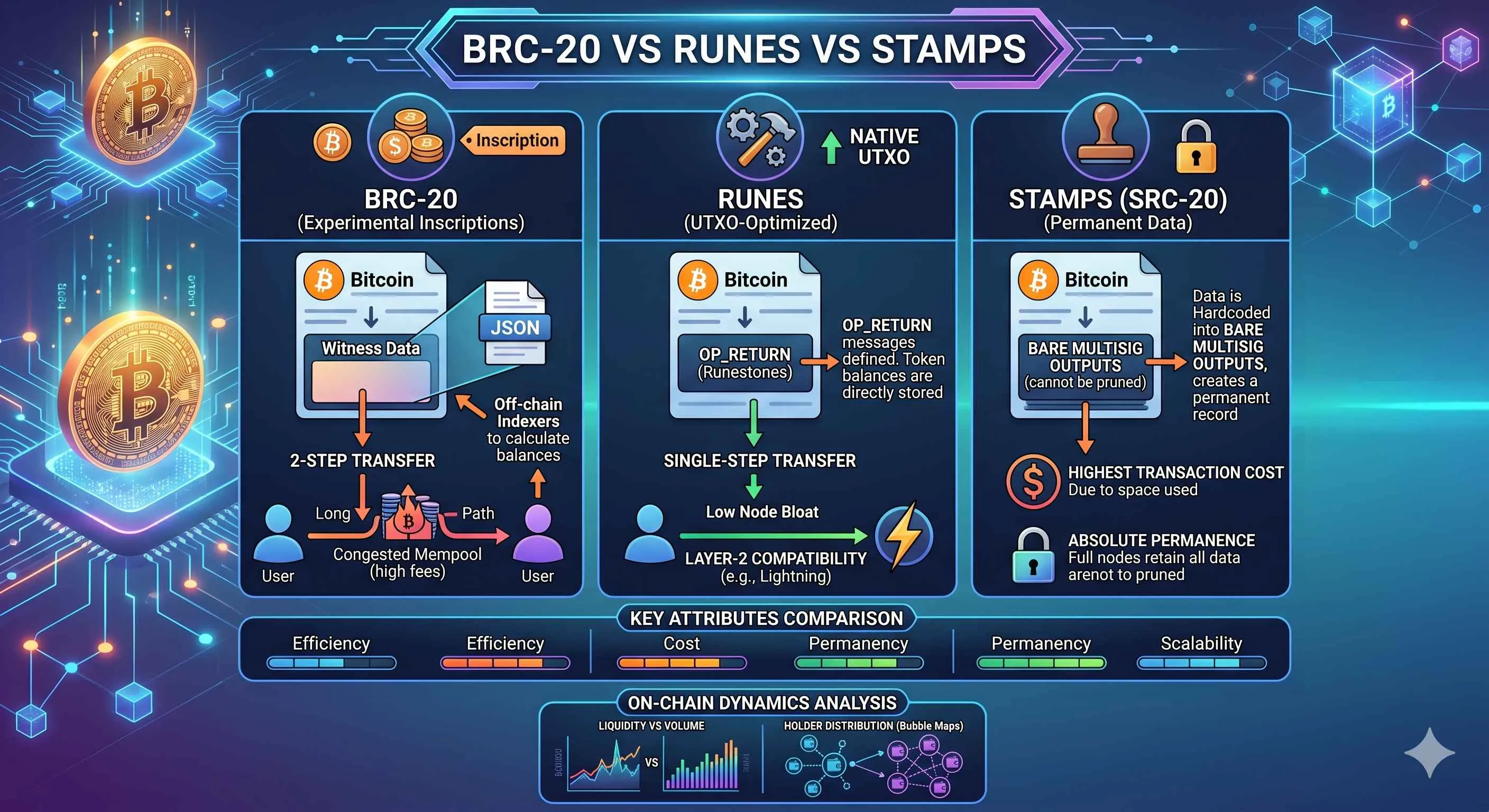
BRC-20 vs Runes vs Stamps: Bitcoin Tokens Compared
The architecture of the Bitcoin blockchain was fundamentally designed to process a single, native asset: BTC. However, the relentless push for innovation within decentralized finance has led to the development of several meta-protocols built on top of Bitcoin's base layer. Today, the landscape is no longer limited to simple peer-to-peer cash transfers. Instead, a multi-faceted ecosystem of fungible and semi-fungible digital assets has emerged, driven by competing design philosophies and technical frameworks.
To effectively navigate this space, analysts and market participants must understand the structural differences between the three most prominent token implementations on Bitcoin: BRC-20, Runes, and Bitcoin Stamps (SRC-20). Each framework introduces unique mechanisms for data storage, efficiency, and permanency, resulting in varied trade-offs regarding transaction fees, network scalability, and on-chain market dynamics. A detailed Bitcoin token standards comparison reveals how these protocols operate under the hood and how their market health can be evaluated.
BRC-20: The Experimental Pioneer of Bitcoin Inscriptions
The BRC-20 framework started as an experimental implementation that utilized the Ordinals protocol to enable fungible token deployment, minting, and transferring on Bitcoin. The core mechanic relies on embedding JSON data directly into the witness data of a Bitcoin transaction, attaching the information to individual satoshis-the smallest unit of Bitcoin. This process is known as an inscription.
While BRC-20 successfully sparked an entirely new asset class, its design architecture introduces substantial data overhead. Because the Bitcoin network does not natively compute token balances for BRC-20, off-chain indexers are required to parse the blockchain history and calculate wallet balances manually.
Furthermore, executing a standard transfer under the BRC-20 framework is a two-step process. A user must first generate a mint inscription to state their intent to transfer tokens, which creates a new unspent transaction output (UTXO), and then execute a second transaction to route that output to the recipient. This dual-transaction bottleneck frequently triggers severe memory pool (mempool) congestion, forcing transaction fees to spike rapidly during periods of high market activity.
Runes: The Native, UTXO-Optimized Framework
Introduced to systematically resolve the structural inefficiencies of BRC-20, the Runes protocol integrates directly with Bitcoin's native architecture. Developed by Casey Rodarmor, the architect behind Ordinals, Runes completely bypasses the reliance on individual satoshi inscriptions. Instead, it utilizes the native Unspent Transaction Output (UTXO) ledger model, aligning perfectly with how standard Bitcoin transactions are validated.
Under the Runes architecture, token balances are contained directly within standard UTXOs. The protocol uses the OP_RETURN script opcode to embed compact, highly efficient messages called Runestones into transaction outputs. These Runestones define token allocations, splits, transfers, and creations within a single transaction step.
By operating entirely within the native UTXO set, the Runes protocol prevents the accumulation of unnecessary "junk" outputs on nodes, keeps memory footprints low, and allows for clean execution profiles. This clean structure makes it highly compatible with Layer-2 scaling frameworks like the Lightning Network, offering a clear scalability advantage in any comprehensive Bitcoin token standards comparison.
Bitcoin Stamps (SRC-20): Un-Prunable, Permanent Data Storage
Bitcoin Stamps, which govern tokens under the SRC-20 standard, represent an entirely different engineering philosophy. While BRC-20 and Runes store token metadata in areas of a transaction that can technically be pruned by individual nodes to save space, Bitcoin Stamps prioritize absolute permanency. They achieve this by embedding data directly into Bitcoin's multi-signature output scripts (bare multisig).
When an asset is minted or transferred using the SRC-20 standard, its data is hardcoded into the actual transaction outputs rather than the witness data. Because full nodes must maintain the entire UTXO set to properly validate the state of the blockchain, Stamp data cannot be discarded, pruned, or optimized out of existence by a node operator.
The immediate trade-off for this absolute, immutable permanency is cost. Storing data directly inside multi-signature outputs requires significantly more physical block space than OP_RETURN scripts or witness records. Consequently, minting and transferring SRC-20 assets is structurally the most expensive method of tokenization on Bitcoin, resulting in a highly specialized ecosystem designed for high-value preservation over rapid, high-frequency retail speculation.
On-Chain Dynamics: Market Health and Risk Analysis
Evaluating these assets requires moving beyond structural mechanics and analyzing live on-chain market data. Because many of these assets are bridged, wrapped, or actively traded across automated market makers (AMMs), utilizing advanced analytics suites like DEXTools is paramount to managing risk in a highly volatile market.
Analyzing Liquidity Profiles and Slippage
When executing trades across new token ecosystems, liquidity tracking is the single most vital metric. Due to the high cost of transactions on the Bitcoin base layer, secondary wrapped pools on EVM and layer-2 networks serve as highly active hubs for price action.
Traders should carefully analyze the relationship between the 24-hour trading volume and total locked liquidity on DEXTools charts. A token standard might boast significant transaction activity on-chain, but if the corresponding liquidity pools are shallow, executing a large market order can cause extreme price slippage, leading to significant capital drawdowns.
Holder Distribution and Cluster Metrics
Given the speculative nature of early-stage assets, checking holder distribution patterns is a required security practice. Highly concentrated supplies expose a token to severe correction risks if early minters or insiders decide to distribute their positions into public buy-side liquidity.
By leveraging the Bubblemaps integration available directly on DEXTools, analysts can visually inspect the relationship between top-tier holding addresses. This integration exposes whether large blocks of supply are naturally decentralized or if they are covertly linked through complex clusters of wallet interactions, indicating sybil behavior or coordinated wash trading designed to manipulate market sentiment.
Utilizing DEXTools for Advanced Bitcoin Token Strategies
Navigating an ecosystem split between BRC-20, Runes, and Stamps requires a systematic, data-driven approach. Integrating DEXTools into an analytical routine provides the essential infrastructure needed to track price structures and market health in real time.
Tracking Price Action and Technical Formations
Whether tracking a wrapped version of a prominent Rune or an inscribed BRC-20 asset, utilizing clean, interactive charting interfaces allows traders to map critical macroeconomic support and resistance levels. Monitoring volume expansion patterns alongside momentum indicators such as the Relative Strength Index (RSI) helps isolate institutional or whale accumulations from simple retail distribution. Identifying bearish RSI divergences near historical overhead resistance can serve as an early warning indicator that a local trend reversal may be approaching.
Volatility Mitigation with Real-Time Price Alerts
Bitcoin token ecosystems are characterized by rapid, around-the-clock volatility. Sudden changes in network fee rates can alter trading behaviors on the base layer, causing instant price reactions across secondary markets.
Setting up proactive, automated price alerts within DEXTools allows market participants to step away from active charting monitors while ensuring they are instantly notified of crucial support breakdowns or resistance breakouts. This allows traders to execute predefined risk mitigation protocols, such as manual stop-loss adjustments, before capital exposure becomes unmanageable.
Comparative Structural Overview
To synthesize this Bitcoin token standards comparison, it is necessary to contrast how each protocol handles its primary technical and economic variables:
BRC-20: Employs Ordinals inscriptions within witness data. Requires external off-chain indexers to track account state. Features a cumbersome, two-transaction transfer mechanism that heavily strains the network mempool during peak demand.
Runes: Operates entirely within the native UTXO ledger model. Uses efficient
OP_RETURNscript structures to house transaction instructions within a single step. Minimizes node bloat and exhibits strong structural compatibility with Layer-2 architectures.Stamps (SRC-20): Embeds token states directly into
bare multisigtransaction outputs. Ensures absolute on-chain permanence that cannot be pruned by node operators. Carries the highest transaction byte cost, limiting its use case to premium, high-value permanence.
Conclusion: Adapting to the Multi-Token Bitcoin Era
The expansion of Bitcoin’s utility layer has permanently transformed the blockchain landscape. BRC-20 proved the initial product-market fit for native fungible assets, Runes refined the architecture by introducing a sleek, UTXO-aligned engine built for scale, and Bitcoin Stamps carved out a niche focused on uncompromising, un-prunable longevity.
For developers, investors, and analysts, success in this multi-standard paradigm depends entirely on selecting the right tool for the right objective. Speculative trading, short-term momentum strategies, and deep asset-health screening require a strict focus on objective on-chain indicators. By continuously tracking volume distribution, mapping wallet clusters, and employing active tracking metrics via DEXTools, participants can navigate the volatile currents of Bitcoin's evolving token economies with clarity and confidence.
Top AI x Crypto Tokens by Use Case: A Buyer's MapFee Revenue per Active Wallet vs Total Fees: Which Shows Real dApp Monetization?
What are Runes? Bitcoin's New Token Standard Explained
What Is RSI in Crypto? Beginner Guide to the Relative Strength Index (2026)
Disclaimer: This article is for informational purposes only and does not constitute investment advice, financial advice, trading advice, or any other kind of advice. DEXTools does not recommend buying, selling, or holding any cryptocurrency or token. Users should conduct their own research and consult with a qualified financial advisor before making any investment decisions. Cryptocurrency investments are volatile and high-risk. DEXTools is not responsible for any losses incurred.
The Intricacies of Bitcoin Script and Token Finality
Understanding the fundamental differences between BRC-20, Runes, and Stamps requires a deeper dive into how each leverages or circumvents Bitcoin's scripting language and transaction finality. Bitcoin Script, a simple, stack-based language, is intentionally non-Turing complete to ensure network security and predictability. Token protocols must therefore cleverly utilize existing opcodes and transaction structures to encode and manage token state, which directly impacts their resilience, upgradeability, and the "trustlessness" of their off-chain indexers.
BRC-20 tokens, for instance, rely heavily on JSON data embedded within witness data, interpreted by off-chain indexers. This approach is highly flexible but introduces a dependency on these external entities for state validation. Runes, conversely, aim for a more native integration by encoding token operations directly into transaction outputs via OP_RETURN, a provably unspendable output type. This method offers a higher degree of "on-chain" finality for token state, reducing reliance on indexer consensus for core operations like minting and transfers, although indexers are still crucial for tracking balances.
Architectural Trade-offs and Network Impact
The architectural choices of each token standard have distinct implications for network efficiency and the overall decentralization of the token ecosystem. While all three leverage Bitcoin's security, their specific methods of encoding data and managing state introduce varying levels of "chattiness" on the blockchain and reliance on off-chain components.
- BRC-20's reliance on arbitrary JSON data in witness fields allows for rich metadata but can lead to larger transaction sizes.
- Runes' use of OP_RETURN for token operations aims for minimal on-chain footprint for core logic, optimizing block space.
- Stamps (SRC-20) embed data directly into transaction outputs via UTXOs, making the data "unprunable" by full nodes, a key distinction.
- The "prunability" of token data significantly impacts a full node's storage requirements and long-term data persistence.
- Indexers for all standards are critical for providing user-friendly balance tracking and historical data, but their role in state validation varies.
- Future upgrades and protocol changes for each standard will also be influenced by their current integration with Bitcoin Script and transaction structures.
Related Guides
- Bitcoin Runes vs BRC-20 vs Ordinals: Complete Comparison 2026
- Bitcoin Ordinals and BRC-20 Inscriptions: Complete Guide 2026
- What Are Bitcoin Stamps (SRC-20)? The Permanent NFT Protocol on Bitcoin Explained in 2026
- What are Runes? Bitcoin's New Token Standard Explained
- What Are Bitcoin Runes: Complete Fungible Token Standard Guide (2026)
Frequently Asked Questions
What are BRC-20, Runes, and Stamps?
They are different standards for creating tokens on the Bitcoin blockchain. Each uses a distinct method to record token data, with differing tradeoffs in efficiency, permanence, and how data is stored on-chain.
What is the difference between BRC-20 and Runes?
BRC-20 records token operations using inscription-based data, while Runes uses a model designed to be more efficient with Bitcoin's UTXO structure. Their differences affect how token transfers are tracked and how much chain data they consume.
What makes Stamps different from other Bitcoin tokens?
Stamps are designed to store data directly in a way intended to be highly permanent on the Bitcoin blockchain. This permanence can come at the cost of higher data footprint compared to some other approaches.
Are Bitcoin token standards the same as smart contracts?
No, Bitcoin does not have a general-purpose smart contract layer like some other chains. These token standards rely on encoding and interpreting data on Bitcoin rather than running full programmable contracts.