What are Runes? Bitcoin's New Token Standard Explained
— By AliceOnChain in Tutorials
Explore the technical design and market dynamics of the Bitcoin Runes protocol. Learn how this UTXO-based standard optimizes fungible tokens on Bitcoin, overcomes the inefficiencies of BRC-20, and how traders can utilize on-chain metrics to evaluate market sentiment, liquidity, and asset distribution.
What are Runes? Bitcoin's New Token Standard Explained
The evolution of the Bitcoin network from a pure peer-to-peer electronic cash system into a multi-layered utility platform has accelerated significantly over the past few years. Following the emergence of Ordinals and the subsequent rise of the BRC-20 experimental standard, the Bitcoin blockchain experienced an unprecedented surge in transaction volume, network congestion, and fee generation. While these developments proved that there is a massive market appetite for issuing and trading fungible assets directly on Bitcoin's base layer, they also exposed severe architectural inefficiencies.
To address the limitations of early experimental token frameworks, Casey Rodarmor-the creator of the Ordinals protocol-introduced an optimized Bitcoin Runes token standard. Runes represents a fundamental shift in how fungible tokens are handled on the Bitcoin blockchain. By leveraging a native UTXO-based architecture, this new Bitcoin Runes token standard aims to minimize blockchain bloating, reduce transaction overhead, and provide a highly efficient, secure framework for developers and on-chain traders alike.
Understanding the structural mechanics, historical context, and on-chain dynamics of this system is essential for market participants looking to navigate the evolving Bitcoin decentralized finance (DeFi) ecosystem.
The Technical Genesis: Moving Beyond BRC-20 Inefficiencies
To fully grasp the architecture of the Bitcoin Runes token standard, it is helpful to contrast it with its predecessor, the BRC-20 standard. BRC-20 tokens utilize the Ordinals inscription framework, which embeds JSON data into the witness data of individual satoshis. While innovative, the operational model of BRC-20 requires a multi-step process for token minting, transferring, and trading.
For instance, to transfer a BRC-20 token, a user must first inscribe a transfer function onto a satoshi, creating a new unspent transaction output (UTXO), and then broadcast a second transaction to actually move the asset. This structural dependency leads to a proliferation of "junk" UTXOs that fill up node storage, inflate memory pools (mempools), and drive network transaction fees to unsustainable levels.
The protocol underlying the Bitcoin Runes token standard resolves these challenges by operating entirely within the native Bitcoin Unspent Transaction Output (UTXO) model. Instead of binding token data to specific satoshis via inscriptions, token balances are associated directly with UTXOs themselves. A single UTXO can contain any amount of any number of different Runes. This matches Bitcoin's underlying design perfectly, preventing the excessive accumulation of unnecessary UTXOs and ensuring that token transfers occur within a single, streamlined transaction.
How the Runes Protocol Operates: Etching, Minting, and Cenotaphs
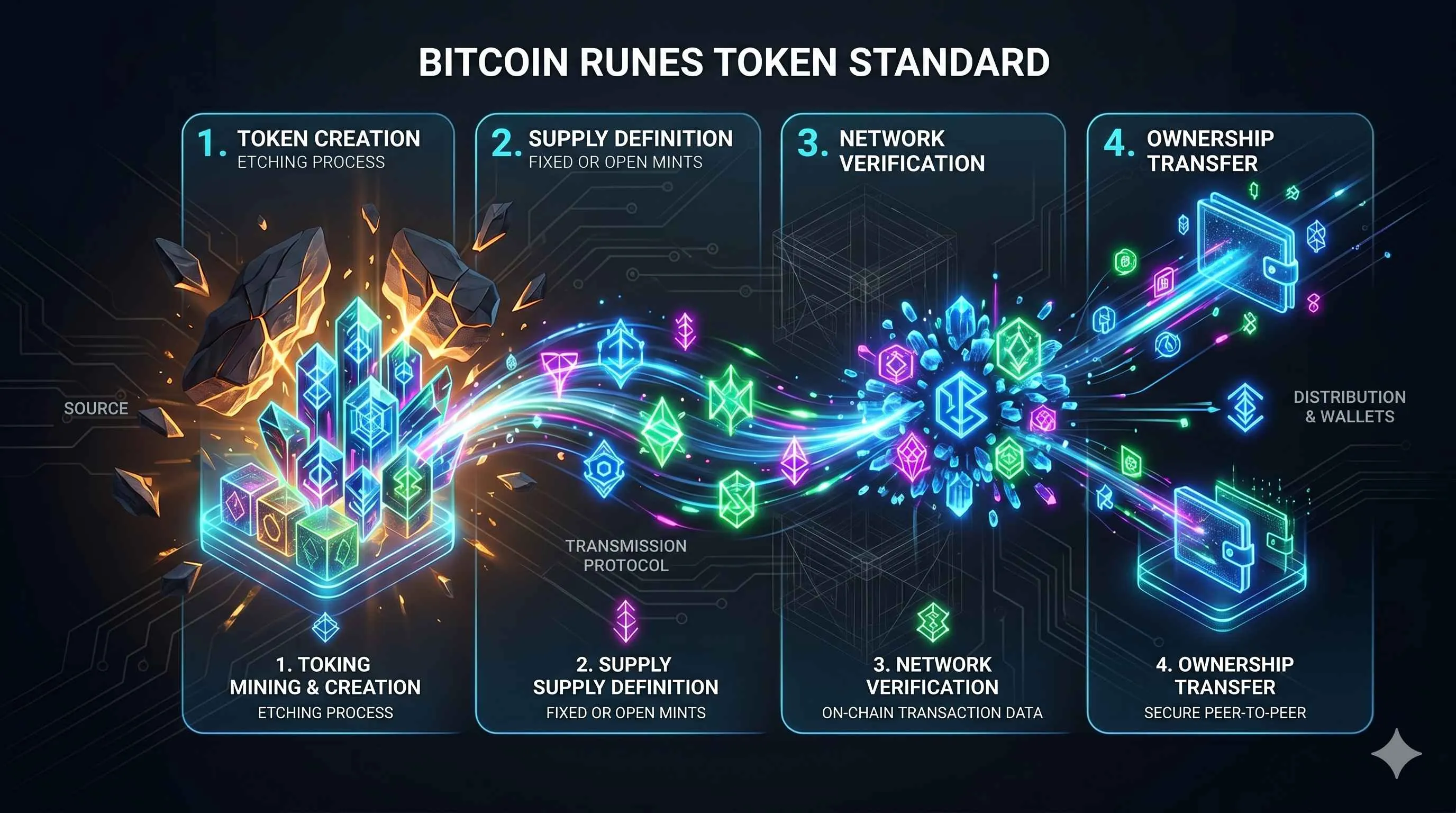
The lifecycle of an asset built on the Bitcoin Runes token standard involves three primary programmatic phases: etching, minting, and transferring. Each process relies on specific messages embedded within Bitcoin transaction outputs using a standard mechanism called OP_RETURN.
Etching
The creation of a new asset within the Bitcoin Runes token standard framework is known as "etching". When a user or project developer etches a Rune, they define its immutable properties, including its name, symbol, divisibility, maximum supply, and minting conditions. To prevent early namespace camping and front-running, the protocol initially restricted short token names, gradually unlocking shorter combinations over time. The metadata associated with an etched Rune is stored compactly in an OP_RETURN script, ensuring it does not permanently bloat the Bitcoin UTXO set.
Minting
Once a token is etched under the Bitcoin Runes token standard, the terms of its mint can be made open to the public according to the parameters set by its creator. Minting transactions specify the target Rune ID and generate a new output containing the designated token allocation. Because assets deploy within the standard UTXO structure, users can mint assets directly to their self-custody wallets efficiently, mitigating the dual-transaction bottleneck characteristic of legacy standards.
Runestones and Cenotaphs
The payload inside the OP_RETURN script that defines an operation within the Bitcoin Runes token standard is called a "Runestone". Runestones dictate how tokens are transferred, split, or combined across transaction inputs and outputs.
However, if a transaction contains an invalid Runestone-such as an unresolvable mint condition, an incorrect asset ID, or a malformed data structure-the protocol triggers a safety mechanism known as a "Cenotaph". When a Cenotaph is generated, the tokens associated with the invalid transaction are burned or rendered permanently inaccessible. This design prevents the creation of ambiguous token balances, ensuring that indexing clients can maintain cryptographic consensus regarding asset distributions without relying on complex off-chain indexing consensus loops.
On-Chain Dynamics: Volatility, Liquidity, and Risk Management
For decentralized finance participants and on-chain analysts, the introduction of the Bitcoin Runes token standard created a highly active, high-volatility ecosystem. Due to the rapid pace of token minting and speculative trading, analyzing market metrics through an advanced toolset like DEXTools is vital to mitigating downside risk and capitalizing on structural shifts in price action.
Analyzing Liquidity Pools and Volume
When trading assets issued via the Bitcoin Runes token standard on secondary markets, or analyzing cross-chain wrapped variants on platforms like DEXTools, liquidity tracking is the single most critical factor. Many early-stage assets suffer from shallow liquidity pools. In low-liquidity environments, large sell or buy orders create significant price slippage, leading to artificial price spikes or rapid cascading sell-offs.
Traders should monitor the relationship between the 24-hour trading volume and the total locked liquidity. A healthy token typically demonstrates sustained, organic volume distributed across a broad range of unique wallet addresses rather than a high volume concentrated within a few automated market maker (AMM) transactions.
Holder Distribution and Concentration Analysis
Before interacting with any newly deployed Bitcoin Runes token standard asset, a comprehensive holder analysis is imperative. High token concentration among a limited number of wallets indicates a centralized distribution model, increasing the probability of sudden market corrections if early holders decide to secure liquidity.
Utilizing the Bubblemaps integration on DEXTools allows analysts to visualize the connections between holding addresses. If a visual inspection reveals complex clusters of interconnected wallets transferring large blocks of tokens among themselves, it may suggest sybil activity or coordinated wash trading to artificially manipulate market sentiment. Clean, decentralized holder distribution maps are a structurally healthier indicator for long-term price stability.
Integrating DEXTools for Advanced Bitcoin Runes Tracking
While the Bitcoin Runes token standard natively operates on the Bitcoin base layer, its integration into the broader DeFi landscape means that wrapped versions, cross-chain bridges, and related tracking metrics frequently appear on EVM-compatible networks and advanced decentralized data aggregators. DEXTools provides a comprehensive dashboard to track these markets accurately.
Technical Analysis and Price Action
When evaluating the price action of a trending Bitcoin Runes token standard asset, utilizing the interactive DEXTools charts helps identify key macroeconomic market structures. Traders can plot critical support and resistance zones, look for volume expansion profiles during breakout phases, and apply momentum indicators such as the Relative Strength Index (RSI).
An RSI divergence-where the asset price prints a higher high but the RSI oscillator prints a lower high-often signals weakening bullish momentum, indicating that a local market top may be forming. Conversely, a bullish divergence at historical support levels can suggest selling exhaustion.
Proactive Monitoring via Price Alerts
Given the inherent volatility of newly issued token frameworks like the Bitcoin Runes token standard, market conditions can shift entirely within minutes. Setting up customizable price alerts on DEXTools allows market participants to track structural breakdowns or breakouts without constantly monitoring a screen. This proactive risk management approach ensures that stop-loss parameters can be manually or systematically managed before a drawdown compromises a capital position.
The Broader Impact on the Bitcoin Ecosystem
The architectural differences introduced by the Bitcoin Runes token standard carry significant implications for the future scaling of the Bitcoin network.
Mempool Optimization: By reducing the accumulation of unspent outputs, this framework helps keep the Bitcoin mempool leaner, preventing the prolonged fee spikes that historically hindered standard peer-to-peer transactions.
L2 and Sidechain Compatibility: The native UTXO design makes the Bitcoin Runes token standard fundamentally compatible with Bitcoin Layer-2 scaling solutions, such as the Lightning Network and various emerging sidechains. This compatibility paves the way for faster, fraction-of-a-cent token swaps, bringing true utility to Bitcoin DeFi.
Miner Sustainability: As Bitcoin block rewards continue to halve over time, transaction fees play an increasingly vital role in maintaining network security. The consistent demand for etching and minting assets under this protocol provides miners with a stable stream of transaction revenue, subsidizing the security budget of the world's oldest blockchain.
Conclusion: Navigating the Future of Bitcoin Tokens
The emergence of the Bitcoin Runes token standard represents a significant structural advancement in the technical architecture of Bitcoin-native assets. By prioritizing efficiency, aligning perfectly with the network's underlying UTXO model, and correcting the flaws inherent in early BRC-20 implementations, this standard has established itself as a permanent pillar of the Bitcoin ecosystem.
However, as with any emerging market vertical, high reward potential is inextricably linked to high volatility and operational risk. Successful navigation of this space requires moving beyond speculative hype and focusing strictly on verifiable on-chain data. By tracking total liquidity profiles, evaluating wallet distribution transparency, setting proactive alerts, and analyzing precise price action indicators through DEXTools, market participants can confidently make informed, risk-adjusted decisions in this new era of decentralized finance.
What Are Bitcoin Runes: Complete Fungible Token Standard Guide (2026)Fee Revenue per Active Wallet vs Total Fees: Which Shows Real dApp Monetization?
What Is an Automated Market Maker (AMM) in DeFi: Complete Guide (2026)
What Is RSI in Crypto? Beginner Guide to the Relative Strength Index (2026)
Disclaimer: This article is for informational purposes only and does not constitute investment advice, financial advice, trading advice, or any other kind of advice. DEXTools does not recommend buying, selling, or holding any cryptocurrency or token. Users should conduct their own research and consult with a qualified financial advisor before making any investment decisions. Cryptocurrency investments are volatile and high-risk. DEXTools is not responsible for any losses incurred.
The Nuances of Rune Issuance and Decentralization
While Runes offer a streamlined approach to fungible tokens on Bitcoin, understanding the mechanics of their issuance is crucial for assessing their long-term decentralization and potential for manipulation. Unlike some other token standards that might rely on smart contracts or external systems for minting, Runes are intrinsically tied to Bitcoin's UTXO model, embedding their creation directly into Bitcoin transactions.
This tight integration with Bitcoin's core mechanics provides a unique security posture, but it also means that the initial distribution and subsequent supply management of a Rune are heavily influenced by the issuer's choices. Early adopters and those with direct access to issuance mechanisms can significantly impact market dynamics, making it vital for traders to scrutinize the initial minting process.
Evaluating Rune Distribution Fairness
For DEXTools users analyzing the potential of a new Rune, assessing the fairness and transparency of its distribution is paramount. A highly centralized initial distribution can lead to "whale" control, making the asset susceptible to price manipulation and reducing its long-term viability as a truly decentralized asset.
- Examine the initial minting transactions: Look for a concentrated number of addresses receiving a large proportion of the initial supply.
- Analyze the number of unique holders shortly after launch: A broad distribution across many addresses suggests a healthier, more decentralized start.
- Investigate the issuer's public statements on distribution strategy: Did they outline a clear and fair plan for initial token allocation?
- Monitor for large, unexplained transfers from initial minting addresses: This could indicate over-the-counter sales or pre-mining activity.
- Assess the total supply and issuance schedule: Understand if the Rune has a fixed supply or if it can be minted continuously, and by whom.
Related Guides
- What Are Bitcoin Runes: Complete Fungible Token Standard Guide (2026)
- BRC-20 vs Runes vs Stamps: Bitcoin Tokens Compared
- Bitcoin Runes vs BRC-20 vs Ordinals: Complete Comparison 2026
- What Is an ERC-20 Token: Complete Guide to Ethereum's Token Standard (2026)
- What Is an XRP ETF? Approval and Trading Guide 2026
Frequently Asked Questions
What are Runes, and how do they differ from BRC-20 tokens?
Runes are a new fungible token standard on Bitcoin, designed for efficiency and simplicity. Unlike BRC-20, which uses Ordinal inscriptions to store token data, Runes are UTXO-based, meaning they leverage Bitcoin's Unspent Transaction Output model directly. This design aims to reduce blockchain bloat and transaction fees associated with token operations, offering a more streamlined approach to creating and managing tokens on Bitcoin.
How do Runes improve upon previous Bitcoin token standards?
Runes significantly improve upon previous standards like BRC-20 by being more efficient and less resource-intensive. Their UTXO-based design minimizes the on-chain footprint of token transactions, leading to lower fees and faster processing. This makes them a more scalable and sustainable solution for fungible tokens on the Bitcoin network.
What are the technical advantages of Runes' UTXO-based design?
The UTXO-based design of Runes offers several technical advantages. It integrates more natively with Bitcoin's existing infrastructure, reducing the need for complex off-chain indexing or workarounds. This design promotes cleaner state management, making it easier for wallets and exchanges to track and process Runes, and potentially leading to greater network stability and security for token operations.
How can traders use on-chain metrics to evaluate Runes?
Traders can utilize on-chain metrics such as transaction volume, active addresses, and token distribution to gauge market sentiment and liquidity for Runes. Analyzing these metrics can help identify trends, assess demand, and understand the overall health and adoption of specific Runes. This data provides valuable insights for making informed trading decisions within the Runes ecosystem.