DEX Net Inflows vs. Trading Volume: Capital Rotation?
— By Whatsertrade in Tutorials
Explore the insights of DEX net inflows versus trading volume to understand the nuances of crypto capital movement and market dynamics.
Trading volume remains one of the most observed metrics in crypto markets. When decentralized exchange (DEX) volume increases, traders often conclude that market interest is on the rise. However, volume alone cannot always demonstrate whether fresh capital is being injected into the market.
Key Takeaways
- The Inside Scoop on DEX Trading Volume
- Contrasting DEX Net Inflows With Trading Volume
- Capital Dynamics: Rotation or New Injection?
- Harnessing Metrics for Strategic Trading
- Frequently Asked Questions
- Related Guides
Exploring DEX Net Inflows
DEX net inflows offer a different angle. They give traders insights into whether capital is entering decentralized exchanges or if current liquidity merely rotates between different tokens. By weighing DEX net inflows against trading volume, market participants can assess if activities are backed by new capital or just repeated trades.
The Inside Scoop on DEX Trading Volume
Decoding DEX Volume
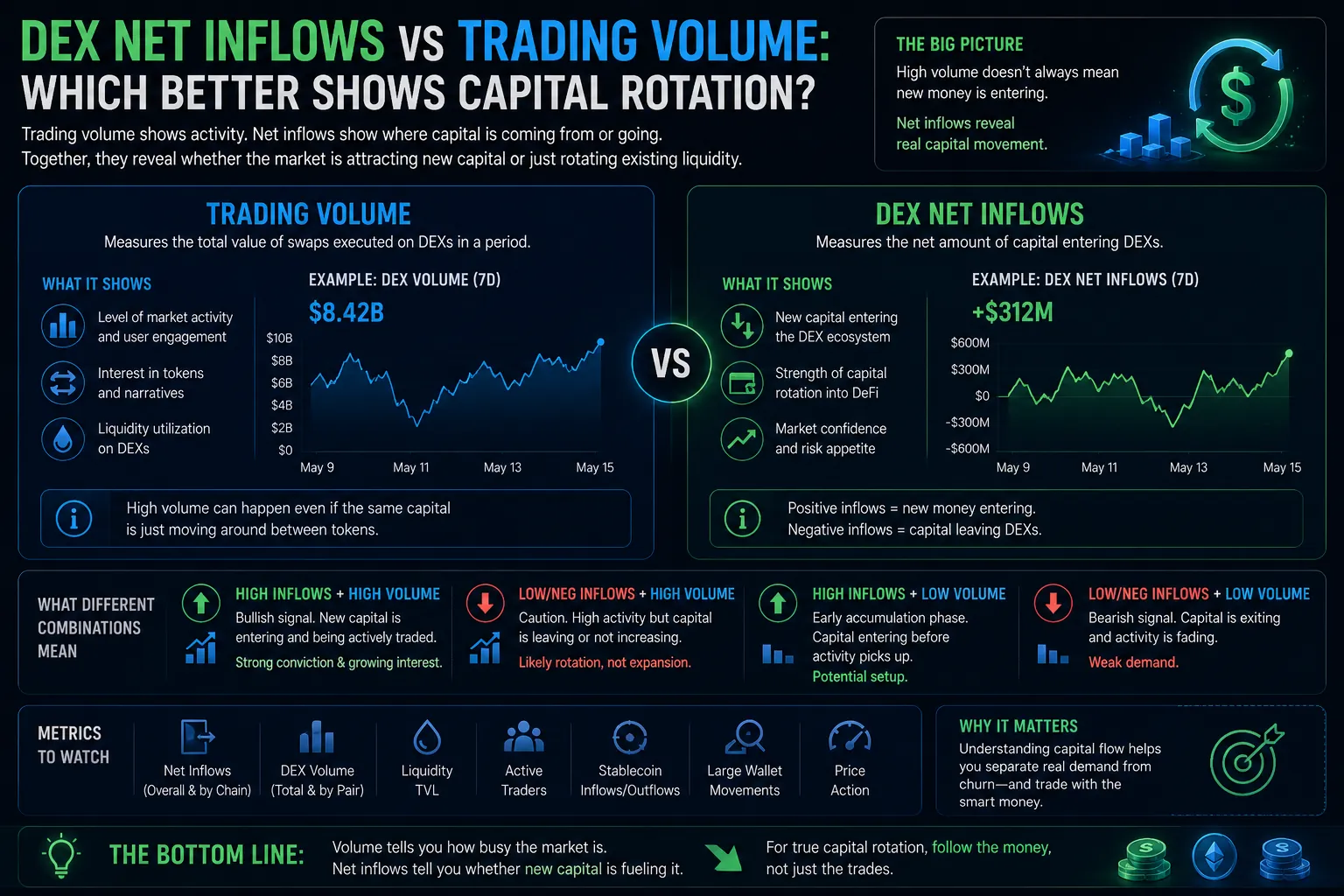
DEX trading volume indicates the cumulative value of exchanges executed on decentralized platforms within a certain timeframe. High volume can hint at active interest, and liquidity demand, and might also reveal asset rotation among traders.
Yet, the source of capital remains hidden in volume data. The same funds can circulate multiple times, inflating volumes without any fresh capital infusion into the market.
Understanding DEX Net Inflows
DEX net inflows denote the net difference between capital entering and leaving DEX platforms. Positive net inflows occur when more value flows into DEX liquidity than exits, whereas negative net inflows indicate the opposite.
This metric aids traders in discerning whether decentralized markets are drawing in new liquidity or if they are losing capital back to other ecosystems.
Contrasting DEX Net Inflows With Trading Volume
The Core Distinction
The crucial distinction lies in movement versus activity. Trading volume captures the scale of trading. In contrast, net inflows measure the entry or exit of capital within the market environment. A DEX could experience high trading volumes with flat or negative net inflows, suggesting existing capital rotation rather than the introduction of new funds.
Conversely, moderate volume with robust net inflows may imply capital accumulation or preparation for upcoming trading opportunities.
Misleading Nature of Trading Volume
Rising trading volumes can stem from various activities, such as new token purchases, panic sales, arbitrage, or farming rewards. It doesn't necessarily point towards bullish demand. At times, increased volume coincides with market stress, as traders rush to exit positions.
Thus, volume assessments should be paired with flow data and price movements for a comprehensive understanding.
The Significance of Net Inflows
Net inflows are crucial in identifying whether new capital is being absorbed by the market. Positive inflows could indicate that users are funneling funds into decentralized finance (DeFi) platforms for trading, liquidity provision, or seizing opportunities.
On the other hand, negative net inflows might suggest withdrawals, a move to centralized exchanges, or risk reduction.
Capital Dynamics: Rotation or New Injection?
Parsing the Differences
Capital rotation refers to the movement of existing funds from one asset to another within the market. For instance, a trader might sell one token and acquire another on the same DEX, causing volume fluctuations without enhancing total market capital.
In contrast, new capital introduction means fresh funds entering and expanding the market environment, typically supporting stronger price rallies than those driven solely by internal rotation.
Recognizing Bullish Trends
A potentially bullish setup includes rising net inflows, augmented liquidity, surging trading volume, and widespread engagement across tokens. This scenario indicates that capital is pouring in, markets are deepening, and active trading is taking place. Nonetheless, traders should discern if activities are organic or incentive-led.
Spotting Bearish Indicators
A bearish scenario might reflect high volumes paired with negative net inflows, coming into play when trading is active but capital is draining from the ecosystem. Such conditions can hint at distribution, panic sales, or waning confidence, which could undermine market stability if liquidity decreases.
Harnessing Metrics for Strategic Trading
Effective Metric Utilization
Traders should judiciously analyze trading volume, net inflows, liquidity variations, price dynamics, stablecoin flows, the number of active pairs, and large wallet behavior. A rise in volume accompanied by positive inflows and enhanced liquidity could imply a market's strengthening phase.
However, if the volume rises amid negative inflows and diminishing liquidity, a cautious approach is advisable.
Embracing DEXTools for Market Insight
Tools like DEXTools empower traders by providing a real-time glimpse into DEX activities, covering aspects like liquidity, volume, price trends, and pair movements. This data assists in discerning whether a token or market sector is gaining actual traction.
Blending such information with net flow analyses can highlight sustainable market growth against short-term speculative behaviors.
The Bottom Line on DEX Insights
DEX trading volume and net inflows each reveal distinct market behaviors. While volume speaks to sheer activity, net inflows unveil capital movement. For traders, the most robust signals arise from an analysis of both together. High volume is more compelling when it aligns with fresh capital introduction and liquidity growth.
Within DeFi, activity doesn't always equate to expansion. Often, it just represents circulating capital without new injections.
How to Bridge Crypto Between Chains: Complete Cross-Chain Tutorial 2026 How to Use 1inch: Complete DEX Aggregator Swap Tutorial (2026) How to Use OKX Web3 Wallet: Multi-Chain DeFi Hub Guide (2026)Frequently Asked Questions
Q: What is DEX net inflow?
A: DEX net inflow refers to the total value of assets moving into decentralized exchanges, exceeding outflows, over a specific period. It indicates fresh capital entering the DEX ecosystem.
Q: How does trading volume differ from net inflow?
A: Trading volume represents the total value of all trades executed on a DEX, regardless of direction. Net inflow specifically measures the net movement of capital into the DEX platform.
Q: Can high trading volume exist with low net inflow?
A: Yes, high trading volume can occur with low or even negative net inflow. This might indicate frequent trading among existing users without significant new capital entering the system.
Q: What does high net inflow suggest for a DEX?
A: High net inflow suggests increasing confidence and interest in a particular DEX or the broader DeFi space. It can indicate new users or existing users depositing more capital.
Q: How can capital rotation be observed through these metrics?
A: Capital rotation might be observed if one DEX experiences high net inflows while another sees outflows, or if trading volume shifts significantly between different asset pairs within the DEX ecosystem.