Buyers vs Sellers Ratio: Why More Buyers Does Not Always Mean Strength
— By Whatsertrade in Tutorials

Explore the nuances of buyer-seller ratios and why a higher buyer count may not signify a strong market. Learn how to assess real market strength.
Many traders look at the buyers vs sellers ratio to judge whether a token is strong. If there are more buyers than sellers, the token may look bullish. If sellers dominate, the token may look weak.
But this metric can be misleading.
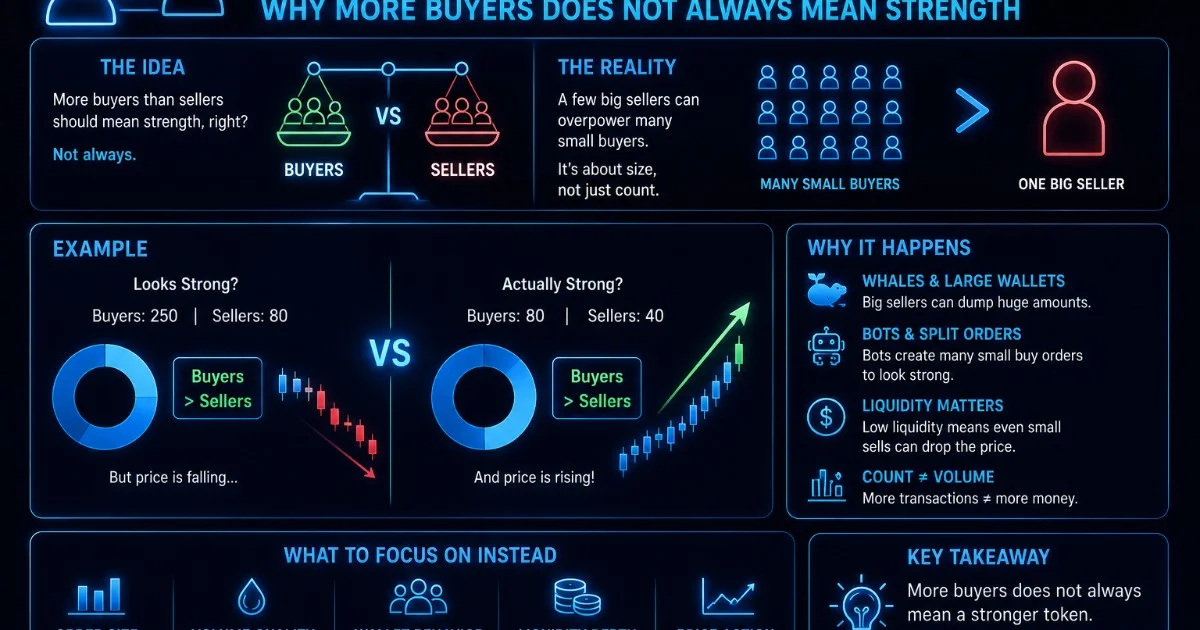
A token can have more buyers than sellers and still go down. A few large sellers can outweigh many small buyers. Bots can create many tiny buy transactions. High buyer count can create confidence while price action tells a different story.
To understand real strength, traders need to look beyond the number of buyers.
Why More Buyers Can Still Be Bearish
The buyers vs sellers ratio counts participants or transactions, but it does not always show size. One seller with a large position can create more pressure than 100 small buyers.
For example, if 200 wallets buy small amounts but one whale sells a much larger amount, the chart can still fall. The ratio may look bullish, but the capital flow is bearish.
This is why traders should analyze both count and value.
Order Size Matters
Order size is one of the most important details behind the buyers vs sellers ratio.
A healthy token usually shows meaningful buy orders from multiple wallets. A weaker token may show many small buys that cannot absorb larger sells.
Traders should ask:
- Are buyers entering with real size?
- Are sellers larger than buyers?
- Are buys spread across many wallets?
- Are sells coming from top holders?
- Is price rising or falling despite the ratio?
The chart often reveals what the ratio hides.
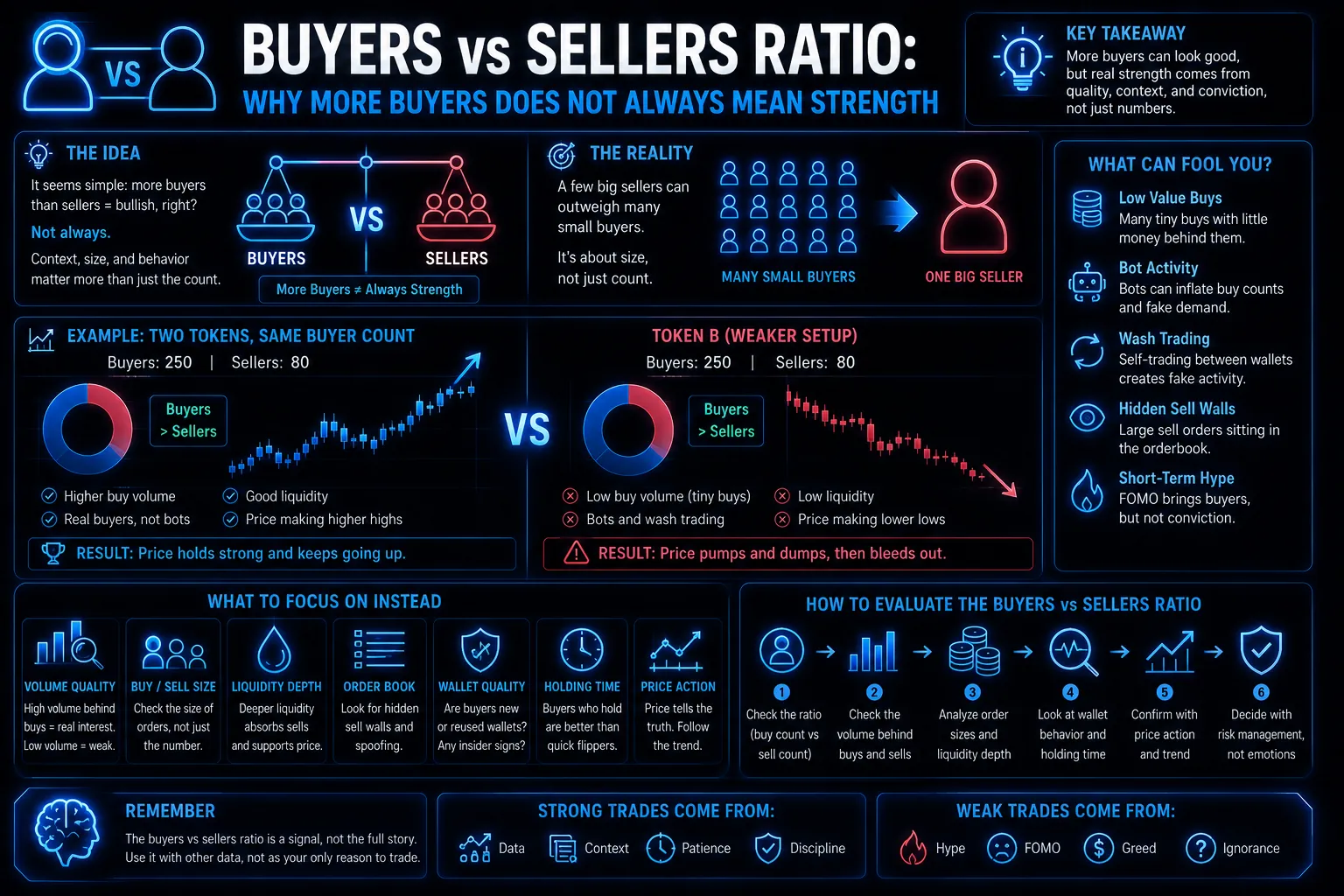
Bots Can Distort the Ratio
Bots can create misleading buyer activity. Some tokens show many small buys that make the market appear active. These transactions may not represent real demand.
Bot driven activity can make a token look popular while liquidity remains weak and price fails to hold.
Warning signs include:
- Repeated identical buys
- Very small transaction sizes
- Rapid wallet activity with no holder quality
- Volume that does not match price strength
- Buyer count rising while price declines
A strong ratio is only useful when the activity looks organic.
Sell Pressure Matters More Than Seller Count
Not all sellers are equal. A few sellers may be harmless if they sell small amounts. But if sellers are early wallets, insiders, or whales, their impact can be much larger.
Traders should watch where sell pressure comes from. If top holders are consistently selling into new buyers, the token may be using retail demand as exit liquidity.
A token with more buyers than sellers can still be weak if the sellers are stronger.
Liquidity Changes the Meaning
Liquidity also affects the buyers vs sellers ratio. In a deep pool, large sells may have less price impact. In a shallow pool, even moderate sells can cause sharp drops.
A bullish ratio on low liquidity can be dangerous because the token may not have enough depth to absorb exits.
Traders should compare buyer activity with liquidity depth before trusting the signal.
A Better Way to Read the Ratio
Instead of asking only whether buyers outnumber sellers, traders should ask:
- Are buyers larger or smaller than sellers?
- Is price confirming buyer strength?
- Is liquidity deep enough?
- Are top holders selling?
- Are buyers new and organic?
- Is volume creating higher lows?
When the ratio, price action, liquidity, and holder behavior all align, the signal becomes more useful.
Final Thoughts
More buyers do not always mean a stronger token. In DEX trading, size, liquidity, wallet quality, and sell pressure matter just as much as the number of participants.
The buyers vs sellers ratio is a starting point, not a final answer.
Smart traders use it with context.
Fake Holders vs Real Buyers: How Wallet Count Can Mislead Traders The Whale Shadow: How Large Wallets Distort Retail Interpretation on DEX Charts Settlement Volume vs Transfer Count: Which Better Shows Real On Chain Value Movement? Median Trade Size vs Trade Count: Why Small Swaps Can Inflate DEX Activity