The Whale Shadow: How Large Wallets Distort Retail Interpretation on DEX Charts
— By Whatsertrade in Tutorials

A whale buy can change more than the price. It can change the way everyone interprets the market.In DeFi trading, large wallet activity often attracts immediate
A whale buy can change more than the price. It can change the way everyone interprets the market.
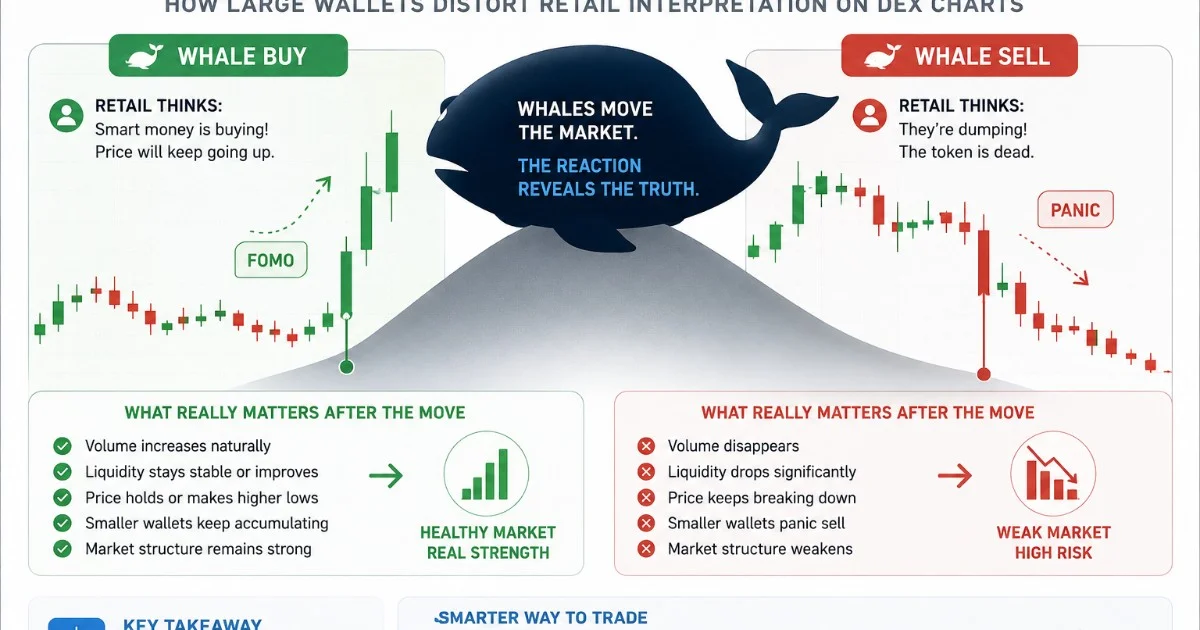
In DeFi trading, large wallet activity often attracts immediate attention. When a whale buys into a token, retail traders may assume that smart money knows something. When a whale sells, they may panic. But large transactions are not always simple signals.
Sometimes whales create a shadow over the chart.
That shadow can distort retail decision making.
What Is the Whale Shadow?
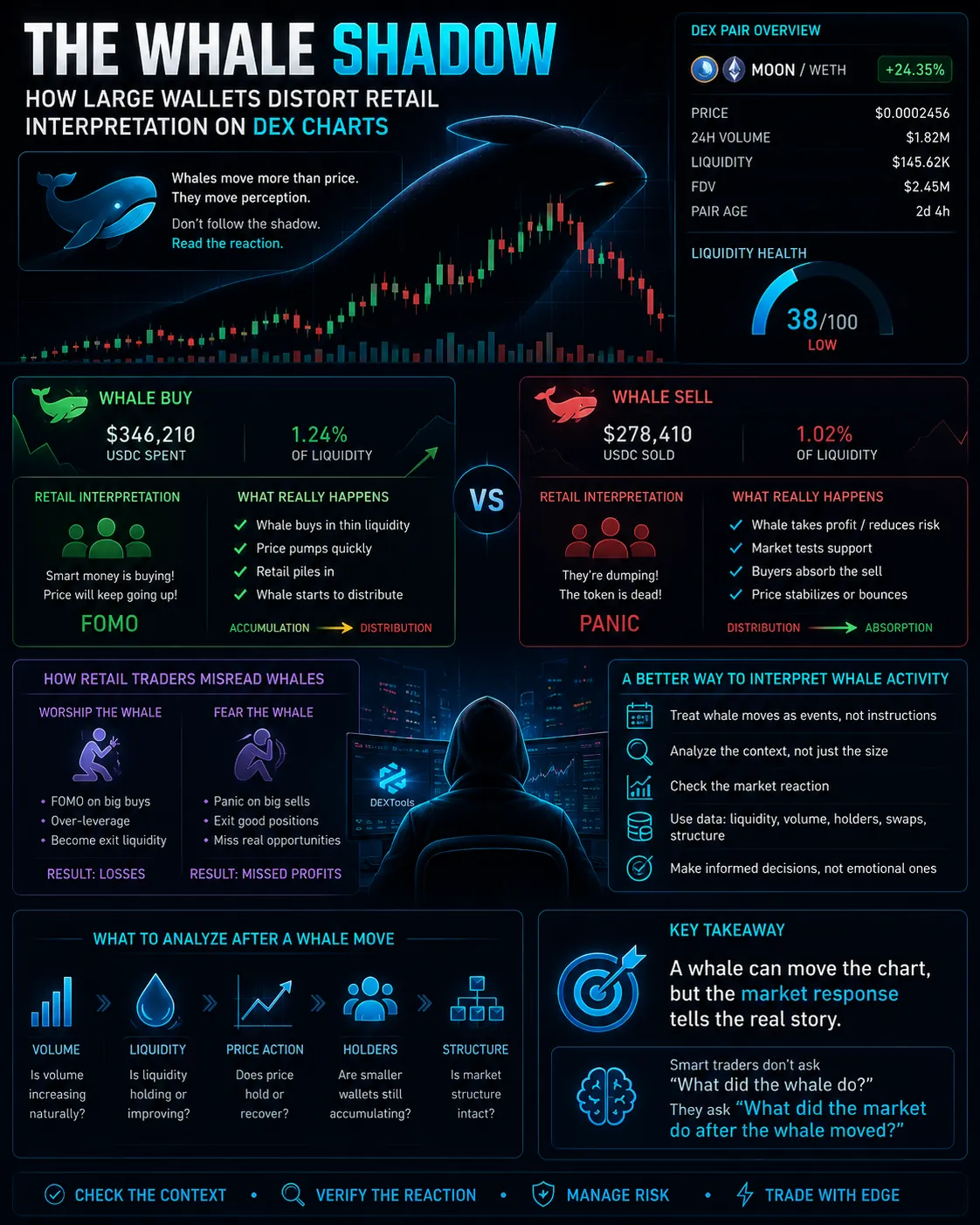
The whale shadow is the psychological effect created by large wallet activity. It happens when traders focus more on the size of a transaction than on its context.
A large buy can make a token look stronger than it really is. A large sell can make a healthy correction look like a collapse. In both cases, retail traders may react emotionally instead of analytically.
The problem is not whale tracking itself. The problem is blind interpretation.
Why Big Buys Are Not Always Bullish
A large wallet entering a token can mean many things. It could be conviction. It could be a short term trade. It could be part of a coordinated strategy. It could also be bait, especially in low liquidity markets where one large buy can attract attention and create retail FOMO.
A whale may buy to create momentum, then gradually sell into the demand created by smaller traders.
This is why traders should avoid treating every big buy as a signal to follow.
Why Big Sells Are Not Always Bearish
The same logic applies to selling. A whale sell does not always mean the token is dead. It could be profit taking, portfolio rotation, partial risk reduction, or a liquidity test.
Context matters. If liquidity remains stable, volume continues, and buyers absorb the sell, the market may remain healthy. If the sell triggers panic, liquidity drops, and volume disappears, the situation is more serious.
DEXTools can help traders observe large swaps, price reaction, liquidity conditions, and trading activity together.
How Retail Traders Misread Whales
Retail traders often make one of two mistakes. They either worship whale activity or fear it too much.
Following whales without context can turn traders into exit liquidity. Panicking after every large sell can make them leave strong markets too early.
The better approach is to ask what happened after the whale move. Did volume increase naturally? Did liquidity hold? Did the chart recover? Did smaller wallets continue buying?
The reaction matters more than the transaction itself.
A Better Way to Interpret Whale Activity
Whale moves should be treated as events, not instructions. They are signals that deserve attention, but they are not automatic trading decisions.
A whale buy is worth watching. A whale sell is worth studying. But neither should replace analysis of liquidity, holders, volume, contract data, and market structure.
Final Thoughts
The whale shadow is powerful because humans are naturally drawn to size. In markets, big numbers feel important. But importance does not always mean clarity.
A whale can move the chart, but the market response tells the real story.
Smart DeFi traders do not simply ask, "What did the whale do?"
They ask, "What did the market do after the whale moved?"
Whale Buy or Exit Liquidity? How to Read Big Swaps Without Blindly Copying Whales Whale Wallet Tracking Strategy in Crypto: How to Follow Smart Money Fake Volume vs Real Demand: How to Spot Artificial Momentum in DeFi Trading Smart Money Wallet Tracking: How to Follow the Pros (2026)Frequently Asked Questions
What is a crypto whale?
A crypto whale is an individual or entity holding a significant amount of a particular cryptocurrency. Their holdings are typically large enough to potentially influence market prices.
How do whales impact crypto markets?
Whales can impact markets through large buy or sell orders, which can cause price fluctuations. Their movements are often tracked by other investors seeking insights into market sentiment.
Are whales always bad for retail investors?
Not necessarily. While large sell-offs can cause price drops, whale accumulation can signal confidence and potentially lead to price increases. Their actions are a factor among many in market dynamics.
How can I track whale movements?
Various blockchain explorers and analytics platforms allow users to track large transactions and wallet movements. These tools provide data on significant transfers of cryptocurrencies.
What is a 'whale wallet'?
A whale wallet refers to a cryptocurrency address holding a very large amount of a specific digital asset. These wallets are often monitored for signs of potential market-moving activity.