What is io.net? Decentralized GPU for AI Workloads Guide
— By AliceOnChain in Tutorials

An advanced technical exploration of io.net, its decentralized GPU clustering infrastructure for AI workloads, and how sophisticated traders leverage DEXTools on-chain data to analyze liquidity distribution, network velocity, and structural token behavior.
What is io.net? Decentralized GPU for AI Workloads
The exponential growth of machine learning architectures and Large Language Models (LLMs) has triggered an unprecedented global computing shortage. Enterprise demand for high-end Graphics Processing Units (GPUs) significantly outpaces the production capacity of traditional silicon manufacturers. Centralized cloud monoliths often impose prohibitive pricing structures, lengthy contract commitments, and severe availability bottlenecks. This systemic deficit has accelerated the development of Decentralized Physical Infrastructure Networks (DePIN) designed to aggregate underutilized computational power.
For on-chain analysts and algorithmic market participants evaluating this sector, answering the foundational query-what is io.net and how does its token economy function-requires a quantitative approach. Navigating the intersection of artificial intelligence (AI) utility and decentralized finance demands an understanding of both hardware orchestration layer mechanics and advanced on-chain analysis. This tutorial breaks down the structural engineering behind io.net and demonstrates how to utilize the primary data suites of DEXTools to audit its native market dynamics.
Understanding the Architecture of io.net
To properly evaluate the asset's structural market behavior, traders must first comprehend the technological framework that sets the protocol apart from legacy computing providers. So, what is io.net from an infrastructural perspective?
At its core, io.net is a decentralized computing network that aggregates geo-distributed GPU pools into unified, low-latency clusters. While alternative DePIN projects focus primarily on single, independent rendering tasks, this architecture is custom-built for resource-intensive AI workloads. This includes deep learning model training, hyperparameter tuning, and massive parallel inference pipelines.
The Clustering Innovation
The primary technological bottleneck for distributed computing is latency. Machine learning tasks require thousands of computing cores to communicate continuously. Traditional decentralized networks suffer from synchronization delays over public internet protocols.
The protocol mitigates this limitation through its specialized orchestration engine. By utilizing open-source distributed computing frameworks like Ray and Kubernetes, the network can rapidly group thousands of independent GPUs-ranging from idle independent data centers to individual enterprise nodes-into a single virtual supercomputer. This process, known as clustering, allows developers to access enterprise-grade computing speeds at a fraction of the cost charged by centralized cloud ecosystems.
The IO Token Economics and Core Velocity
When analyzing infrastructure-backed digital assets, sophisticated market participants look directly at the underlying tokenomic cycle. What is the fundamental utility of the IO token, and how does it sustain its economic velocity?
The native asset serves as the foundational unit of value exchange, network staking, and programmatic governance within the ecosystem. The network employs a balanced token allocation system alongside a dynamic payment architecture designed to incentivize long-term node uptime while managing structural inflation.
Developers and AI enterprises pay for distributed computing clusters using USD-pegged stablecoins or native IO tokens. When payments occur via fiat or stablecoins, automated smart contracts routing through decentralized exchange liquidity pools systematically convert the capital into the native asset. Node operators are rewarded based on a dual mechanism:
Availability Rewards: Commending the hardware node for remaining accessible, verified, and meeting strict latency requirements.
Utilization Rewards: Issued when active AI workloads are actively processed by the allocated hardware cluster.
This direct connection between actual computational demand and on-chain token velocity means that macroeconomic shifts in the broader machine learning sector can quickly translate into localized network volume changes. Monitoring these liquidity configurations via decentralized applications is essential for determining market sustainability.
On-Chain Analysis: Tracking io.net with DEXTools
Trading highly anticipated infrastructure tokens within the AI and DePIN narratives requires an analytical framework that extends far beyond standard centralized exchange order books. Because these assets experience high initial volatility, managing risk requires a deep, real-time look into smart-contract parameters, liquidity configurations, and capital flows. DEXTools delivers the exact quantitative architecture needed to parse this data natively.
Evaluating Market Structure via Pair Explorer
When analyzing the primary liquidity pools for the IO token across leading decentralized exchanges, the DEXTools Pair Explorer serves as the initial diagnostic layer.
Liquidity Depth and Slippage Mitigation: High daily trading volume without proportional liquidity pool depth presents substantial tail-risk for larger positions. Analysts looking at the asset verify the ratio of total value locked (TVL) within the pools against the 24-hour transaction volume to estimate potential execution slippage.
DEXT Score Verification: The system computes an automated reliability score by reviewing parameters such as contract verification status, creator address balances, and pool locking mechanisms. A low DEXT Score often warns of unoptimized contract permissions or unsecured liquidity pairs, prompting careful risk adjustment.
Analyzing Holder Distribution and Network Concentration
The structural stability of utility tokens can be severely compromised if supply concentration is heavily weighted toward a closed group of early insiders or unvested venture allocations. Identifying these systemic risk factors requires a thorough audit of wallet distributions.
Through the DEXTools Holder Analysis suite and its native Bubblemaps integration, market participants can look past superficial wallet addresses. This tool visually diagrams the real-time flows between separate on-chain identities. If the data displays large, interconnected wallet clusters moving funds systematically, it suggests coordinated whale behavior or concentrated insider supply. Conversely, a fragmented, decentralized distribution pattern typically indicates healthier structural accumulation and minimizes the risk of sudden, large-scale liquidations.
Advanced Volatility Management and Strategy Execution
Navigating emerging infrastructure assets requires strict adherence to quantitative execution parameters to prevent emotional decision-making during high-volatility market phases.
Spotting Technical Divergences Natively
On-chain price action frequently signals trend exhaustion before it becomes visible on simple daily line charts. By utilizing advanced indicators within DEXTools Charts, traders track the relationship between Volume-Weighted Average Price (VWAP) and the Relative Strength Index (RSI).
If the price of the asset pushes to a localized higher high while the underlying RSI shifts downward to form a lower high, a bearish RSI divergence is established. Historically, this mismatch signals a clear loss of buying momentum, alerting disciplined analysts to tighten trailing stops, hedge spot exposure, or defer entries until major horizontal support levels are retested.
Automating Exit Protocols with Price Alerts
The fast-paced nature of DeFi means that localized market tops and sudden re-accumulations occur rapidly. To maintain mechanical execution, setting automated Price Alerts within DEXTools allows traders to operate independently of screen-monitoring constraints.
Setting up cascading alerts across key technical intervals-such as major volume nodes or key Fibonacci expansion points-enables a programmatic approach to capital preservation. Taking partial profits at predetermined resistance levels ensures that earned gains are systematically realized rather than lost to a sharp downside correction.
Conclusion: Data-Driven Navigation of the DePIN Ecosystem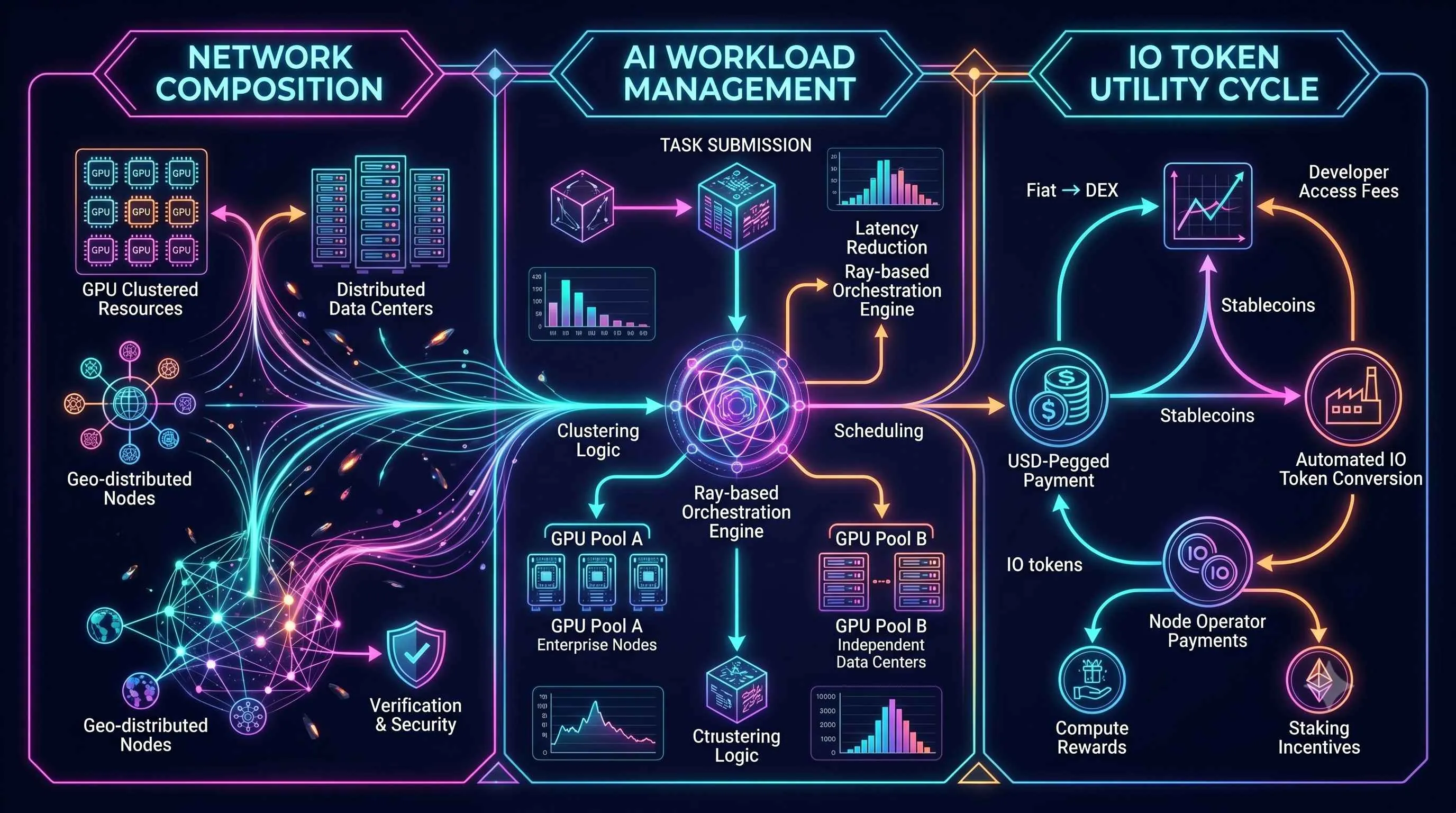
In defining what is io.net, it becomes clear that the project represents an important shift in how global GPU infrastructure is sourced, clustered, and allocated for artificial intelligence training. Its ability to solve real-world hardware shortages positions it as a significant fundamental actor within the broader Web3 ecosystem.
However, fundamental alignment does not completely erase market volatility. To successfully navigate these specialized token economies, retail and institutional traders must balance their long-term structural theses with disciplined, real-time on-chain data. By continuously auditing pool health via DEXTools, keeping track of whale wallet clusters, monitoring structural divergences, and using automated price triggers, market participants can effectively separate short-term market hype from real, data-driven liquidity trends.
- What Is io.net? The Decentralized GPU Network Powering AI on Solana in 2026
- What Is DePIN: Complete Decentralized Physical Infrastructure Networks Guide (2026)
- Pair Explorer Data Trend Reversals: A Pro Trading Guide
- DEXTools Pair Explorer for Early Liquidity Signals
Disclaimer: This article is for informational purposes only and does not constitute investment advice, financial advice, trading advice, or any other kind of advice. DEXTools does not recommend buying, selling, or holding any cryptocurrency or token. Users should conduct their own research and consult with a qualified financial advisor before making any investment decisions. Cryptocurrency investments are volatile and high-risk. DEXTools is not responsible for any losses incurred.
The Economic Nexus: Tokenomics and Decentralized Resource Allocation
Beyond the technical architecture, io.net's long-term viability and attractiveness to both providers and consumers hinge on its tokenomics. The native token is not merely a medium of exchange but a critical mechanism for aligning incentives, securing the network, and governing its evolution. Understanding this economic nexus is paramount for sophisticated traders looking to assess the project's intrinsic value and potential for sustainable growth.
The token's utility extends to staking by GPU providers to ensure service quality and availability, as well as by network participants for governance voting on protocol upgrades and fee structures. This multi-faceted utility creates demand, while carefully designed issuance and burning mechanisms aim to control supply and foster a healthy market equilibrium. The interplay of supply, demand, and network activity directly impacts token price, making it a key indicator for DEXTools users.
Analyzing Network Health Through Token Behavior
- Monitor staking activity: Increased staking can signal growing confidence among GPU providers and a commitment to network stability.
- Track transaction velocity: A higher velocity of the native token within the io.net ecosystem suggests robust utilization of GPU resources.
- Observe token distribution: Analyze the concentration of token holdings to identify potential whales or early adopters, understanding their potential impact on market dynamics.
- Evaluate governance participation: Active participation in proposals and voting indicates a healthy, engaged community vital for decentralized project success.
- Assess fee generation and burn rates: The consistent generation of network fees and their subsequent burning can indicate strong network usage and a deflationary pressure on supply.
Related Guides
- What Is io.net? The Decentralized GPU Network Powering AI on Solana in 2026
- What is Render (RENDER)? Decentralized GPU Network Guide
- What Is Render Network (RNDR/RENDER)? Decentralized GPU DePIN Guide 2026
- What Is Aethir (ATH)? The Decentralized GPU Cloud Powering AI and Gaming in 2026
- DEX Net Inflows vs. Trading Volume: Capital Rotation?
Frequently Asked Questions
What is io.net?
io.net is a decentralized network that aggregates GPU computing power from many providers to serve AI and machine learning workloads. The aim is to make compute resources more accessible by pooling distributed hardware.
Why use decentralized GPU networks for AI?
Decentralized GPU networks can tap into underused hardware around the world, which may improve access and flexibility for compute heavy AI tasks. They coordinate many independent suppliers through a shared protocol and incentives.
How do token incentives work in a decentralized compute network?
Providers typically earn tokens for contributing GPU resources, while users pay to access compute, aligning supply and demand. This creates a marketplace where capacity grows as participation increases.
How can traders analyze a decentralized GPU project token?
Traders often review on chain metrics such as liquidity, holder distribution, and trading activity alongside research into the network usage. Combining market data with fundamentals gives a clearer view of risk.