Coinbase vs Binance Listing Effect: How Tokens Usually React
— By Whatsertrade in Tutorials

Learn how tokens usually react to the Coinbase vs Binance listing effect, from rumor pumps to post-listing volatility, liquidity shifts, and trade timing.
This guide explains the Coinbase vs Binance listing effect on token price behavior. It is about announcement and listing reaction patterns, not about exchange account setup.
A major exchange listing can change the market structure of a token in minutes. When a token gets listed on Coinbase, Binance, or another large centralized exchange, traders often expect more visibility, deeper liquidity, easier access, and a larger buyer base.
This expectation can create powerful price moves. Sometimes the token rallies before the announcement. Sometimes it pumps immediately after the listing news. Sometimes it dumps once trading opens. In many cases, the biggest move happens before retail traders even notice the official announcement.
Understanding the Coinbase and Binance listing effect can help traders avoid emotional decisions. A listing is important, but it does not guarantee profit. The key is to understand the different phases: rumor, confirmation, opening volatility, post listing liquidity, and market exhaustion.
This guide explains how tokens often react before and after a major exchange listing, what to watch on DEXTools, and how to avoid buying the top during a hype cycle.
What Is the Exchange Listing Effect?
The exchange listing effect refers to the price and volume reaction that happens when a token is listed on a major centralized exchange. Large exchanges give tokens more exposure and make them easier to buy for users who do not trade directly on decentralized exchanges.
A listing can lead to higher trading volume, more market attention, increased liquidity, more social media discussion, greater credibility in the eyes of some traders, more volatility, and faster price discovery.
However, a listing can also create short term selling pressure. Early holders, private investors, market makers, and traders who bought before the announcement may use the hype to take profits.
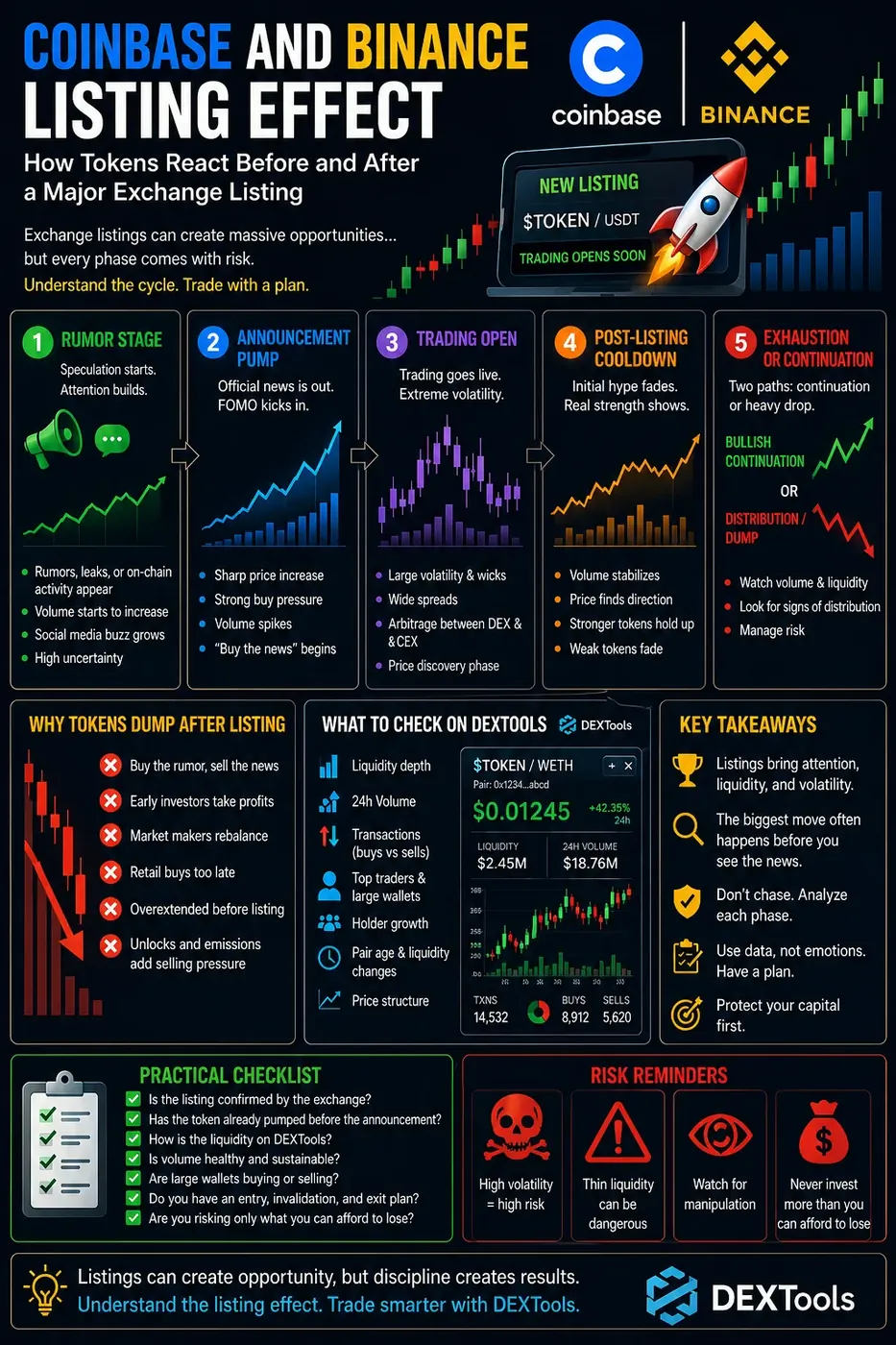
Phase 1: The Rumor Stage
Before a listing is confirmed, rumors may begin to spread. Traders may speculate based on wallet activity, exchange deposits, unusual volume, influencer posts, or hints from the project team.
During this phase, the token may experience sudden volume spikes, more buys from fresh wallets, faster price movement, increased social media mentions, chart breakouts without clear news, and new liquidity entering the pair.
The rumor stage is risky because nothing is confirmed. A token can rally on speculation and crash if the rumor turns out to be false. Traders should avoid assuming that unusual volume always means an exchange listing is coming.
Phase 2: The Announcement Pump
When a major exchange officially announces a listing, the token can move very quickly. Traders rush to buy because they expect new demand once trading opens.
The announcement pump often includes a rapid price increase, higher buy pressure, strong trending activity, large candles on the chart, new traders entering from social media, and increased liquidity on DEX pairs.
This is the moment when many traders feel the most FOMO. The problem is that the announcement may already be priced in. If insiders, early traders, or rumor buyers entered before the news, they may sell into the announcement.
Phase 3: The Trading Open
The actual opening of trading on a centralized exchange can be extremely volatile. Price may move sharply in both directions as order books form and market makers adjust liquidity.
At this stage, you may see large spreads, fast wicks, heavy arbitrage between DEX and CEX markets, sudden dumps after initial buys, price differences across exchanges, and high volume with unclear direction.
Traders should be careful during the first minutes of a new listing. Volatility can be intense, and a market order can fill at a worse price than expected.
Phase 4: The Post Listing Cooldown
After the initial excitement fades, the token enters the cooldown phase. This is where the real strength of the listing becomes clearer.
A healthy post listing phase may show stable liquidity, continued volume after the hype, higher holder count, less extreme volatility, support forming above pre listing levels, and organic social interest.
A weak post listing phase may show volume collapsing quickly, large holders selling, price returning to pre announcement levels, social interest fading, liquidity thinning out, and failed attempts to reclaim the announcement high.
The listing itself is not the full story. What happens after the first wave of hype often matters more.
Why Tokens Sometimes Dump After a Major Listing
Many traders assume that a Binance or Coinbase listing should make price go up. In reality, a listing can become a liquidity event for early buyers.
A post listing dump can happen because traders bought the rumor and sell the news, early holders use new liquidity to exit, market makers rebalance inventory, retail buyers arrive too late, the token was overextended before the listing, the announcement was already priced in, or unlocks and emissions create additional supply.
A listing increases access. It does not remove supply pressure.
How to Analyze a Token Before a Listing
If you think a token may be close to a major exchange listing, analyze the market carefully before entering.
Use DEXTools to check current liquidity, recent volume compared with normal volume, price trend before the rumor, number of transactions, buy and sell pressure, holder behavior, pair age, market cap relative to liquidity, and whether the token is already trending.
A token that has already moved hundreds of percent before confirmation may carry more risk than a token that is building slowly with healthy volume.
How to Analyze a Token After a Listing Announcement
After the announcement, do not look only at the green candle. Study the structure.
Ask whether the token was already pumping before the announcement, whether volume expanded naturally or in one violent spike, whether large wallets are selling into the news, whether liquidity is improving or weakening, whether price is holding above previous resistance, whether buyers are still active after the first candle, and whether social media is full of late FOMO.
The answer to these questions can help you decide whether the move still has strength or whether the market is close to exhaustion.
DEX vs CEX Price Differences
When a token is listed on a centralized exchange, price differences can appear between DEX and CEX markets. Arbitrage traders may buy on one venue and sell on another until prices align.
This can cause rapid DEX price movement even if you are not trading on the centralized exchange. Watch for sudden DEX volume increases, large swaps after the CEX listing opens, price gaps between markets, higher slippage, and fast liquidity changes.
If you trade only on decentralized exchanges, you still need to understand how centralized exchange listings affect DEX liquidity and price.
Common Mistakes Traders Make During Listing Hype
The listing effect is powerful because it triggers emotion. Common mistakes include buying immediately after a huge green candle, ignoring pre announcement price movement, assuming every listing creates a long term uptrend, trading with too much size during high volatility, not checking liquidity depth, ignoring large holder sells, confusing rumors with confirmed announcements, and holding without an exit plan.
A major listing can create opportunity, but it can also punish traders who chase blindly.
Practical Trading Checklist
Before trading a token around a major exchange listing, review this checklist.
Is the listing confirmed by the exchange? Has the token already pumped before the announcement? What is the current liquidity on DEXTools? Is volume still growing after the announcement? Are large holders buying, holding, or selling? Is price holding support or only creating wicks? Are you entering before, during, or after the main move? Do you have a clear invalidation level? Do you know where you would take profit? Are you risking only what you can afford to lose?
How Long Does the Listing Effect Last?
There is no fixed answer. Some tokens continue trending for days or weeks after a major listing. Others peak within minutes of the announcement.
The duration depends on market conditions, token narrative, liquidity depth, holder distribution, exchange size, broader crypto sentiment, supply unlocks, community strength, and whether the listing attracts long term buyers.
The best listings do more than create a short term candle. They increase access, improve liquidity, and support a stronger market structure.
Final Thoughts
The Coinbase and Binance listing effect is one of the most watched patterns in crypto trading. A major exchange listing can bring attention, liquidity, and volatility, but it does not guarantee a sustainable rally.
The smartest traders do not chase the headline alone. They study the full sequence: rumor, announcement, trading open, liquidity reaction, and post listing behavior.
Use DEXTools to monitor volume, liquidity, transactions, and price structure before and after the listing. The goal is not to predict every move perfectly. The goal is to avoid buying blindly when the market is already overheated.
What is the Coinbase and Binance listing effect?
It is the price, volume, and attention reaction that can happen when a token is listed on a major centralized exchange.
Do tokens always pump after a major exchange listing?
No. Some tokens pump, some dump, and some move in both directions. Many tokens sell off after the announcement because early buyers take profits.
What does buy the rumor, sell the news mean?
It means traders may buy before an expected announcement and sell once the news becomes public.
How can DEXTools help during a listing event?
DEXTools can help you track liquidity, volume, price movement, transactions, and pair activity on decentralized exchanges.
Is it safe to buy immediately after a listing announcement?
It can be risky because volatility is often high and price may already be extended. Always check liquidity, holder behavior, and market structure first.
How to Bridge Crypto Between Chains: Complete Cross-Chain Tutorial 2026 How to Use 1inch: Complete DEX Aggregator Swap Tutorial (2026) How to Use OKX Web3 Wallet: Multi-Chain DeFi Hub Guide (2026)Frequently Asked Questions
Q: How does a Coinbase listing typically affect a token's price?
A: A Coinbase listing often leads to a short-term price surge due to increased accessibility and perceived legitimacy. This effect can be more pronounced for smaller market cap tokens.
Q: What is the usual price reaction to a Binance listing?
A: Binance listings can also cause price increases, driven by its large user base and global reach. The impact may vary depending on the token's prior availability on other major exchanges.
Q: Are the listing effects from Coinbase and Binance sustainable long-term?
A: Initial listing pumps are frequently followed by price corrections as early investors take profits. Long-term price sustainability depends on the project's fundamentals, adoption, and market conditions.
Q: Does the size of the exchange matter for listing effects?
A: Listings on larger, more reputable exchanges like Coinbase and Binance generally have a greater immediate impact than listings on smaller platforms. This is due to their liquidity and user exposure.
Q: Can a token be listed on both Coinbase and Binance?
A: Yes, many tokens are listed on both Coinbase and Binance. The effect of a subsequent listing on the second exchange may be less dramatic than the initial major exchange listing.
Related Guides
- Send Crypto From Binance to Coinbase Wallet: 2026
- Binance vs Coinbase vs Kraken 2026: Fees, Features & Winner
- When DEX Liquidity Stops Representing the Main Market After a CEX Listing
- What Is wagmi: React Hooks, Wallet Connectors and EVM State (2026)
- How to Use Binance Exchange: Complete Tutorial (2026)