Crypto Phishing Email Patterns: 10 Core Red Flags
— By AliceOnChain in Tutorials

An operational security analysis decoding the structural engineering of modern cryptocurrency phishing campaigns, establishing an objective ten-point telemetry framework to identify and neutralize malicious email vector threats before wallet interaction.
https://www.dextools.io/app/token/dextoolsCrypto Phishing Email Patterns: 10 Red Flags
The decentralized economy has radically democratized capital allocation, but its non-custodial architecture places absolute security responsibility onto the individual asset manager. Because public block validation layers permanently record transactions, malicious threat groups cannot easily reverse engineered smart contract protections to steal funds. Instead, they weaponize social engineering vectors to trick users into surrendering their credentials.
Among these attack vectors, deceptive messaging remains the primary entry method for high-yield wallet-draining exploits. Analyzing Crypto Phishing Email Patterns: 10 Red Flags is a vital technical prerequisite for preserving your capital and maintaining a secure workflow.
Modern cryptographic exploit networks have evolved far beyond the crude, grammatically incorrect broad scams of the early internet era. Today, targeted operations utilize automated on-chain scraping engines to cross-reference public data, creating highly customized messages that mimic legitimate protocols. For market participants who monitor network health and active liquidity pools using tools like DEXTools, building a precise internal verification framework to filter these deceptive messages is an essential skill.
1. High-Urgency Account Security Hooks
Malicious communications are structurally engineered to bypass rational analytical scrutiny by triggering a chemical panic response. The subject lines and opening sections focus heavily on immediate account suspension risks, unverified security breaches, or compliance updates like the GENIUS Act rules. If an email claims your wallet infrastructure will be permanently frozen unless you execute an action within a narrow timeframe (such as 12 to 24 hours), it matches a textbook social engineering pattern.
2. Counterfeit RPC Node Network Warnings
A highly sophisticated indicator seen frequently involves fabricated technical warnings regarding remote procedure call (RPC) network configurations. The message may claim that the target blockchain network has updated its mainnet routing mechanics or experienced a major split, requiring you to update your wallet software or confirm your local RPC settings via a provided link. Legitimate blockchain networks never manage infrastructure shifts by reaching out directly to retail users through corporate email lists.
3. Homograph and Look-Alike Domain Masking
Exploit networks routinely register look-alike domains that replace standard alphanumeric characters with identical symbols from foreign character sets. For example, a lowercase "l" might be replaced with a numeric "1", or a Cyrillic character might swap out a standard Latin "e." While the sender banner on your mobile interface may look identical to a trusted entity like Paxos or PayPal, inspect the complete, raw mail transfer protocol (SMTP) headers to reveal the true originating routing domain.
4. Requests for Private Keys or Seed Phrases
No legitimate protocol, centralized exchange support team, or hardware wallet manufacturer will ever possess a technical reason to ask for your 12-to-24-word recovery seed phrase or your private key. The cryptographic architecture of private key generation is entirely one-way and local. If any communication asks you to type your recovery phrase into a verification portal or support form, the message is a fraudulent harvesting operation designed to compromise your master key.
5. Generic or Scraped On-Chain Salutations
While generic openings like "Dear User" remain common indicators of low-tier broad campaigns, contemporary operations often parse public ledger data to customize their messages. An exploit email might reference your exact public wallet address string or note a specific token balance you hold to create a false impression of authority. Legitimate financial entities do not combine your anonymous public ledger address with random, external direct messaging lists.
6. Blind Signing and Permit Signature Triggers
Deceptive emails rarely try to steal your assets via simple text instructions. Instead, they try to direct you toward a malicious web portal that triggers a blind-signing event or an exploit signature. When you connect your wallet to these counterfeit interfaces, the platform prompts you to confirm a transaction that looks like a harmless connection test, but is actually an EIP-2612 Permit command or an infinite allowance approval (approve(spender, 0xfff...)). Once signed, the exploit group can programmatically drain your balances.
7. Fabricated Air-Drop and Token Reward Allocations
The allure of unearned yield remains one of the most effective ways scams bypass a trader's risk parameters. These emails claim that your historic trading volume on platforms like Uniswap or your data monitoring frequency on tools like DEXTools has qualified you for an exclusive, high-value token air-drop. If the message requires you to claim these unexpected rewards by navigating to an external site and executing a transaction, it is an entry vector for a malicious wallet-draining script.
8. Mismatched Inbound and Outbound Hyperlinks
Before interacting with any link inside a crypto-related message, hover your cursor over the visual text to reveal the hidden destination URL preview. In phishing structures, the visual text may display a verified web address, but the underlying hyperlink points to an entirely different, unverified tracking domain or IP address. If the text link and the actual destination path do not match exactly, treat the communication as entirely compromised.
9. Corporate Brand Spoofing Without Multi-Factor Context
When centralized financial platforms or major payment giants send legitimate security changes, the notification occurs alongside context-rich multi-factor verification points. Phishing structures try to mimic official corporate styling by copying styling sheets and logos directly from official sites. However, they cannot replicate personalized anti-phishing phrases or security codes that you configure inside your verified account profile settings.
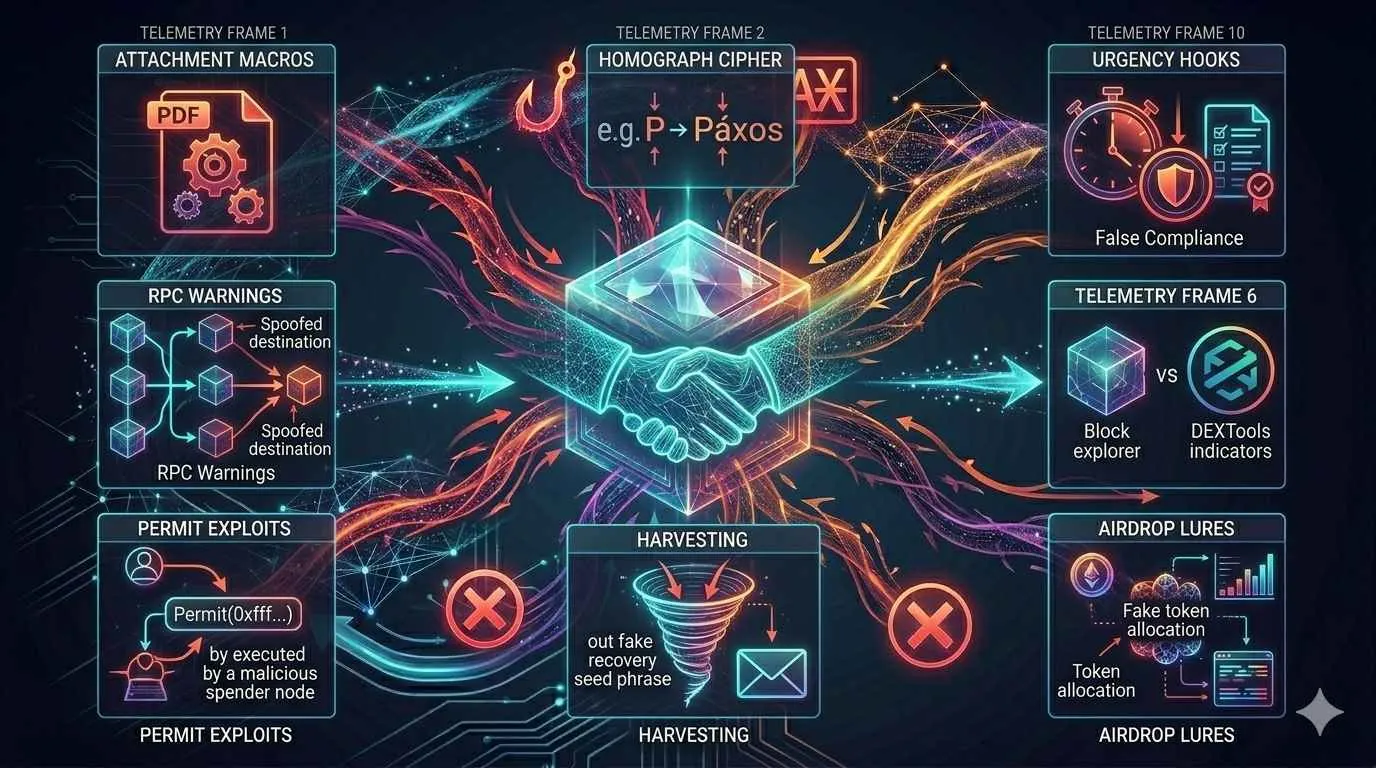
10. Attachment Injections and Malicious Macros
A final critical indicator is the inclusion of attached documentation, such as account statements, compliance forms, or token distribution spreadsheets. These files often utilize double extensions (e.g., statement.pdf.exe) or embed malicious macros designed to execute quietly in your operating system's background. Once activated, these malicious scripts can locate local keystroke logs, extract your browser extension wallet data, or capture locally stored secret files.
The Analytical Defense: On-Chain Verification Over Email
To insulate your capital from these persistent patterns, your primary defense tool is an analytical workflow that bypasses email links entirely. When you receive a critical security update or token reward alert, do not interact with the message interface. Instead, go directly to an independent blockchain analysis environment.
Verify the true state of the network by consulting primary data indices, inspecting verified token contract hashes via the DEXTools Pair Explorer, or reviewing direct announcements on the official developer repositories. If the public block explorer or native protocol dashboard does not actively show the event or require the requested update, you can safely delete the email, knowing you successfully neutralized a social engineering vector.
Conclusion: Developing an Institutional Defense Practice
Understanding Crypto Phishing Email Patterns: 10 Red Flags is an essential daily security practice for protecting non-custodial capital. Treat every inbound crypto message with systematic skepticism. By looking past surface-level branding, hunting for look-alike domains, avoiding unverified signature requests, and using independent data tools to audit any claims, you build a strong layer of defense around your digital infrastructure.
In a permissionless financial landscape, your ultimate security asset is your own technical vigilance. Implementing a strict verification-first routine ensures that your private keys remain secure and your portfolio is insulated from social engineering threats across the web3 ecosystem.
How to Bridge Crypto Between Chains: Complete Cross-Chain Tutorial 2026How to Use 1inch for Swaps: Classic, Fusion and Limit Orders (2026)
OKX Web3 Wallet Tutorial 2026: Multi-Chain Setup Guide
Disclaimer: This article is for informational purposes only and does not constitute investment advice, financial advice, trading advice, or any other kind of advice. DEXTools does not recommend buying, selling, or holding any cryptocurrency or token. Users should conduct their own research and consult with a qualified financial advisor before making any investment decisions. Cryptocurrency investments are volatile and high-risk. DEXTools is not responsible for any losses incurred.