Crypto Tax Calculation for DEX Swaps and LP Positions

Navigating DeFi tax compliance is an accounting minefield. We break down the exact frameworks for calculating capital gains and income from swaps and LP positions.
How to Calculate Crypto Taxes from On-Chain DEX Swaps and LP Positions
- The migration of trade volume from centralized platforms to decentralized financial (DeFi) networks has granted market participants unmatched custody and execution sovereignty. However, this architectural freedom introduces a severe operational headache when tax season arrives. Unlike centralized exchanges that compile clean, automated tax summaries or generic forms, decentralized applications operate entirely via anonymous, raw smart contract logic.
On-chain accounting means there is no corporate entity tracking your cost basis or reporting your transaction history.
- Every single token swap, liquidity provisioning loop, and yield harvest leaves a fragmented cryptographic footprint across the ledger. To maintain absolute compliance and protect your digital wealth from strict regulatory penalties, you must act as your own forensic accountant. This technical blueprint unbundles the tax classification frameworks, cost-basis calculations, and real-time telemetry checks required to reconcile DEX swaps and liquidity pool (LP) positions.
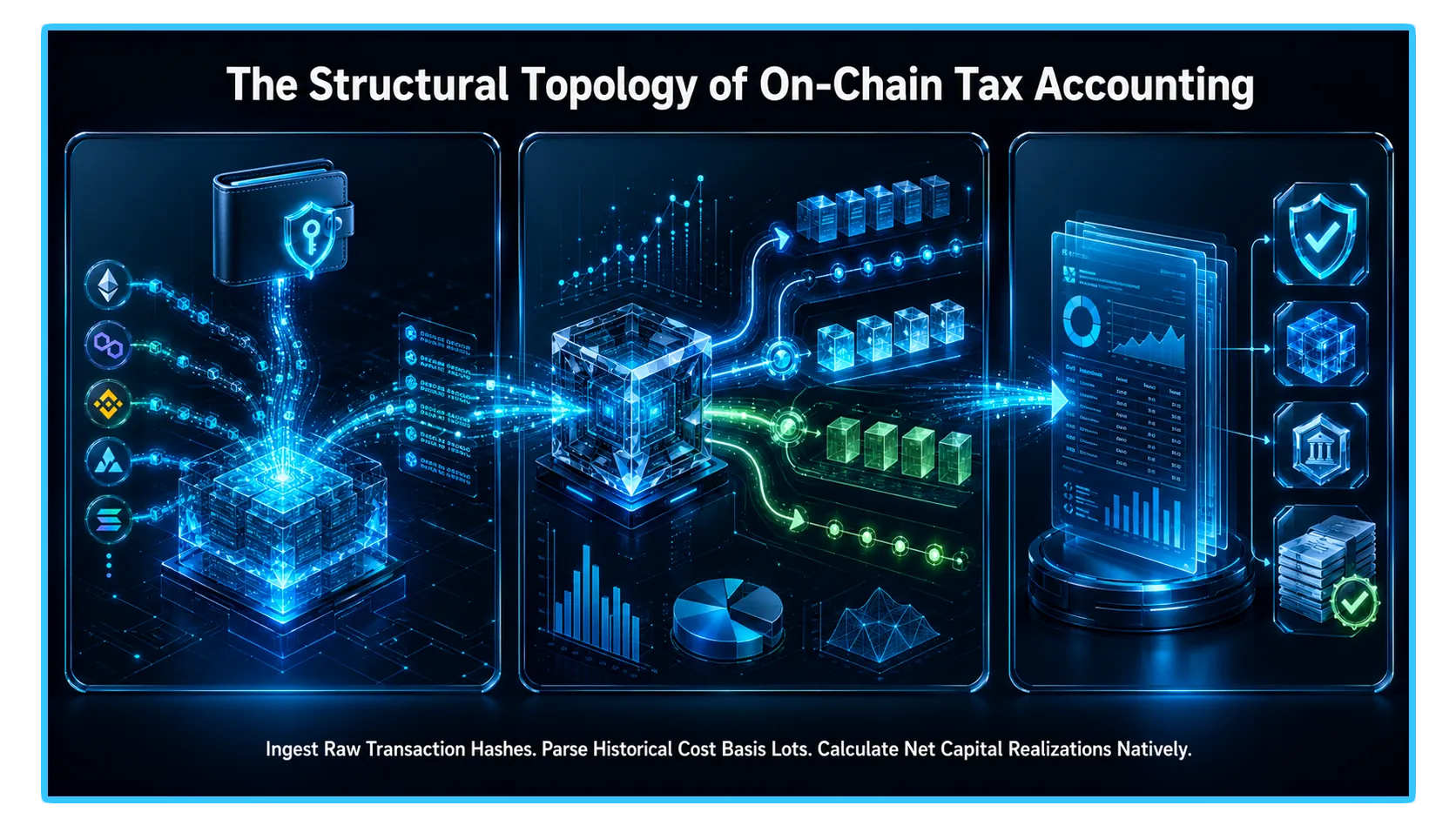
1. The Taxable Triggers: Evaluating On-Chain DEX Swaps
To evaluate decentralized transaction logs with professional accounting precision, you must strip away user-interface abstractions. Swapping Token A for Token B on an automated market maker (AMM) like Uniswap or Aerodrome is not a simple asset modification; it is a realization event.
Global tax authorities universally treat crypto-to-crypto swaps as a dual-action transaction lot:
The immediate disposition (sale) of your initial asset.
The simultaneous acquisition (purchase) of the secondary token.
The exact millisecond your transaction clears a block, you have triggered a taxable capital gains event. To determine your taxable exposure, you must convert the transaction value into your local fiat currency (e.g., USD or EUR) based on the exact fair market value of the assets at the precise block execution timestamp.
2. Deconstructing Liquidity Pool (LP) Positions: Income vs. Capital Gains
Provisioning assets to a concentrated or constant-product liquidity pool introduces complex multi-layered accounting challenges. Entering, holding, and exiting an LP position triggers distinct tax classifications that must be tracked independently.
The LP Token Dilemma: Token Entry and Exit
When you deposit a dual-asset pair into a liquidity pool, the smart contract factory issues you a fractional share receipt known as an LP token. Depending on your local regulatory jurisdiction, this structural shift can be interpreted in two ways:
The Non-Taxable Deposit Approach: The standard conservative interpretation treats the deposit as a simple change in asset vehicle, keeping your original cost basis intact until a final exit occurs.
The Barter Exchange Approach: Aggressive regulatory frameworks interpret surrendering your individual tokens for an LP token asset class as a taxable crypto-to-crypto exchange, immediately triggering capital gains liabilities based on the fair market value changes of the assets upon entry.
Harvested Fees and Dynamic Rebalancing
- The yield generated by your active LP positions is subjected to strict Income Crypto Tax parameters. If your pool choice natively accumulates trading fees that require manual harvesting, each claim event represents immediate gross income valued at the fair market price upon block arrival.
Furthermore, if you are utilizing a concentrated liquidity pool, the AMM's automated internal swaps, which constantly rebalance your token ratio as the spot price trends across your ticks: can register as microscopic, automated capital realization events, creating thousands of data rows that must be accounted for cleanly.
3. The Component Grid: DeFi Tax Accounting Parameters
To maintain a clean structural mapping of how different decentralized actions alter your tax compliance ledger, analyze the core performance categories organized inside this standardized layout:
| DeFi Transaction Type | Primary Tax Classification | Core Accounting Ledger Impact |
| DEX Token-to-Token Swap | Capital Gains / Losses | Triggers an immediate realization event based onpot value differentials. |
| LP Capital Entry / Exit | Capital Transformation | Tracks cost-basis migration or registers as an active crypto-to-crypto exchange lot. |
| Claimed Trading Fees | Ordinary Gross Income | Values token earnings at fair market price upon block arrival execution timestamps. |
| Impermanent Loss Event | Capital Loss Realization | Decreases net capital gains liabilities only upon final pool exit and asset liquidation. |
4. Calculating Cost Basis and Gains Math
Where Gross Proceeds equals the fair market fiat value of the asset at the moment of the taxable swap, and Cost Basis represents the total capital spent to acquire that specific asset lot initially, including any historical network gas fees incurred during the original purchase block.
To track how cost-basis layers migrate across your historical wallet transactions, you must choose a standard accounting methodology:
FIFO (First-In, First-Out): The default regulatory baseline. The oldest token lots you purchased are programmatically treated as the first assets sold or swapped, which can increase tax liabilities during prolonged multi-year bull market trends.
HIFO (Highest-In, First-Out): The most capital-efficient strategy for active momentum traders. This method automatically pairs your highest-priced acquisition lots against your current sales proceeds, systematically minimizing your net short-term capital gains exposure.
5. Real-Time Telemetry and Accounting Diagnostics via DEXTools
- Formulating a flawless, bulletproof tax accounting report requires access to absolute, historical on-chain telemetry data. While automated sub-graph portfolio tools attempt to read your transaction logs retroactively, they frequently hallucinate or fail to map values accurately during complex multi-chain liquidity migrations, oracle de-pegs, or low-liquidity token launches.
- DEXTools provides the critical analytical data infrastructure needed to verify these data parameters in real-time. By utilizing advanced pair explorers, historical transaction ledgers, and look-through wallet telemetry across alternative layer scaling ecosystems, market participants can independently verify the exact fair market value of any asset at the precise block timestamp of execution.
- Cross-referencing your automated tax software diagnostics with authentic, non-manipulated blockchain telemetry ensures your portfolio parameters remain completely optimized, keeping your financial records completely insulated from audit discrepancies or unexpected tax penalties.
You can access DEXTools here and start trading today!
Crypto Cost Basis method: FIFO vs. Specific ID What Is Cost Basis in Crypto? Tax Guide (2026) How to Read On-Chain Data: Metrics, Wallet Flows and Dashboards (2026) Crypto Tax Loss Harvesting: Sell Low, Rebuy LegallyDisclaimer: This article is for informational purposes only and does not constitute investment advice, financial advice, trading advice, or any other kind of advice. DEXTools does not recommend buying, selling, or holding any cryptocurrency or token. Users should conduct their own research and consult with a qualified financial advisor before making any investment decisions. Cryptocurrency investments are volatile and high-risk. DEXTools is not responsible for any losses incurred.