Crypto.com App vs Exchange: Which to Use for Trading
— By AliceOnChain in Tutorials

An advanced structural comparison between the Crypto.com App brokerage model and the Crypto.com Exchange matching engine, detailing how fee mechanics, order types, and liquidity dynamics impact real-world trading performance.
Crypto.com App vs Exchange: Which to Use
Navigating the digital asset ecosystem requires selecting the appropriate infrastructure for execution. For users within the Crypto.com ecosystem, this choice frequently comes down to a fundamental dilemma: the Crypto.com App vs Exchange. While they share an institutional custodian and unified brand ecosystem, they represent completely different execution environments designed for entirely different market behaviors.
Choosing the incorrect interface can significantly impact capital efficiency, execution slippage, and overall trading performance. For retail market participants transitioning from basic spot purchasing to active trading-including volatile sectors like on-chain liquidity pools, decentralized finance (DeFi) tokens, and high-velocity micro-cap assets-understanding the structural differences of the Crypto.com App vs Exchange is paramount.
The Structural Blueprint: Retail Gateway vs. Institutional Order Book
To understand which to use between the Crypto.com App vs Exchange, one must first analyze the technical architecture underpinning both environments. The distinction lies in how trades are routed, cleared, and settled.
The Crypto.com App: A Closed Brokerage Model
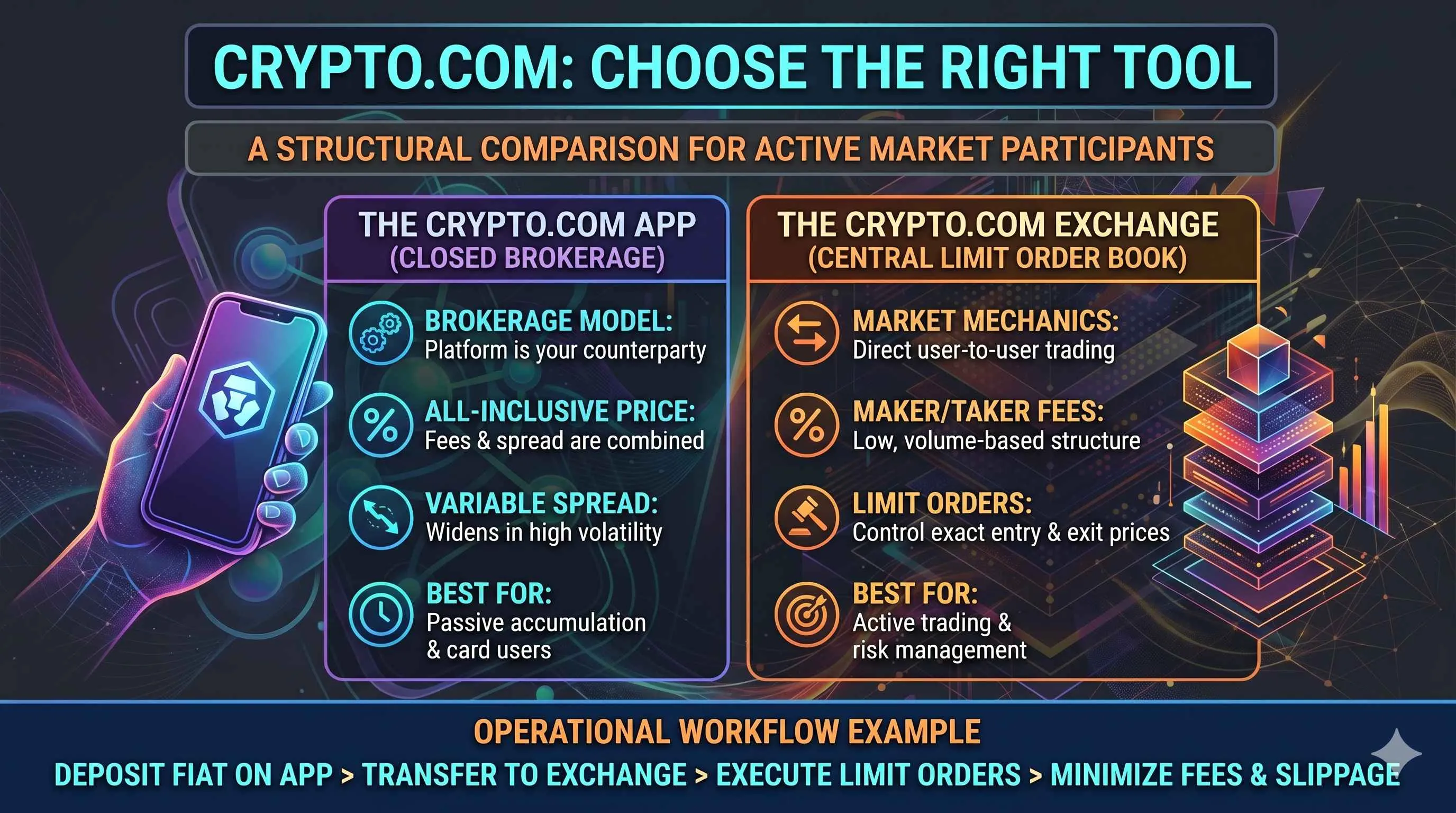
The Crypto.com App operates primarily as a simplified brokerage interface. When analyzing the Crypto.com App vs Exchange mechanics, it becomes clear that in the app, the user is not interacting with a live, peer-to-peer matching engine. Instead, Crypto.com acts as the direct counterparty, quoting a single "all-inclusive" price.
This model is optimized for accessibility and rapid onboarding. Users can fund accounts via local fiat rails, debit cards, or bank transfers and acquire assets within seconds. However, this convenience introduces a significant financial trade-off: spread and liquidity buffers. Because the platform guarantees execution at the quoted price during volatile intervals, it embeds a variable premium into the buy and sell rates. For passive, long-term market participants purchasing major blue-chip assets, this structural premium may be acceptable, though less efficient than a dedicated order-book environment.
The Crypto.com Exchange: A High-Throughput Matching Engine
Conversely, the Crypto.com Exchange is a dedicated trading platform powered by a high-throughput central limit order book (CLOB). Here, market participants interact directly with other buyers and sellers globally, showcasing the core structural contrast when evaluating the Crypto.com App vs Exchange. Price discovery is completely organic, driven by real-time supply and demand imbalances across localized liquidity pairs.
Instead of accepting a single broker-determined quote, users of the centralized trading platform utilize advanced order types-such as limit orders, stop-limits, and trailing stops-to dictate exactly how much slippage or premium they are willing to tolerate. The platform operates on a transparent maker-taker fee schedule that scales downward based on 30-day trading volume and native utility token staking. This makes it the mathematically logical choice for capital deployment, risk mitigation, and high-frequency portfolio adjustments.
Liquidity Architecture, Execution Mechanics, and Slippage
In any digital asset strategy-whether tracking macro reversals on established assets or hunting for micro-cap breakouts via on-chain data tools like DEXTools-liquidity and execution mechanics determine profitability. Looking at the Crypto.com App vs Exchange dynamic reveals how deeply infrastructure affects your execution costs.
Deciphering the Cost of Execution
When trading on the smartphone application, users frequently notice a discrepancy between the spot price displayed on market tracking sites and the final execution price shown on their confirmation screens. This variance is not a standard trading fee; it is the spread. In low-liquidity conditions or periods of extreme market volatility, the app’s algorithm expands this spread to insulate the brokerage from rapid price shifts.
On the order-book platform, the spread is determined purely by the market's depth-specifically, the distance between the highest bid and the lowest ask on the order book. When comparing the Crypto.com App vs Exchange spread models, the latter allows traders to inspect depth charts, monitor real-time volume fluctuations, and place resting limit orders within the order book. This structure eliminates unexpected execution premiums, enabling precise capital positioning.
Bridging Centralized Venues with On-Chain Realities
For modern tactical traders, centralized environments do not exist in a vacuum. Market trends often originate on decentralized networks, where early-stage assets launch directly into automated market maker (AMM) liquidity pairs. Analytical tools like the DEXTools Pair Explorer show that early whale activity, volume spikes, and shifting holder distributions on decentralized protocols often serve as leading indicators for broader centralized market movements.
When an asset experiences an on-chain breakout, a trader’s choice between the Crypto.com App vs Exchange dictates how effectively they can capitalize on that momentum:
Using the App for High-Volatility Assets: Attempting to trade highly volatile tokens or recently listed assets via a standard app interface can expose capital to severe slippage. Because the brokerage model struggles to quote real-time prices during parabolic expansions or cascading sell-offs, the spread can widen drastically, eating into realized gains.
Leveraging the Exchange for Systematic Execution: Choosing the centralized trading venue allows traders to set precise limit orders ahead of market moves. For instance, if on-chain monitoring tools indicate a massive divergence between decentralized pools and centralized order books, a trader can execute precise arbitrage or localized risk reduction using the platform's granular interface.
Advanced Risk Management and Order Type Execution
Strategic market participation requires robust downside protection. The ability to preserve capital during systemic liquidations is what separates professional traders from retail speculation, highlighting another critical division in the Crypto.com App vs Exchange comparison.
Order Type Granularity
The risk management capabilities of the basic brokerage app are inherently limited. It supports basic market buys, market sells, and scheduled recurring purchases. While suitable for basic accumulation strategies, it lacks the mechanisms required to defend capital against sudden market drawdowns.
Evaluating the Crypto.com App vs Exchange features highlights that the dedicated trading desk provides a full suite of algorithmic risk management tools:
Limit Orders: Ensure capital enters or exits the market only at a pre-specified price or better, completely eliminating execution slippage.
Stop-Loss Orders: Automatically trigger a market sell if an asset breaches a structural support level, preventing a minor drawdown from turning into a catastrophic portfolio impairment.
Take-Profit Limits: Automate profit harvesting at pre-calculated technical resistance levels, ensuring gains are secured without requiring constant manual oversight.
Integrating Technical and On-Chain Safeguards
Advanced traders often combine centralized order book automation with external analytical frameworks. By cross-referencing order book depth on the spot and derivatives market with on-chain health indicators on DEXTools-such as live liquidity tracking, holder concentration metrics, and verified contract security assessments-traders can construct highly resilient execution loops.
For example, if DEXTools charts signal a structural break in an asset's decentralized liquidity distribution or an abrupt shift in whale wallet concentration, a proactive trader navigating the Crypto.com App vs Exchange ecosystem can immediately deploy resting stop-limit orders on the professional interface to secure their exposure before the on-chain sell-off cascades into centralized order books.
Fee Structures and Capital Optimization
Fees represent a permanent friction point in capital growth. Minimizing these operational costs is critical for anyone executing multiple trades per month, making the fee discrepancy a defining factor in the Crypto.com App vs Exchange selection.
The retail app utilizes an opaque pricing structure where trading fees are largely generalized within the quoted asset price. Additionally, credit/debit card funding methods can incur steep transaction percentages, making regular capital deployment via the App highly inefficient.
The professional order-book platform operates on an industry-standard Maker/Taker model. A "Maker" order adds liquidity to the order book (e.g., a resting limit order), while a "Taker" order removes liquidity from the order book (e.g., an immediate market order).
Maker Fees: Generally lower, rewarding traders for adding structural depth to the book.
Taker Fees: Slightly higher, reflecting the immediate consumption of available liquidity.
By shifting active trading volume away from brokerage apps and onto central limit order books, participants analyzing the Crypto.com App vs Exchange cost-effectiveness can reduce their transaction overhead by up to 80-90%, preserving essential capital for active market allocation.
Comparative Assessment: When to Use Each Interface
To streamline your operational workflow within the broader ecosystem, use this analytical guide to determine which platform aligns with specific transactional intents.
When to Use the Crypto.com App
Fiat On-Ramping and Off-Ramping: The application excels as a capital gateway, offering direct connections to traditional banking networks for seamless fiat deposits or local currency withdrawals.
Passive Long-Term Accumulation: For individuals executing basic asset accumulation strategies over multi-year horizons where minor execution spreads are neutralized by long-term holding targets.
Ecosystem Utility Access: Utilizing peripheral products like the Crypto.com Visa Card, crypto-backed borrowing features, or localized reward spending.
When to Use the Crypto.com Exchange
Active Trading and Scalping: Mandatory for any strategy involving technical analysis, short-term price action tracking, or rapid position adjustments.
Advanced Risk Management: Essential when positions require automated stop-loss protections, trailing safeguards, or multi-tiered take-profit targets.
High-Volume Execution: Crucial for managing larger capital allocations where fractional percentages in spread or maker-taker discrepancies equate to significant nominal capital sums.
Ecosystem Cross-Analysis: Ideal for traders who complement their centralized order book execution with advanced on-chain analysis-using tools like DEXTools price alerts, holder analysis, and real-time token tracking to spot broader market rotations early.
Conclusion: Maximizing Trading Performance
Ultimately, the Crypto.com App vs Exchange debate reveals that these are not competing products, but rather complementary tools designed for different phases of a digital asset workflow. The mobile app serves as an excellent gateway for capital custody, fiat management, and basic ecosystem access. However, for actual market execution, the advanced matching engine is the superior infrastructure, providing the liquidity depth, transparent pricing, and advanced risk controls necessary to navigate modern markets successfully.
By pairing the institutional execution capabilities of a central limit order book with the real-time, decentralized insights provided by on-chain analysis platforms like DEXTools, market participants can approach the crypto landscape with institutional-grade precision, minimizing structural friction while maximizing capital efficiency.
- How to Bridge Crypto Between Chains: Complete Cross-Chain Tutorial 2026
- How to Use 1inch for Swaps: Classic, Fusion and Limit Orders (2026)
- OKX Web3 Wallet Tutorial 2026: Multi-Chain Setup Guide
Disclaimer: This article is for informational purposes only and does not constitute investment advice, financial advice, trading advice, or any other kind of advice. DEXTools does not recommend buying, selling, or holding any cryptocurrency or token. Users should conduct their own research and consult with a qualified financial advisor before making any investment decisions. Cryptocurrency investments are volatile and high-risk. DEXTools is not responsible for any losses incurred.
Related Guides
- How to Use Crypto.com: Complete Exchange and App Tutorial (2026)
- TON Terminal: Complete Guide to Not.Trade - The Fastest TON Trading App (2026)
- OKX Exchange Tutorial 2026: Trading + Fee Discount Guide
- How to Use MEXC Exchange: Trading Guide 2026
- How to Use KuCoin: Complete Trading Guide 2026
Frequently Asked Questions
What is the difference between the Crypto.com App and the Exchange?
The Crypto.com App is designed as a simple brokerage-style product for buying and selling crypto, while the Exchange offers a full trading platform with an order book. The App prioritizes ease of use and the Exchange targets more active traders.
Which has lower fees, the App or the Exchange?
Exchange platforms with order-book matching often have lower trading fees than simplified brokerage apps. Actual costs depend on the current fee schedule and your trading volume, so review up-to-date terms.
What order types are available on the Exchange?
Order-book exchanges typically support order types like market and limit orders, giving traders more control over execution. Simplified apps usually offer fewer options focused on instant buying and selling.
Should beginners use the App or the Exchange?
Beginners often find a brokerage-style app easier because the interface is streamlined for quick purchases. More experienced traders may prefer the Exchange for its advanced tools and liquidity.