DAO Governance Models: Token, Quadratic & Conviction Voting
— By AliceOnChain in Tutorials

An advanced guide into decentralized governance mechanics. Explore how different voting structures shape tokenomics, market sentiment, and liquidity risk, and how to analyze these movements using DEXTools.
DAO Governance Models: Token, Quadratic, and Conviction Voting
The evolution of decentralized finance (DeFi) has shifted the focus of market participants from simple price speculation to the underlying structures that dictate protocol upgrades, treasury allocations, and risk parameters. Decentralized Autonomous Organizations (DAOs) rely on programmatic governance frameworks to coordinate decisions without centralized intermediaries. For the intermediate on-chain analyst or retail trader, understanding these structural models is not just an academic exercise; it is a fundamental prerequisite for managing protocol-specific risk.
Changes in a protocol’s governance structure often precede major shifts in on-chain variables such as liquidity depth, volume velocity, and token distribution patterns. By monitoring how capital interacts with governance proposals, market participants can better understand protocol health and potential volatility before it manifests on a candlestick chart.
1. Token-Weighted Voting: The Standard Capital-Centric Model
The most widespread implementation of decentralized decision-making is the token-weighted model, often summarized as "one token, one vote." In this ecosystem, a participant's voting power is directly proportional to the number of governance tokens they hold or have delegated to a representative.
The Structural Mechanics and Incentives
From a technical standpoint, token-weighted voting aligns governance weight with financial exposure. The core thesis posits that entities with the largest capital allocation have the greatest incentive to ensure the protocol’s long-term viability. When a critical proposal goes live—such as adjusting a lending platform's collateral parameters or modifying trading fees—holders use their native assets to sign transactions that approve or reject the change.
On-Chain Distortions and Whale Influence
While intuitive, token-weighted systems are highly susceptible to plutocratic dynamics. A concentrated holder distribution can lead to a scenario where a small group of whales dictates protocol direction, occasionally prioritizing short-term liquidity extraction over sustainable growth.
When analyzing protocols with token-weighted models on DEXTools, keeping a close eye on the Pair Explorer and Holder Analysis features becomes essential. A sudden centralization of supply in a few wallets may signal that governance is vulnerable to capture. If a whale wallet accumulates a large position, it can skew voting outcomes entirely, which sometimes leads to sudden capital flight from the protocol's pools if retail participants lose confidence in the system's decentralization.
2. Quadratic Voting: Diluting Plutocracy with Sybil Resistance
To mitigate the disproportionate influence of concentrated capital, several modern DAOs utilize quadratic voting. This framework shifts the focus from the sheer volume of tokens held to the total number of unique participants supporting a decision.
The Mathematical Framework
In a quadratic voting system, the cost of casting additional votes for a single proposal increases quadratically rather than linearly. The relationship between voting power and token cost follows a specific formula:
1 Vote requires 1 Token
2 Votes require 4 Tokens
3 Votes require 9 Tokens
4 Votes require 16 Tokens
This exponential cost curve ensures that while a major token holder can still exert significant influence, doing so becomes prohibitively expensive. It effectively gives a broad coalition of smaller retail holders the mathematical leverage to outvote a single monolithic entity.
Analytical Indicators and Market Implications
Implementing quadratic voting often changes the distribution dynamics of a governance token. Because hoarding massive quantities in a single wallet yields diminishing returns in terms of voting power, whales may distribute their assets or retail accumulation may become more pronounced.
Using the Holder Analysis and Bubblemaps integration on DEXTools helps analysts visualize these dynamics. In a protocol running quadratic governance, an ideal healthy structure often looks like a highly fragmented web of independent wallets rather than tight clusters controlled by a single entity. If a protocol claims to use quadratic voting but the on-chain data reveals a highly concentrated token distribution, it could indicate that the system is vulnerable to Sybil attacks—where a single entity splits their funds across hundreds of derivative wallets to bypass the quadratic cost curve.
3. Conviction Voting: Time-Weighted Consensus and Continuous Governance
Unlike traditional discrete voting mechanisms that rely on rigid start and end times, conviction voting introduces a continuous, real-time approach to decentralized decision-making.
How Conviction Accumulates Over Time
In a conviction voting system, members express their preference for specific proposals by staking their tokens toward them. Instead of counting votes at a specific snapshot, the system measures the length of time those tokens remain staked. The "conviction" or voting weight grows exponentially the longer capital is committed to a proposal.
If a user removes their tokens or shifts them to a different proposal, their accumulated conviction drops significantly. This structure prevents wealthy entities from purchasing a massive amount of liquidity right before a vote, tilting the outcome, and immediately dumping the tokens back into the market.
Tracking Governance Commitment via On-Chain Metrics
Conviction voting alters market behavior and liquidity dynamics. Because tokens must be locked or committed continuously to maintain influence, a significant portion of the circulating supply is frequently removed from active trading venues.
When conducting an analysis on DEXTools, this dynamic can be cross-referenced by checking the relationship between trading volume, available liquidity, and price action. A successful conviction voting proposal that locks up substantial token supply typically results in a reduction of active circulating tokens on decentralized exchanges. If this lockup coincides with steady or rising market sentiment, the reduced sell-side pressure can alter volatility profiles. Conversely, if a major proposal loses momentum and users withdraw their conviction, a sudden influx of tokens back into the Pair Explorer can precede a spike in volatility and a shifting Relative Strength Index (RSI).
4. Advanced Tutorial: Analyzing Governance Actions on DEXTools
A trader or analyst can cross-reference active governance proposals with real-time on-chain data to identify shifts in protocol health and liquidity risk.
Step 1: Establish the Baseline via Holder Distribution
Before a vote occurs, navigate to the DEXTools Pair Explorer for the target token. Open the Holder Analysis tool to evaluate the concentration of the supply. Look for the percentage of tokens held by the top 10 and top 50 wallets, excluding known protocol contracts like vesting escrows or bridge pools. A highly concentrated supply in a token-weighted DAO indicates a higher risk of centralized decision-making.
Step 2: Monitor Volume and Liquidity Tracking During Active Proposals
When an impactful governance proposal is introduced, monitor the pool's liquidity depth and trading volume. Significant adjustments to a protocol often cause institutional liquidity providers to hedge their positions. If liquidity tracking reveals a steady drop in the pool's total value locked (TVL) while trading volume increases, it may indicate that market participants are de-risking ahead of the vote's execution.
Step 3: Identify Strategic Accumulation or Distribution
Whales frequently accumulate tokens ahead of critical votes to sway the outcome or distribute them immediately afterward. Track the "Top Traders" tab on DEXTools to see if smart money wallets are actively buying or selling the asset during the voting window. A cluster of large buy orders paired with an RSI divergence in oversold or overbought territory can signal that a governance-driven move is underway.
Step 4: Utilize Price Alerts for Governance Execution
Once a proposal passes, its implementation can cause sudden changes in protocol mechanics. Set automated Price Alerts on DEXTools around key support and resistance levels. If the execution of a governance proposal goes poorly or creates unforeseen smart contract vulnerabilities, breaking these technical levels on high volume provides a clear indicator of shifting market consensus.
5. Comparative Evaluation of Governance Models
Each model offers unique tradeoffs that directly impact the underlying asset's market profile and tokenomics.
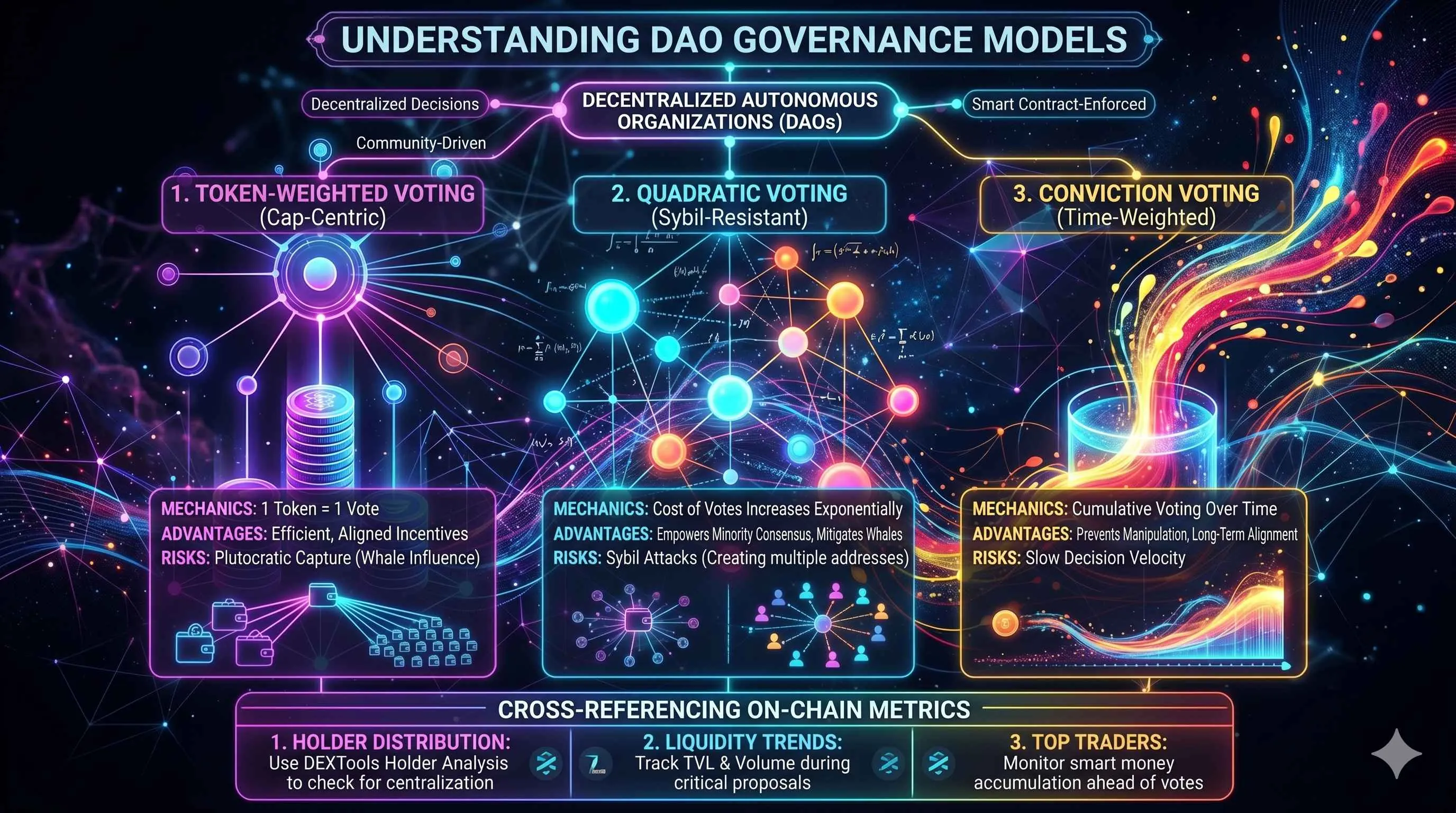
Token-Weighted Voting features low technical complexity and high execution speed, making it highly efficient for fast-moving protocols. However, its vulnerability to plutocratic capture is exceptionally high, which often manifests as sudden whale-driven volatility on the charts.
Quadratic Voting provides excellent mitigation against whale dominance, balancing the playing field for retail participants. Its primary risk lies in its high vulnerability to Sybil attacks, requiring advanced identity verification or sophisticated on-chain behavioral analysis to ensure validity.
Conviction Voting excels at preventing flash-loan attacks and sudden governance manipulation, promoting long-term alignment among participants. The main tradeoff is slower decision-making velocity, which can hinder a protocol's ability to react quickly during black swan market events or systemic crises.
Conclusion: Governance as a Core Pillar of Risk Management
Evaluating DAO governance models is an essential component of comprehensive fundamental and on-chain analysis. Whether a protocol implements token-weighted, quadratic, or conviction voting dictates how its native token behaves under macroeconomic stress and structural upgrades.
By integrating governance tracking with the real-time analytical features available on DEXTools—such as liquidity monitoring, holder distribution mapping, and volume analysis—market participants can look past basic sentiment and base their strategies on quantifiable on-chain realities. Managing risk effectively requires recognizing that governance parameters are just as vital to a protocol's survival as its code integrity and liquidity depth.
DAO: Decentralized Autonomous Organizations ExplainedGovernance Quorum vs Whale Voting: How DAO Control Risk Affects Tokenholders
What Is Snapshot: Complete DAO Governance Voting Guide
How Do DAOs Work? Governance, Treasury and Voting Explained
Disclaimer: This article is for informational purposes only and does not constitute investment advice, financial advice, trading advice, or any other kind of advice. DEXTools does not recommend buying, selling, or holding any cryptocurrency or token. Users should conduct their own research and consult with a qualified financial advisor before making any investment decisions. Cryptocurrency investments are volatile and high-risk. DEXTools is not responsible for any losses incurred.