ERC-4337 Account Abstraction: How Smart Wallets Work

Traditional EOA wallets lock users into rigid seed phrases and strict native gas requirements. We break down the cryptographic execution layers powering programmable smart wallets.
The Legacy Constraint: The Monolithic EOA Bottleneck
- Since the inception of the Ethereum network, user access has been fundamentally limited by the architecture of Externally Owned Accounts (EOAs). An EOA (the standard wallet structure utilized by applications like MetaMask) unifies two entirely separate concepts into a single entity: the account balance (where your assets are stored) and the private key (the cryptographic signer that controls those assets).
- This monolithic configuration creates a severe user experience bottleneck. If a user misplaces their physical seed phrase or signs a single malicious transaction, their entire account is instantly compromised with zero recourse. Furthermore, EOAs cannot natively automate tasks, batch transactions, or execute actions without holding native ETH to pay for network gas fees.
- ERC-4337 Account Abstraction completely breaks this coupling. Rather than modifying Ethereum’s core consensus layer via high-risk hard forks, ERC-4337 introduces a specialized developer standard that transforms standard user accounts into programmable Smart Contract Wallets. By converting user intent into off-chain message wrappers and routing execution through a dedicated transaction pipeline, account abstraction delivers an enterprise-ready user experience featuring multi-key security permissions, gas sponsorship frameworks, and seamless recovery mechanisms.
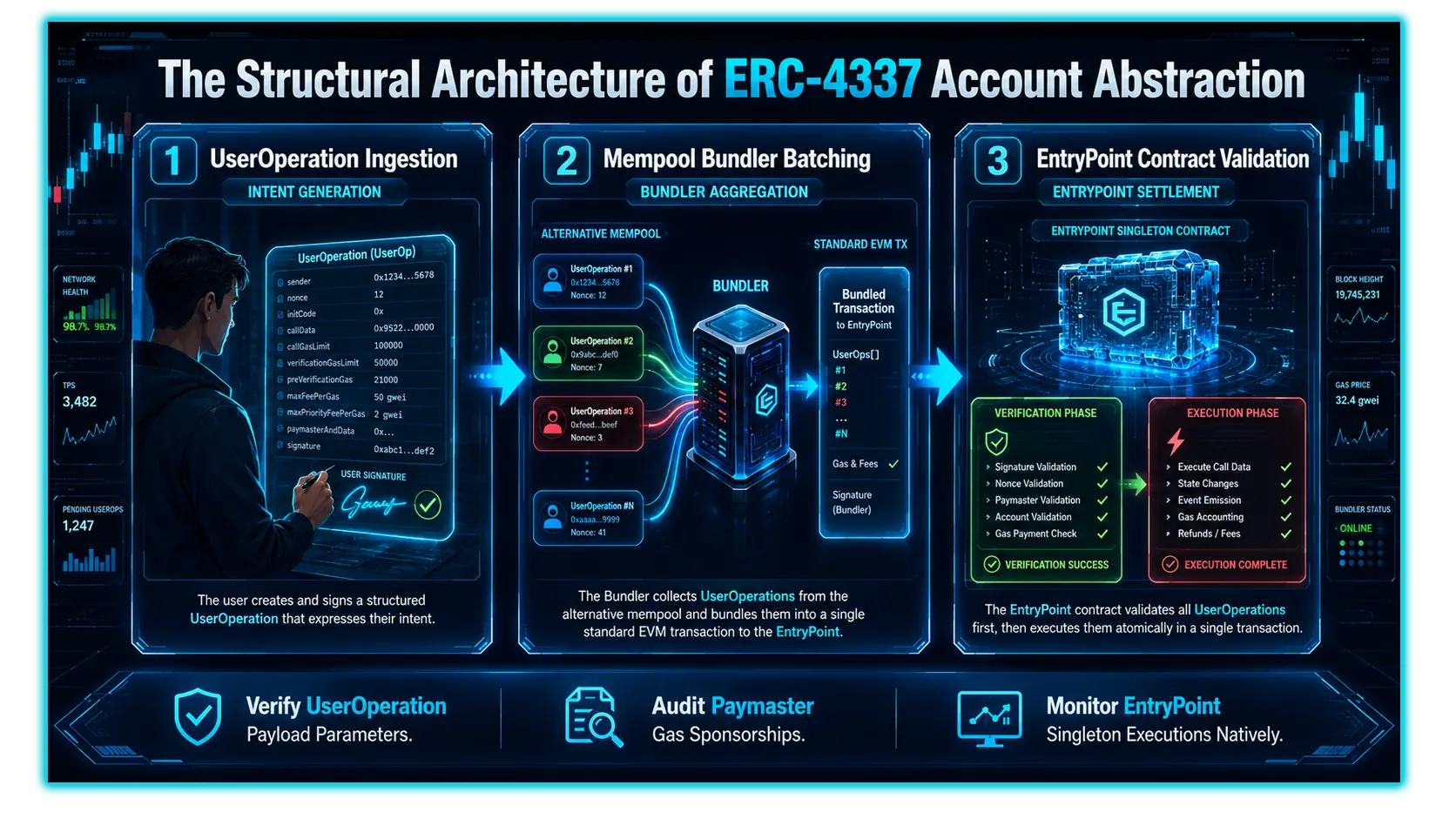
1. The UserOperation (UserOp): Bypassing Native Transactions
In a traditional EOA setup, every user interaction requires broadcasting a standard EVM transaction object containing rigid fields like nonce, gasPrice, and a direct cryptographic ECDSA signature.
ERC-4337 completely bypasses this constraint by introducing a pseudo-transaction object known as a UserOperation (UserOp).
Instead of forcing a user to broadcast a raw ledger transaction, a smart wallet client generates a structured UserOp data container that describes the user's explicit operational intent. A UserOp includes unique specialized fields:
sender: The target address of the user's smart contract wallet.callData: The exact execution instructions being sent to the wallet (e.g., swapping tokens or interacting with a dApp).nonce: An abstracted tracking parameter that enables custom parallel transaction processing.paymasterAndData: An optional parameter slot that specifies third-party fee sponsorship rules.
2. The Infrastructure Layer: Bundlers and the Alt Mempool
Because the native Ethereum network cannot directly parse or execute a UserOperation object, these payloads do not enter the traditional public mempool. Instead, they travel through a dedicated, isolated channel called the Alternative Mempool (Alt Mempool).
Specialized node operators known as Bundlers monitor the alt mempool. Bundlers fulfill a critical infrastructural translation role:
Aggregation & Batching: A bundler collects multiple independent UserOperations from the alt mempool and packages them together into a single, standard EVM transaction.
Base Layer Settlement: The bundler pays the native blockchain gas fees upfront out of their own wallet to execute the master batch transaction on the underlying base ledger.
The Revenue Spread: To remain profitable, the bundler charges the individual smart wallets a corresponding gas fee inside the transaction loop, capturing a financial spread for providing processing services.
3. The Gatekeeper: The EntryPoint Singleton Contract
To protect the network from Denial of Service (DoS) attacks and ensure that rogue user operations cannot drain a bundler's capital, every bundled transaction is routed through a single, highly audited global smart contract known as the EntryPoint.
The EntryPoint contract acts as a central orchestrator, executing every bundled transaction in two strictly separated phases:
The Verification Phase
- The EntryPoint loops through each UserOperation in the batch, calling the
validateUserOpfunction built into the user's specific smart wallet. This phase checks that the operation's signature is valid and verifies that the smart wallet holds sufficient funds to reimburse the bundler for the upcoming gas costs. If any single validation check fails, the EntryPoint instantly drops the operation before executing any heavy code, protecting the system from empty computational spam.
The Execution Phase
- Once all operations in the batch are safely verified, the EntryPoint triggers the
executephase. It unpacks thecallDatapayloads and forwards the instructions directly to each user's smart contract account, prompting the wallets to execute their targeted smart contract actions (such as minting an NFT or liquidity mining) while transferring the computed gas reimbursement back to the bundler.
4. The Sponsorship Engine: Paymasters and Gasless UX on ERC-4337
One of the most powerful consumer-facing primitives unlocked by ERC-4337 is the introduction of Paymasters. A Paymaster is an external smart contract asset pool that handles the gas reimbursement mechanics for a UserOperation.
Gas Abstraction Integration: By populating the
paymasterAndDatafield inside a UserOp, developers can decouple the transaction execution from the requirement of owning native gas tokens.
Paymasters operate through two primary models:
Gas Sponsorship (Gasless Transactions): Application developers can choose to fully subsidize user interactions. When a user executes a trade or mints an asset, the Paymaster contract intercepts the EntryPoint fee request and pays the bundler directly, allowing retail users to interact with Web3 applications for free.
ERC-20 Gas Payment Abstraction: A Paymaster can be configured to accept alternative tokens as fee payment. If a user holds zero native ETH but possesses a stablecoin balance (like USDC), the Paymaster pays the bundler in ETH while programmatically deducting an equivalent amount of USDC straight from the user's smart wallet balance.
Wallet Infrastructure Comparison Matrix
| Metric | Traditional EOA Wallets | ERC-4337 Smart Wallets |
| Account Identity | Direct Private Key Bound | Programmable Smart Contract |
| Gas Fee Constraints | Must hold native network asset | Absorbable via Paymasters / ERC-20 |
| Transaction Loops | Strict Sequential Execution | Parallel Processing & Multi-Batching |
| Recovery Vector | Single Vulnerable Seed Phrase | Social Recovery / Multi-Key Guards |
Monitoring Smart Wallet Adoption via DEXTools Telemetry
- As account abstraction technologies mature across Layer 1 and scaling networks, tracking the resulting token capital distributions, platform volumes, and utility token parameters of underlying wallet infrastructure providers becomes an essential trading requirement. Sourcing analytics through advanced decentralized charting architectures like DEXTools gives market participants an essential universal platform to monitor live token behaviors, evaluate pool depths, and inspect contract parameters across all public execution networks.
- By leveraging core features like the Pair Explorer, Live New Pairs dashboard, and the integrated Trade Story or Top Traders diagnostic tools, technical traders can seamlessly audit localized volume trends, track large whale wallet capital reallocations via the Big Swap Explorer, and check automated contract safety scores before initiating any on-chain interactions, ensuring your hardened hardware setup interacts safely with verified market venues.
Disclaimer: This article is for informational purposes only and does not constitute investment advice, financial advice, trading advice, or any other kind of advice. DEXTools does not recommend buying, selling, or holding any cryptocurrency or token. Users should conduct their own research and consult with a qualified financial advisor before making any investment decisions. Cryptocurrency investments are volatile and high-risk. DEXTools is not responsible for any losses incurred.