ETH vs WETH Explained: Differences and Uses (2026)
ETH vs WETH explained for 2026: the main differences, DeFi use cases, the risks of wrapped ETH and when wrapping your ETH is actually needed.
ETH vs. WETH
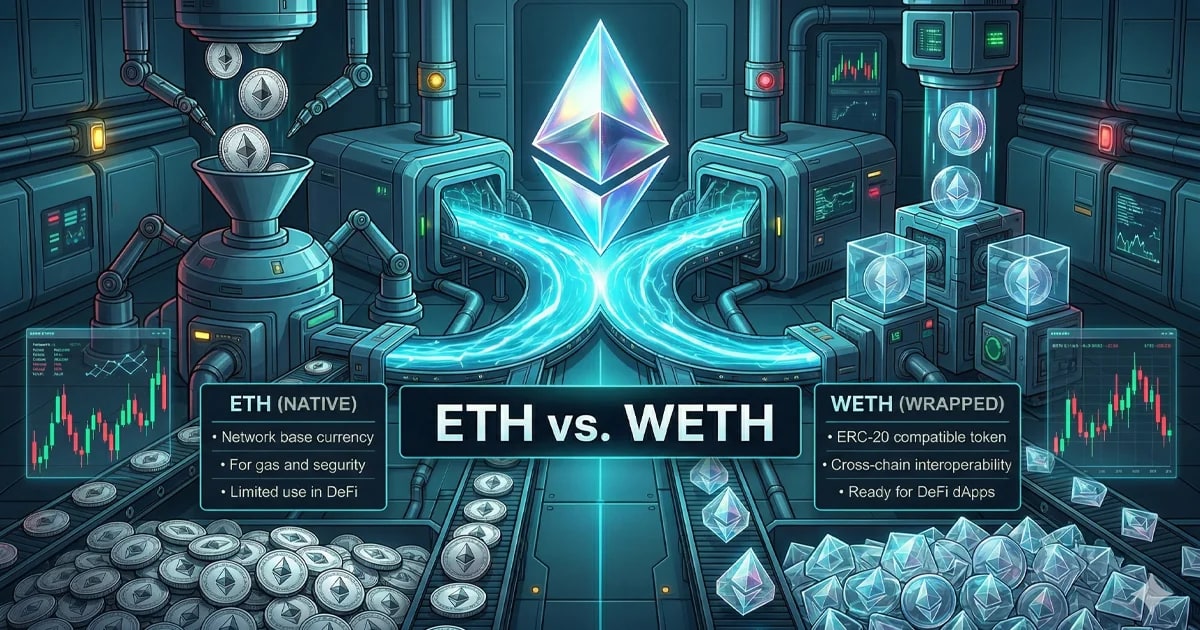
ETH is the native currency of Ethereum, primarily used to pay for gas fees and standard transactions. In contrast, WETH (Wrapped ETH) is an ERC-20 token that represents ETH in a “wrapped” form, making it compatible with DeFi platforms and decentralized applications.
Although both maintain a 1:1 value, WETH enables technical interoperability across systems where native ETH cannot be used directly.
Intent split
- This page targets the ETH vs WETH comparison intent.
- For the mechanics and practical workflow of wrapped ETH, read Full Guide to Wrapped ETH.
- As of March 31, 2026, the Ethereum ecosystem has undergone transformative changes. With the successful implementation of the Pectra and Fusaka upgrades last year, and the highly anticipated Glamsterdam upgrade just around the corner, the network is faster and more efficient than ever.
- However, one fundamental concept remains a source of confusion for many newcomers and even some seasoned traders: the distinction between native ETH and Wrapped ETH (WETH). While they share the same value, they serve completely different technical roles within the decentralized financial (DeFi) landscape. This guide explores the mechanics, use cases, and risks of these two assets in the current market.
What is Native ETH?
- Native ETH is the primary lifeblood of the Ethereum blockchain. It is the original currency created when the network launched. Its most critical role is acting as the "fuel" or gas required to pay for transactions. Whether you are sending a simple payment to a friend or interacting with a complex smart contract, you must pay the network's validators in native ETH.
- In the 2026 landscape, native ETH is also the asset used for staking. Following the Pectra upgrade, which improved the efficiency of the consensus layer, millions of users now hold native ETH in validator nodes to secure the network and earn rewards. It exists at the protocol level, meaning it does not follow the same rules as the tokens created on top of Ethereum. It is built into the foundation of the blockchain itself.
What is Wrapped ETH (WETH)?
To understand WETH, we must first understand the ERC-20 standard. Most tokens you see on Ethereum, such as stablecoins or governance tokens, follow a specific set of rules called ERC-20. This standard allows different applications and wallets to interact with tokens in a predictable way.
The paradox of Ethereum is that native ETH was created before the ERC-20 standard existed. Consequently, native ETH does not actually conform to the very rules that the rest of the ecosystem uses. This is where WETH comes in. Wrapped ETH is simply an ERC-20 compliant version of ETH. It is created by a smart contract that takes your native ETH and holds it in a "vault," then mints an equivalent amount of WETH in return. It acts as a bridge that allows the native currency to speak the same language as the rest of the DeFi world.
Does ETH Work as WETH?
Technically, the answer is no. You cannot use native ETH in a protocol that specifically requires an ERC-20 token. Think of it like a vending machine that only accepts gold coins. Native ETH is like a gold bar: it has the same value as the coins, but the machine is not designed to process a bar. You must first take your gold bar to a "wrapper" (the smart contract) to exchange it for standardized coins (WETH) that the machine can accept.
In 2026, while many applications have built-in features to wrap your ETH automatically behind the scenes, the two assets remain distinct on the blockchain. When you look at your wallet balance on a block explorer, you will see ETH and WETH listed as two separate line items, even though their market price is always pegged at a 1:1 ratio.
When to Use Native ETH
Native ETH should be your default choice for basic operations. You should keep a balance of native ETH in your wallet for the following reasons:
Paying Gas Fees: You can never pay for gas with WETH. Even if you are trading WETH, the transaction fee must be paid in native ETH.
Simple Transfers: If you are just moving value from one wallet to another or a centralized exchange, native ETH is simpler and avoids the extra step of wrapping.
Staking: If you want to participate in the security of the network or join a staking pool like Rocket Pool or Lido, you typically start with native ETH.
Primary Store of Value: Most hardware wallets and long term investors prefer to keep their "stack" in native ETH to minimize exposure to smart contract dependencies.
When to Use WETH
WETH becomes necessary the moment you step into the world of decentralized applications (dApps). You will need to use WETH for:
Decentralized Exchanges (DEXs): Platforms like Uniswap V4 or the latest version of SushiSwap use WETH in their liquidity pools. If you want to swap ETH for a new altcoin, the protocol often converts your ETH to WETH first to complete the trade.
NFT Bidding: On marketplaces like OpenSea or Blur, you cannot make a "bid" on an NFT using native ETH. This is because a bid is a promise to pay that the smart contract must be able to execute automatically if the seller accepts. Only the ERC-20 version (WETH) allows for this level of automated permission.
Yield Farming and Lending: If you want to lend your ETH on Aave or Spark to earn interest, you are technically interacting with WETH. The protocol needs the tokenized version to track your balance and calculate your interest in real time.
Example Scenario:
Suppose you see an NFT you want to buy for 2 ETH. If the seller has a "Buy Now" price, you can often pay in native ETH because the transaction is immediate. However, if you want to offer 1.8 ETH and wait for the seller to decide, you must convert that 1.8 ETH into WETH. This allows the NFT platform's smart contract to "pull" the funds from your wallet the moment the seller clicks accept.
The Risks of Using WETH
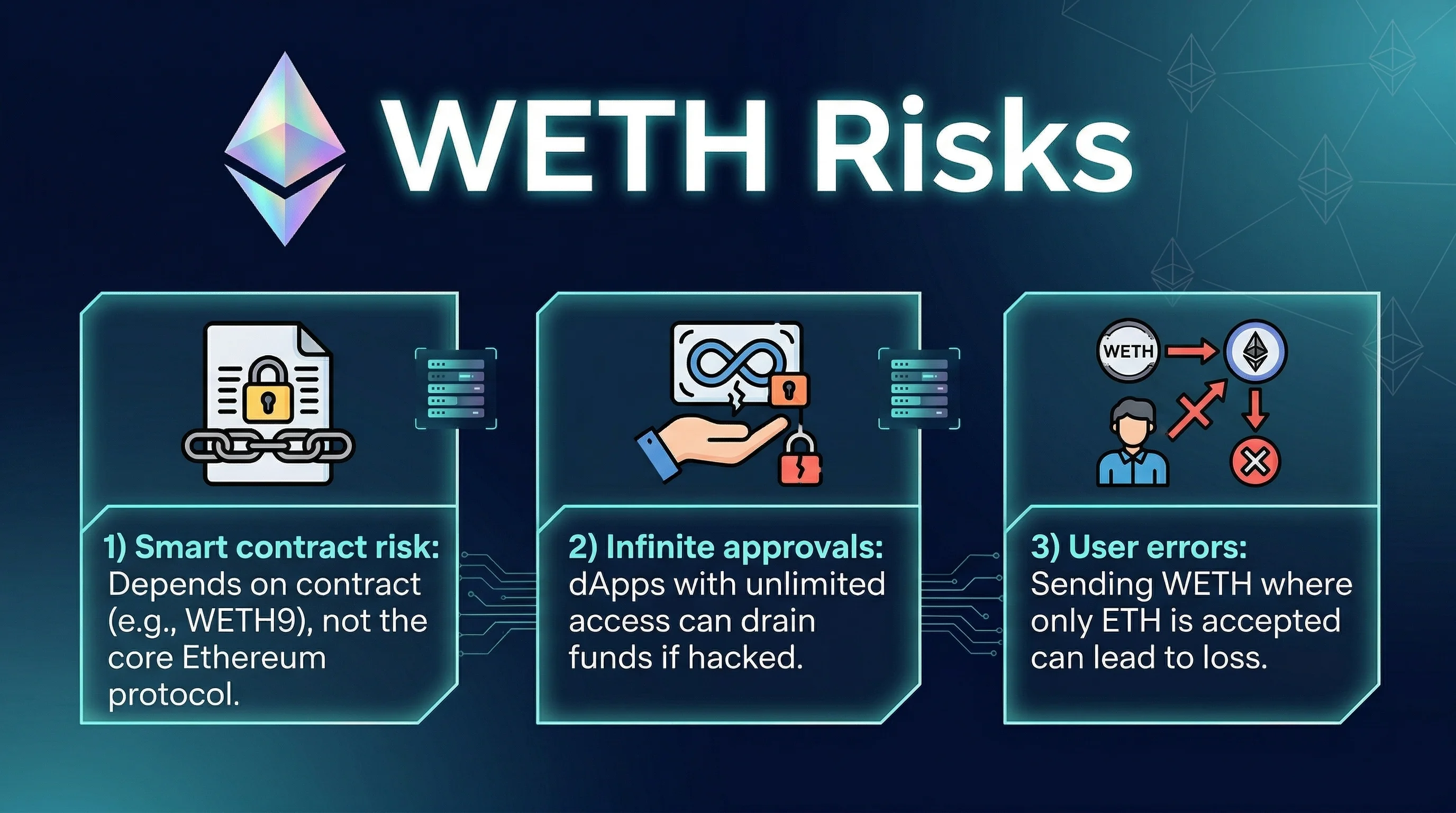
While WETH is one of the most trusted assets in the crypto space, it is not entirely risk-free. By March 2026, the community has identified several key areas of concern:
Smart Contract Risk: Unlike native ETH, which is secured by the entire Ethereum protocol, WETH relies on a specific smart contract (usually WETH9). Although this contract has been audited thousands of times and has never failed, any code can theoretically have a vulnerability.
Infinite Approvals: When you use WETH in a dApp, you often have to "approve" the dApp to spend your WETH. In the past, users often gave "infinite approvals" to save on gas. In 2026, this is still a major security risk. If the dApp is hacked, the attacker could drain all the WETH from your wallet.
Operational Errors: Because they look so similar, it is easy for a user to accidentally send WETH to a contract or an exchange address that only supports native ETH. While most modern exchanges in 2026 have recovery tools, some funds can still be lost in transition if sent to the wrong type of address.
The Future: Will WETH Disappear?
With the 2025 Pectra upgrade and the introduction of EIP-7702, Ethereum accounts have become "smarter." There has been significant debate in the developer community about "enshrining" WETH into the protocol itself. This would make native ETH behave like an ERC-20 token automatically, removing the need for wrapping.
However, as of early 2026, WETH remains the industry standard. The thousands of protocols already built on Ethereum rely on the existing WETH contract, and changing this would require a massive migration. For the foreseeable future, understanding the difference between these two assets will remain a core skill for any Ethereum user.
Summary of Key Points
Native ETH is the base currency of the blockchain used for gas fees and staking.
WETH (Wrapped ETH) is an ERC-20 token version of ETH used for dApps and DeFi.
The Exchange Rate is always 1:1, managed by a decentralized smart contract.
Use ETH for gas, simple transfers, and long term holding in cold storage.
Use WETH for NFT bidding, providing liquidity, and complex DeFi strategies.
Risks include smart contract vulnerabilities and the dangers of granting infinite token approvals to dApps.
Pectra and Fusaka upgrades have improved account functionality but have not yet replaced the need for WETH.
Navigating the nuances of the Ethereum ecosystem requires the right tools and real-time data. To ensure you are making the most of your assets and managing your WETH positions effectively, we invite you to use Ethereum in the dashboard of DEXTools here. Our platform provides the security audits and market transparency you need to tradear seguro and stay ahead of the curve in the 2026 market. Explore the latest pools and verify contract safety with confidence today.
Disclaimer: This article is for informational purposes only and does not constitute investment advice, financial advice, trading advice, or any other kind of advice. DEXTools does not recommend buying, selling, or holding any cryptocurrency or token. Users should conduct their own research and consult with a qualified financial advisor before making any investment decisions. Cryptocurrency investments are volatile and high-risk. DEXTools is not responsible for any losses incurred.
Related Guides
- How Wrapped ETH Works in DeFi: WETH Guide for 2026
- How to Buy Ethereum in Canada (2026)
- What Is Wrapped Bitcoin (WBTC)? Uses, Risks and WBTC vs BTC (2026)
- EMA vs SMA in Crypto: Key Differences, Signals and Best Uses (2026)
- What Is Ethereum Staking? How It Works, Rewards and Risks (2026)
Frequently Asked Questions
What is the difference between ETH and WETH?
ETH is the native currency of Ethereum used for transactions and gas fees, while WETH is a wrapped version of ETH that conforms to the ERC-20 standard, enabling compatibility with DeFi platforms.
How is Wrapped ETH (WETH) created?
WETH is created by a smart contract that takes your native ETH and holds it in a vault, then mints an equivalent amount of WETH in return, allowing it to be used in ERC-20 compliant applications.
Can I use native ETH in DeFi applications?
No, native ETH cannot be used directly in protocols that require ERC-20 tokens; you must first wrap it to convert it into WETH.
When should I use native ETH instead of WETH?
You should use native ETH for basic operations like paying gas fees and simple transfers, as WETH cannot be used for these purposes.
What upgrades have impacted the Ethereum network in 2026?
The Pectra and Fusaka upgrades have improved the efficiency of the Ethereum network, with the Glamsterdam upgrade anticipated to further enhance its performance.