How Wrapped ETH Works in DeFi: WETH Guide for 2026

Learn how wrapped ETH works in DeFi, why WETH exists, and how it connects ETH with ERC-20 token workflows in 2026.
Bridging the Gap in the Ethereum Ecosystem
- As of April 3, 2026, the Ethereum network has reached a level of sophistication that was once the stuff of whitepapers. With the successful deployment of the Pectra and Fusaka upgrades over the past year, the network is more efficient, scalable, and institutionally integrated than ever.
- However, even in this advanced landscape, a fundamental technical paradox remains: the native currency of the network, ETH, does not actually speak the same language as the tokens built on top of it. This is where Wrapped ETH (WETH) becomes an essential tool for every participant in the decentralized economy.
The Technical Paradox of Native ETH
- To understand Wrapped ETH, one must first understand the ERC-20 standard. This standard is a set of rules that allows developers to create tokens that are instantly compatible with one another and with various decentralized applications (dApps). Most of the assets you see on the market today, from stablecoins to governance tokens, are ERC-20 compliant.
- The paradox is that native ETH was created before the ERC-20 standard was finalized. Consequently, native ETH does not follow the very rules that the rest of the Ethereum ecosystem uses to function. It is like having a high tech vending machine that accepts only specific gold coins, while you are standing there with a solid gold bar. The value is the same, but the machine cannot process the bar. WETH is the process of minting those standardized coins from your gold bar.
How the Wrapping Process Works
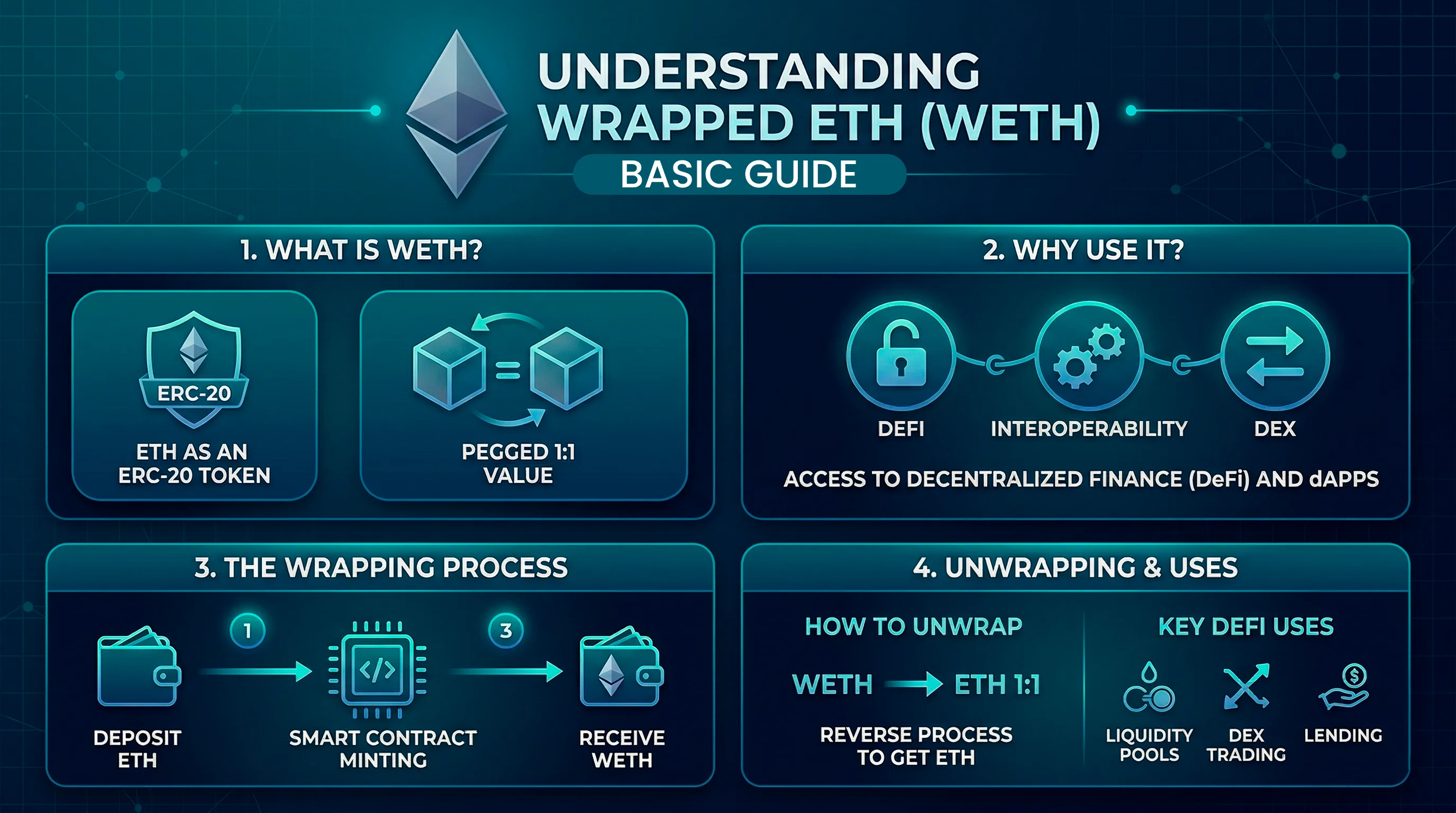
- Wrapping ETH is a decentralized, permissionless process handled by a smart contract. When you "wrap" your ETH, you are essentially sending your native tokens to a specific vault (a smart contract). In exchange, the contract mints an equal amount of WETH and sends it back to your wallet.
- This process is strictly 1:1. The smart contract acts as a transparent custodian. For every 1 WETH in circulation, there is exactly 1 native ETH locked in the contract. Because this is handled by code rather than a centralized company, you do not need to trust a middleman. You can "unwrap" your WETH at any time, which triggers the contract to burn the WETH and release the original native ETH back to you.
Example Scenario:
Imagine an investor, Maria, who wants to participate in a new decentralized lending pool. The pool only accepts ERC-20 tokens. Maria goes to a swap interface and wraps 5 ETH. She now has 5 WETH in her wallet. The market value remains identical, but her 5 WETH can now be deposited into the lending contract to start earning interest.
Intent split
- This page targets the how wrapped ETH works intent.
- For the comparison page, read ETH vs WETH in 2026.
WETH in Decentralized Swaps and Liquidity
- One of the primary uses for WETH in 2026 is within Decentralized Exchanges (DEXs) like Uniswap or SushiSwap. Most liquidity pools are designed to trade one ERC-20 token for another. For example, a pool might be set up to trade USDC for WETH.
- If you try to swap native ETH for another token, the dApp often performs a "silent wrap" behind the scenes. It takes your ETH, wraps it into WETH, and then executes the swap. By using WETH directly, professional traders can save on the computational complexity (and therefore the gas fees) of these multi step operations. Furthermore, WETH allows for complex order types, such as limit orders or automated "stop-loss" triggers, which are technically difficult to execute with native ETH due to its protocol-level nature.
The Role of WETH in Cross-Chain Bridges
- In April 2026, the Ethereum ecosystem is no longer just a single chain; it is a massive web of Layer 2 networks like Base, Arbitrum, and Optimism, as well as connections to other blockchains like Solana or Avalanche. Bridges are the infrastructure that moves value between these different environments.
- When you use a bridge to move ETH from the Ethereum Mainnet to another chain, you are almost always dealing with a wrapped version. For instance, when you move ETH to a different blockchain, the bridge locks your native ETH on the Ethereum side and mints a "Wrapped" or "Synthetic" version on the destination chain. While these are often given specific names like "cbETH" or "aeETH," they all function on the fundamental principle of wrapping. WETH serves as the standardized unit that ensures your value remains consistent as it travels across the multi-chain landscape.
2026 Advancements: Account Abstraction and WETH
One of the most exciting developments in 2026 is the widespread adoption of EIP-7702 and account abstraction. For years, the need to wrap and unwrap ETH was a significant point of friction for new users. Today, "Smart Accounts" have largely automated this process.
Many modern wallets can now handle the wrapping process automatically. When you attempt to make a bid on an NFT or enter a liquidity pool, your smart wallet detects that WETH is required and performs the wrap in the same transaction. While this makes the user experience much smoother, the underlying technical necessity for WETH still exists. Even if you do not see the "Wrap" button, WETH is still the engine under the hood of your DeFi interactions.
Risks Associated with Wrapped ETH
While WETH is a cornerstone of the industry, it is not without risks. In 2026, the community remains vigilant about two primary concerns:
Smart Contract Vulnerability: Because WETH relies on a smart contract, any bug or vulnerability in that code could theoretically put the locked ETH at risk. However, the standard WETH contract is one of the most audited and battle-tested pieces of code in history.
De-pegging: In times of extreme market stress or bridge failures, the "Wrapped" version of ETH on a specific Layer 2 or alternative chain could lose its 1:1 value relative to native ETH. This is known as "de-pegging." While rare on the Ethereum Mainnet, it is a risk that traders must manage when moving assets across experimental bridges.
ETH vs. WETH Comparison Table
The following table highlights the key differences between the two assets as they stand in early 2026.
| Feature | Native ETH | Wrapped ETH (WETH) |
| Token Standard | Native (Protocol Level) | ERC-20 (Application Level) |
| Gas Payment | Yes (Primary Use) | No (Cannot pay for gas) |
| DeFi Compatibility | Limited | High (Standard for dApps) |
| Staking | Yes (Native Staking) | No (Must unwrap first) |
| Creation | Minted by Validators | Minted by Smart Contract |
| Custody | Self-custody in wallet | Held in a 1:1 Vault |
Summary of Key Points
Native ETH is the original currency of the Ethereum blockchain but does not follow the ERC-20 token standard.
WETH is an ERC-20 compliant version of ETH, created by locking native ETH in a smart contract at a 1:1 ratio.
Swaps on decentralized exchanges usually require WETH to ensure compatibility with other tokens in liquidity pools.
Bridges use wrapped versions of ETH to move value between the Ethereum Mainnet and Layer 2s or other blockchains.
2026 Upgrades like account abstraction have made the wrapping process nearly invisible to the user, though it remains technically necessary.
Risks are primarily centered on smart contract integrity and the potential for de-pegging on secondary networks or bridges.
Understanding the mechanics of Wrapped ETH is vital for anyone looking to navigate the complex world of decentralized finance and cross-chain trading. To ensure you are getting the best rates and interacting with secure contracts, we invite you to use the Ethereum dashboard on DEXTools here. Monitor your WETH positions and explore new opportunities with confidence on DEXTools today.
Disclaimer: This article is for informational purposes only and does not constitute investment advice, financial advice, trading advice, or any other kind of advice. DEXTools does not recommend buying, selling, or holding any cryptocurrency or token. Users should conduct their own research and consult with a qualified financial advisor before making any investment decisions. Cryptocurrency investments are volatile and high-risk. DEXTools is not responsible for any losses incurred.
Related Guides
- ETH vs WETH in 2026: Differences, Uses and Tradeoffs
- What Is Ethereum Staking? How It Works, Rewards and Risks (2026)
- Who Created ETH and When Was It Founded? Full History 2026
- How to Bridge ETH to Optimism Safely in 2026: Full Guide
- Aave Protocol Explained: V3, GHO, Risk Modes and How the Market Works (2026)
- The Ethereum Ecosystem in 2026
Frequently Asked Questions
What is Wrapped ETH (WETH)?
Wrapped ETH (WETH) is a token that represents native ETH on the Ethereum network, allowing it to be compatible with ERC-20 tokens and decentralized applications.
How does the wrapping process work for ETH?
The wrapping process involves sending your native ETH to a smart contract, which mints an equal amount of WETH and returns it to your wallet, maintaining a 1:1 ratio.
Why is WETH important for decentralized exchanges?
WETH is crucial for decentralized exchanges as it allows for easier trading of ERC-20 tokens, reduces computational complexity, and enables advanced order types that native ETH cannot support.
Can I unwrap my WETH back to ETH?
Yes, you can unwrap your WETH at any time, which will burn the WETH and release the original native ETH back to your wallet.
How does WETH facilitate cross-chain transactions?
WETH is often used in cross-chain bridges, where native ETH is locked on the Ethereum side, and a wrapped version is minted for use on other blockchains, enabling seamless value transfer.