Honeypot Tokens Explained: How to Detect Buy-Only Scams

Parabolic crypto charts can hide devastating smart contract traps. We break down how honeypot tokens utilize 100% sell taxes and blacklists to lock up your funds, and how to spot them using automated simulators.
What is a Honeypot?
A honeypot is a malicious cryptocurrency token contract engineered to trap investor capital through one-way transaction rules. It mimics a legitimate, highly attractive trading opportunity by allowing users to buy the asset freely, while secretly utilizing hidden code modifications (such as absolute sell taxes or wallet blacklists) to permanently block them from executing sell orders and retrieving their funds.
The One-Way Gate: Capital Ingestion vs. Asset Isolation
- Decentralized finance (DeFi) offers unparalleled financial autonomy, allowing any developer to deploy a custom token contract and establish global liquidity pools within minutes. While this permissionless architecture drives rapid web3 innovation, it creates a massive sandbox for malicious actors. One of the most deceptive traps on decentralized market dashboards is the Honeypot Token.
- Driven by social media hype, artificial volume bots, and parabolic price charts, these tokens exploit the Fear Of Missing Out (FOMO). Mechanically, they are engineered as digital trapdoors: anyone can buy the token, but no one can sell it. This guide breaks down the code-level mechanics of buy-only scams, explains how bad actors evade baseline security filters, and details the diagnostic simulation environments required to safeguard your trading capital.
The Whitelist: Privileged wallets owned by the deployer, marketing lines, or internal automated bots are granted unrestricted, zero-fee transfer clearance.
The Blacklist: Every public retail wallet that buys into the pool after launch is programmatically assigned to a restricted blacklist.
- When a standard retail user attempts to execute a sell order, the contract calls an internal validation check. If the caller's address matches the blacklist parameters, the transaction throws an execution error and fails, permanently trapping your principal capital inside the token pool.
2. How Scammers Evade Basic Checks
- As market participants have become familiar with basic smart contract auditing, malicious developers have upgraded their code to bypass superficial security scans.
- Trigger-Based and Time-Locked Exploits: Advanced honeypots display entirely normal buy and sell logs on their initial execution charts. The code blocks are tied to specific parameters, such as a set block number, a specific market cap target, or a time limit. Early buyers can exit with no friction, generating a clean transactional footprint that tricks superficial scanners into giving the project a safe rating. Once the preset threshold is crossed, the contract triggers its hidden transfer restrictions globally.
- Upgradeable Proxy Vulnerabilities: Bad actors frequently disguise malicious logic by deploying an entirely clean, un-flagged base contract that routes user interactions to a secondary implementation contract via a proxy framework. If the administrative owner keys are not fully renounced, the developer can quietly upload a malicious contract upgrade post-launch, transforming a completely standard token into a buy-only trap overnight.
3. The Technical Defense: Deploying Simulator Tools
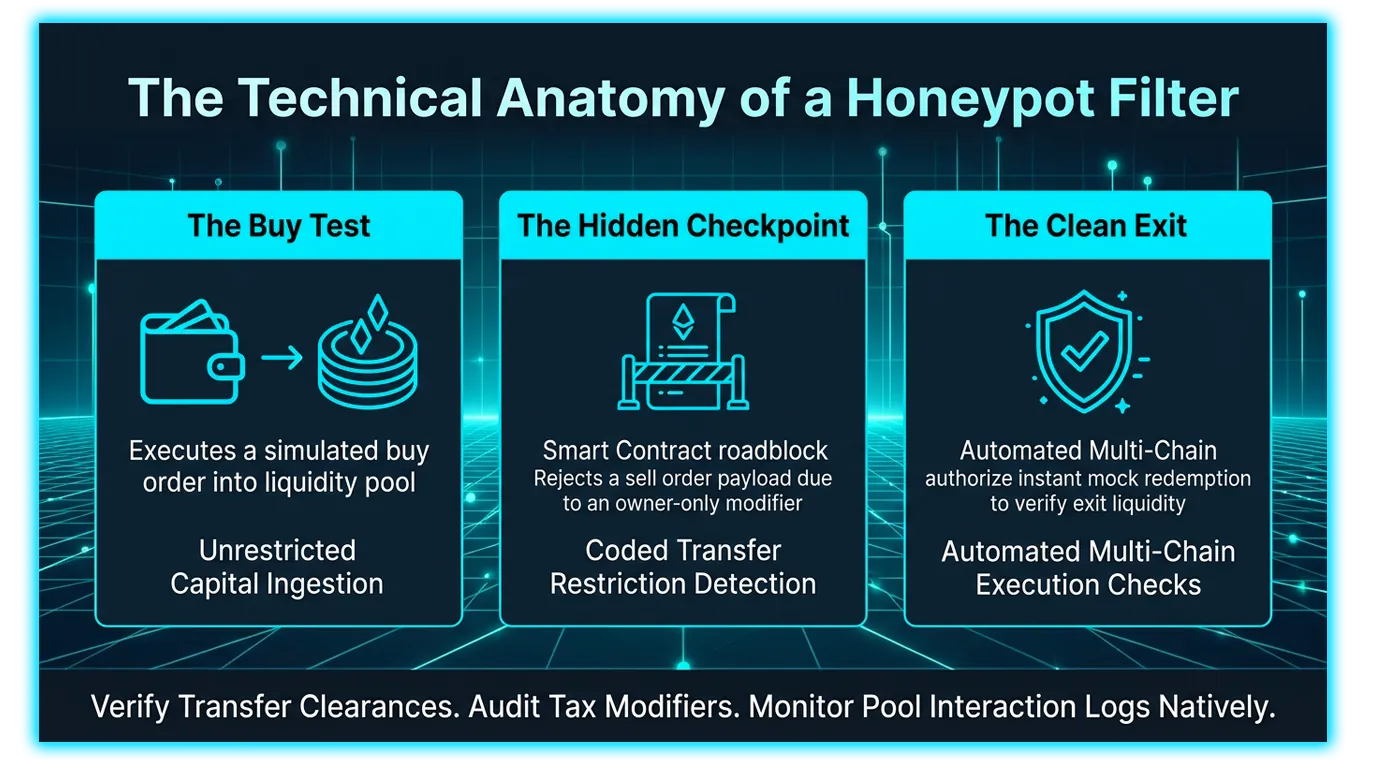
- Manual code inspection is difficult and highly inefficient during rapid, high-volume market events. Protecting your portfolio requires the use of automated simulator tools that audit token behavior dynamically.
- Advanced diagnostic engines (including Honeypot.is, Token Sniffer, GoPlus Security, and CoinStats' Glider analyzer) do not simply read what a smart contract claims to do. Instead, they pull the token's compiled code and spin up a local, isolated virtual machine environment to execute real-time simulation mock-ups.
- Before you commit real funds, the simulator automatically attempts a virtual buy transaction, evaluates the internal state balance adjustments, and immediately forces an execution-level mock sell order from a random, unprivileged wallet address. If the simulated sell order fails due to an owner-only modifier, a hidden balance manipulation loop, or an exorbitant tax adjustment, the screening tool instantly outputs a honeypot verdict, filtering out the fraud before it can interact with your active wallet.
Technical Risk Screening Matrix
| Feature | Mechanism | Detection Signature |
| Sell-Lock | Owner-only transfer blocks | Failure on simulated sell |
| Sell Tax | 100% or adjustable fees | Severe token output deficit |
| Blacklist | Targeted wallet freeze | Address-specific execution failure |
| Proxy Traps | Post-launch code modification | Unrenounced upgrade permissions |
4. Universal On-Chain Forensics and Trading Telemetry via DEXTools
- Identifying hidden honeypots requires pairing automated smart contract simulators with live, raw ledger visibility. Utilizing universal DEXTools market telemetry gives market participants an essential, real-time diagnostic command center to evaluate structural token performance.
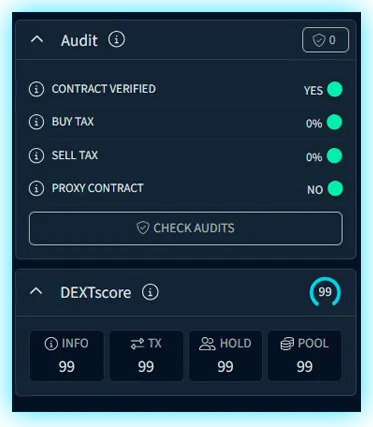
- By running contracts through advanced monitoring modules like the Pair Explorer, technical analysts can immediately inspect automated code safety rankings, verify liquidity lock states, and audit live transactional feeds. If a trending token shows millions of dollars in green buy inflowing transactions but exhibits a complete absence of red sell liquidations over a multi-hour window, the telemetry alerts you to a structural block, providing the critical transparency needed to identify buy-only traps and protect your capital from on-chain fraud.
- You can use DEXTools' Audits and DEXTscore to detect honeypots and other scams, assess a token's quality, and trade safely.
Disclaimer: This article is for informational purposes only and does not constitute investment advice, financial advice, trading advice, or any other kind of advice. DEXTools does not recommend buying, selling, or holding any cryptocurrency or token. Users should conduct their own research and consult with a qualified financial advisor before making any investment decisions. Cryptocurrency investments are volatile and high-risk. DEXTools is not responsible for any losses incurred.
Related Guides
- How to Detect a Honeypot Token in 60 Seconds 2026
- What Is a Watch-Only Wallet in Crypto? Guide
- What Is a Honeypot Token? Sell Traps Explained
- How to Use TokenSniffer: Contract Risk Checks and Honeypot Clues (2026)
- How to Check If a Token Is a Honeypot with DEXTools (Step by Step)
Frequently Asked Questions
What is a honeypot token?
A honeypot token is a scam token whose smart contract lets users buy but prevents most or all of them from selling. Victims see a balance that they cannot actually cash out.
How do honeypot scams trap funds?
They commonly use contract code such as extreme sell taxes, blacklists, or hidden conditions that block sells for ordinary holders. The chart may look healthy because only the scammers can exit.
How can I detect a honeypot before buying?
Automated honeypot checker tools can simulate a sell to flag tokens that block selling, and reviewing the contract for unusual taxes or blacklist functions helps. Checking holder distribution and liquidity locks can also reveal red flags.
Can a token become a honeypot after launch?
Yes, if the contract has owner privileges, the deployer may be able to change taxes or enable blacklists later. Contracts with such mutable permissions carry ongoing risk even if selling works at first.