How to Bridge Assets to TON Safely: Guide (2026)
— By Tony Rabbit in Tutorials
Bridge assets to TON safely: learn route selection, wallet checks, post-bridge verification, wrapped-asset risk, fees, and what to do after funds arrive.
Bridging to TON means moving value from another blockchain into the TON network using a bridge or routed transfer service. This allows users to access TON-native applications, wallets, and liquidity. The process involves balancing multiple wallets, understanding two fee systems, and navigating bridge interfaces, with potential settlement delays and asset identification risks.
Bridging into TON sounds simple on paper. Pick a route, send the asset, wait, and keep moving. In practice, this is one of the easiest places to make a clean but costly mistake, because the user is balancing multiple wallets, two fee systems, a bridge interface, settlement delays, and the risk that the thing arriving on TON is not exactly what they thought they were sending for.
Intent check: This page is the chain-specific execution guide for TON. If you need the general risk model first, read What Is Bridge Risk in Crypto?. If you want routing tools that compare paths, read What Is a Bridge Aggregator in Crypto?
Quick answer: bridging to TON means moving value from another chain into TON through a bridge or routed transfer service so you can use TON-native apps, wallets, and liquidity. The safe workflow is to choose the destination asset first, verify the supported route, fund gas on the source chain, confirm the TON destination wallet, send a test amount, and verify the received asset before you swap or use it.
- Choose the destination outcome first. Know whether you want TON, USDT on TON, or another specific asset before you approve anything.
- Gas matters on both sides. You need the source-chain gas asset, and you may still need TON after arrival for the next action.
- Bridged assets carry wrapper and route risk. The name on the wallet screen is not enough.
- Delays are normal. Panic-clicking a second transfer because settlement feels slow is a classic bridging mistake.
- DEXTools is most useful after the bridge lands. Verify the asset and market quality before you swap into anything smaller.
Why users bridge assets into TON
People bridge to TON because they already hold capital on another chain and want to use TON-native products without off-ramping and re-buying. That could mean funding a Tonkeeper wallet, using a TON Mini App, buying Jettons, or moving stablecoins into a TON liquidity venue. Bridging is a workflow choice, not an ideology. It is useful when it is the cleanest path from where your funds already are to where you actually need them.
Trade TON with Not.Trade, the fastest terminal on TON
Not.Trade is purpose built for TON traders: real-time on-chain charts for every jetton, insider safety scoring (Top 10 wallets, snipers, dev movement, bundlers, LP lock), MCAP-trigger limit orders, multi-wallet sniping, MEV protection and one-click swaps routed across STON.fi and DeDust. It runs natively inside Telegram and as a fast web terminal, with TON Connect non-custodial wallet support.
Read the full Not.Trade guide →It is not always the best path, though. If a major exchange, broker, or on-ramp already lets you buy the asset directly on TON, the direct route may be simpler. This page focuses on the cases where bridging really is the practical choice, while the concept layer is covered more broadly in the DEXTools bridged token guide.
A good bridging mindset starts with this question: what do I need on TON when the transfer finishes? If the answer is vague, the bridge route is probably premature.
What you need before bridging to TON
Safe bridging starts before the first click. The clean pre-flight checklist is simple but non-negotiable.
| Requirement | Why it matters |
|---|---|
| Source-chain wallet access | You need full control of the wallet that will send the asset through the route. |
| Native gas on the source chain | The bridge transaction cannot start if the source wallet has no gas. |
| A TON destination wallet | You need a verified receiving address, usually in Tonkeeper or another TON wallet. |
| A plan for destination gas | Some routes land the asset cleanly but do not solve the next-step fee problem on TON. |
| The exact destination asset | Bridging stablecoins, bridged wrappers, and TON itself are different end states. |
That destination-gas point trips up more users than it should. Bridging USDT into TON does not automatically mean you can move it, swap it, or send it onward without any TON available. Some routes or apps help with sponsored actions, but you should not build your whole plan around that assumption.
It is also smart to decide whether the funds are heading into a main wallet or an exploration wallet. If the purpose is testing a new TON app, consider keeping the first bridge small and separate from your primary balance.
How a TON bridge flow works, step by step
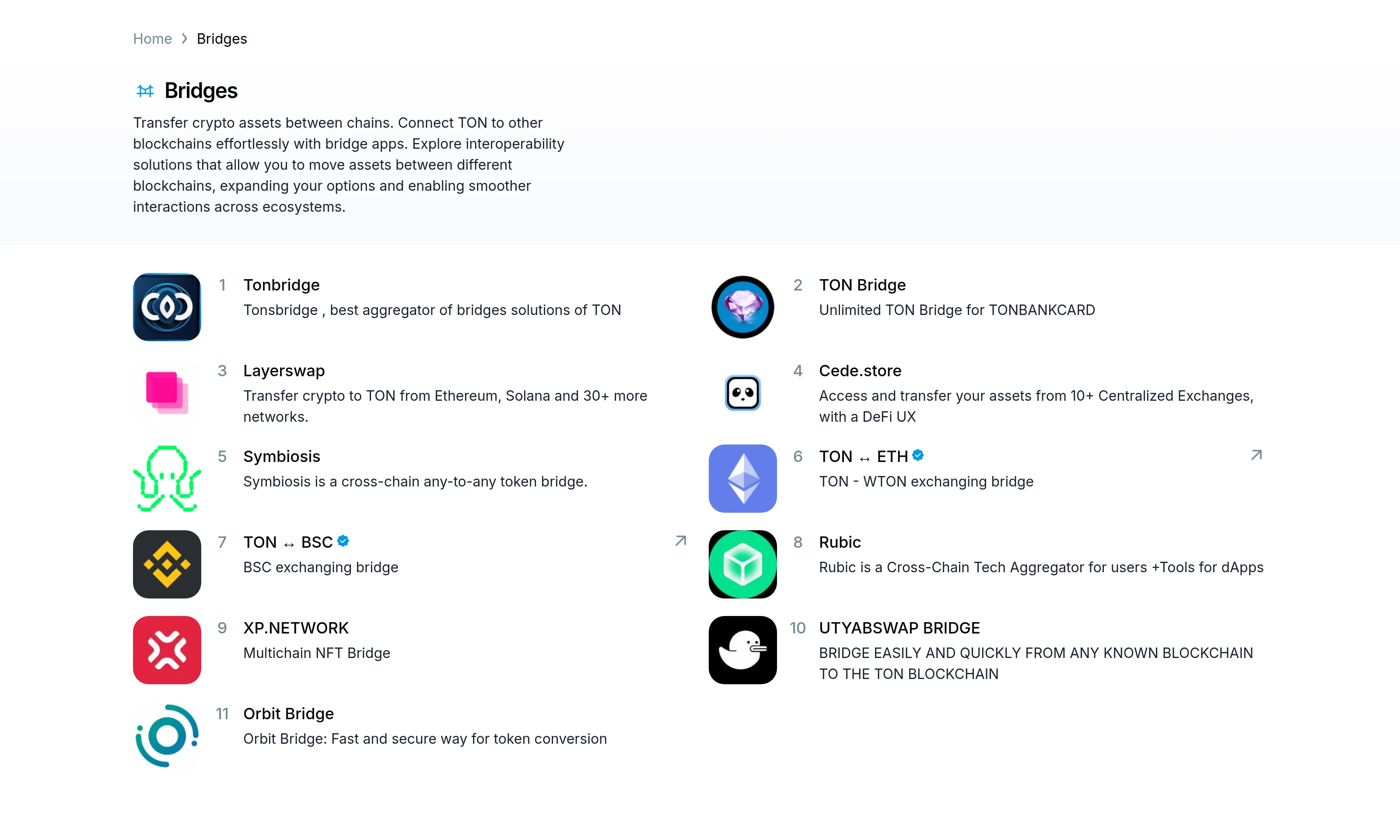
The exact interface changes from bridge to bridge, but the safe sequence stays consistent.
- Choose the asset you want to end up with on TON. Do not begin with “whatever gets there fastest.” Begin with the actual asset you need after arrival.
- Select a supported route. Confirm that the source chain, source asset, destination chain, and destination asset are all explicitly supported by the route you are using.
- Verify the TON destination address. Copy it directly from your wallet. Do not paste an address from chat history, forwarded messages, or old notes.
- Review fees, minimums, and expected settlement time. If the route has a minimum size or poor quoted output, it is better to know before you approve.
- Send a test amount first. Low fees and multi-step risk make testing worth it.
- Wait for settlement without improvising. A route can take time across confirmations and relayers.
- Verify what arrived on TON. Check the asset identity and whether it matches the planned destination.
- Only then swap, deposit, or continue deeper into TON.
This is why bridge safety feels less like a “how to click” problem and more like an operator discipline problem. Most losses come from skipping the verification steps because the user wanted the result faster than they wanted certainty.
Route quality, delays, minimums, and fees
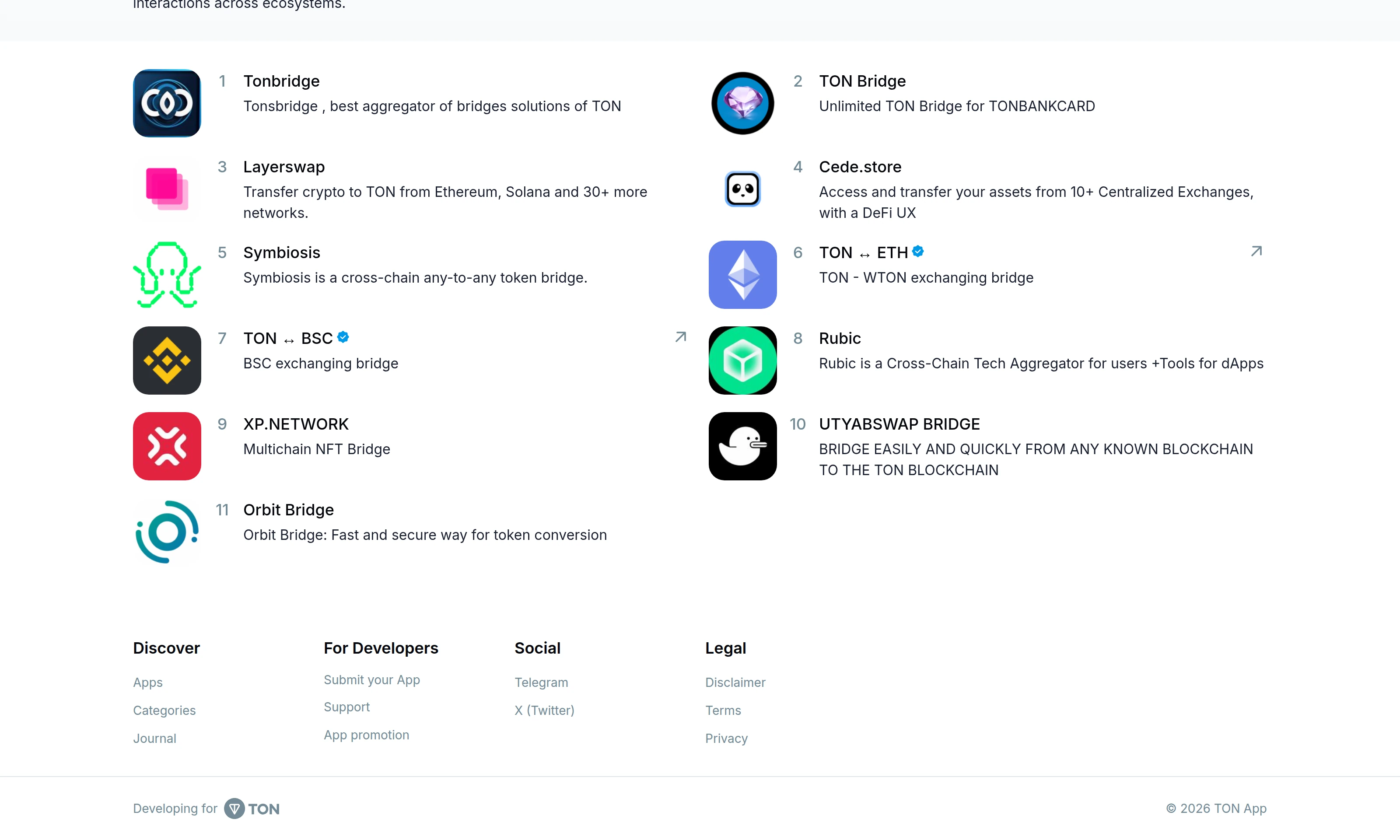
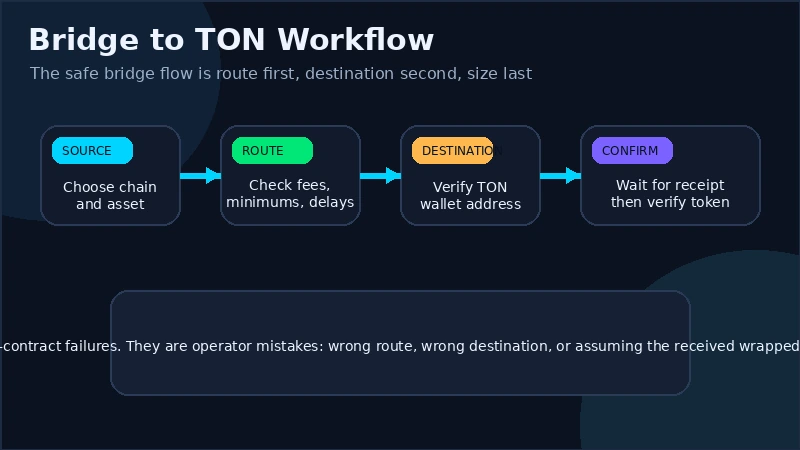
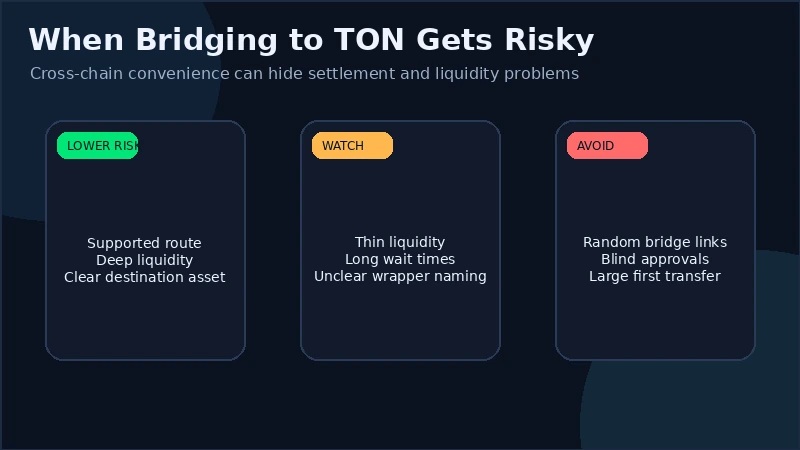
Not all bridge routes are equal. A route that looks cheapest on the surface may be worse once you factor in price impact, hidden wrapper exposure, or the fact that it lands an asset you did not really want. Route quality is not only about speed. It is about what you end up holding and whether that asset is actually usable on TON afterward.
Always review minimum transfer sizes. Small test transfers are smart, but some bridges or routed services will quote poorly or reject tiny amounts. That is still useful information. If the route cannot handle your test in a reasonable way, it may not be the right route for your real size either.
Delays are another place where users sabotage themselves. Cross-chain routes can pause while waiting on source confirmations, relayers, settlement windows, or intermediate liquidity. A slow transfer is not automatically a failed transfer. Rushing to send a second full-size transaction because the first one feels delayed is one of the most expensive forms of impatience in crypto.
Fee review also needs to be broader than the bridge line item. Think about the source gas cost, any protocol fee, the spread or route conversion cost, and the next move you plan to make on TON. A “cheap bridge” that lands a thin wrapped asset you then need to swap with bad slippage is not cheap in any useful sense.
Wrapped asset risk and how to verify what arrived
The asset arriving on TON deserves the same skepticism as any other token transfer. Bridging often creates or relies on a representation of value, not on the original chain-native asset magically teleporting across. That is why the destination check matters so much.
Start by comparing the received asset to the route you selected. Does the wallet show the exact asset you expected? If it is a stablecoin or a token wrapper, does the official source or route documentation confirm that this is the intended TON version? If the naming is vague, do not continue into a swap until you can answer those questions clearly.
This is where the DEXTools token verification guide becomes directly relevant. A bridged token that arrived safely can still be the wrong thing to trade if you do not verify identity and market quality. The concept article about bridged tokens helps with the mental model. This page is about the operator habit: verify the asset after arrival, not only before departure.
Also remember that the bridge completing successfully does not guarantee that the TON-side market is deep. Arrival is not the end of the risk. Sometimes it is the beginning of a new one.
Common bridge errors on the way into TON
- Sending the wrong asset on the wrong network: matching tickers do not fix unsupported routes.
- Using an unverified destination address: copied text from chat or recent history is not enough.
- Forgetting about destination gas: the asset lands, but the next action is blocked because there is no TON.
- Ignoring minimums and route quality: the transfer technically works while the economic result is still poor.
- Assuming slow means failed: users often create duplicate risk by sending again too quickly.
- Swapping instantly after arrival: many users never verify the bridged asset before pushing it into a second trade.
A safer default is to assume that bridges deserve the same respect as exchanges and new dApps. They are useful infrastructure, but they are still another trust and execution layer in the workflow.
When to bridge, and when it is better to buy directly on TON
Bridging is usually the right move when you already hold funds on another chain, the route quality is acceptable, and the asset you want on TON is clearly reachable that way. Buying directly is usually better when the destination asset is already available through a TON-supported venue or a centralized venue you trust, especially if that route avoids wrapper confusion or reduces the number of moving parts.
| If your real goal is... | Often better choice | Why |
|---|---|---|
| Get a small TON balance for fees | Buy directly if available | Simpler than bridging stablecoins and then solving gas after arrival. |
| Move existing stablecoin capital into TON | Bridge can make sense | You keep funds on-chain and move into the ecosystem you already plan to use. |
| Use a TON app immediately after funding | Whichever route lands the exact usable asset | The destination state matters more than the headline bridge fee. |
| Trade a smaller TON token | Bridge only if you already trust the TON-side market | Otherwise you are stacking bridge risk on top of token risk. |
If you cannot explain why bridging is better than buying directly in your case, you may be bridging out of habit instead of out of need.
A practical DEXTools workflow after the bridge lands
Once the asset arrives on TON, DEXTools becomes the truth check before any second step. This is especially important if your next move is a swap into a Jetton or a deposit into a smaller TON app.
- Search the received asset carefully. Confirm the identity before you treat it as interchangeable with another version of the same ticker.
- Inspect liquidity and recent transactions. A bridged asset can exist on TON while still trading in a shallow market.
- Review slippage before the next swap. DEXTools plus the slippage guide is the right combination here.
- Check your security context. If a random group or fake support account pushed the route, assume the threat model is worse than usual and lean harder on the DEXTools security guide.
- Then decide whether to continue. The safe move after bridging is often “pause and verify,” not “swap immediately.”
The bridge did its job when value reached TON. Your job is to make sure the received market is actually worth using.
Frequently asked questions
Do I need TON before I bridge to TON?
You need gas on the source chain to start the transfer, and you may still need some TON after arrival for the next action. The safe assumption is that destination gas still matters.
How long does a bridge to TON usually take?
It depends on the route, chain confirmations, and settlement design. Some routes are fast, while others take longer. A delay is not automatically a failure.
Can I bridge directly from an exchange to TON?
Sometimes a service may support it, but it is usually safer to bridge from a wallet you control directly unless the route explicitly says otherwise.
Is a bridged asset on TON the same as a native asset?
Not always. Some routes create or depend on a representation of value, so you should verify the exact asset you received instead of assuming the ticker tells the whole story.
Should I swap immediately after my asset lands on TON?
Usually no. First verify the asset identity, liquidity, and next-step market conditions, then decide whether the swap still makes sense.
Final takeaway: the safest way to bridge into TON is to treat the process like a controlled transfer, not a casual click path. Decide the destination asset first, verify the route and wallet, send a test amount, wait for settlement, and use DEXTools to check what landed before you do anything else.
Disclaimer: This draft is for educational purposes only and does not constitute investment, financial, legal, or trading advice. Bridge routes, fees, and supported assets can change without notice.
Related Guides
- TON vs Solana: Complete Network Comparison Guide (2026)
- TON vs Ethereum: Complete Network Comparison Guide (2026)
- What Is Tokenization? How Real World Assets Become Onchain Claims (2026)
- What is Centrifuge (CFG)? Real-World Assets on Chain
- What Are Real World Assets (RWA) in Crypto? Asset Types, Yield and Risks (2026)
Frequently Asked Questions
What does it mean to bridge assets to TON?
Bridging assets to TON means moving tokens from another blockchain onto the TON network, usually through a bridge service or smart contract. The process often locks or burns the asset on the source chain and issues a matching token on TON.
How can I bridge to TON safely?
Use reputable bridges, double-check the official contract or app address, and start with a small test amount before moving larger sums. Confirm your TON wallet is set up correctly to receive the bridged asset.
What is wrapped-asset risk when bridging?
When you bridge, you often receive a wrapped version of the original asset that depends on the bridge holding the underlying tokens. If the bridge is compromised or fails, the wrapped token can lose its backing and its value.
What should I do after bridging funds to TON?
Verify that the correct token arrived in your wallet by checking the contract address and balance, and confirm the transaction on a TON explorer. Make sure you received the intended asset and not a lookalike token.