Institutional Crypto Custody: Top Providers
— By AliceOnChain in Tutorials

An in-depth analysis of how institutional custody frameworks operate, their impact on decentralized markets, and how retail traders can track large-scale capital flows using on-chain data.
Institutional Custody Explained: Coinbase Custody, Fireblocks, and BitGo
The infrastructure supporting the digital asset market has evolved from experimental cryptographic setups to highly regulated frameworks capable of managing billions of dollars in capital. At the center of this evolution is institutional crypto custody—the specialized financial and technical architectures designed to secure large-scale digital asset holdings for hedge funds, asset managers, and corporate treasuries.
For participants in decentralized finance (DeFi), tracking institutional capital requires a deep understanding of digital asset custody frameworks, where these funds are held, and how they move across protocols. Providers of institutional crypto custody act as the primary gateways for traditional capital entering the blockchain ecosystem. When these entities shift assets, the resulting impact can cause notable fluctuations in volume, order book depth, and overall market sentiment.
By analyzing the operational frameworks of industry leaders like Coinbase Custody, Fireblocks, and BitGo, market participants can better understand capital flows and integrate these insights into their risk management strategies.
The Architecture of Institutional Security
To understand how enterprise capital influences decentralized markets, one must first understand how that capital is secured. Unlike retail users who rely on single private keys or hardware wallets, institutions require advanced digital asset custody configurations that mitigate internal fraud, human error, and sophisticated cyberattacks.
Multi-Party Computation vs. Multi-Signature
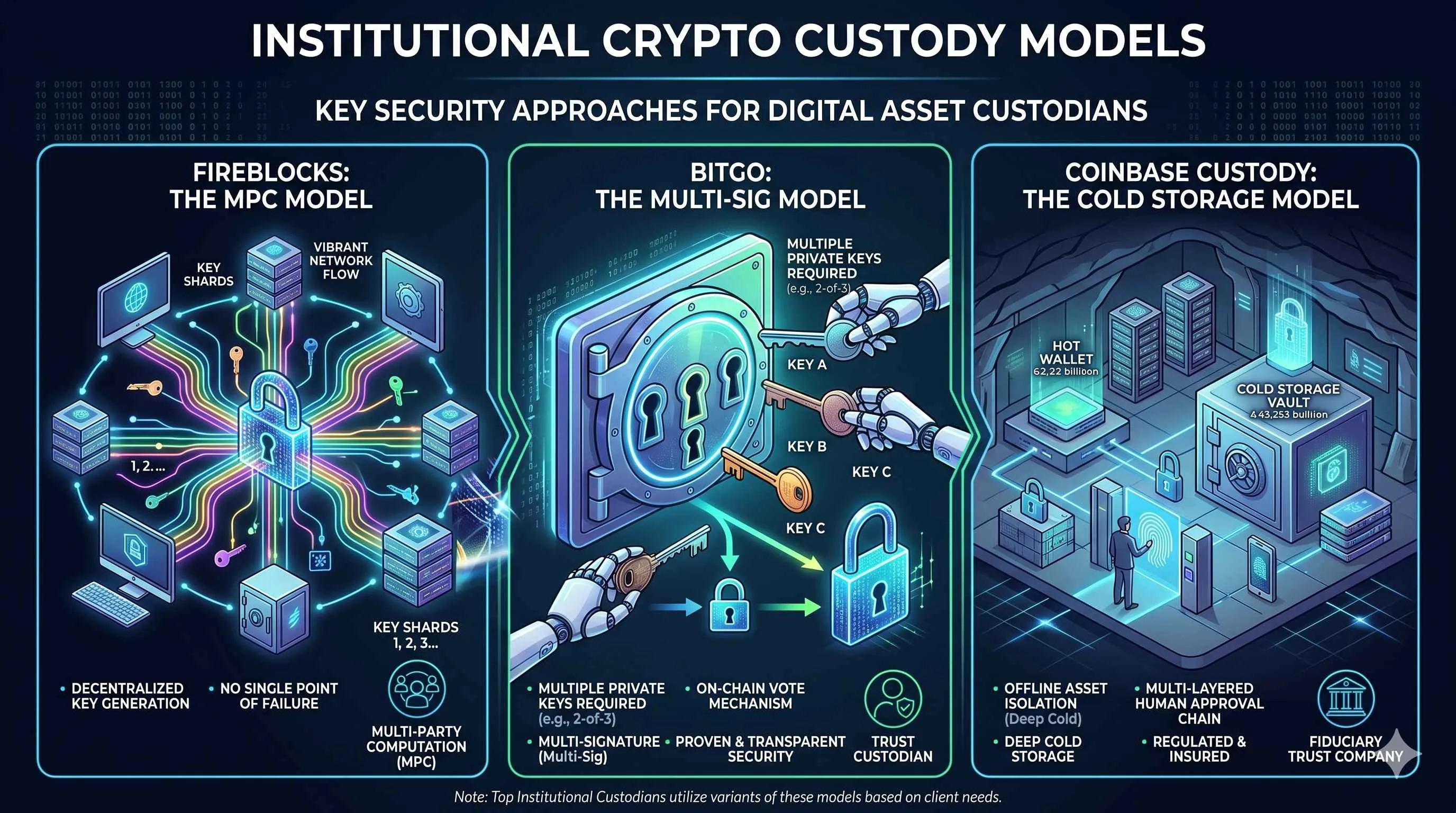
The two primary technologies powering modern institutional crypto custody solutions are Multi-Party Computation (MPC) and Multi-Signature (Multi-Sig) smart contracts.
Multi-Sig requires a transactions to be signed by a predetermined number of private keys (e.g., 3 out of 5) before it is broadcast to the blockchain. While highly secure, Multi-Sig is tied to specific blockchain architectures and can introduce higher transaction fees due to the complexity of the smart contract execution.
Multi-party computation takes a different approach by breaking a single private key into multiple encrypted shards. These shards are distributed across separate servers and locations. When a transaction needs approval, the shards mathematically interact to sign the transaction without ever reconstituting the full private key in any single location. This eliminates a single point of failure and remains protocol-agnostic, meaning it can be implemented across various blockchain networks seamlessly.
Co-Signatory Frameworks and Governance
Providers of institutional crypto custody do not simply hold keys; they enforce strict compliance and operational governance. A typical institutional transfer requires multiple layers of authentication, including biometric verification, localized whitelist approvals, and automated velocity controls that flag unusual transaction sizes or patterns. Understanding these friction points is essential when utilizing whale wallet tracking to analyze sudden changes in blockchain activity.
Fireblocks: The Infrastructure Approach
Fireblocks operates primarily as an enterprise infrastructure provider rather than a direct depository custodian, offering specialized tooling for digital asset custody to help financial institutions move, store, and issue digital assets safely.
Technology and Implementation
Fireblocks relies heavily on multi-party computation wallet architecture combined with hardware-isolated security enclaves (Intel SGX technology). This dual-layer approach ensures that even if a server is compromised, the cryptographic material remains protected within the hardware itself.
Impact on On-Chain Liquidity
Because Fireblocks connects hundreds of liquidity providers, over-the-counter (OTC) desks, and exchanges through its proprietary network, capital moves rapidly through its ecosystem, impacting overall on-chain liquidity. When an institution initiates a rebalancing strategy across multiple decentralized applications (dApps), these movements often register as significant spikes in localized pool volumes.
Traders monitoring asset velocity can look at tools like the DEXTools Pair Explorer to cross-reference sudden, large-scale token influxes with established pool historical baselines to determine if institutional rebalancing is shifting on-chain liquidity dynamics.
BitGo: The Pioneer of Multi-Sig
Founded in the early days of Bitcoin infrastructure, BitGo pioneered the commercial application of Multi-Sig security and remains a dominant player in the regulated institutional crypto custody space.
Technology and Implementation
BitGo relies primarily on a 2-of-3 Multi-Sig structure. One key is held by the client, one by BitGo, and a third backup key is kept in an offline, secure vault for emergency recovery. As a qualified custodian, BitGo offers bank-grade trust structures and robust cold storage security, providing legal and regulatory protections that go beyond pure technical cryptography.
The Wrapped Bitcoin Connection
BitGo’s most visible footprint within DeFi is its role as the primary custodian for Wrapped Bitcoin (WBTC). Every WBTC circulating on Ethereum or other chains is backed 1:1 by physical Bitcoin held in BitGo’s insured vaults, demonstrating a massive application of institutional cold storage security.
Consequently, shifts in BitGo's institutional demand often directly correlate with the minting and burning rates of WBTC. An increase in WBTC supply frequently signals an influx of institutional collateral entering DeFi lending protocols and automated market makers (AMMs), reshaping market-wide on-chain liquidity.
Coinbase Custody: The Regulated Exchange Model
Coinbase Custody operates as a standalone, fiduciary trust company under New York Banking Law. It represents the exchange-centric model of institutional crypto custody, serving as the primary underlying custodian for the majority of US-based spot crypto Exchange-Traded Funds (ETFs).
Technology and Implementation
Coinbase combines geographical separation with deep cold storage security architectures. The vast majority of client assets are stored offline in disconnected hardware modules, requiring multi-layered human approval chains across disparate jurisdictions to initiate withdrawals.
Market Access and Sentiment Shifts
Because Coinbase Custody is deeply integrated with Coinbase Pro and its institutional OTC desks, large transfers out of deep cold storage security environments often precede major market updates. When significant quantities of an asset are moved from cold vaults into hot wallets, it can indicate an intention to provide liquidity, sell on the open market, or reallocate across decentralized protocols.
Conversely, large movements from exchange addresses back into known custodial vaults typically suggest long-term accumulation and a reduction in immediate circulating supply. Retail traders can utilize whale wallet tracking to spot these macro capital shifts before they manifest as retail price trends.
How to Track Institutional Capital Movements
When institutional funds interact with decentralized markets, they leave definitive footprints on the blockchain. While the identity of the specific institution remains obscured, the scale of the transactions makes them distinct from retail trading activity, making whale wallet tracking a vital skill for DeFi participants.
Monitoring Liquidity Pools and Volume Real-Time
Institutions rarely execute large trades directly into shallow liquidity pools to avoid excessive price slippage. Instead, they utilize algorithmic execution or spread orders across multiple high-density pairs to preserve on-chain liquidity.
Using the DEXTools platform, traders can monitor real-time pool metrics to identify unusual patterns:
Sustained Volume Spikes: A consistent, hours-long increase in trading volume without a corresponding retail social media trend often indicates programmatic institutional accumulation or distribution.
Liquidity Depth Analysis: Tracking changes in total value locked (TVL) within specific pairs can reveal when sophisticated actors are introducing capital to alter on-chain liquidity or removing it in anticipation of volatility.
Price Alerts: Configuring granular price alerts helps identify when an asset breaches key structural support or resistance lines, which are often the regions where institutional algorithmic buy or sell walls are placed.
Assessing Token Distribution and Whale Concentration
To distinguish true institutional accumulation from superficial retail momentum, a thorough review of holder architecture is required. The DEXTools Holder Analysis tool allows users to perform whale wallet tracking and observe the concentration of supply across the top wallet addresses.
When a token exhibits an RSI divergence on the daily chart—where the price creates lower lows but the RSI trends upward—cross-referencing this with holder data can clarify the structure. If the number of smaller retail wallets is decreasing while the concentration in top-tier wallets or digital asset custody addresses increases, it suggests that capital is consolidating into larger, institutional-grade hands.
Volatility Management and Sentiment Metrics
Institutional desks frequently trade against extreme retail sentiment. During periods of high market volatility, identifying whether large-scale liquidity is entering or exiting a pair provides essential context.
By analyzing block trade data and monitoring tools like Bubblemaps to detect interconnected wallet webs, traders can practice effective whale wallet tracking to determine whether a sudden price movement is a localized retail cascade or a structural repositioning by entities managing enterprise institutional crypto custody infrastructure.
Conclusion
The frameworks powering modern institutional crypto custody—developed by pioneers like Fireblocks, BitGo, and Coinbase Custody—provide the security foundation required for traditional capital to engage with digital assets. The interplay between high-security offline vaults and active on-chain liquidity continues to dictate the broader structural trends of decentralized markets.
For intermediate traders, navigating these markets successfully requires shifting focus away from short-term retail hype and moving toward data-driven, on-chain metrics. By observing volume distribution, tracking liquidity depth, and monitoring wallet concentration through advanced digital asset custody analytics, market participants can better understand the footprints left by institutional players and execute their trading strategies with a clearer perspective on risk management.
What Is Fireblocks: Digital Asset Custody, Treasury and Wallet InfrastructureFireblocks Custody and MPC Wallet Guide
Coinbase Wins Initial OCC Approval for National Trust Charter in Major Custody Push
RWA Risks Explained: Custody, Legal and Regulatory Guide
Disclaimer: This article is for informational purposes only and does not constitute investment advice, financial advice, trading advice, or any other kind of advice. DEXTools does not recommend buying, selling, or holding any cryptocurrency or token. Users should conduct their own research and consult with a qualified financial advisor before making any investment decisions. Cryptocurrency investments are volatile and high-risk. DEXTools is not responsible for any losses incurred.