Light Client in Crypto Explained: vs Full Nodes
— By Whatsertrade in Tutorials

Light client in crypto explained: learn how it verifies blockchain data with headers and Merkle proofs and how it differs from running a full node.
This page explains what a light client is in crypto. If you need the broader node primer first, read What Is a Node in Crypto?.
Key Takeaways
- Why Full Nodes Are Not Practical for Most Users
- How a Light Client Works
- What Is a Merkle Proof and Why It Matters
- Security Trade Offs of Light Clients
- When Light Clients Are the Right Choice
- Light Clients and User Experience
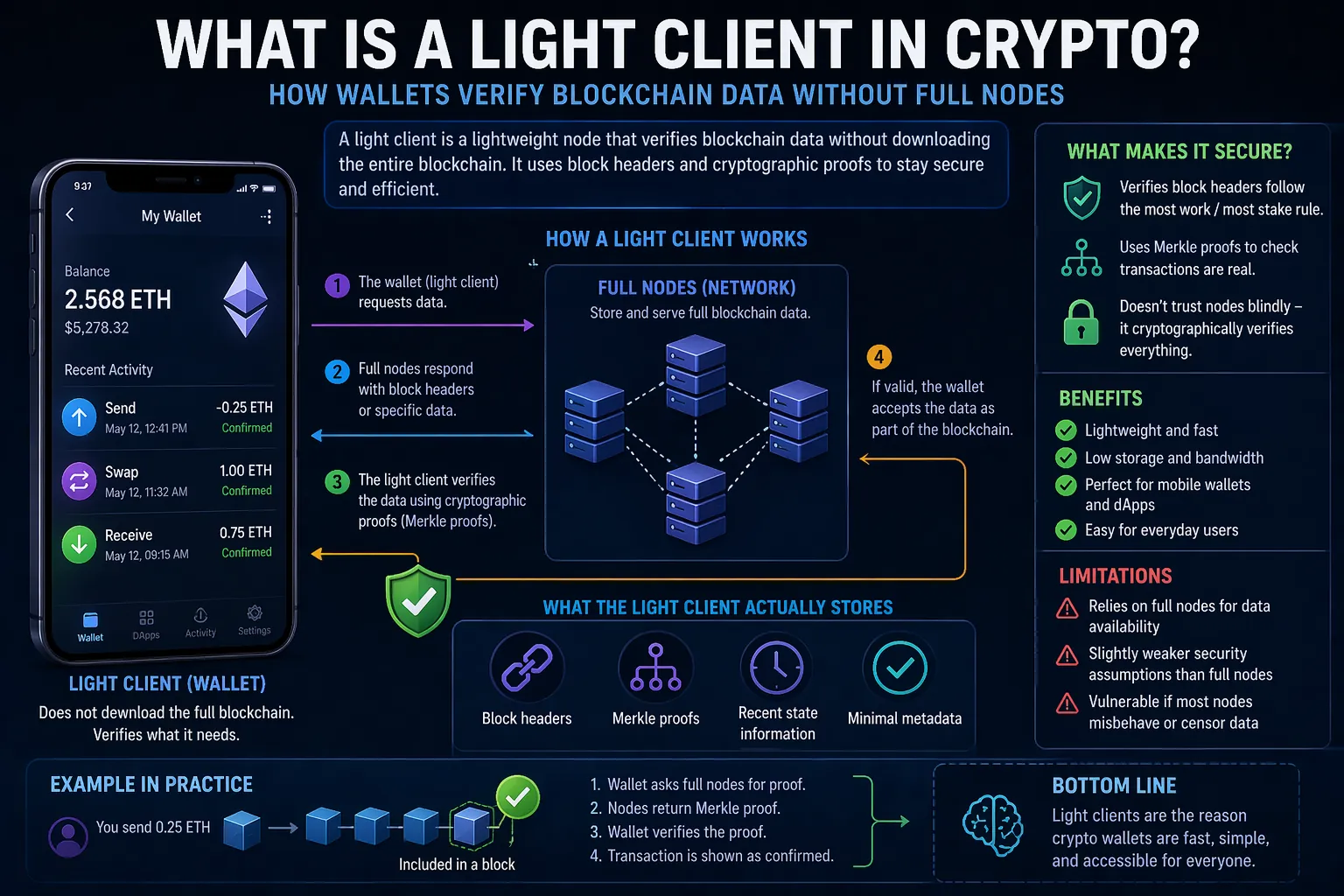
A light client in crypto is a type of blockchain node that allows users to interact with a network without downloading the entire blockchain. Instead of storing every transaction ever made, a light client only keeps a small portion of the data needed to verify information.
This is what makes most crypto wallets usable. Without light clients, every user would need to run a full node, which requires significant storage, bandwidth, and technical knowledge.
In simple terms, a light client in crypto is a lightweight way to verify blockchain activity without carrying the full weight of the network.
Why Full Nodes Are Not Practical for Most Users
A full node downloads and verifies the entire blockchain. This can involve hundreds of gigabytes of data, constant synchronization, and ongoing maintenance.
For everyday users, this is not practical. Most people want to check balances, send transactions, and interact with applications quickly. They do not want to maintain infrastructure.
Light clients exist to solve this problem. They allow users to access blockchain functionality without becoming infrastructure providers.
How a Light Client Works
A light client does not store full transaction data. Instead, it relies on block headers, which contain essential information about each block.
These headers include data such as:
Block hash
Previous block reference
Timestamp
Merkle root
Using this information, a light client can verify that a transaction is included in a block without downloading the entire block.
When more detailed information is needed, the light client requests it from full nodes. It then verifies the data using cryptographic proofs.
This model allows light clients to remain efficient while still maintaining a reasonable level of security.
What Is a Merkle Proof and Why It Matters
A key part of how light clients work is the use of Merkle proofs. These proofs allow a client to verify that a transaction belongs to a block without downloading all transactions in that block.
Instead of checking everything, the light client verifies a small path within a data structure that proves inclusion.
This is what makes light clients viable. They do not need full data to verify correctness. They only need enough data to validate specific claims.
Security Trade Offs of Light Clients
Light clients are efficient, but they come with trade offs.
Because they rely on external full nodes, they are not completely independent. A malicious or unreliable node could attempt to provide incorrect data.
However, cryptographic verification reduces this risk significantly. The client does not blindly trust the data. It checks whether the data matches the expected structure.
Even so, light clients are generally considered less secure than full nodes because they depend on external sources for data availability.
When Light Clients Are the Right Choice
For most users, light clients are the correct choice.
They are used in:
Mobile wallets
Browser wallets
DeFi interfaces
Trading tools
Portfolio trackers
They allow fast interaction without requiring technical setup.
Only advanced users, developers, or institutions typically run full nodes for maximum control and independence.
Light Clients and User Experience
Without light clients, crypto adoption would be much slower.
Light clients make it possible to:
Open a wallet instantly
Check balances in real time
Send transactions without delay
Interact with decentralized applications
This improves accessibility and lowers the barrier to entry.
Final Thoughts
A light client in crypto is a practical solution that allows users to verify blockchain data without running a full node. It uses block headers, cryptographic proofs, and external nodes to provide a balance between efficiency and security.
While it introduces some trade offs, it is the foundation of most modern crypto user experiences. Understanding how light clients work helps users better evaluate wallet security, data trust assumptions, and the infrastructure behind everyday blockchain interactions.
How to Bridge Crypto Between Chains: Complete Cross-Chain Tutorial 2026 How to Use 1inch: Complete DEX Aggregator Swap Tutorial (2026) How to Use OKX Web3 Wallet: Multi-Chain DeFi Hub Guide (2026)Related Guides
- What Is Firedancer? Solana's Jump Crypto Validator Client 2026
- What Is NOWNodes: Shared RPC, Dedicated Nodes and WebSocket Access (2026)
- What Is Chainstack: Managed Blockchain Nodes, Dedicated RPC and Web3 Infrastructure (2026)
- What Is a Node in Crypto? Blockchain Nodes Explained (2026)
- Who Created ETH and When Was It Founded? Full History 2026
Frequently Asked Questions
What is a light client in crypto?
A light client is software that interacts with a blockchain without downloading and storing the entire chain. It verifies data using block headers and cryptographic proofs instead of holding the full transaction history.
How does a light client verify blockchain data?
A light client downloads block headers and uses Merkle proofs to confirm that specific transactions are included in a block without needing the full block data. This lets it check validity while using far fewer resources than a full node.
What is the difference between a light client and a full node?
A full node downloads and independently validates the entire blockchain, while a light client stores only headers and relies on proofs to verify selected data. Full nodes offer stronger independent verification, and light clients trade some of that for lower resource use.
Why would I use a light client instead of a full node?
Light clients are useful on devices with limited storage, bandwidth, or processing power, such as phones, because they avoid syncing the whole chain. They make blockchain access more practical for everyday use at the cost of relying partly on other nodes for data.