Liquidity Turnover vs TVL: How to Know If a DeFi Pool Is Active or Idle
— By Whatsertrade in Tutorials

TVL is one of the most common metrics in DeFi. A pool with high total value locked may look strong, deep and trusted. But TVL alone does not show whether liquid
TVL is one of the most common metrics in DeFi. A pool with high total value locked may look strong, deep and trusted. But TVL alone does not show whether liquidity is actually being used.
A DeFi pool can hold large amounts of capital while generating little trading activity. In that case, liquidity may be idle.
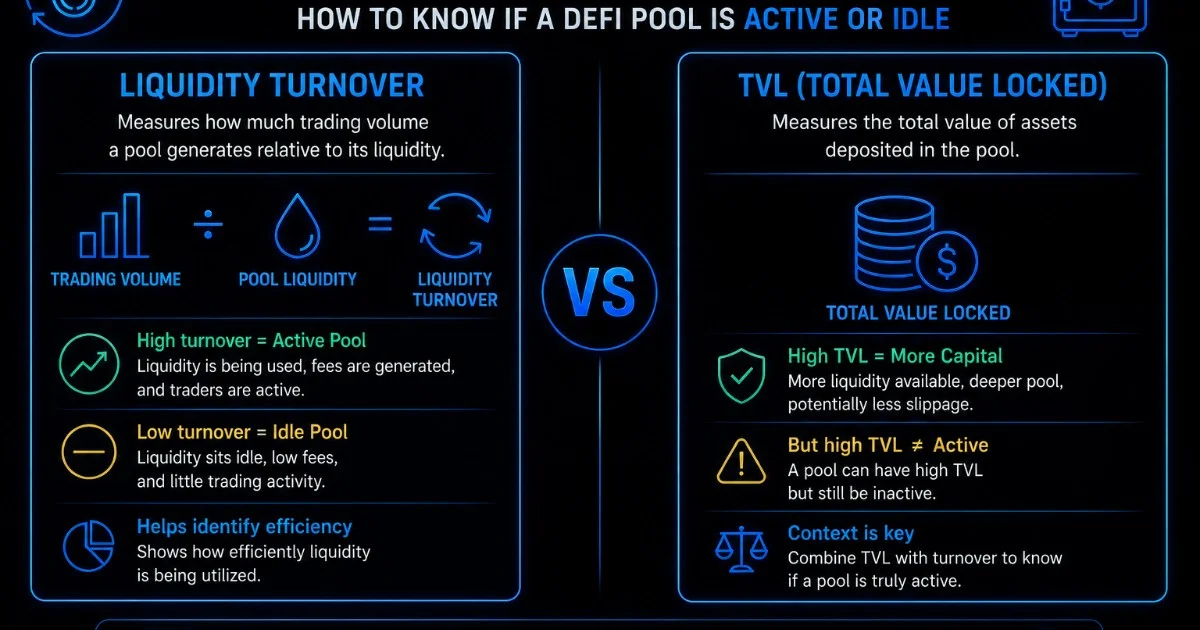
Liquidity turnover helps solve this problem. It compares trading activity with the amount of liquidity in the pool.
Understanding liquidity turnover vs TVL can help traders evaluate whether a DeFi pool is active, efficient or mostly inactive.
What Is TVL?
TVL, or total value locked, measures how much capital is deposited in a protocol, pool or smart contract.
In a DEX pool, TVL shows the value of assets available for trading.
High TVL can be useful because it may reduce slippage and improve execution. It can also suggest that liquidity providers trust the pool.
However, TVL does not show how often that liquidity is used.
What Is Liquidity Turnover?
Liquidity turnover measures how much trading volume a pool generates relative to its liquidity.
A pool with high liquidity turnover is actively used. Traders are swapping through it, fees are being generated and liquidity providers may be earning from real activity.
A pool with low liquidity turnover may have capital sitting idle.
Liquidity turnover helps reveal efficiency.
Liquidity Turnover vs TVL: The Key Difference
The key difference is capital size vs capital activity.
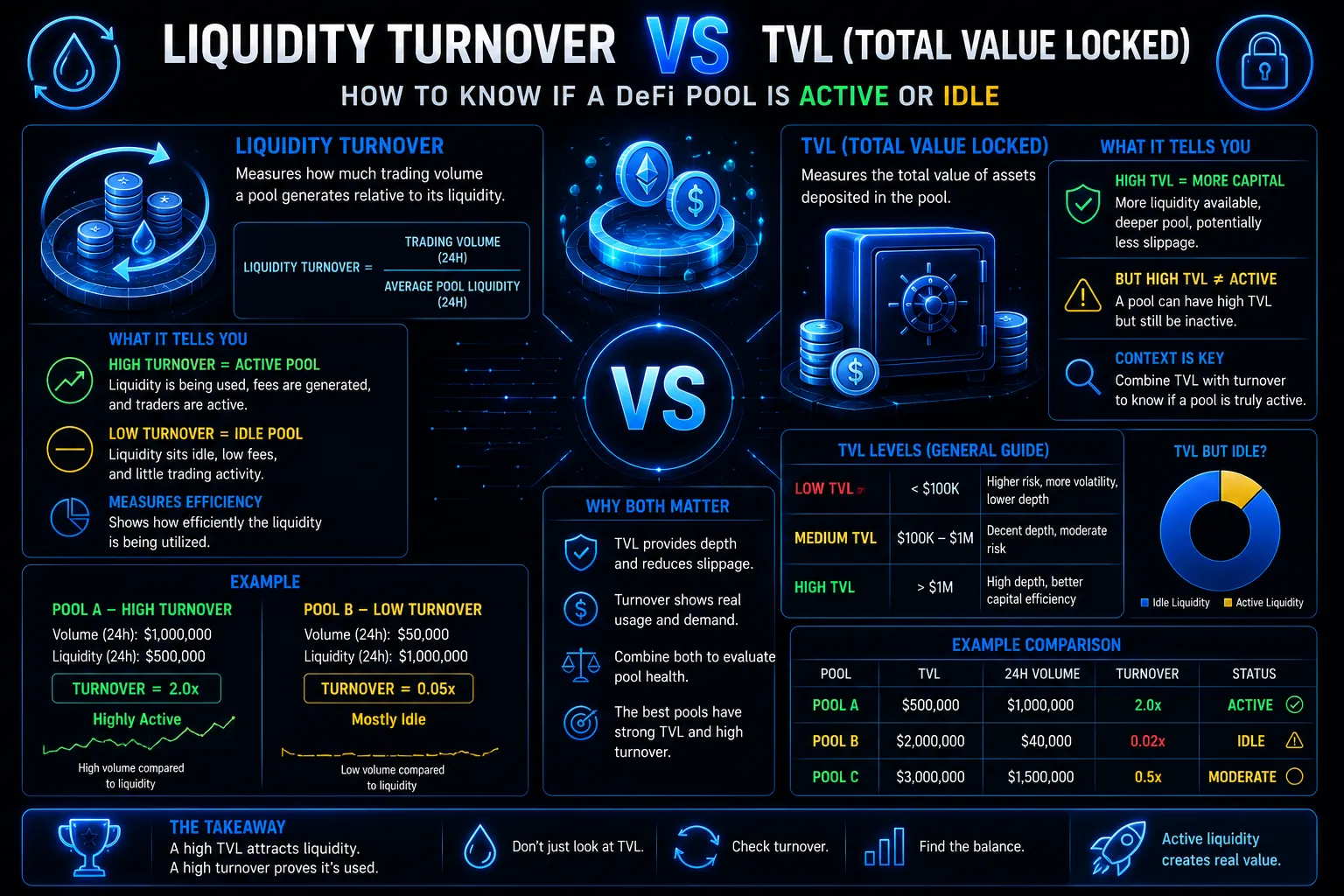
TVL shows how much capital is in the pool. Liquidity turnover shows how actively that capital is used.
A pool with high TVL and low turnover may be deep but inactive. A pool with moderate TVL and high turnover may be more efficient and useful.
For traders and liquidity providers, both metrics matter.
Why TVL Can Be Misleading
TVL can make a pool look healthier than it is.
A pool may attract deposits through incentives, but if traders do not use it, the capital may not generate meaningful fees.
High TVL can also hide poor capital efficiency. Liquidity providers may supply assets but earn little if volume is low.
For traders, high TVL is helpful only if it supports real execution and active markets.
Why Liquidity Turnover Matters
Liquidity turnover shows whether a pool is actually serving traders.
If a pool has strong turnover, it means capital is being used to facilitate swaps. This can support fee generation and market relevance.
High turnover can also show that a pair is important within an ecosystem.
For liquidity providers, turnover can help evaluate whether a pool is worth supplying.
When High Turnover Can Be Risky
High liquidity turnover is not always positive.
A pool may have high volume because of volatility, arbitrage, farming strategies or short term speculation. If turnover is too high relative to liquidity, slippage and impermanent loss risk may increase.
Traders should check whether volume is organic and whether liquidity is stable.
High turnover is best when it is consistent, not only event driven.
Idle Liquidity in DeFi Pools
Idle liquidity happens when capital sits in a pool but is rarely used.
This can occur when incentives attract liquidity providers but traders prefer other routes. It can also happen when a token loses attention, volume moves to another DEX or liquidity becomes fragmented.
Idle liquidity may look impressive on dashboards, but it does not always support strong protocol activity.
What Healthy Pool Activity Looks Like
A healthy DeFi pool often has:
Meaningful TVL.
Consistent volume.
Reasonable liquidity turnover.
Stable liquidity providers.
Low slippage for normal trades.
Real fee generation.
Active use across market conditions.
The best pools combine depth with activity.
How Traders Can Use Liquidity Turnover
Traders can use liquidity turnover to understand whether a pair is truly active.
If TVL is high but turnover is low, the pool may be less important than it appears. If turnover is rising with stable liquidity, the pool may be gaining real usage.
Liquidity turnover can also help traders compare pools across DEXs.
How DEXTools Can Help
DEXTools helps traders review liquidity, volume, pair activity and price behavior. This makes it useful for identifying whether a pool is active or idle.
Instead of looking only at TVL, traders can compare market depth with live trading activity.
This can improve execution decisions and reduce the risk of relying on misleading liquidity signals.
Final Thoughts
Liquidity turnover and TVL measure different things.
TVL shows how much capital is available. Liquidity turnover shows how actively that capital is being used.
A pool with high TVL is not automatically healthy. A pool with strong turnover and stable liquidity may show better real demand.
In DeFi, liquidity matters. But active liquidity matters more.
How to Bridge Crypto Between Chains: Complete Cross-Chain Tutorial 2026 How to Use 1inch for Swaps: Classic, Fusion and Limit Orders (2026) OKX Web3 Wallet Tutorial 2026: Multi-Chain Setup GuideRelated Guides
- Liquidity Pool Economics: Fees, Slippage and Impermanent Loss
- Main Pool Drift: How to Know When a Token's Real Market Has Moved
- Utilization Rate vs TVL: The DeFi Metric That Matters
- 5 Best Crypto Lending Platforms 2026: APY, TVL & Safety
- Protocol Revenue vs TVL: DeFi Demand Explained
- What Is a Vampire Attack in Crypto? DeFi Liquidity Wars (202
Frequently Asked Questions
What is the difference between liquidity turnover and TVL?
TVL, or total value locked, measures how much capital is sitting in a pool, while liquidity turnover compares trading volume to that locked value. Turnover shows whether the capital is actively used or mostly idle.
Why is TVL alone not enough to judge a pool?
A high TVL can look strong but says nothing about how much trading actually happens in the pool. A large pool with little volume may be idle, while a smaller pool with high turnover can be more active.
How do you tell if a DeFi pool is active?
Compare the pool's trading volume against its total value locked over a period to gauge how often the capital is being used. A higher ratio of volume to TVL generally indicates a more active pool.
Why does an active pool matter for traders?
Active pools tend to have more consistent trading and can offer better price discovery, while idle pools may have stale prices and thin real depth. Activity helps indicate whether a pool is genuinely usable for trading.