MEXC Tutorial: Listings, Earn and Futures Guide
— By AliceOnChain in Tutorials

Navigating a fast-moving trading platform requires a firm grasp of instant token listings, high-leverage futures execution, and passive wealth tracking. This operational MEXC tutorial breaks down the venue's core infrastructure. Discover how to access early-stage spot markets, run leveraged hedging contracts safely, and verify macro liquidity parameters before deploying capital.
MEXC Tutorial: Listings, Earn and Futures Guide
The continuous expansion of the decentralized web relies on centralized trading venues to act as primary processing zones for newly deployed crypto assets. For active market participants seeking exposure to early-stage innovations, choosing an infrastructure that prioritizes immediate listing speed and deep leveraged derivatives liquidity is paramount. Within this macro environment, MEXC has solidified an explicit market footprint, frequently recognized as a high-velocity launchpad due to its rapid token integration engine and extensive perpetual futures contract options.
Operating inside an aggressive exchange framework requires an absolute structural methodology. Entering highly volatile new token pairs or executing high-leverage trades without an analytical blueprint exposes your underlying capital to sudden liquidations. Utilizing an uncompromised MEXC Tutorial ensures that you can systematically audit structural order books, safely deploy capital into flexible savings pools, and manage derivative risk parameters without committing critical operational errors.
This practical operational tutorial outlines the core account segregation principles of the platform, analyzes how to safely trade hyper-recent spot listings, unpacks the passive yield infrastructure inside the Earn hub, and explains advanced perpetual futures risk settings while leveraging on-chain indicators from DEXTools.
Architectural Portfolio Management: The Internal Account Framework
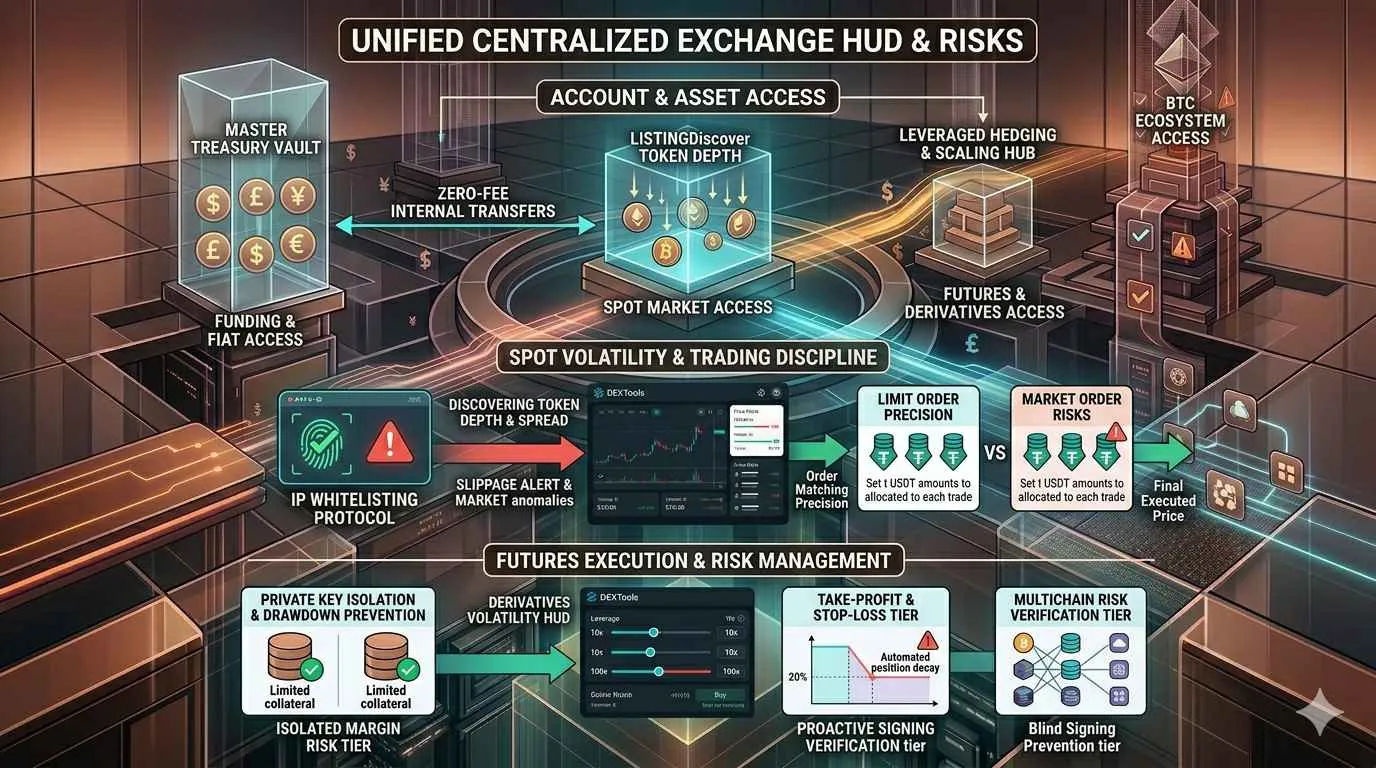
Before initiating your first spot trade or modifying leverage sliders on a futures layout, you must understand how the platform isolates balances across independent financial systems.
The Specialized Sub-Account Protocol
To protect your core holdings from unintended operational overlap or margin calls, the exchange segregates assets into dedicated account buckets:
Fiat/Funding Account: Your master onboarding treasury. This vault securely houses incoming bank transfers, credit card deposits, and direct peer-to-peer (P2P) balances. Capital here remains isolated from the trading engines.
Spot Account: The dedicated environment for standard buying and selling. Assets must be transferred internally to this account before you can interact with newly listed token pairs.
Futures Account: An entirely independent sub-account engineered for derivative execution. It holds the collateral used exclusively to back active long or short positions, protecting your spot holdings from liquidation risks.
Securing Your Session Profile
High-velocity exchanges are primary targets for automated API exploit scanners and local data keyloggers. Beyond activating standard Google Authenticator 2FA, you should configure custom IP Whitelisting for your trading keys. This advanced defensive setup ensures that even if a malicious actor acquires your login credentials or API passphrases, the exchange server will instantly block any transaction or withdrawal requests originating from an unverified network address.
Capitalizing on Speed: Navigating New Token Listings
The primary competitive edge of this platform is its hyper-aggressive token onboarding philosophy, often introducing spot trading pairs for nascent utility projects days or weeks before they scale to larger corporate exchanges.
Managing Price Volatility and Spread
Trading newly listed assets demands immense execution discipline. When a token debuts on the public order book, it undergoes an intense phase of initial price discovery. During the first few hours of trading, the spread-the difference between the highest bid and lowest ask price-can widen significantly due to fluctuating order book density.
To preserve your capital during these liquidity anomalies, avoid deploying automated Market Orders, which can force your trade to execute at a highly unfavorable price. Instead, always utilize Limit Orders to pre-define your exact entry or exit thresholds, shielding your transaction from sudden slippage.
Maximizing Capital Efficiency via MEXC Earn
For long-term asset holders who prefer steady portfolio accumulation over active intraday market execution, the platform provides a dedicated capital-efficiency portal known as MEXC Earn.
The Flexible Savings Engine
The core of the Earn suite revolves around its Flexible Savings infrastructure. This mechanism allows you to commit core stablecoins or prominent layer-1 assets to yield-generating protocols while maintaining complete transactional agility. Unlike rigid staking frameworks that lock up your tokens for weeks, flexible savings products allow you to withdraw your underlying principal back to your spot wallet instantly at any hour. This ensures you can accrue daily passive yield without missing unexpected market opportunities.
Navigating the Derivatives Market: The Perpetual Futures Guide
For experienced risk managers, the platform's high-leverage perpetual futures interface offers advanced tools to hedge spot positions or trade market directionality with capital efficiency.
Isolated Margin vs. Cross Margin Modes
When initializing a leveraged futures contract, your choice of margin configuration defines your systemic risk layer:
Isolated Margin Mode: This setting restricts the financial liability of a trade to the precise amount of collateral manually assigned to that specific position. If the market moves violently against you and hits your liquidation price, only that isolated pool is forfeit. The remaining balance in your futures sub-account remains completely unaffected.
Cross Margin Mode: This framework aggregates the entire available balance within your futures account to act as a unified collateral pool for all open positions. While this reduces the immediate likelihood of liquidation by giving losing trades a wider breathing room, a severe market crash can wipe out your entire futures portfolio simultaneously.
The Crucial Role of Take-Profit and Stop-Loss (TP/SL) Orders
Operating with leverage multiplies both your potential gains and your potential losses. Professional risk management dictates that you should never open a futures position without simultaneously embedding Take-Profit (TP) and Stop-Loss (SL) parameters directly into the order configuration.
A stop-loss order acts as an uncompromised automated trigger that alerts the matching engine to close your position the millisecond your maximum risk threshold is crossed. This step completely eliminates emotional bias from your workflow and protects your account from catastrophic liquidation events during flash-crash scenarios.
Synchronizing Centralized Trading with DEXTools Insights
Centralized listing engines and leveraged futures profiles provide top-tier execution tools, but their internal indicators are naturally restricted to the platform's localized books. To establish a truly complete market perspective, you should cross-reference your exchange actions with the expansive on-chain intelligence of DEXTools.
Before chasing a newly listed spot token or initiating a leveraged perpetual long position on the exchange, check the asset's decentralized footprint on the DEXTools Pair Explorer. New listings frequently maintain decentralized liquidity pools on various automated market makers. By analyzing the macro charts on DEXTools, you can track the historical on-chain volume profile, identify established support zones, and verify whether the asset is facing immediate sell-side distribution from early seed participants.
Simultaneously, monitoring DEXTools' live transaction logs and contract verification data provides a crucial layer of security. If your exchange book displays intense buying pressure but DEXTools reveals massive, coordinated whale distribution across decentralized pools, it alerts you to an underlying divergence. Using DEXTools as an early market health monitor allows spot and futures traders to configure accurate price targets and set tighter stop-losses before centralized books reflect broader market corrections.
Conclusion: Orchestrating a Secure Trading Workflow
Sustaining consistent portfolio growth requires a multi-layered approach to market execution. As demonstrated throughout this MEXC Tutorial, the platform provides an agile centralized environment equipped with the tools needed to capture early token listings, optimize passive balances via the Earn hub, and run leveraged derivative strategies under strict margin constraints.
However, advanced exchange features are only as effective as the market data guiding them. By grounding your centralized spot entries and futures risk settings inside the live on-chain insights, contract verification tools, and volume tracking metrics of DEXTools, you can effectively insulate your wealth from sudden market shifts and navigate the digital asset landscape with absolute clarity.
Related Guides
- How to Use MEXC Exchange: Trading Guide 2026
- Top trading Tools for New Token Listings in 2026
- Event-Driven Liquidity: How Airdrops, Listings and TGEs Create Temporary Markets
- Binance Meme Coins: Listings, Filters & Trading Guide 2026
- What Is Futures Trading in Crypto? Guide 2026
Frequently Asked Questions
What is MEXC used for?
MEXC is a centralized cryptocurrency exchange where users can trade spot and futures markets and access earn-style products. It is often known for listing a wide range of tokens, including newer ones.
What are MEXC Earn products?
Earn products generally let users set aside crypto to receive rewards over time, often through flexible or fixed-term options. The returns and terms vary by product, and rewards are not guaranteed.
What is futures trading on MEXC?
Futures trading lets users take leveraged positions that bet on the rising or falling price of an asset without holding it directly. Leverage can amplify both gains and losses and carries liquidation risk.
What should beginners know before using leverage on MEXC?
Leverage increases both potential profit and the risk of liquidation, where a losing position can be closed automatically. Beginners should start with small sizes, understand margin requirements, and use risk controls like stop orders.