MiCA Regulation Explained: EU Crypto Rules for DeFi Traders
— By AliceOnChain in Tutorials

The European Union's Markets in Crypto-Assets (MiCA) regulation is fundamentally shifting the digital asset landscape. Discover how these sweeping rules impact liquidity structures, stablecoin stability, and decentralized trading protocols, and explore the advanced on-chain metrics necessary to navigate this new compliance era.
MiCA Regulation Explained: What Crypto Users in Europe Need to Know
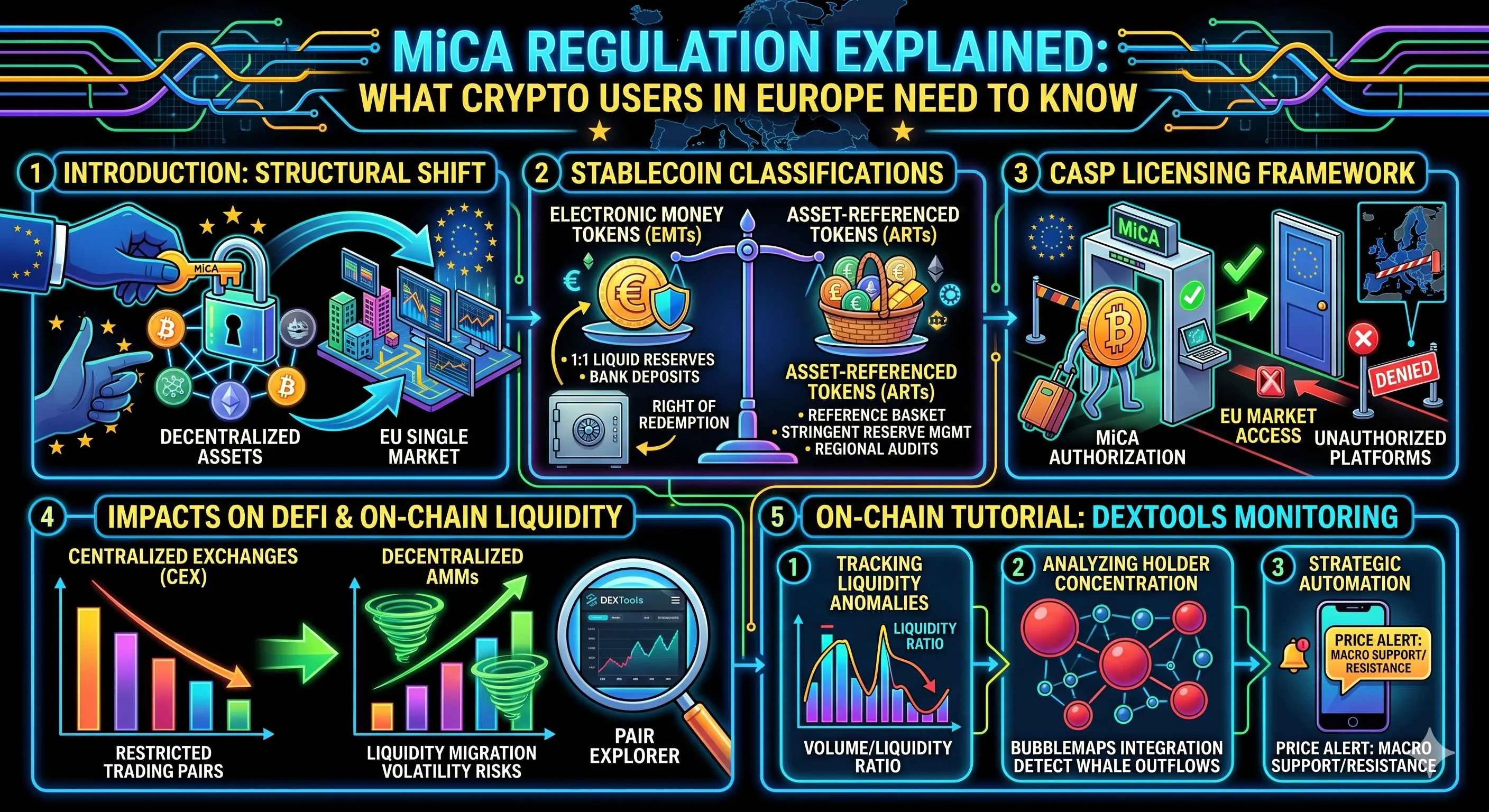
The European digital asset landscape is undergoing its most significant structural shift since the inception of decentralized networks. The Markets in Crypto-Assets framework, widely known as the MiCA regulation, represents the first comprehensive framework established by a major economic bloc to govern the issuance, trading, and custody of digital assets. While the legislative text aims to harmonize the internal market across all 27 European Union member states, the practical enforcement of this new mica regulation exerts immediate pressure on the underlying architecture of decentralized finance (DeFi), stablecoin liquidity pools, and retail market participation.
For intermediate traders and on-chain analysts, treating this sweeping mica regulation as a mere legal abstraction is a structural mistake. Regulatory shifts act as major macroeconomic catalysts that fundamentally alter capital flows, modify exchange listings, and redefine counterparty risk. Navigating the European market under the jurisdiction of the MiCA regulations necessitates an analytical approach to evaluating on-chain data, tracking systemic liquidity patterns, and monitoring the protocols that choose to adapt or exit the European single market entirely.
The Phased Architecture of MiCA Regulations
The implementation of the MiCA regulation has been systematically executed in stages to prevent sudden liquidity vacuums while ensuring compliance. The initial phase of this regulatory framework focused heavily on Asset-Referenced Tokens (ARTs) and Electronic Money Tokens (EMTs), which encompass the broader stablecoin sector. The subsequent phases of the mica regulation extend strict compliance requirements to Crypto-Asset Service Providers (CASPs), covering centralized exchanges, custodial wallet services, and localized brokerage platforms. With the final transition periods concluding in mid-2026, the market is adjusting to a fully supervised operational environment dictated by these EU rules.
Understanding the Stablecoin Dichotomy: ARTs vs. EMTs
The MiCA regulation introduces precise legal definitions for stablecoins, dividing them into categories based on their underlying backing mechanisms. This classification determines the level of capital reserves and regulatory oversight required by the issuers under the new law.
Electronic Money Tokens (EMTs): These are crypto-assets intended to maintain a stable value by referencing the value of a single official fiat currency. Under the strictures of the mica regulation, issuers of EMTs are required to hold 1:1 liquid reserves, with a significant percentage backed by segregated bank deposits, alongside giving holders an absolute right of redemption at par.
Asset-Referenced Tokens (ARTs): This category covers digital assets that attempt to maintain a stable value by referencing any other value or right, including a basket of fiat currencies, commodities, or other crypto-assets. Under the parameters of the MiCA regulations, these instruments face stringent reserve management policies and continuous audits by regional monetary authorities to verify collateral adequacy.
The CASP Licensing Framework and Extraterritorial Reality
Under the global reach of the mica regulation, any entity facilitating the exchange, placement, or custody of digital assets for EU residents must obtain formal authorization as a Crypto-Asset Service Provider. This requirement introduces strict customer due diligence (CDD) programs and transaction monitoring standards that align with broader anti-money laundering policies.
This specific aspect of the MiCA regulations severely impacts international, non-EU platforms that historically serviced European capital without localized physical presences. Platforms failing to secure localized compliance or leverage transitional grandfathering periods established by the regulation are structurally restricted from processing orders or sustaining active marketing operations within the economic area.
Structural Impacts of the MiCA Regulation on DeFi and On-Chain Liquidity
The primary friction point for active market participants does not lie within fully centralized venues, but rather within the decentralized trading pairs that rely heavily on stablecoin liquidity. Because the MiCA regulation prohibits centralized exchanges and custodial brokers from supporting unauthorized stablecoins, a fragmentation of liquidity across on-chain and off-chain ecosystems may materialize as a direct consequence of this regulatory framework.
Liquidity Pooling and Pair Stability Under New Rules
When centralized venues restrict trading pairs to comply with the mica regulation, trading volume frequently migrates to decentralized automated market makers (AMMs). This migration can drastically impact the composition of decentralized liquidity pools.
Using the DEXTools Pair Explorer, analysts can observe how the MiCA regulations shift the total value locked (TVL) and transaction volume of affected trading pairs in real time. If a non-compliant asset experiences restricted access on centralized rails due to the regulation, capital may concentrate in localized on-chain smart contracts. This influx of capital can temporarily distort normal trading patterns and heighten volatility.
Capital Outflow → Centralized Exchange Restrictions → Decentralized AMM Inflows → Increased Volatility & Slippage Risks
Divergence and De-pegging Vulnerabilities
The structural mandate for stablecoin issuers under the mica regulation to hold substantial portions of their reserves in fractional-reserve commercial banking institutions introduces distinct localized banking risks. If an issuing partner experiences structural duress while trying to comply with the regulation, the corresponding stablecoin on-chain pool could display immediate stress signals.
Traders monitoring these assets should continuously audit the DEXTools Charts for localized deviations from par value caused by market adaptations to the MiCA regulations. A prolonged contraction in liquidity combined with high sell volume on decentralized pairs often precedes broader cross-chain de-pegging events. This can be quantified by monitoring severe Relative Strength Index (RSI) divergences on short-to-medium timeframes.
On-Chain Tutorial: Monitoring MiCA Regulation Risk via DEXTools
Evaluating market health under changing regulatory conditions requires a disciplined framework. Relying on market sentiment alone is insufficient when dealing with the systemic impacts of the mica regulation; traders should analyze structural data, holder profiles, and whale behavior directly from the blockchain ledger.
Step 1: Tracking Liquidity and Volume Anomalies
To evaluate whether a specific token or pool is experiencing capital flight due to adjustments related to the MiCA regulations, navigate to the DEXTools Pair Explorer for the specific contract address. Observe the ratio between the 24-hour trading volume and the total pooled liquidity.
A sudden, disproportionate increase in trading volume relative to static or declining liquidity often signals distribution by major market participants reacting to the mica regulation. If the pool's depth is shallow, this volume acceleration can create wide bid-ask spreads and severe price slippage, compounding execution risks for retail traders trying to navigate the updated regulatory framework.
Step 2: Analyzing Holder Concentration and Distribution
Enforcement of the MiCA regulation often acts as a catalyst for institutional or large-scale reallocations. To determine if whales are quietly liquidating exposure to assets facing compliance hurdles under the regulation, access the Holder Analysis suite on DEXTools.
Holder Analysis Suite → Analyze Wallet Concentration Metrics → Cross-Reference via Bubblemaps (Identify Cluster Associations) → Detect Coordinated Capital Outflows (Whale Liquidations)
Analyze the concentration metrics to see what percentage of the circulating supply is held by the top wallets under this changing paradigm. To deepen this analysis, cross-reference the data using Bubblemaps integration to see how the mica regulation alters participant behavior. This visual mapping allows you to identify interconnected wallet clusters that may be executing coordinated capital outflows. If these key clusters display consistent balance reductions, it historically coincides with systematic distribution ahead of broader market drawdowns linked to the enforcement of the MiCA regulations.
Step 3: Utilizing Strategic Automation and Smart Triggers
Market-wide structural changes driven by the mica regulation do not conform to standard trading hours. When regulatory entities release formal updates or enforcement alerts regarding the regulation, token prices can react within seconds.
To mitigate manual monitoring fatigue brought on by compliance shifts, configure customizable Price Alerts within the DEXTools interface on primary asset pairs. Setting up multi-tiered alerts near established macro support and resistance lines allows traders to detect sudden capital shifts triggered by the MiCA regulation without constantly staring at screen interfaces.
Macro Resistance Line → Alert Tier 2: Potential Breakout / Regulatory Invalidation Current Price Action Macro Support Line → Alert Tier 1: Liquidity Drain / Stop-Trigger Target
Advanced Risk Management Under the MiCA Regulation
Sustaining long-term market participation as an on-chain trader requires adjusting your risk models to account for the ongoing roll-out of the regulatory framework. The introduction of standardized market abuse rules under the MiCA regulation means that algorithmic patterns, wash trading detection, and manipulative pool activities will face deeper scrutiny by regional authorities.
Counterparty Assessment: When selecting assets or yield-bearing contracts under the mica regulation, evaluate the geographic jurisdiction and corporate architecture of the underlying core contributors. Protocols operating with completely opaque management structures may face stricter access controls under evolving CASP rules established by the regulation.
Slippage Calibration: During periods of heightened regulatory announcements concerning the MiCA regulations, localized pool depth can thin out quickly. Manually adjusting slippage tolerances on decentralized routers prevents your trades from being executed at highly disadvantageous pricing levels during sudden market cascades.
Volatility Mitigation: High volatility often coincides with sudden updates to token whitepapers or changes in localized compliance with the mica regulation. Implementing defensive position sizing and maintaining higher balances in highly liquid, authorized e-money tokens can help preserve your capital during systemic market corrections.
Summary of Core Technical Indicators for Regulatory Analysis
To efficiently evaluate an asset's market health during transitions forced by the MiCA regulation, consistently track these fundamental metrics across your monitoring routine:
Liquidity-to-Market Cap Ratio: A low ratio implies that even minor liquidations triggered by the mica regulation can cause disproportionate downside price action.
Whale Concentration Index: Visible via Holder Analysis; high concentration suggests the token's market price remains highly vulnerable to how a few entities respond to the MiCA regulations.
Volume Profile Delta: Persistent selling volume on accelerating momentum can confirm that smart money is actively reducing exposure to assets under pressure from the ongoing regulatory framework.
What Are Liquidity Pools in DeFi? Explained
Stablecoin Market Cap vs On-Chain Liquidity Guide
Chain Rotation: How Traders Detect Liquidity Moving Between Ecosystems
Disclaimer: This article is for informational purposes only and does not constitute investment advice, financial advice, trading advice, or any other kind of advice. DEXTools does not recommend buying, selling, or holding any cryptocurrency or token. Users should conduct their own research and consult with a qualified financial advisor before making any investment decisions. Cryptocurrency investments are volatile and high-risk. DEXTools is not responsible for any losses incurred.