Organic Traction vs Paid Campaigns: How to Analyze Real Demand in a New Token
— By Whatsertrade in Tutorials

A new token can look popular very quickly. Social posts appear, influencers mention it, chat groups become active, and the chart may start moving. But popularit
A new token can look popular very quickly. Social posts appear, influencers mention it, chat groups become active, and the chart may start moving. But popularity is not always the same as demand. In crypto, especially in decentralized markets, traders need to separate organic traction from paid campaigns.
Organic traction means the market is discovering, discussing, and trading a token because people find it interesting or useful. A paid campaign means attention is being created through promotion. Both can influence price, and both can exist at the same time. The key is to understand whether the attention is turning into real market participation.
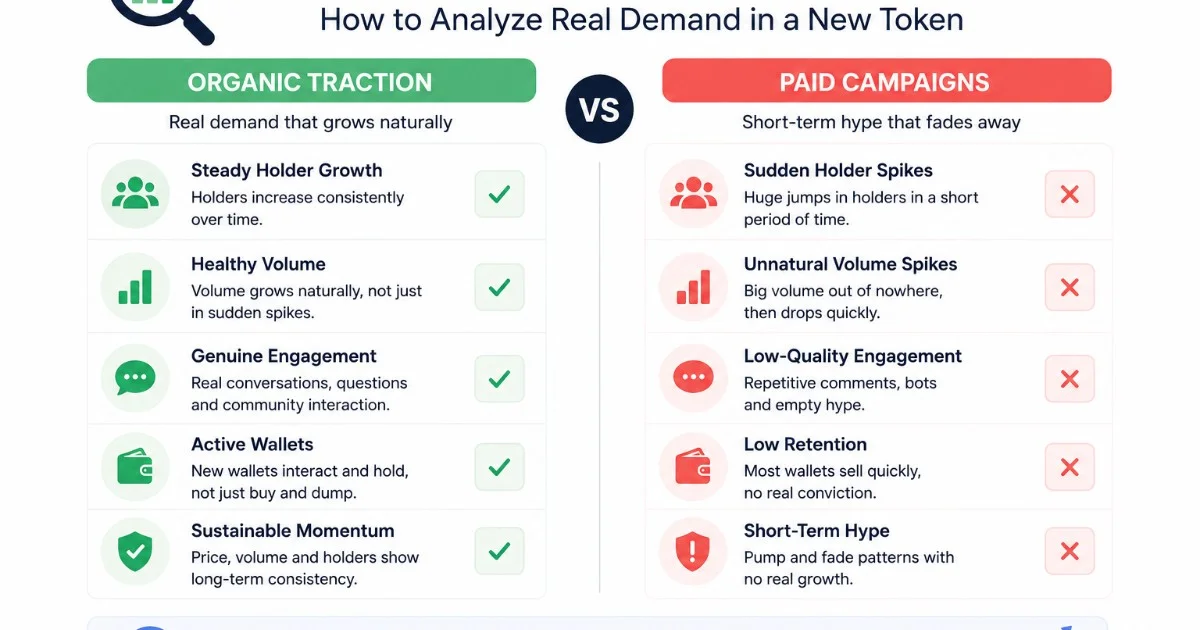
DEXTools helps traders compare social noise with actual trading behavior. By looking at volume, liquidity, transactions, holders, and price structure, traders can evaluate whether a token is building real demand or only renting attention.
Why This Distinction Matters
Paid promotion is not automatically negative. Many legitimate projects use marketing to reach new users. The problem appears when promotion creates the illusion of strength while market data remains weak. Traders who buy only because a token is visible may enter late, after the best risk reward has already passed.
Organic traction tends to produce more durable signals. When traders find a token naturally, return to it, discuss it without constant incentives, and continue trading after the first wave, the market may be showing deeper interest.
The goal is not to reject every promoted token. The goal is to ask whether the campaign is supported by real behavior on the chart.
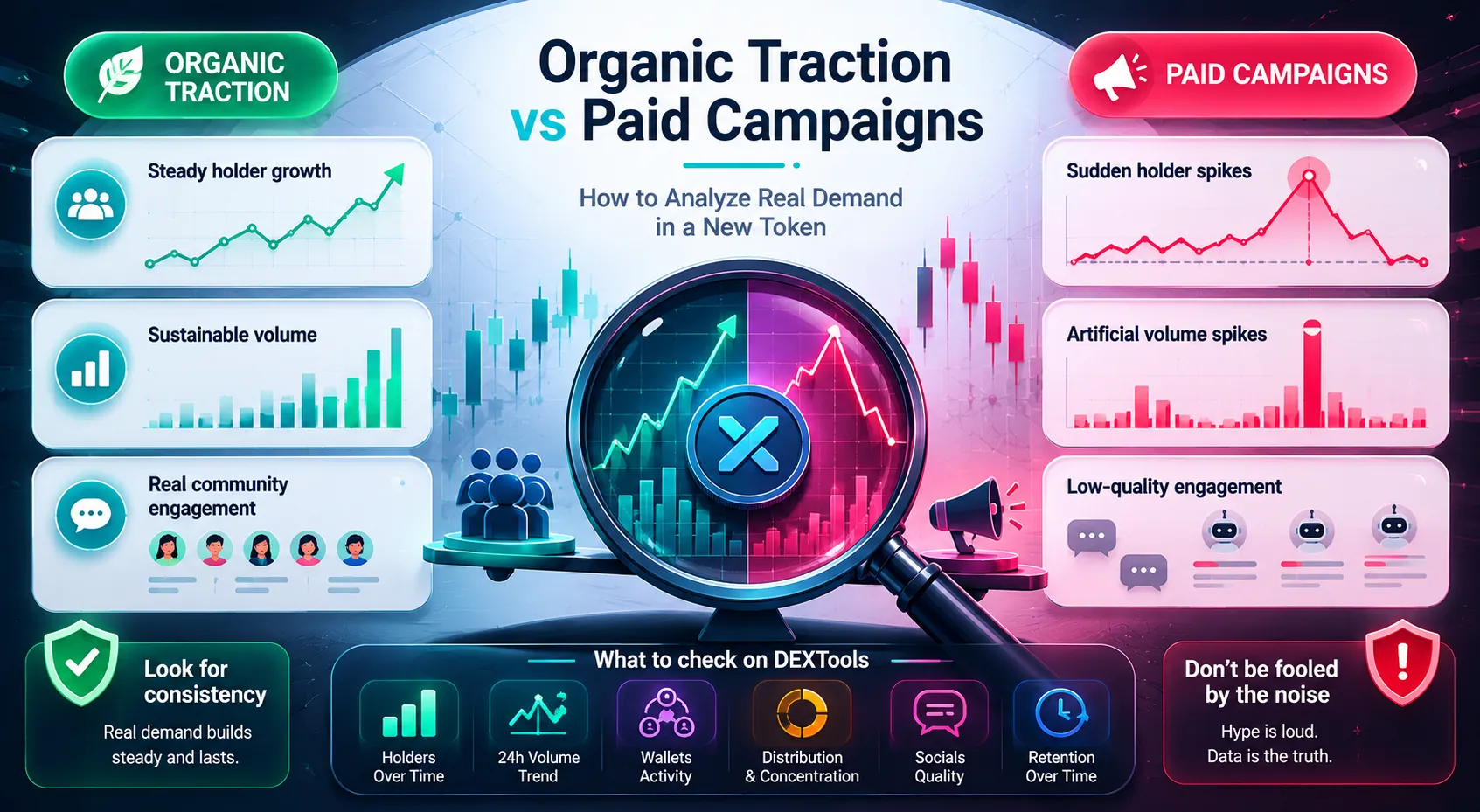
Signal 1: Volume That Continues After Promotion Peaks
Paid campaigns often create sharp attention spikes. A token may see sudden volume after a major post, call, or marketing push. The important question is what happens after the spike.
If volume disappears quickly, the campaign may have generated temporary curiosity without lasting demand. If volume remains active after the promotional moment, the token may have converted attention into real market interest.
On DEXTools, traders can watch whether activity continues across multiple periods. A single burst of volume is less convincing than repeated participation. Strong organic traction often leaves a trail of consistent trading, not just one candle.
Signal 2: Holder Growth That Looks Natural
A paid campaign may bring many new wallets, but holder growth needs context. Healthy holder growth usually appears gradually and is accompanied by real trading activity. Suspicious holder growth may come from tiny wallets, dust amounts, or distribution patterns that make the token look more popular than it is.
A token with organic traction often shows new participants entering at different times and sizes. It may have buyers who hold through small pullbacks and return during consolidation. A token driven mainly by promotion may show a wave of buyers followed by rapid exits.
Holder count is useful, but holder quality is more important.
Signal 3: Liquidity That Supports the Campaign
If a project is promoting heavily, its liquidity should support the level of attention it is trying to attract. A token that receives large visibility but has weak liquidity may create poor entries for late buyers. This can lead to extreme slippage, unstable candles, and fast reversals.
A healthier campaign is usually supported by stable or growing liquidity. This does not guarantee success, but it shows that the market structure is better prepared for attention. If promotion increases while liquidity weakens, traders should be cautious.
Marketing can bring eyes to a token, but liquidity determines whether those eyes can become sustainable market activity.
Signal 4: Price Action After Influencer Mentions
Influencer activity can create strong short term movement. The more important signal is how price behaves after the audience arrives. Does the chart hold a higher range, or does it immediately retrace? Do buyers continue to step in, or does each bounce get sold? Does volume remain balanced, or does selling pressure dominate?
Organic traction often appears when a token can absorb attention without collapsing. Paid attention without real demand often creates a spike that becomes exit liquidity for earlier buyers.
Traders should study the period after promotional activity rather than the promotional moment itself. The reaction tells more than the announcement.
Signal 5: Transaction Flow That Feels Balanced
Transaction flow can reveal whether a token has a diverse market or a narrow group of actors. Organic traction usually brings a mix of buys and sells from different participants. The market may be volatile, but activity feels distributed.
A campaign driven token may show bursts of buying followed by concentrated sells. If large wallets repeatedly sell into new buyers, promotion may be functioning as liquidity for exits. This does not always mean the token is malicious, but it changes the risk.
Recent transaction data on DEXTools helps traders evaluate whether the market is broadening or simply recycling attention.
Signal 6: Community Attention Without Constant Incentives
Organic communities keep discussing a token even when price is not moving every minute. Paid attention often fades when incentives stop. Traders can compare social behavior with market behavior to see whether the community remains engaged during quieter periods.
A token that only trends during paid pushes may struggle to maintain momentum. A token that continues to attract conversation, holders, and trades during consolidation may have stronger foundations.
The best signal appears when community attention and market activity support each other.
How Traders Can Use DEXTools in This Analysis
DEXTools allows traders to ground their research in market data. Start by opening the token pair and reviewing price action, volume, liquidity, and transactions. Then compare those signals with the timing of social activity. If a token receives heavy promotion, check whether volume and liquidity improve in a healthy way.
Next, review whether the market remains active after attention peaks. Look for signs of continued participation, not just a single spike. Finally, compare holder growth and transaction flow with the broader narrative.
This process helps traders avoid being influenced only by visibility. A token can be everywhere online and still have weak market structure.
Common Red Flags
Several patterns should make traders cautious. One is a large promotional push with very thin liquidity. Another is heavy social activity with low or fading volume. A third is repeated price spikes followed by immediate selling. Another is holder growth that appears artificial or disconnected from real demand.
The strongest red flag is a mismatch between attention and market quality. If a token looks famous but trades like nobody truly wants to hold it, the attention may be shallow.
Conclusion
Organic traction and paid campaigns can look similar at first. Both can bring volume, price movement, and social visibility. The difference appears in what happens after the initial attention.
DEXTools helps traders analyze whether a token is building real demand by tracking volume retention, liquidity stability, holder behavior, transaction flow, and price reaction. These signals allow traders to move beyond social noise and evaluate what the market is actually doing.
A paid campaign can introduce a token to the market. Organic traction is what keeps the market interested after the campaign fades.
How to Bridge Crypto Between Chains: Complete Cross-Chain Tutorial 2026 How to Use 1inch for Swaps: Classic, Fusion and Limit Orders (2026) How to Use OKX Web3 Wallet: Multi-Chain DeFi Hub Guide (2026)Related Guides
- Gas Subsidies vs Organic Fee Demand: When Free Transactions Hide Weak Adoption
- Spot Real Demand vs Hype: On-Chain Metrics Guide
- Fake Volume vs Real Demand: How to Spot Artificial Momentum in DeFi Trading
- How to Analyze Solana Meme Coins Before Trading: On-Chain Risk Checklist (2026)
- Best Free Smart Contract Analysis Tools in 2026
Frequently Asked Questions
How can you tell if a new token has real demand?
Real demand tends to show up in organic, sustained activity such as steady holder growth, genuine community engagement, and recurring on-chain transactions. Artificial hype often fades quickly once paid promotion stops.
What is the difference between organic traction and paid campaigns?
Organic traction is interest that grows naturally from users finding value, while paid campaigns are interest generated through promotions and influencer marketing. Paid attention can inflate visibility without reflecting lasting demand.
Why can a new token look popular but lack real interest?
A coordinated marketing push can produce social posts, chat activity, and price movement that look organic. Without supporting on-chain behavior and retention, that visibility may not represent durable demand.
What on-chain signals help analyze token demand?
Useful signals can include the rate and quality of new holders, transaction patterns, liquidity depth, and whether activity persists over time. Combining several metrics gives a clearer picture than any single number.