Privacy on EVM: Analyzing Aztec, Railgun, and Privacy Pools
— By AliceOnChain in Tutorials

Preserving transactional anonymity on public ledgers remains one of DeFi's greatest hurdles. This advanced guide breaks down how Aztec, Railgun, and Privacy Pools implement privacy on EVM-compatible chains, and details how smart traders analyze the liquidity and market sentiment surrounding these privacy-centric protocols.
Privacy on EVM: Aztec, Railgun, and Privacy Pools
The transparency of Ethereum and other Ethereum Virtual Machine (EVM) compatible blockchains is both a foundational feature and a significant hurdle for user discretion. Every transaction, wallet balance, smart contract interaction, and liquidity movement sits permanently in the public domain. For institutional allocators, professional traders, and privacy-conscious retail participants, this absolute transparency introduces distinct structural risks, such as front-running, sandwich attacks, and the unwanted tracking of proprietary trading strategies.
As the demand for transactional confidentiality grows, developers are building advanced cryptographic solutions directly on top of the EVM ecosystem. Achieving privacy evm compatibility requires balancing user anonymity with regulatory compliance and smart contract programmability.
This guide analyzes the architectures of three prominent privacy frameworks—Aztec, Railgun, and Privacy Pools—and provides a framework for analyzing their underlying health, liquidity, and market sentiment using on-chain metrics.
The Core Technical Architectural Approaches to EVM Privacy
Implementing privacy on an inherently transparent state machine like the EVM requires sophisticated cryptography, primarily centering around Zero-Knowledge (ZK) proofs. However, the exact execution varies wildly between layer-2 scaling solutions, smart contract mid-layer protocols, and decentralized application frameworks.
Aztec: Hybrid ZK-ZK Rollup Architecture
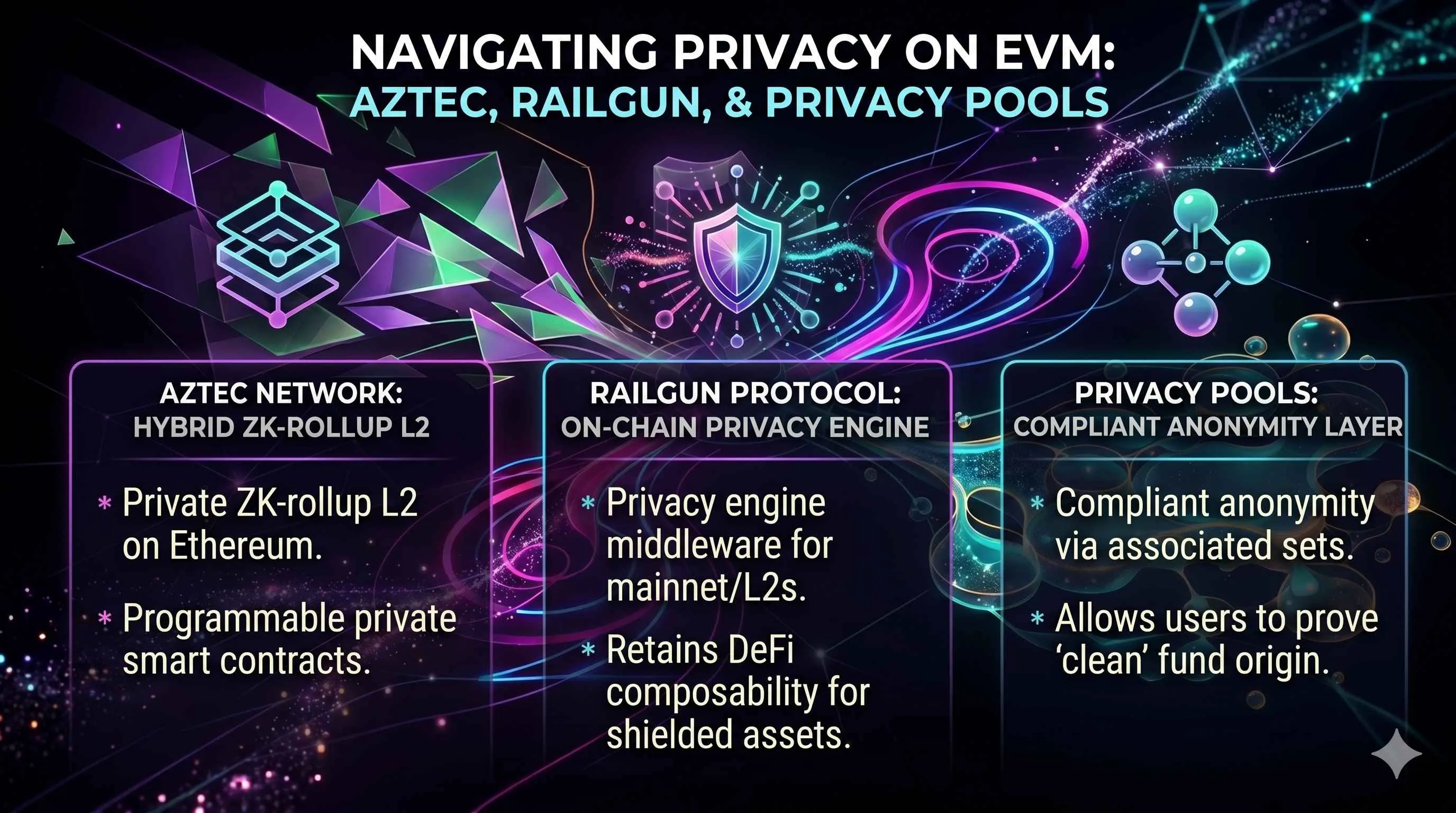
Aztec has pivoted its architecture toward creating a fully programmable, privacy-first Layer 2 network on Ethereum. Unlike early iterations that simply masked simple transfers, Aztec utilizes a hybrid ZK-ZK rollup structure. This system processes private smart contract execution off-chain, generating zero-knowledge proofs that validate the correctness of transactions without revealing the underlying state variables.
The protocol distinguishes between public state (visible to all, like standard EVM networks) and private state (encrypted via UTXO-based notes similar to Bitcoin). By executing transactions within a specialized virtual machine, Aztec allows users to interact with decentralized finance applications while keeping identities, transaction values, and balance allocations confidential.
Railgun: On-Chain Privacy Engine
Railgun takes a fundamentally different approach by deploying directly on existing EVM Layer 1 and Layer 2 chains as a system of smart contracts. Rather than migrating to a new network, users interact with Railgun's "Shielded Pool" on chains like Ethereum, Arbitrum, and Polygon.
When an asset is shielded within the Railgun smart contract system, its subsequent movements, swaps, and yield-generation activities are obscured from public view using zk-SNARKs. The primary structural advantage here is the preservation of composability. Railgun allows users to interact with existing public DeFi protocols directly from their shielded accounts, effectively acting as an anonymity middleware layer that hides the originating wallet address.
Privacy Pools: Compliance-Conscious Anonymity
Originally inspired by older mixer alternatives, Privacy Pools represent an evolutionary leap toward legally compliant on-chain privacy. The core vulnerability of historical privacy protocols was the lack of screening; malicious actors could mix illicit funds, which contaminated the entire liquidity pool and forced compliance-bound entities to abandon the platform.
Privacy Pools solve this via "association sets." Users utilize zero-knowledge proofs to demonstrate that their deposited funds did not originate from a known list of illicit or flagged addresses without revealing their specific wallet identity. This balance enables honest users to maintain transactional privacy against the broader public while remaining provably clean to regulators and institutional counterparts.
On-Chain Analysis Metrics for Privacy Protocols
Evaluating the health, stability, and market sentiment of privacy-centric EVM protocols requires a deep dive into specific on-chain metrics. Because the transactions themselves are shielded, analysts must evaluate the public entry points, exit points, and governance/utility tokens that power these ecosystems.
Liquidity and Total Value Locked (TVL) Stability
For any privacy protocol, liquidity is the ultimate arbiter of utility. In a shielded pool or privacy-centric Layer 2, deeper liquidity translates to a larger anonymity set, making it statistically harder to correlate deposits with withdrawals.
When evaluating privacy protocols, smart traders monitor the stability of the liquidity pools. Sudden, massive drawdowns in pool liquidity may signal a loss of confidence or impending regulatory pressure. Conversely, steady, organic accumulation of liquidity suggests a growing network effect.
Using tools like the DEXTools Pair Explorer, analysts can inspect the depth of trading pairs associated with privacy tokens, examining the real-time order books, spread, and historical liquidity provisioning to ensure that the ecosystem can support larger allocations without massive slippage.
Volume-to-Liquidity Ratios and Price Action
Tracking trading volume against available liquidity provides critical insights into market sentiment and capital efficiency. High trading volume relative to a pair's liquidity often coincides with increased price volatility, signaling intense speculative interest or rapid accumulation/distribution cycles.
Analyzing historical price action alongside volume trends helps identify structural support and resistance levels for privacy tokens. An expansion in volume while a token breaks out above a major resistance level often confirms strong underlying demand, whereas declining volume during a price rally may indicate exhausting buy pressure.
Identifying Whale Activity and Holder Distribution
Because privacy protocols are heavily scrutinized, understanding the concentration of token supply among large ecosystem participants is crucial. High token concentration in a few wallets presents a structural risk; if a single large holder decides to liquidate their position, the resulting market impact can be severe.
Analysts utilize advanced tools like DEXTools Holder Analysis and integrated visual features like Bubblemaps to assess token distribution. Examining the dispersion of tokens across contract addresses and individual wallets reveals whether a protocol is decentralized or dominated by a handful of insiders and early venture allocators.
Volatility Management via Technical Indicators
Due to regulatory uncertainties and varying network adoption rates, privacy-focused assets can experience intense shifts in market sentiment. Traders frequently employ momentum oscillators, such as the Relative Strength Index (RSI), to manage volatility risk.
Monitoring for RSI divergence is a common practice when charting these assets. For example, if a privacy token's price prints a new lower low while the RSI registers a higher low, it reveals a bullish divergence that can signal an impending shift in market momentum. Conversely, bearish RSI divergences often caution that an uptrend is losing structural strength, prompting a re-evaluation of exposure.
Tutorial: Step-by-Step Guide to Tracking Privacy Protocols on DEXTools
Monitoring the market behavior of tokens tied to privacy architectures requires a systematic setup. This framework outlines how to leverage on-chain analytics to evaluate the market conditions of EVM privacy assets.
Step 1: Locating the Primary Pair and Assessing Liquidity
Begin by navigating to DEXTools and searching for the governance or utility token associated with the specific privacy protocol you are analyzing. Ensure you verify the smart contract address against official documentation to avoid spoof tokens or phishing pools.
Open the Pair Explorer for the primary trading pair (e.g., Token/WETH). Examine the total liquidity metric displayed in the informational panel. A healthy pool should display deep, locked, or contract-verified liquidity relative to its daily volume, mitigating the risk of sudden liquidity removal.
Step 2: Set Technical Parameters and Price Alerts
Switch to the charting view within the Pair Explorer to map out current market behavior. Apply key structural indicators to your chart:
Set exponential moving averages (EMAs) to identify macro trends.
Draw clear horizontal lines marking major historical support and resistance zones.
Overlay the RSI indicator at the bottom of the chart to monitor for overbought or oversold extremes.
If you are waiting for a specific entries or structural confirmation, use the DEXTools Price Alerts feature to set customized triggers at key technical levels, ensuring you remain informed without constantly monitoring the live tape.
Step 3: Audit Holder Distribution and Transfer Dynamics
Navigate to the Holder Analysis tab to review the supply architecture. Check the percentages of supply held by the top 10, 20, and 50 wallets.
Utilize the Bubblemaps integration to visually trace the relationships between these top holding addresses. Look closely for clusters of interconnected bubbles; a large network of linked wallets shifting tokens among themselves can signal hidden concentration or coordinated market activity that may not be apparent from a simple text list of holders.
Step 4: Monitor Real-Time Order Flow and Volatility
Scroll down to the real-time transaction history ledger below the chart. Filter the ledger to isolate large transactions, often referred to as whale swaps.
Observing a cluster of large buy orders hitting the pool at a defined support zone can confirm an accumulation phase. Conversely, a steady stream of large market sell orders can signal a broader distribution phase, warning you of heightened volatility and potential downward price pressure.
Conclusion and Risk Management in Privacy Ecosystems
Navigating the landscape of privacy evm integrations requires a dual understanding of advanced cryptographic tech and disciplined on-chain analysis. Networks like Aztec, protocols like Railgun, and compliance-oriented layers like Privacy Pools present compelling solutions to the public ledger privacy dilemma, yet each carries distinct operational profiles.
When tracking these ecosystems, disciplined risk management remains paramount. Regulatory shifts can rapidly alter the liquidity profile and accessibility of privacy-centric protocols. By routinely monitoring on-chain metrics—such as pool depth, holder distribution patterns, volume spikes, and technical momentum indicators—market participants can make data-driven assessments of protocol health, avoiding speculative pitfalls while identifying stable, long-term infrastructure development.
What Is Railgun? The On-Chain Privacy Protocol for EVM DeFi Explained in 2026Sandwich Attacks and MEV Risks in DEX Trading
Top 5 Crypto Privacy Tools in 2026: Protecting Your On-Chain Anonymity
Smart Contract Audit Guide: How to Read an Audit Report
Disclaimer: This article is for informational purposes only and does not constitute investment advice, financial advice, trading advice, or any other kind of advice. DEXTools does not recommend buying, selling, or holding any cryptocurrency or token. Users should conduct their own research and consult with a qualified financial advisor before making any investment decisions. Cryptocurrency investments are volatile and high-risk. DEXTools is not responsible for any losses incurred.