Sandwich Attacks and MEV Risks in DEX Trading
— By Whatsertrade in Tutorials
Explore how sandwich attacks and MEV influence traders on decentralized exchanges. Learn tips to minimize crypto slippage risk.
Understanding Sandwich Attacks and MEV in Crypto Trading
Decentralized exchanges offer traders freedom, speed, and early access to new tokens, sometimes long before they hit centralized platforms. However, that freedom comes with inherent risks. One of the lesser-known threats is MEV, especially sandwich attacks in crypto trading.
A sandwich attack makes your trade costlier without you realizing it until the transaction is finalized. It can inflate your entry price, hinder execution, and turn a promising trade into a loss. For active DEX traders, understanding sandwich attacks is critical.
This guide unpacks sandwich attacks, the concept of MEV (Maximal Extractable Value), the impact on retail traders, and ways to mitigate risks when using DEXTools and decentralized exchanges.
Defining MEV in the Crypto World
MEV, or Maximal Extractable Value, refers to the maximum value that can be extracted by altering the order, inclusion, or timing of transactions within a block.
Simply put, when a transaction is submitted on a blockchain, it's not always executed immediately. It may linger before being confirmed. During this time, bots can scan these pending transactions for profitable opportunities.
MEV bots can profit by:
- Front running trades
- Back running trades
- Engaging in arbitrage
- Liquidating positions
- Executing sandwich attacks
Not all MEV activities are harmful; some enhance market efficiency. However, sandwich attacks explicitly harm traders by extracting value off their orders.
Decoding a Sandwich Attack
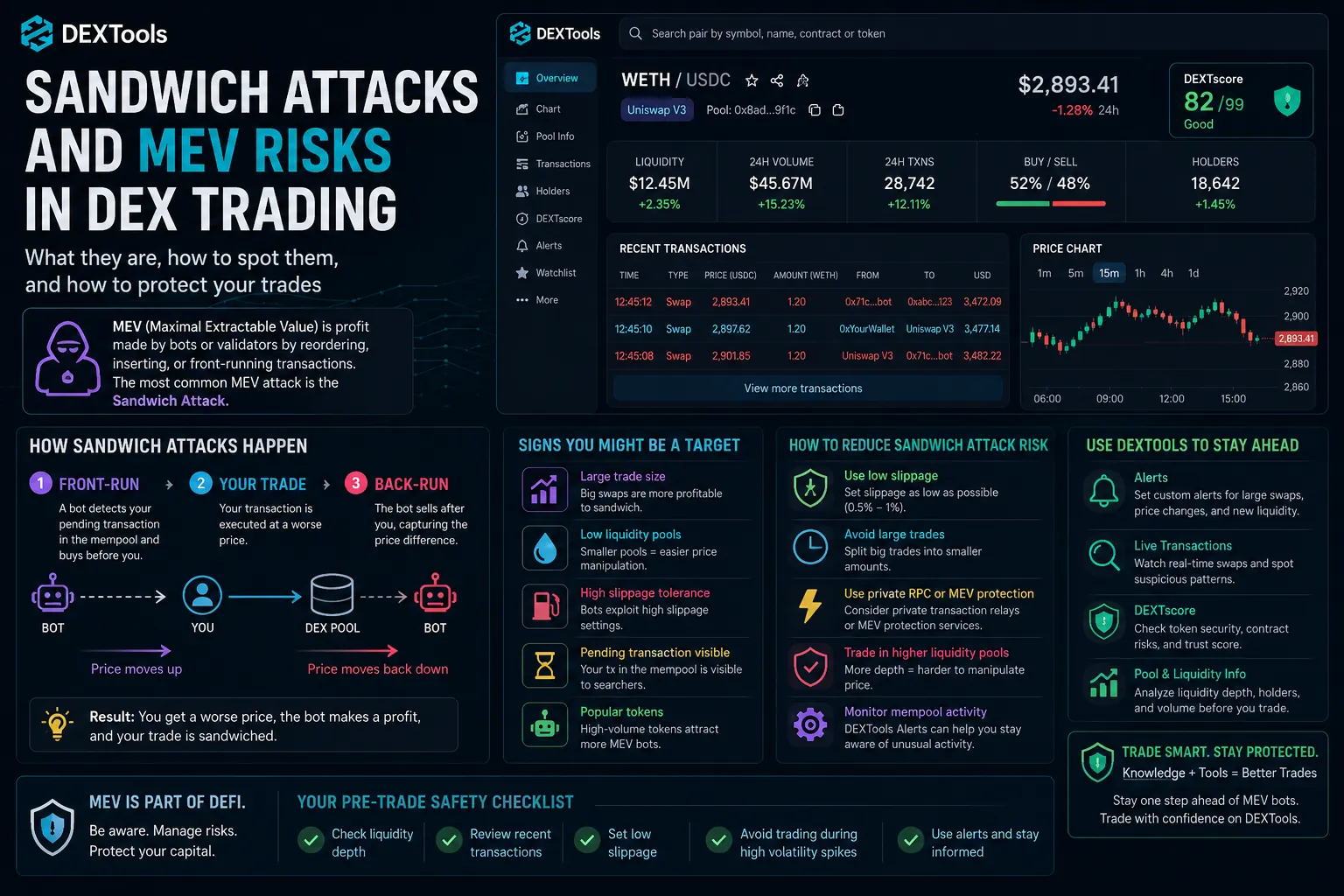
A sandwich attack occurs when a bot places a transaction both before and after your trade.
The sequence goes as follows:
- The bot detects your pending buy order
- The bot buys ahead of you
- Your buy order executes at an elevated price
- The bot sells after you
- The bot profits from the price movement driven by your order
Your trade forms the middle layer of the sandwich. The bot exploits your trade to predictably alter the price and capture profits.
Sandwich attacks are prevalent in scenarios involving tokens with low liquidity, high slippage tolerance, or large order sizes relative to pool depth.
Why Retail Traders Fall Victim
Retail traders are susceptible because many set aggressive slippage settings to secure transactions, especially during new launches, meme coin surges, or volatile markets.
High slippage settings signal to the market that you're open to higher prices. MEV bots leverage this information.
You're likely more exposed if:
- You trade in low liquidity tokens
- You tolerate high slippage
- Your orders are substantial relative to pool size
- You trade amidst major hype events
- You pursue fast-changing tokens
- You buy right after a token trends upward
The more predictable and profitable your trade seems, the more it attracts MEV bots.
Impact of Sandwich Attacks on Trades
Sandwich attacks can negatively impact your trades in several ways.
Firstly, you might pay more than anticipated. The bot's buy prior to yours could push the price upward, forcing your order to execute at a higher cost.
Secondly, your position might begin at a loss. After the bot sells, prices can dip back, leaving you with an unfavorable entry.
Thirdly, your slippage tolerance might be exhausted, implying acceptance of much poorer execution than initial chart reviews suggested.
Lastly, frequent sandwich activity can render a token more volatile and harder to predict.
For short-term traders, this variance may decide between a profitable trade and an immediate loss.
Spotting Sandwich Activity on DEXTools
DEXTools provides traders with charts, transactions, liquidity views, and price movement insights. While sandwich attacks confirm at a transactional level, several patterns suggest potential MEV activity.
Watch out for these signs.
Indicator 1: Abrupt Price Movements Near Single Trades
When trades are bookended by sudden buys and sells, it could signal MEV activity. A large buy quickly followed by a sell may indicate that bots are exploiting price impacts.
Observe:
- A buy preceding a significant trade
- A substantial user trade
- An immediate sell thereafter
- Transactions closely timed
- Price reverting to its prior level
This pattern can be especially concerning in low liquidity pools.
Indicator 2: High Slippage Tokens
Tokens necessitating high slippage for trading are more susceptible to attacks. Some involve transfer taxes or unstable liquidity, demanding higher slippage; others remain illiquid.
High slippage expands room for poor execution.
Before diving in, consider:
- Why does this require high slippage?
- Is there sufficient liquidity for the order?
- Will my trade shift the price noticeably?
- Can I divide the order into smaller trades?
- Is the token stable enough to enter?
The aim is not merely ensuring transaction success but securing a fair price entry.
Indicator 3: Large Orders Relative to Pool Liquidity
Your order size bears significance. Small buys in deep pools usually have minimal impact. Large trades in thin pools can shift prices enough to grab bot attention.
Compare your trade size with liquidity before proceeding. If your order forms a significant pool portion, execution risks heighten.
Thin liquidity translates to:
- Higher price impact
- Increased slippage
- Simpler manipulation
- Greater exposure to MEV
- Difficult trade exits
In DEX trading, liquidity is more than a number; it's your safeguard.
Indicator 4: Volatile Conditions During Launch
New token launches present prime environments for sandwich attacks. Traders often buy frantically, rely on high slippage, and neglect execution quality. Bots exploit this chaos.
Exercise caution during:
- Token introductions
- Meme coin spikes
- Influencer-promoted entries
- Major announcements
- Early trading with low liquidity
- Trending chart breakouts
Bots likely monitor aggressive market entries driven by urgency.
Strategies to Mitigate Sandwich Attack Risks
While you can never entirely eliminate MEV risk, minimizing exposure is possible.
Adopt Lower Slippage Rates
Avoid unnecessarily high slippage rates. While they might ensure transaction success, they also permit poor execution.
Opt for minimal slippage that fits the token's requirement. If exorbitant slippage is essential, reconsider the trade's worthiness against accompanying risks.
Avoid Oversized Orders in Thin Liquidity
Placing large orders in low liquidity pools increases susceptibility to attacks. Smaller entries are advisable, especially when dealing with new or volatile tokens.
Reducing order sizes can lessen price impacts and deter bot interest.
Examine Liquidity Before Transactions
Leverage DEXTools for liquidity insights before initiating trades. Higher liquidity usually signals reduced price impact and execution risks.
Avoid focusing solely on market caps or chart momentum. Safety during entry and exit relies heavily on liquidity strength.
Resist Chasing Overly Fast-Moving Candles
As tokens accelerate, traders often join in with high slippage, elevating MEV risks.
A preferable approach is to await consolidation, scrutinize transaction qualities, and enter under calmer conditions.
Analyze Transaction Flow
Before trading, review the live transaction feed. If transactions are consistently flanked by swift buys and sells, proceed cautiously.
Transaction flow indicates market quality, distinguishing organic markets from those dominated by robotic, aggressive activities.
Errors Increasing MEV Susceptibility
Many traders inadvertently simplify MEV activities by rushing decisions.
Avoid these pitfalls:
- Setting excessively high slippage without liquidity reviews
- Executing large trades in small pools
- Neglecting price impacts
- Following volatile trendings
- Trading solely from social media hype
- Ignoring recent transaction analyses
While MEV bots are swift, several trader losses stem from presenting them easy-to-exploit opportunities.
Stay Prepared for Better Execution
Sandwich attacks represent hidden costs in DEX pursuits. Despite appearing minor in charts, they can silently undermine trade profitability through subpar execution.
Being well-prepared is essential. Before trading, assess liquidity, slippage, transaction flow, and order sizes. Use DEXTools to gauge market stability versus aggressive bot activity.
In decentralized markets, execution matters as much as direction. Even a solid trading strategy can lead to losses if execution is flawed.
FAQ
What is a sandwich attack in crypto?
A sandwich attack involves a bot placing transactions around your trade to leverage the price movement your order causes.
What does MEV mean?
MEV describes the maximum value extractable by strategically orchestrating blockchain transaction orders.
Are sandwich attacks illegal?
Depending on jurisdiction and context, regulations vary. In decentralized markets, such attacks often align with technical and structural market risks instead of clear-cut exchange violations.
How can I avoid sandwich attacks?
Adopt lower slippage rates, dodge oversized trades in thin liquidity, inspect transaction flow, and prevent hasty actions during highly volatile launches.
Can DEXTools assist in identifying MEV risks?
DEXTools offers charts, liquidity data, and transaction insights, aiding traders in spotting elevated MEV risk conditions.
CTA: Before initiating your next DEX trade, evaluate liquidity, slippage, and active transactions on DEXTools to ensure improved execution. Informed trading starts with precise data.
How to Bridge Crypto Between Chains: Complete Cross-Chain Tutorial 2026 How to Use 1inch: Complete DEX Aggregator Swap Tutorial (2026) How to Use OKX Web3 Wallet: Multi-Chain DeFi Hub Guide (2026)Frequently Asked Questions
What is a sandwich attack in crypto?
A sandwich attack is a type of market manipulation where an attacker places two orders around a victim's pending transaction. The attacker buys before the victim's transaction executes, driving up the price, and then sells immediately after, profiting from the price difference.
How do sandwich attacks exploit MEV?
Sandwich attacks exploit Miner Extractable Value (MEV) by front-running and back-running victim transactions. Validators or sophisticated traders can reorder transactions within a block to their advantage, capturing value from price movements they induce.
What are the risks of sandwich attacks for DEX traders?
DEX traders face risks of price slippage and financial loss due to sandwich attacks. Their intended trade execution price can be significantly worse than anticipated, leading to reduced profits or increased losses.
How can I protect myself from sandwich attacks?
Strategies to mitigate sandwich attack risks include using private transaction relays to avoid public mempools, setting higher slippage tolerance (though this has its own risks), or trading on DEXs with built-in anti-MEV mechanisms.
Are sandwich attacks legal?
The legality of sandwich attacks is a complex and evolving area. While they exploit market inefficiencies, specific regulations directly addressing these decentralized trading strategies are still under development in many jurisdictions.
Related Guides
- What Is a MEV Bot: Complete Frontrunning & Sandwich Attacks Guide (2026)
- What Is a Sandwich Attack in Crypto? How MEV Worsens Your Trades (2026)
- MEV Risks for Crypto Traders: How to Reduce Losses
- How to Use MEVX: Complete MEV Protection and Trading Tutorial (2026)
- What Is Matcha? The 0x-Powered DEX Aggregator Explained (2026 Guide)