Retention Cohorts vs Daily Active Wallets: Why Crypto User Quality Matters
— By Whatsertrade in Tutorials

Daily active wallets are one of the most common metrics used to measure crypto adoption. If a dApp has more active wallets, it may look like the product is grow
Daily active wallets are one of the most common metrics used to measure crypto adoption. If a dApp has more active wallets, it may look like the product is growing.
But daily active wallets do not always show user quality.
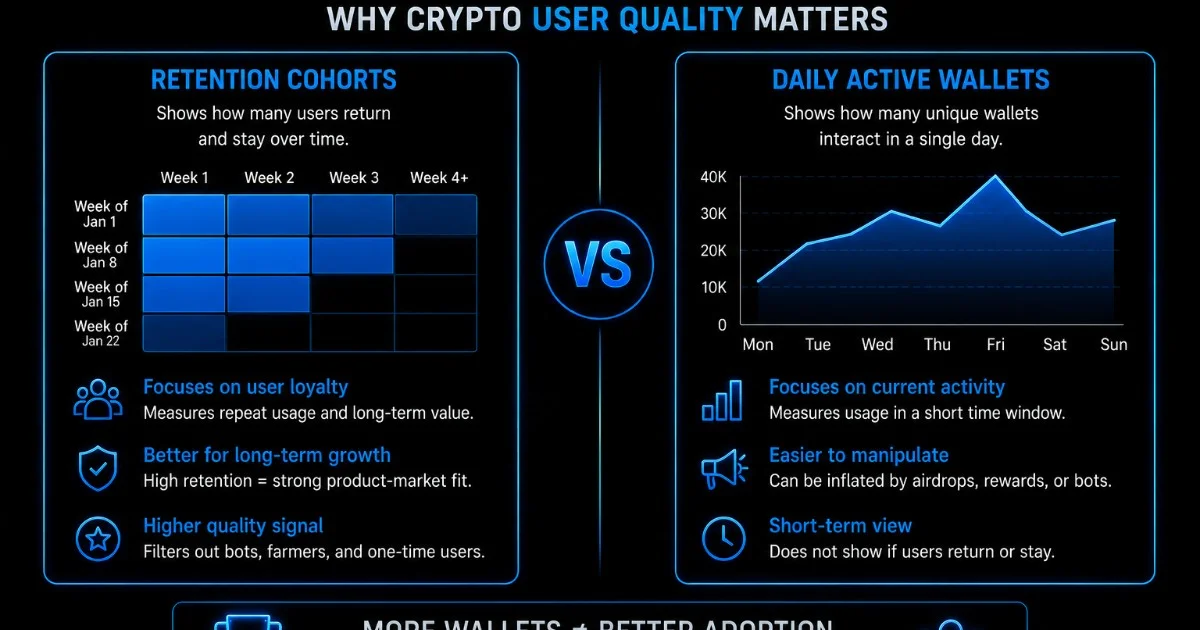
A dApp can attract many wallets for a short time through rewards, airdrops, campaigns or speculation. If those users do not return, the growth may not be sustainable.
Retention cohorts help reveal whether users come back over time.
Understanding retention cohorts vs daily active wallets can help traders and analysts judge real dApp adoption more accurately.
What Are Daily Active Wallets?
Daily active wallets measure how many unique wallets interact with an application or network during a day.
This metric is useful because it shows current activity. A rising number of active wallets may indicate more attention, stronger usage or a successful campaign.
However, daily active wallets show a snapshot. They do not prove that users are loyal or engaged.
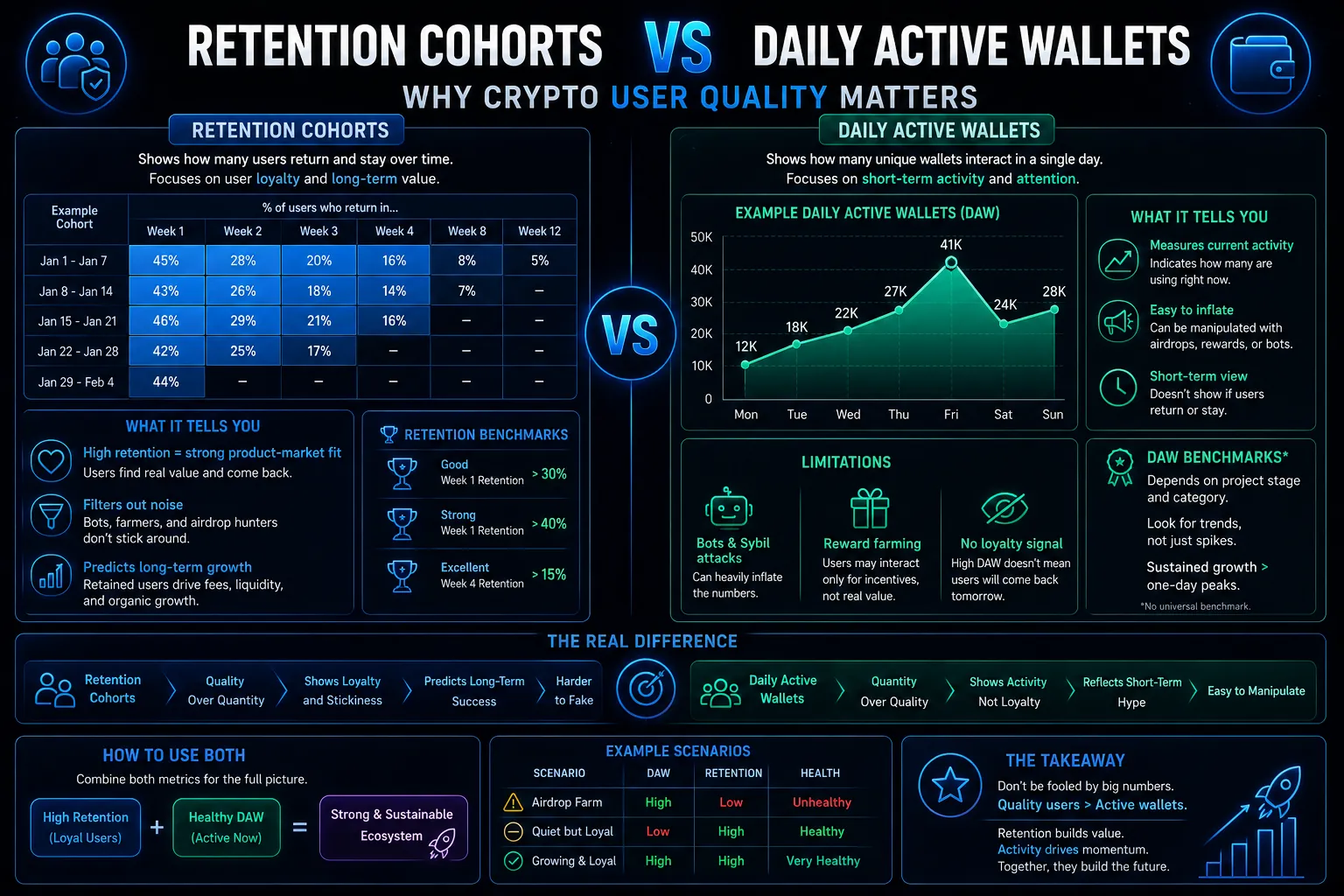
What Are Retention Cohorts?
Retention cohorts group users based on when they first interacted with an application and track whether they return over time.
For example, a cohort may include all users who joined in January. Analysts then check how many of those users returned after one week, one month or three months.
Retention cohorts show whether users stay.
This makes them useful for measuring long term product quality.
Retention Cohorts vs Daily Active Wallets: The Key Difference
The key difference is activity today vs loyalty over time.
Daily active wallets show how many wallets are active now. Retention cohorts show whether users keep coming back.
A dApp can have high daily active wallets but poor retention. That may suggest temporary activity.
A dApp with moderate daily active wallets but strong retention may have better user quality.
Why Daily Active Wallets Can Be Misleading
Daily active wallets can be inflated.
Airdrop farmers may create many wallets. Bots can interact with applications repeatedly. Incentive campaigns may attract users who leave once rewards end.
This can make user growth look stronger than it really is.
A high number of daily active wallets is useful only if those wallets represent meaningful and repeated engagement.
Why Retention Cohorts Matter
Retention shows whether users find enough value to return.
If users continue interacting after the first visit, the product may have stronger demand. If users disappear quickly, adoption may be shallow.
Retention is especially important in crypto because incentives can create temporary spikes.
Long term users are usually more valuable than one time wallets.
What Strong Retention Looks Like
Strong retention usually means users return regularly without needing constant rewards.
They may continue trading, staking, lending, voting, playing, minting or using the product because it solves a real problem.
Good retention can indicate product market fit.
It can also support stronger token narratives if the token benefits from continued usage.
What Weak Retention Looks Like
Weak retention may appear when user activity spikes during a campaign and falls soon after.
This can happen after airdrops, points programs, NFT mints or temporary yield opportunities.
If most users do not return, the project may be attracting attention but not building loyalty.
For traders, this can be a warning sign.
User Quality Matters More Than User Quantity
In crypto, not all users are equal.
One loyal user who trades, provides liquidity or participates in governance may be more valuable than many wallets that interact once.
User quality depends on behavior, retention, transaction value, engagement depth and willingness to pay fees.
Daily active wallets measure quantity. Retention cohorts help measure quality.
What Traders Should Analyze
Traders should ask:
Are active wallets growing?
Do users return after the first interaction?
Does activity remain after rewards end?
Are users interacting with core features?
Are wallets real users or farming accounts?
Is transaction value meaningful?
Does user retention support token demand?
Are cohorts improving over time?
These questions help identify sustainable adoption.
How DEXTools Can Help
DEXTools can help traders monitor whether user adoption narratives are reflected in token markets. If a project claims strong user growth, traders should still review liquidity, volume, price action and transaction flow.
If user activity rises but token liquidity weakens, market confidence may not be strong.
Combining user metrics with live trading data gives a clearer view.
Final Thoughts
Retention cohorts and daily active wallets reveal different parts of crypto adoption.
Daily active wallets show current activity. Retention cohorts show whether users stay.
For real dApp growth, retention is often more important than short term wallet spikes.
In crypto, user quantity can create hype. User quality creates durability.
How to Bridge Crypto Between Chains: Complete Cross-Chain Tutorial 2026 How to Use 1inch for Swaps: Classic, Fusion and Limit Orders (2026) OKX Web3 Wallet Tutorial 2026: Multi-Chain Setup GuideBeyond the Raw Numbers: Understanding Cohort Behavior and Value
While daily active wallets provide a snapshot of current engagement, they tell us little about the underlying health or long-term potential of a dApp. A surge in active wallets could be a fleeting response to a promotional event or a temporary market trend. True insight emerges when we segment these users into cohorts based on their acquisition date or initial interaction and then track their behavior over time. This allows us to differentiate between sustainable growth driven by genuine user retention and transient activity.
Analyzing retention cohorts reveals patterns of user loyalty, product stickiness, and the effectiveness of onboarding processes. For example, a dApp might see a high number of initial users, but if subsequent cohorts demonstrate rapidly declining retention rates, it signals a fundamental issue with the product's value proposition or user experience. Conversely, consistent retention across cohorts, even with smaller initial numbers, points to a strong, sustainable user base.
Practical Applications of Cohort Analysis for DApp Developers
- Identify the most effective marketing channels by comparing the retention rates of users acquired through different campaigns.
- Pinpoint product features that drive long-term engagement by observing which features retained cohorts utilize most frequently.
- Optimize onboarding flows by analyzing the drop-off points for early-stage cohorts and making targeted improvements.
- Forecast future user growth and revenue more accurately by understanding the typical lifecycle and value of different user segments.
- Detect "churn" early by monitoring the activity patterns of specific cohorts and proactively addressing potential issues before users fully disengage.
Related Guides
- What Is Privy: Embedded Wallets, User Onboarding and Key Infrastructure (2026)
- What Is Privy: Embedded Wallets, Auth and User Onboarding (2026)
- Token Transfer Velocity vs Holder Retention: What Shows Real Conviction?
- Airdrop Claim Rate vs Retention Explained
- Liquidity Turnover vs TVL: How to Know If a DeFi Pool Is Active or Idle
Frequently Asked Questions
What are daily active wallets in crypto?
Daily active wallets count how many unique wallets interact with a protocol or application in a day. It is a common measure of activity but does not by itself show whether users return.
What is a retention cohort?
A retention cohort groups users by when they first joined and tracks how many keep coming back over time. This helps reveal whether an application is keeping users rather than just attracting new ones.
Why does user quality matter more than raw active counts?
A high active wallet count can be inflated by one time users, airdrop hunters, or bots who do not stick around. Retention shows whether users find lasting value, which is a stronger signal of real adoption.
How do retention cohorts complement active wallet metrics?
Active wallets show current activity, while cohorts show how that activity holds up over time, so together they give a fuller view. Reading both helps distinguish genuine growth from short lived spikes.