Second Chance Tokens: Reviving Failed Crypto Launches
— By Whatsertrade in Tutorials

Failed crypto launch? Explore which tokens might deserve another shot based on liquidity, community, and market dynamics.
Understanding Second Chance Tokens in Crypto
Not every failed crypto launch spells the end for a token. Some projects stumble out of the gate due to poor timing, technical issues, liquidity challenges, or unclear messaging. At times, the market's pace outstrips a team's ability to keep up, contributing to a failed crypto launch.
Key Takeaways
- Understanding Second Chance Tokens in Crypto
- Reasons Behind Failed Launches
- Spotting Tokens with Recovery Potential
- Frequently Asked Questions
- Related Guides
While most failed launches should be met with caution, a handful of these tokens can rebound and become intriguing again. These are what we call second chance tokens.
The challenge lies in distinguishing between genuinely defunct projects and those on the path to recovery.
Defining a Second Chance Token
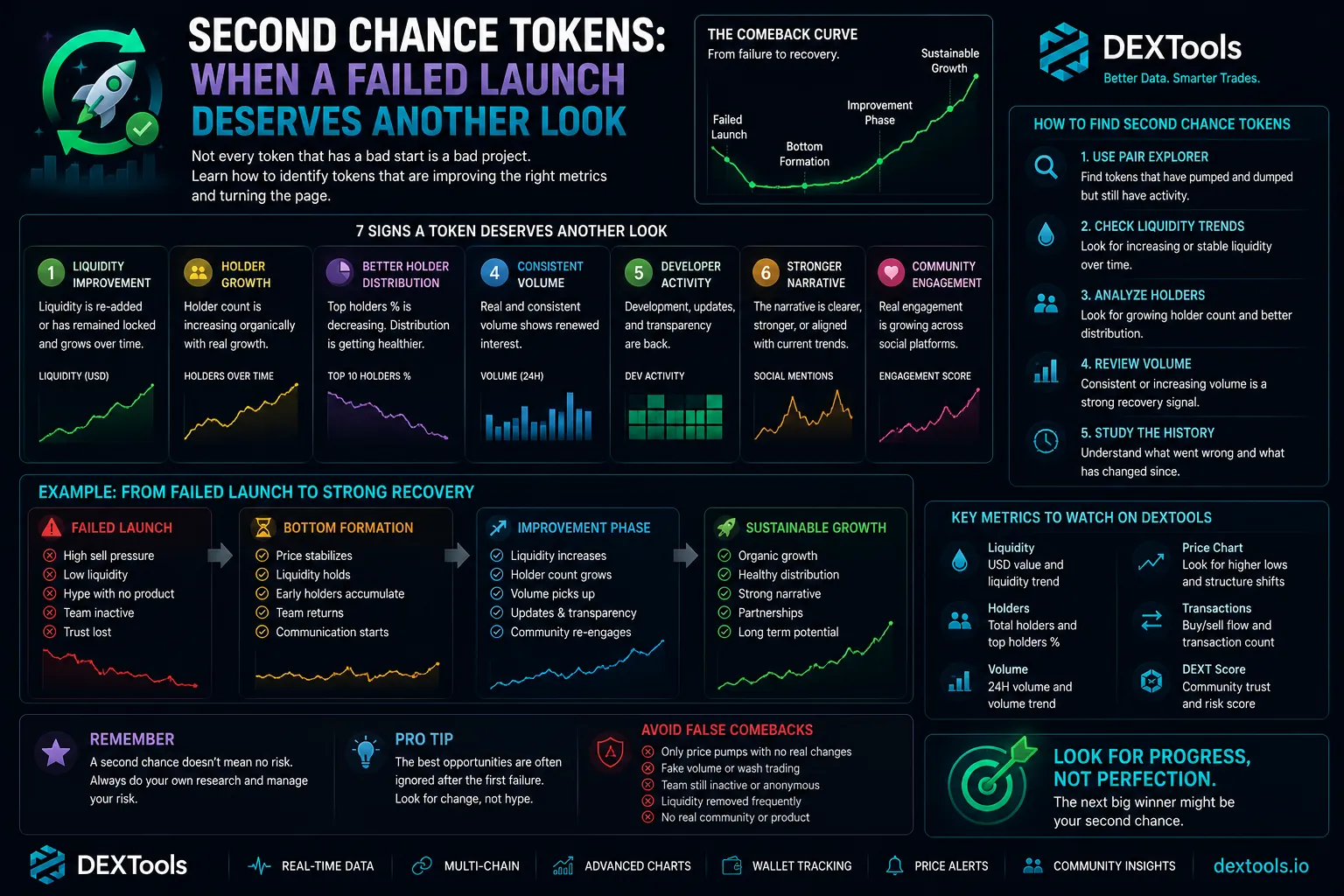
A second chance token is one that initially performed poorly but later shows signs of improvement. It might have lost early momentum, seen a significant selloff, or failed to draw attention at the start.
The token's revival often coincides with improved market structure. This can involve healthier liquidity, stabilization among holders, enhanced communication, or new catalysts emerging.
It's crucial to remember that a second chance token isn't a guaranteed good trade-it's a project prompting fresh analysis instead of instant dismissal.
Reasons Behind Failed Launches
Common Pitfalls in Crypto Launches
Crypto launches can stumble for various reasons. Some of the most common include:
- Poor liquidity at launch
- Market timing issues
- Lackluster communication from the team
- Early buyers cashing out aggressively
- Confusing narratives
- Technical glitches or contract problems
- Insufficient community preparation
While some issues may be fatal, others are potentially fixable.
Identifying Truly Failed Tokens
Before seeking recovery potentials, traders need to recognize the signs of failure. A genuinely dead token often exhibits diminishing liquidity, negligible volume, inactive community channels, large-scale holder exits, and lacks rebuilding efforts.
Even if the chart occasionally moves, a token without genuine market engagement is essentially lifeless. Such projects might tease small price pumps, but the underlying support remains flimsy.
A project with no communication, liquidity support, or buyer retention likely isn't a second chance candidate-it's a zombie token.
Spotting Tokens with Recovery Potential
When to Consider a Second Look
A token deserves renewed consideration when multiple conditions improve together.
Indicators of potential recovery include:
- Stabilized liquidity
- Organic volume return
- Steady holder numbers
- Enhanced team communication
- Chart base formation
- Reduced concentration of early distribution
- New catalysts post-failure
The best recovery situations usually indicate both market and communication progress.
Building a New Investment Thesis
A second chance trade requires a fresh rationale. Buying solely based on a token's low price isn't sufficient.
The new thesis could involve improved liquidity, a refined narrative, community revitalization, product updates, or stronger holder behavior. Without a new thesis, traders risk falling into the trap of buying weakness with fingers crossed.
Consider: what has changed since the unsuccessful launch?
If nothing significant has evolved, it's likely that the risk hasn't either.
Steering Clear of the Revenge Pump
Some failed tokens see brief surges post-collapse. These blips can result from bargain hunting, shallow liquidity, or planned attention grabs.
A revenge pump isn't synonymous with recovery. Authentic recovery requires sustained effort. Prices need to stabilize, and volume should remain robust with liquidity to support exits.
If a token spikes but liquidity remains feeble and earlier holders sell into strength, proceed with caution.
Creating a Second Chance Checklist
Before undertaking a second look, follow a systematic checklist:
- Has liquidity improved since launch?
- Has holder behavior stabilized?
- Is volume recovering naturally?
- Is the team's communication clearer?
- Is there a new catalyst?
- Are major holders still selling?
- Is there a clear threshold for invalidation?
If several answers are negative, the token might not be ready for a second chance.
In crypto's torrent of launches, many initial failures occur. While most tokens don't recover, some manage to turn initial fumbles into new opportunities.
The key isn't blindly purchasing failure; it's about identifying meaningful change. Improved liquidity, stronger holder behavior, effective communication, and revitalized demand can transform a weak start into a promising opportunity.
Ultimately, a second chance token should earn attention through tangible improvements rather than nostalgia.
How to Bridge Crypto Between Chains: Complete Cross-Chain Tutorial 2026 How to Use 1inch: Complete DEX Aggregator Swap Tutorial (2026) How to Use OKX Web3 Wallet: Multi-Chain DeFi Hub Guide (2026)Frequently Asked Questions
Q: What is a second chance token?
A: A second chance token is a cryptocurrency that aims to revive a previously failed or struggling crypto project. It often involves a new team, updated tokenomics, or a modified project vision.
Q: Why do crypto projects need a second chance?
A: Projects may need a second chance due to initial missteps, market downturns, or poor execution. A relaunch can address these issues and attempt to build renewed community interest.
Q: How do second chance tokens differ from regular tokens?
A: Second chance tokens are typically associated with a project's revival rather than its initial launch. They often carry the history of a previous attempt, which can influence investor perception.
Q: What are the risks associated with second chance tokens?
A: Risks include the possibility of repeated failure, lack of investor confidence, and the challenge of overcoming a negative past reputation. Thorough due diligence is crucial.
Q: Can a second chance token succeed?
A: Yes, some second chance tokens can succeed if the underlying project addresses its past issues effectively, builds a strong community, and delivers on its promises. Success is not guaranteed, however.
Related Guides
- How to Detect a Honeypot Token in 60 Seconds: Fast Crypto Safety Test (2026)
- How to Spot Recycled Deployers on New Token Launches (2026)
- How to Snipe New Token Launches on DEXTools (2026)
- What Is a Failed Transaction in Crypto? Complete Beginner Guide (2026)
- The Hidden Cost of a Round Trip Trade: Slippage, Gas, Failed Transactions and Fees