Should You Buy XRP Now? XRP Potential in 2026 Analyzed
Should you buy XRP now? An honest 2026 analysis of XRP's potential, catalysts, risks and price scenarios to help you decide. Not financial advice.
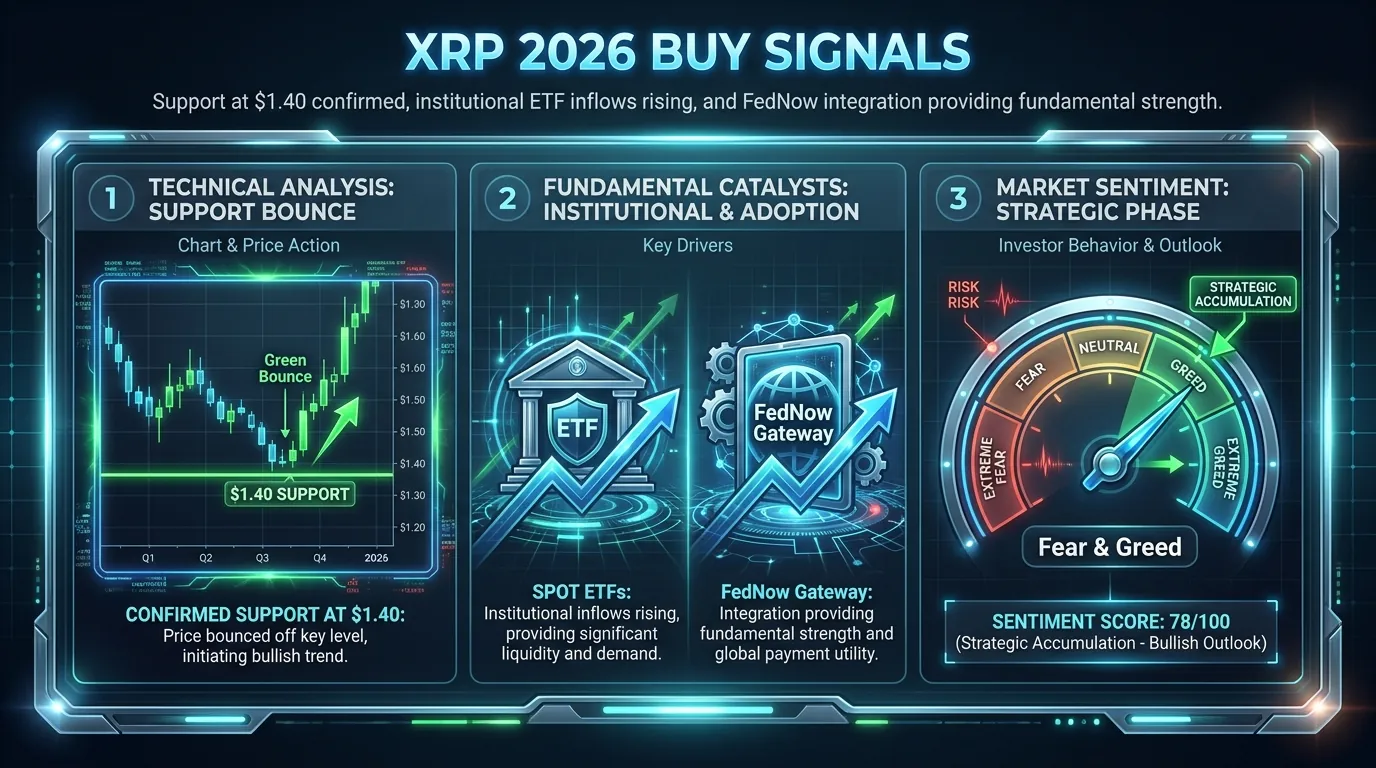
As of April 2026, XRP's potential for recovery and growth is supported by institutional integration, including Spot XRP ETFs and its role in global banking infrastructure. The asset is consolidating around the $1.40 support level after a 2025 legal victory pump and subsequent correction.
- Spot XRP ETFs create a permanent bid.
- The $1.40 level acts as an accumulation zone.
- Ripple's RLUSD stablecoin integrates with XRPL.
- FedNow update invites Ripple to the table.
- Whale wallets show increased accumulation.
Analyzing the XRP Potential in 2026
- The perennial question in the crypto markets has shifted from ‘Will it survive?’ to whether now is the right moment to buy XRP. As of April 2026, the landscape for Ripple’s native asset has matured significantly. We are no longer in the era of speculative "moonboy" theories; we are in the era of institutional integration.
- With XRP trading around the $1.40 mark (consolidating after a 60% drawdown from its 2025 local high of $3.65) investors are looking for confirmation signals to determine if the asset will continue to rise or if a further correction is imminent. Understanding the true XRP Potential requires a deep dive into liquidity cycles, technical support levels, and the fundamental shift in global banking.
The Current Market Context: Is XRP Gonna Go Up?
- To answer if XRP is "gonna go up," we must look at the macro cycle. In 2025, the market experienced a massive "legal victory pump" that propelled the price toward its previous all-time high. However, the subsequent 60% correction throughout the first quarter of 2026 has washed out over-leveraged retail traders. This "reset" is often viewed by seasoned analysts as a healthy consolidation phase.
- The entry of Spot XRP ETFs has created a "permanent bid" in the market. Unlike retail traders who panic sell during a 10% dip, institutional ETF providers manage capital with a multi-year horizon. This institutional floor suggests that while short-term volatility remains, the long-term trajectory is supported by massive capital inflows. For those asking "will xrp recover," the presence of BlackRock and Goldman Sachs in the ETF space provides a resounding "yes" from a structural perspective.
Identifying Technical Indicators for XRP Potential
When searching for the right entry point to buy XRP, technical analysis offers the clearest confirmation signals. In the current 2026 environment, several key levels have emerged:
The $1.40 Support Floor: This level has been tested four times in the last three months. In technical terms, this is an "accumulation zone." If the price holds above $1.40, it indicates that "smart money" is absorbing the sell pressure from retail participants.
The 200-Day Moving Average: Currently hovering near $1.25, a bounce off this line would be a classic "buy the dip" signal for momentum traders.
Volume Profiles: On-chain data shows that while the price has been sideways, the "whale" wallets (holding 1M+ XRP) have increased their positions by 12% since February. This divergence between price and accumulation is a classic lead indicator that the asset is preparing to unlock the true XRP Potential in institutional markets.
Fundamental Drivers: Will XRP Continue to Rise?
- Beyond the charts, the fundamental "plumbing" of the financial world is being rewritten. Ripple’s RLUSD stablecoin has become a vital component of the XRP Ledger (XRPL). By providing a stable medium of exchange, RLUSD allows banks to move into the ecosystem without immediate exposure to XRP’s price swings. Once they are "on-chain," the move to using XRP for the actual bridge settlement is a natural next step.
- The April 2026 Federal Reserve update regarding FedNow intermediaries is the most significant fundamental catalyst since the SEC victory. By allowing authorized intermediaries to bridge international payments, the Fed has effectively invited Ripple to the table. This systemic integration is why many believe XRP will not only recover but will eventually challenge the $5.00 level. For long-term investors seeking XRP Potential, the focus should be on the volume of transactions processed via RippleNet rather than daily price fluctuations.
Buy XRP: risks and Headwinds, what Could Go Wrong?
No investment is without risk if you want to buy XRP (or any other asset). While the "will xrp go back up" sentiment is high, there are two primary threats to monitor:
Macroeconomic Contraction: If the global economy enters a deep recession in late 2026, all "risk-on" assets, including XRP, will face selling pressure regardless of their utility.
Regulatory Pivot: While the SEC case is over, new legislative hurdles regarding stablecoins (like RLUSD) could temporarily slow down the speed of institutional adoption.
Usage Examples in 2026
Institutional Arbitrage: A trading firm sees a price gap between XRP on Coinbase and the XRPL DEX. They buy on the DEX, move the assets in 3 seconds, and sell on Coinbase for a 0.5% profit, repeating this 100 times a day.
SME Cross-Border Payments: A small clothing manufacturer in Italy pays their textile supplier in Vietnam. By using an XRP-enabled local bank, they save $40 in fees and the supplier receives the funds before the Italian bank even closes for the day.
Programmable Finance: A developer builds a decentralized insurance protocol on the XRPL. When a flight is delayed (verified by an oracle), the smart contract automatically sends an XRP payout to the traveler’s wallet instantly.
The Verdict: Will XRP Ever Go Up to New Highs?
The data suggests that the "death" of XRP was greatly exaggerated during the legal years. In 2026, the asset is more alive than ever. The current consolidation at $1.40 represents a rare window where the market is pricing in "uncertainty" while the underlying utility is reaching "certainty." While we may not see a vertical "candle to the moon" tomorrow, the steady absorption of the circulating supply by ETFs and the integration of the ledger into national payment rails suggest the sheer XRP Potential for cross-border dominance remains intact.
Key Points to Remember
Buy Signal: The $1.40 support level is a critical accumulation zone for institutional "smart money."
Confirmation: Look for a sustained breakout above the $1.85 resistance to confirm a new bullish leg.
Institutional Floor: Spot ETFs have changed the liquidity profile, reducing the likelihood of "90% crashes."
Utility Focus: Adoption in the FedNow ecosystem and the success of RLUSD are the real drivers of long-term value.
Navigating these confirmation signals requires professional-grade data. Whether you are tracking the latest AMM pool liquidity or monitoring real-time price action against key moving averages, start using DEXTools today here, to ensure you are trading with the most accurate on-chain insights available.
Disclaimer: This article is for informational purposes only and does not constitute investment advice, financial advice, trading advice, or any other kind of advice. DEXTools does not recommend buying, selling, or holding any cryptocurrency or token. Users should conduct their own research and consult with a qualified financial advisor before making any investment decisions. Cryptocurrency investments are volatile and high-risk. DEXTools is not responsible for any losses incurred.
XRP Bull vs Bear Case at a Glance
As of June 8, 2026, XRP navigates a complex landscape of bullish catalysts and bearish headwinds.
The Level That Matters
Understanding key technical levels can provide insight into potential future price movements.
Related Guides
- How Much XRP Should You Own? Position Sizing and Risk Management (2026)
- Should I Buy Ethereum (ETH) in 2026? Complete Analysis Framework
- How to Buy XRP Meme Coins: XRPL Trust Lines, Wallets and Audit Steps (2026)
- How to Buy XRP on Coinbase or Fidelity in 2026
- When Not to Trade: 12 Red Flags Every DeFi Trader Should Know
Frequently Asked Questions
Is now a good time to buy XRP?
As of April 2026, XRP is trading around $1.40 after a significant correction, and many analysts suggest it could be a good time to buy due to institutional support and technical indicators.
What are the key technical indicators for XRP in 2026?
Key technical indicators for XRP include the $1.40 support floor, the 200-day moving average near $1.25, and increased accumulation by whale wallets, suggesting a potential upward movement.
Will XRP recover after its recent price drop?
Many analysts believe XRP will recover due to strong institutional backing from firms like BlackRock and Goldman Sachs, alongside a structural shift in the financial ecosystem.
What fundamental factors are driving XRP's potential?
Fundamental drivers include the integration of Ripple’s RLUSD stablecoin into the XRP Ledger and recent updates from the Federal Reserve that enhance Ripple's role in international payments.
What risks should investors consider when buying XRP?
Investors should be aware of macroeconomic risks, particularly the potential for a deep recession in late 2026, which could impact all risk-on assets, including XRP.