What Will XRP Be Worth in 2030? An Honest Price Prediction
What could XRP be worth in 2030? An honest, scenario-based price prediction covering adoption, regulation and realistic targets, not hype. Not financial advice.
XRP's price prediction for 2030 ranges from a moderate $5.00 to an optimistic $20.00, driven by institutional adoption, the G20's 2030 payment targets, and the XRP Ledger's utility in global finance. Spot XRP ETFs and RLUSD integration provide a new price floor.
- G20 2030 payment targets
- Institutional Spot XRP ETFs
- XRPL for global liquidity
- RLUSD stablecoin integration
The Institutional Path for the XRP token Prediction
- The digital asset market is often a battlefield of extremes, caught between hyper-bullish "moon" targets and skeptical "zero" forecasts. As of April 2026, with XRP token trading at approximately $1.43 and the regulatory fog in the United States finally cleared, investors are looking toward the next decade.
- Predicting the value of a bridge asset requires more than just chart patterns; it demands an understanding of global liquidity shifts, the G20's 2030 payment targets, and the actual utility of the XRP Ledger (XRPL). This data-driven XRP Prediction aims to strip away the noise and provide a realistic outlook for 2030 based on institutional adoption and market mathematics.
- To forecast where XRP will be in 2030, we must first look at the foundations being laid today. In 2025, Ripple achieved total legal clarity, which acted as a catalyst for the launch of Spot XRP ETFs. By April 2026, these financial products have already attracted billions in institutional capital from firms like Goldman Sachs and Fidelity. This institutionalization changes the asset's volatility profile; XRP is no longer just a retail play but a core component of digital wealth management.
- The primary driver for a bullish XRP Prediction is the integration of the XRPL into the world's financial plumbing. The G20 has set ambitious goals for 2030: 75% of cross-border transactions should be completed within one hour, with costs reduced to less than 1%. Traditional systems like SWIFT are currently evolving to meet these targets, moving toward blockchain-based "shared ledgers." Ripple's strategy is not to "destroy" SWIFT but to act as the liquidity engine that facilitates these high-speed movements.
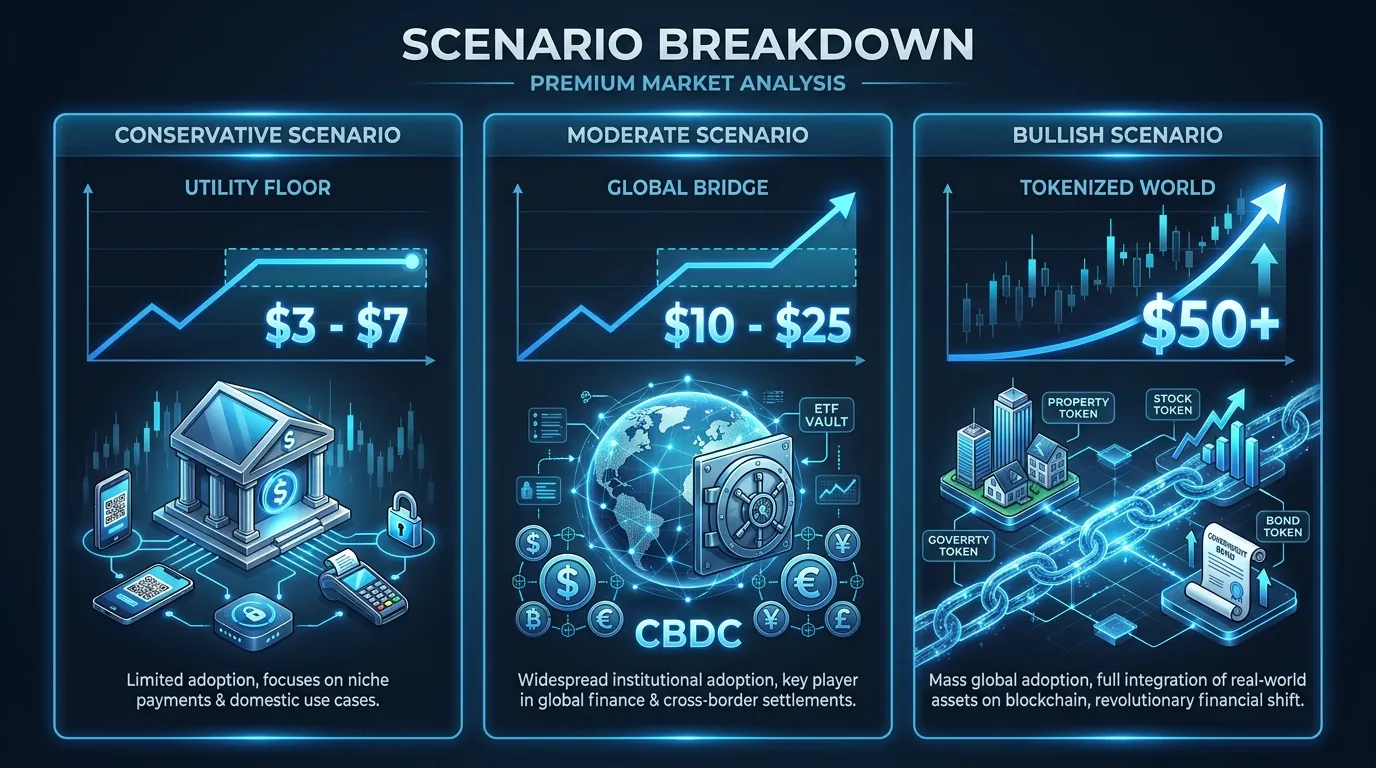
Scenario 1: The Conservative "Utility Floor" ($3 - $7)
- In this scenario, we assume that XRP continues its steady growth as a specialized bridge asset for specific payment corridors. By 2030, if Ripple captures approximately 5-8% of the global remittance market and serves as the backbone for a handful of regional Central Bank Digital Currencies (CBDCs), the organic demand would likely push the price into the mid-single digits.
- This XRP Prediction is supported by the "Utility Floor" theory. Unlike purely speculative coins, XRP's value is increasingly tied to the volume of transactions it settles. As the RLUSD stablecoin scales on the ledger, it provides a stable entry point for banks, who then use XRP token for the split-second "bridge" between different fiat currencies. A price of $5.00 by 2030 would represent a roughly 250% increase from today's levels, outperforming many traditional asset classes while remaining within the realm of realistic market capitalization.
Scenario 2: The Moderate "Global Bridge" ($10 - $25)
- The moderate scenario relies on the successful integration of XRP into the broader "Interledger" ecosystem. By 2030, the financial world is expected to be a "network of networks." If the XRPL becomes the primary interoperability layer (connecting FedNow in the U.S., the Digital Euro, and various private bank ledgers) the demand for liquidity would be massive.
- In this scenario, the XRP Prediction moves toward the $15 - $20 range. At these prices, the XRP market cap would approach $1 trillion, comparable to the valuation of Bitcoin in 2021 or major tech giants. This valuation is necessary for institutional utility; for a bank to move $1 billion across the ledger without causing a massive price spike (slippage), the bridge asset must have deep, high-value liquidity.
Scenario 3: The "New Financial Order" ($50+)
- The most optimistic forecasts assume a total paradigm shift. This involves the tokenization of Real World Assets (RWAs) on a global scale. If trillions of dollars in real estate, private equity, and government bonds are moved onto the XRPL for secondary market trading, XRP becomes the "gas" and the settlement medium for the world's economy.
- While this target remains a statistical outlier, the technical capacity of the XRPL to handle 1,500+ transactions per second at negligible cost makes it a prime candidate for such a role.
The 5-Year vs. 10-Year Outlook
In 5 Years (2031): We expect the "Post-Resolution" phase to be in full swing. XRP will likely have completed its current consolidation and moved toward the $4 - $8 range, driven by the maturity of the Spot ETF market and the full deployment of the FedNow intermediary framework.
In 10 Years (2036): The focus shifts toward the deflationary nature of the asset. As billions of transactions are processed, the "fee burn" begins to have a more noticeable impact on the total supply. If XRP has successfully replaced the liquidity layer of a significant portion of the $5 trillion daily SWIFT volume, double-digit valuations become a mathematical necessity rather than a hope.
Usage Examples in 2030
Seamless CBDC Exchange: The Bank of Thailand uses XRP token to settle a trade with the Central Bank of Brazil. The "Digital Baht" is swapped for XRP, which is then instantly swapped for "Digital Real," with the entire process taking 3.5 seconds.
Fractional Real Estate: An investor in Germany buys 0.01% of a shopping mall in Singapore. The ownership token is transferred via the XRPL, with XRP token used to pay the transaction fee and the instantaneous dividend distribution.
Automated Supply Chains: A manufacturer's smart contract automatically releases payment in XRP to a shipping company the moment a maritime sensor confirms a cargo container has been offloaded at the port.
Key Points to Remember
G20 Targets: The 2030 goal for fast, cheap cross-border payments is a massive tailwind for the XRPL.
Market Cap Math: Realistic 2030 targets range from $3 to $20, requiring market caps between $165B and $1.1T.
Institutional Shift: The presence of Spot ETFs and RLUSD integration provides a price floor that did not exist in previous cycles.
Utility vs. Hype: Long-term value is driven by "On-Demand Liquidity" volume, not social media trends.
The transition to a digital-first financial system is an ongoing journey. To monitor the real-time institutional flows, analyze the growth of RWA tokenization on the XRPL, and stay updated on the latest liquidity movements, start using DEXTools today here to navigate the next decade of digital finance with professional precision.
Disclaimer: This article is for informational purposes only and does not constitute investment advice, financial advice, trading advice, or any other kind of advice. DEXTools does not recommend buying, selling, or holding any cryptocurrency or token. Users should conduct their own research and consult with a qualified financial advisor before making any investment decisions. Cryptocurrency investments are volatile and high-risk. DEXTools is not responsible for any losses incurred.
XRP 2030 Scenarios at a Glance
Understanding the potential future of XRP involves considering various market scenarios and their implications.
What Would Drive XRP to the High End
Achieving the higher end of price predictions for XRP would depend on several key developments and market conditions aligning favorably.
- Regulatory Clarity. The passing of the CLARITY Act would significantly de-risk XRP for institutional investors and foster wider adoption.
- Market Cycles. The April 2028 Bitcoin halving triggering a strong altcoin cycle could provide substantial momentum for XRP.
- Banking Partnerships. Continued and expanded Ripple cross-border payment and banking partnerships would drive utility and demand.
- CBDC Integration. Potential integration of XRP into Central Bank Digital Currency (CBDC) infrastructure could unlock massive new use cases.
Related Guides
- Bitcoin Price Prediction 2026: Expert Analysis, Scenarios and Key Levels
- What Is a Bull Run and Bear Market in Crypto: Complete Guide (2026)
- Is XRP worth buying? Risk, Upside, and What to Watch
- Solana Chain Price Prediction 2026: Market outlook
- What is the XRP ATH? Analysis & 2026 Outlook
- Arbitrage Delay
- Bitcoin vs XRP: Which Is Better?
- Solana vs XRP Compared
- XRP vs Ethereum Compared
- Cardano vs XRP Compared
Frequently Asked Questions
What is the predicted value of XRP in 2030?
XRP's value in 2030 could range from $3 to over $50, depending on various scenarios including its adoption as a bridge asset and integration into global payment systems.
What factors influence XRP's price prediction for 2030?
Key factors include institutional adoption, regulatory clarity, the integration of the XRP Ledger into global financial systems, and the overall demand for cross-border transactions.
How does institutional investment affect XRP's volatility?
Institutional investment is expected to stabilize XRP's volatility, transforming it from a retail-focused asset to a core component of digital wealth management.
What is the 'Utility Floor' theory regarding XRP's value?
The 'Utility Floor' theory suggests that XRP's value is tied to its transaction volume, predicting a price range of $3 to $7 if it captures a portion of the global remittance market.
What role does the G20 play in XRP's future?
The G20's 2030 payment targets aim for faster and cheaper cross-border transactions, which could significantly boost XRP's utility and demand as a liquidity engine.