Social Recovery Wallets: How to Set Up Guardians Safely

Account abstraction removes the existential dread of losing a 24-word seed phrase. Discover the best practices for choosing and structuring your recovery guardians.
Social Recovery Wallets: What is Social Recovery?
- The historic vulnerability of self-custody has always been its unforgiving nature. For years, the baseline security model of decentralized applications forced users to assume total custody over an immutable, 12 or 24-word seed phrase. If you misplaced that single paper card, or fell victim to a subtle phishing interface, your capital was permanently lost to the void. This binary risk structure has kept millions of risk-averse allocators from transitioning their capital completely on-chain.
- The paradigm shift toward Account Abstraction (formalized via standards like ERC-4337) rewrites this entire relationship. Instead of navigating the blockchain via a fragile Externally Owned Account (EOA), users can now deploy programmable Smart Contract Wallets.
- The crown jewel of this programmatic ecosystem is Social Recovery. By discarding the antiquated notion of a static seed phrase, social recovery allows you to distribute recovery permissions across a customized network of trusted entities known as Guardians. This guide explains the mechanics of account abstraction recovery and delivers an operational playbook to establish your guardian network safely.
- A smart contract wallet functions as an autonomous, on-chain digital vault. The vault is controlled by a designated signing key, but its structural logic is governed by code. If you lose your primary hardware device or smartphone holding the active signing key, your funds remain securely locked inside the contract.
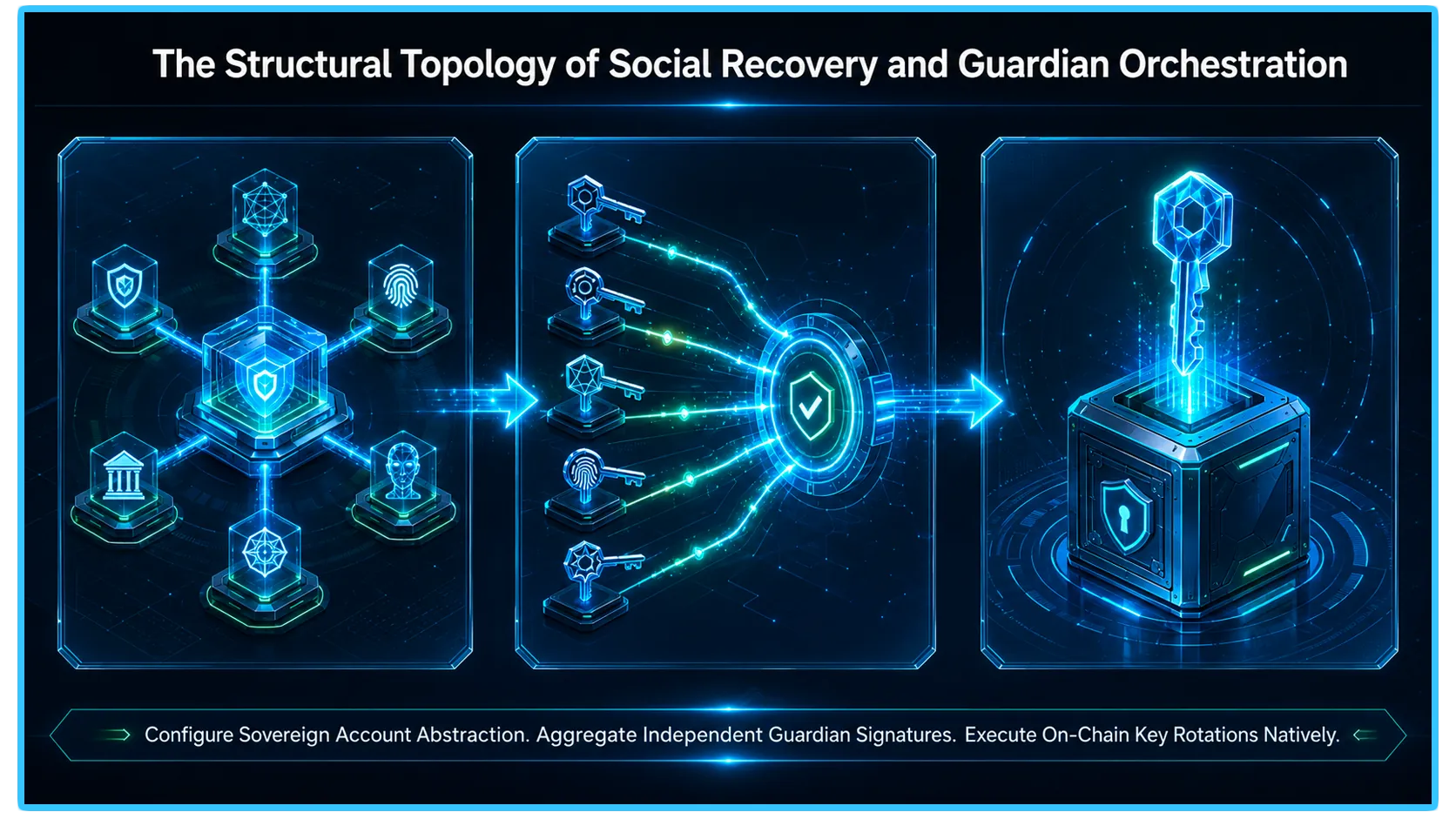
- To regain access, you invoke the contract’s recovery module. This action pings your pre-configured list of independent Guardians—which can be a mix of friends, family members, institutional cold storage vaults, or secondary hardware keys under your control. By providing a decentralized quorum of cryptographic approvals, your guardians sign an on-chain transaction that executes a Key Rotation, instantly stripping access from your old lost key and assigning control to a fresh, clean wallet signature.
Diversify Your Guardian Classes
The Self-Custody Shards (2 Slots): Assign these slots to your own alternative hardware wallets (such as a cold-storage hardware ledger stored in a remote secure lockbox).
The Trusted Alliance Shards (2 Slots): Select two highly trusted individuals who do not know each other, operate in separate social circles, and possess strong operational security hygiene.
The Institutional Shard (1 Slot): Utilize an automated, cloud-based institutional guardian service or an emergency third-party recovery proxy provided natively by the wallet developer interface.
Enforce Operational Privacy
- The primary vector of failure for a human guardian network is social coordination. If you choose three close personal friends who gather in the same chat environments, an attacker who compromises that single chat layer can socially engineer a coordinated recovery attack against you.
- Enforce a strict policy of operational isolation: do not inform your human guardians who the other members of your recovery matrix are. If the guardians remain completely anonymous to one another, the risk of a malicious, collusive key-rotation attack drops to absolute zero.
Conduct Periodic Recovery Drills
A recovery protocol with Recovery Wallets is only as good as its real-world execution. Every twelve months, initiate a controlled, non-emergency recovery simulation or ping your guardians to verify that their active signing keys remain intact, their devices are updated, and they understand the confirmation interface. Routine verification ensures that your backup infrastructure remains fully optimized long before a true physical or digital emergency strikes.
Real-Time Telemetry and Infrastructure Security via DEXTools
- Successfully engineering a bulletproof, multi-guardian social recovery vault insulates your capital from structural key loss and physical coercion. However, securing your entry gates is only half the battle; managing your active capital requires continuous validation of live ecosystem conditions.
- If you maintain deep liquidity allocations or execute strategic token transformations using your smart contract account, checking real-time capital velocity, trading trends, and pool depth is the only way to protect your active positions from sudden market shocks.
- DEXTools provides the critical analytical data infrastructure needed to perform these diagnostic checks in real-time. By utilizing advanced multi-chain pair trackers, live transaction logs, and look-through wallet telemetry, market participants can instantly verify the structural health of any asset pool.
- Cross-referencing your hardware security layers with live market telemetry ensures your active portfolio parameters remain completely optimized, keeping your digital wealth securely protected from hidden pool contractions or systemic liquidity issues across alternative layers.
You can access DEXTools here and start trading today!
Disclaimer: This article is for informational purposes only and does not constitute investment advice, financial advice, trading advice, or any other kind of advice. DEXTools does not recommend buying, selling, or holding any cryptocurrency or token. Users should conduct their own research and consult with a qualified financial advisor before making any investment decisions. Cryptocurrency investments are volatile and high-risk. DEXTools is not responsible for any losses incurred.