Sybil Resistance Explained: Why Some Wallets Get Filtered

Industrial bot farms utilize thousands of ghost wallets to exploit token distributions. We break down the graph network topologies and behavioral heuristics used to filter them out.
The Sybil Arms Race: The Industrialization of On-Chain Identities
- The baseline assumption of any open, permissionless blockchain network is anonymity. Anyone can spin up thousands of entirely unique cryptographic addresses in a matter of seconds using basic open-source software scripts. While this absolute lack of identity barriers preserves user privacy, it presents a massive systemic vulnerability for Web3 protocols launching token airdrops, quadratic funding grants, or decentralized governance models. This vulnerability is known as a Sybil Attack, an exploit where a single real-world entity fabricates a swarm of artificial, pseudo-anonymous identities to manipulate voting systems or siphon off a disproportionate share of a community's incentive rewards budget.
- As billions of dollars in token distributions shifted into the hands of specialized, industrial-scale farming teams, protocol developers had to completely abandon primitive transaction-counting metrics. Today, networks leverage advanced data forensics to build institutional-grade Sybil Resistance. Working alongside analytics networks like LayerZero Foundation, Nansen, and Gitcoin, projects actively audit the collective behavioral footprint of every interacting wallet, stripping artificial bot nets of their allocations to protect organic community participants.
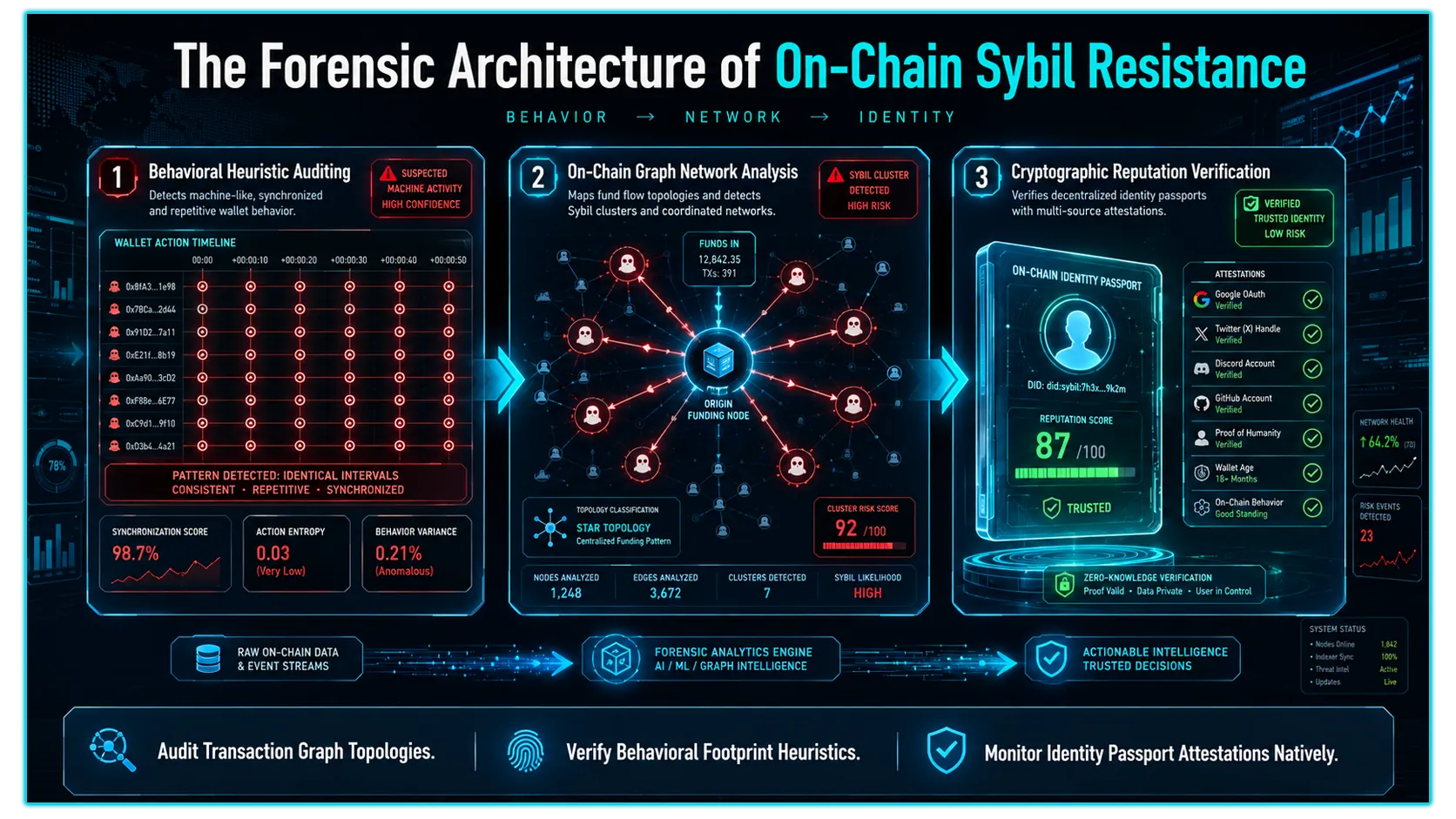
1. Behavioral Heuristics: The First Line of Forensic Defense
The entry point for on-chain screening involves checking Behavioral Heuristics: a set of rules and pattern-matching baselines that cross-examine a wallet's metadata against normal human behaviors. Automated script setups prioritize speed and efficiency; real humans, by contrast, behave with high randomness and economic asymmetry.
When a data team runs a heuristic audit over an ecosystem's transaction logs, they target three primary behavioral markers:
Chronological Synchronization: If a group of fifty wallets interacts with the exact same sequence of smart contracts within seconds or minutes of each other over multiple days, the algorithm flags them. Real humans do not coordinate automated, identical time-stamped transaction paths over extended operational pipelines.
Value Uniformity: Automated farming scripts frequently distribute identical, machine-precise capital amounts across target nodes (e.g., depositing exactly 0.05 ETH or swapping exactly 50 USDC across one hundred accounts). This exact mathematical duplication stands out instantly inside public block explorers.
Contract Sequencing Identicality: Real users explore a decentralized application organically, often clicking random tabs, checking balances, or changing parameters. Bots bypass the user interface entirely to ping smart contract methods directly, executing identical code paths with zero behavioral variation.
2. On-Chain Graph Analysis: Exposing Network Topologies
- Even if a professional farming operation utilizes sophisticated time-delay randomizers to defeat basic heuristic checks, they cannot alter the immutable record of where their capital originated or where it settles. Data forensic teams expose these networks by building complex visual transaction maps using Graph Analysis.
- Graph analysis treats wallets as directional data nodes and transactions as interconnected lines. By evaluating the overall web, forensic algorithms map distinct malicious architectures:
Star Topologies (The Hub-and-Spoke Red Flag)
A Star Topology occurs when a single, heavily funded central wallet (the hub) distributes native gas tokens straight to dozens or hundreds of fresh, isolated sub-wallets (the spokes). Even if those sub-wallets never interact with each other directly on-chain, their shared financial umbilical cord links them to a single point of origin, causing the entire cluster to be blacklisted.
Linear and Tree Topologies
To evade star-graph detection, some farms route capital sequentially (Wallet A funds Wallet B, which funds Wallet C, and so forth). Others use a branching tree format to split balances progressively. Graph analysis software easily tracks these paths by calculating the Clustering Coefficient and spatial proximity of the accounts, recognizing that a closed circuit of capital moving through an isolated chain of wallets is a clear sign of industrial entity replication.
3. Passports, KYC, and Cryptographic Reputation Layers
To reduce their reliance on retroactively filtering raw transaction data, modern Web3 networks increasingly utilize proactive, front-end identity filters known as On-Chain Reputation Platforms. These frameworks assign wallets a verifiable "humanity score" by compounding historical ledger records and decentralized identity credentials.
Gitcoin Passport & Verifiable Credentials: Gitcoin Passport aggregates independent cryptographic attestations. A user links their wallet to external Web2 social grids (like GitHub, LinkedIn, or Google accounts) alongside native Web3 milestones (like owning an ENS domain or holding a Safe multi-sig account). These connections generate a cumulative score that protocols use to verify humanity without storing private data.
Proof-of-Humanity and Biometrics: More aggressive protocols mandate biometric assertions through frameworks like Worldcoin's Orb infrastructure. By matching a wallet to a unique, zero-knowledge biometric iris scan hash, the protocol guarantees that one physical human can control exactly one reward allocation slot, neutralizing automated script farms completely.
Sybil Detection Core Metrics Matrix
| Forensic Vector | Primary Detection Method | Target Vulnerability |
| Heuristic Sweep | Time & Value Profiling | Uniform Script Automation |
| Graph Analysis | Topology Link Tracking | Interconnected Funding Paths |
| Reputation Scoring | Identity Multi-Attestation | Zero Historical On-Chain Footprint |
On-Chain Reputation Benchmarks
| Wallet Attribute | Organic Signal | Sybil Flag |
| Account Age | Multi-Month Multi-Chain Activity | Freshly Minted for Campaign |
| Gas Footprint | Dynamic / Mainnet History | Precise / Sub-Dollar Allocations |
| Assets Held | Diverse Mainnet Token Mix | Transient / Empty Capital Drains |
Real-Time Telemetry Auditing via DEXTools
- As protocols complete their anti-Sybil forensic sweeps and distribute liquid tokens to verified, high-reputation community members, tracking the resulting token capitalizations, real-time market entries, and decentralized exchange pool depths becomes an essential workflow for market participants. Sourcing analytics through advanced decentralized charting architectures like DEXTools gives market participants an essential universal platform to monitor live token behaviors, evaluate pool depths, and inspect contract parameters across all public execution networks.
- By leveraging core features like the Pair Explorer, Live New Pairs dashboard, and the integrated Trade Story or Top Traders diagnostic tools, technical traders can seamlessly audit localized volume trends, track large whale wallet capital reallocations via the Big Swap Explorer, and check automated contract safety scores before initiating any on-chain interactions. This ensures your hardened hardware setup interacts safely with verified market venues as you analyze the post-launch distribution landscape.
You can access DEXTools here and start trading today!
Disclaimer: This article is for informational purposes only and does not constitute investment advice, financial advice, trading advice, or any other kind of advice. DEXTools does not recommend buying, selling, or holding any cryptocurrency or token. Users should conduct their own research and consult with a qualified financial advisor before making any investment decisions. Cryptocurrency investments are volatile and high-risk. DEXTools is not responsible for any losses incurred.
Disclaimer: This article is for informational purposes only and does not constitute investment advice, financial advice, trading advice, or any other kind of advice. DEXTools does not recommend buying, selling, or holding any cryptocurrency or token. Users should conduct their own research and consult with a qualified financial advisor before making any investment decisions. Cryptocurrency investments are volatile and high-risk. DEXTools is not responsible for any losses incurred.