Airdrops Farming Guide: How to Qualify for Retroactive Drops
Modern token airdrops are no longer simple giveaways; they are sophisticated user acquisition audits. We break down the behavioral clustering and wallet aging metrics used to filter out bots.
The Evolution of Token Distribution: From Free Crypto to Behavioral Auditing
- In the early days of decentralized networks, airdrops were simple promotional tools. Protocols distributed tokens to almost any wallet that executed a basic transaction or held a nominal balance. However, as the decentralized web matured, industrial farming networks and automated bots began exploiting these distributions. This dynamic forced core developers to fundamentally re-engineer user-incentive programs.
- Modern token distributions have moved past primitive transactional criteria. Today, core networks and decentralized applications treat airdrops as targeted user acquisition budgets. Utilizing advanced data tools from analytics firms like Nansen and Chaos Labs, protocols analyze the on-chain behavior of every interacting address. Qualifying for an asset distribution now demands an organic, high-conviction ecosystem profile that proves a user brings authentic value to the protocol.
Airdrops farming
- The practice of airdrops farming has evolved from a casual weekend hobby into a highly calculated, industrial-grade optimization strategy. Capital allocators no longer simply stumble upon retroactive distributions; they systematically map out nascent ecosystems, deploy liquidity across strategic smart contracts, and mimic organic user patterns to maximize their final token allocations.
- While the potential rewards of positioning yourself early inside a high-conviction protocol remain massive, the margin for error with airdrops farming has narrowed completely. Navigating this modern landscape requires a surgical understanding of on-chain footprints: a single misstep or repetitive behavioral cluster can cause automated protocol screeners to classify your entire web of wallets as a malicious bot network, evaporating your invested time, capital, and gas fees instantly.
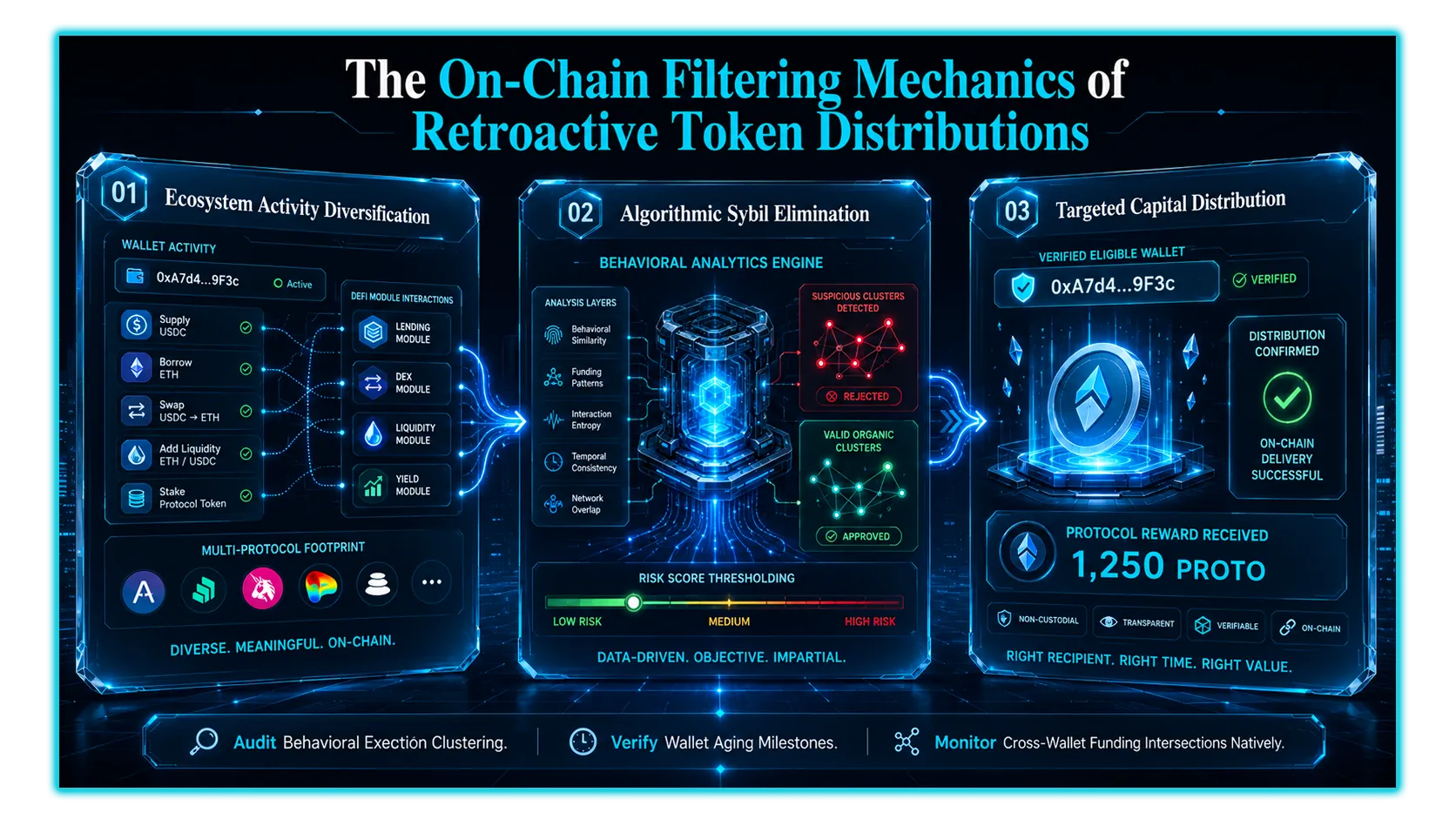
- Multi-Module Interaction: Do not restrict your footprint to decentralized exchanges. Interact with the full spectrum of an ecosystem's primitives: supply capital to a lending vault, borrow against your collateral, bridge assets across networks, mint a native domain name, and purchase an on-chain collectible.
- Governance Engagement: Authentic users care about protocol steering. Acquiring a project's core tokens and actively participating in off-chain Snapshot votes or on-chain governance decisions is one of the strongest indicators of real, high-conviction alignment.
2. The Economic Proof: Gas Spend and Wallet Aging
Data analysts filter out low-value "dust" accounts by establishing strict capital and time-based thresholds. An account that exists for forty-eight hours, spends three dollars in gas, and goes permanently dark is immediately dropped from allocation matrixes.
Wallet Lifespan and Retention
Wallet age is one of the hardest metrics for industrial farms with airdrops to replicate at scale. Protocols track your footprint across weekly and monthly active boundaries. Maintaining regular, baseline interactions over a rolling three- to six-month window proves to data engines that you are a retained participant rather than a fleeting capital opportunist.
Volume and Gas Commitments
Ecosystems value economic commitment. While high transaction volumes (such as crossing the ten-thousand or one-hundred-thousand dollar aggregate trading brackets) boost allocation tiers, the total cumulative gas spent on-chain is increasingly used as a foundational filter. Committing capital to network gas fees shows that you have "skin in the game," ensuring that rewards flow to participants who actively fund the underlying validator infrastructure.
3. The Threat Matrix: Deciphering Sybil Filters
A Sybil Attack occurs when an individual or group creates hundreds of artificial addresses to capture an unfair share of a network's token distribution. Modern airdrop filtering software relies on advanced pattern matching to isolate and eliminate these networks.
Behavioral Clustering
Data engines plot transactions on a chronological timeline. If twenty or thirty wallets execute identical smart contract interactions within short time windows of each other, they are flagged as an automated cluster. Real human users act randomly; machine-driven networks act uniformly.
Funding Source Intersections
The most common mistake amateur farmers make is funding multiple destination wallets from a single personal address or exchange account. On-chain transparency makes it incredibly easy to track these connections. If a group of wallets is linked back to a single financial origin point, the entire web is permanently blacklisted.
4. Multi-Wallet Tactics & Governance Ethics
- Real talk: running multiple web3 wallets is a normal part of maintaining privacy and isolating financial risk in DeFi. However, scaling this setup into an industrial token-extraction machine crosses into predatory territory. When farming groups extract millions in tokens and immediately dump them on the market, they drain working capital away from organic developers and long-term stakers.
- If you choose to manage a multi-wallet setup, you must approach the process with strict operational isolation to maintain a clean profile:
- Complete Financial Separation: Never allow your accounts to interact, send funds to one another, or share a centralized exchange deposit address. Every account must be treated as a completely isolated entity.
- Randomized Execution Execution: Vary your transaction values, alternate the decentralized applications you interface with, and space out your activities across different days and weeks to avoid generating clustered metadata footprints.
On-Chain User Profile Optimization Metrics
| Metric Category | Target Threshold | Strategic Objective |
| Wallet Age | 90+ Days Active | Establishes user retention |
| Contract Variety | 10+ Unique Scripts | Proves diverse module use |
| Aggregate Volume | $10,000+ Transacted | Signals economic value |
Sybil Detection Red Flags & Mitigations
| Red Flag Trigger | Systemic Danger | Proper Mitigation |
| Direct Transfers | Links wallets instantly | Fund solely via separate CEX layers |
| Simultaneous Tx | Triggers cluster flags | Randomize times across days |
| Identical Balances | Signals macro scripting | Vary deposit sizes randomly |
Post-Drop Navigation via DEXTools Telemetry
- The exact millisecond an airdrop claim goes live, the market experiences an intense surge of volatility and high-volume price discovery. Sourcing analytics through advanced decentralized charting architectures like DEXTools gives market participants an essential universal platform to monitor live token behaviors, evaluate pool depths, and inspect contract parameters across all public execution networks.
- By leveraging core features like the Pair Explorer, Live New Pairs dashboard, and the integrated Trade Story or Top Traders diagnostic tools, technical traders can seamlessly audit localized volume trends, track large whale wallet capital reallocations via the Big Swap Explorer, and check automated contract safety scores before initiating any on-chain interactions. This ensures your hardened hardware setup interacts safely with verified market venues as you determine whether to lock, stake, or liquidate your newly acquired tokens.
Disclaimer: This article is for informational purposes only and does not constitute investment advice, financial advice, trading advice, or any other kind of advice. DEXTools does not recommend buying, selling, or holding any cryptocurrency or token. Users should conduct their own research and consult with a qualified financial advisor before making any investment decisions. Cryptocurrency investments are volatile and high-risk. DEXTools is not responsible for any losses incurred.