The Attention Decay Curve: How to Know When a Trending Token Is Losing Power
— By Whatsertrade in Tutorials

A token does not always lose power when the price falls. Sometimes it starts losing power while it is still trending. The chart may still look active, social po
A token does not always lose power when the price falls. Sometimes it starts losing power while it is still trending. The chart may still look active, social posts may still appear, and traders may still talk about it. But underneath the surface, attention may already be decaying.
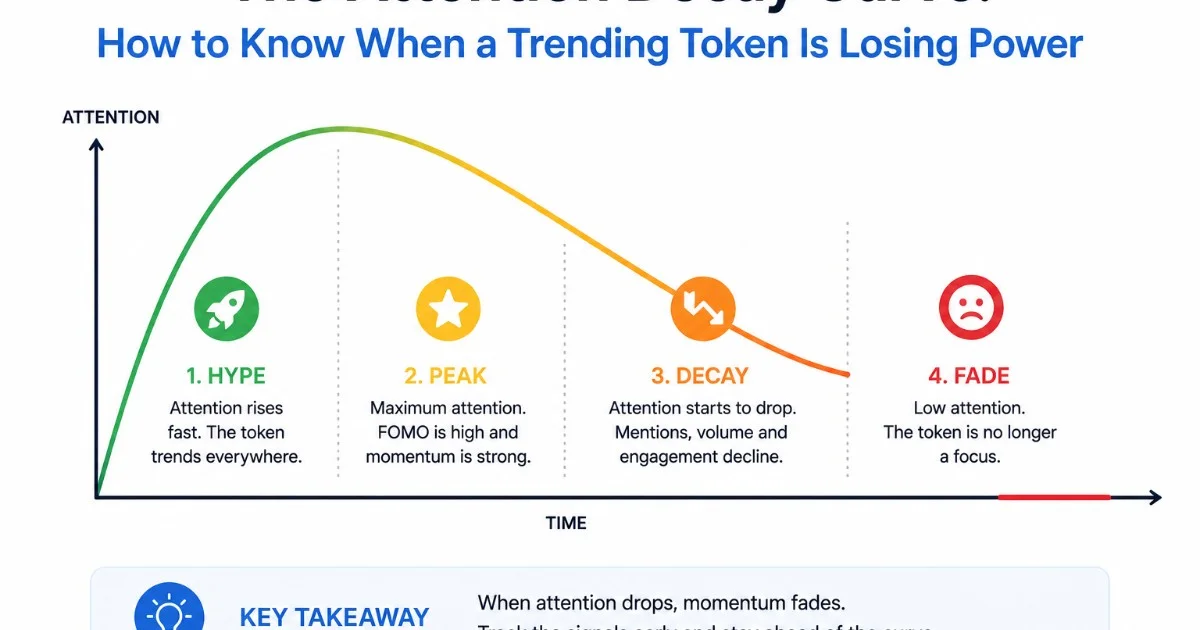
The attention decay curve is the process by which a token gradually stops converting visibility into real market activity. In crypto, attention is fuel. But fuel burns quickly when it is not supported by liquidity, new buyers, holder retention, and a strong narrative.
Understanding attention decay can help traders avoid buying the final stage of a trend.
What Is Attention Decay?
Attention decay happens when a token continues to receive visibility but the market response weakens. People may still mention the token, but fewer new buyers enter. Volume may decline. Holders may stop growing. Liquidity may become unstable. Price may struggle to make higher highs.
This is different from a sudden crash. Attention decay can be slow. It can happen while the token is still visible in chats, rankings, and social feeds. That is why it can be dangerous. Traders may think the token is still strong because it is still being discussed, but the market may no longer be responding with the same energy.
A trending token is only powerful if attention keeps converting into action.
Why Attention Has a Life Cycle
Crypto markets move through narratives. A token can become exciting because of a launch, meme, influencer mention, product update, listing rumor, or broader sector rotation. At first, attention is fresh. Traders discover the token, early buyers enter, and volume increases.
Then the token reaches a crowded stage. Many traders already know about it. Early buyers are in profit. Social content becomes repetitive. New buyers need stronger reasons to enter. If the narrative does not evolve, attention begins to decay.
The token may still be visible, but visibility alone is no longer enough.
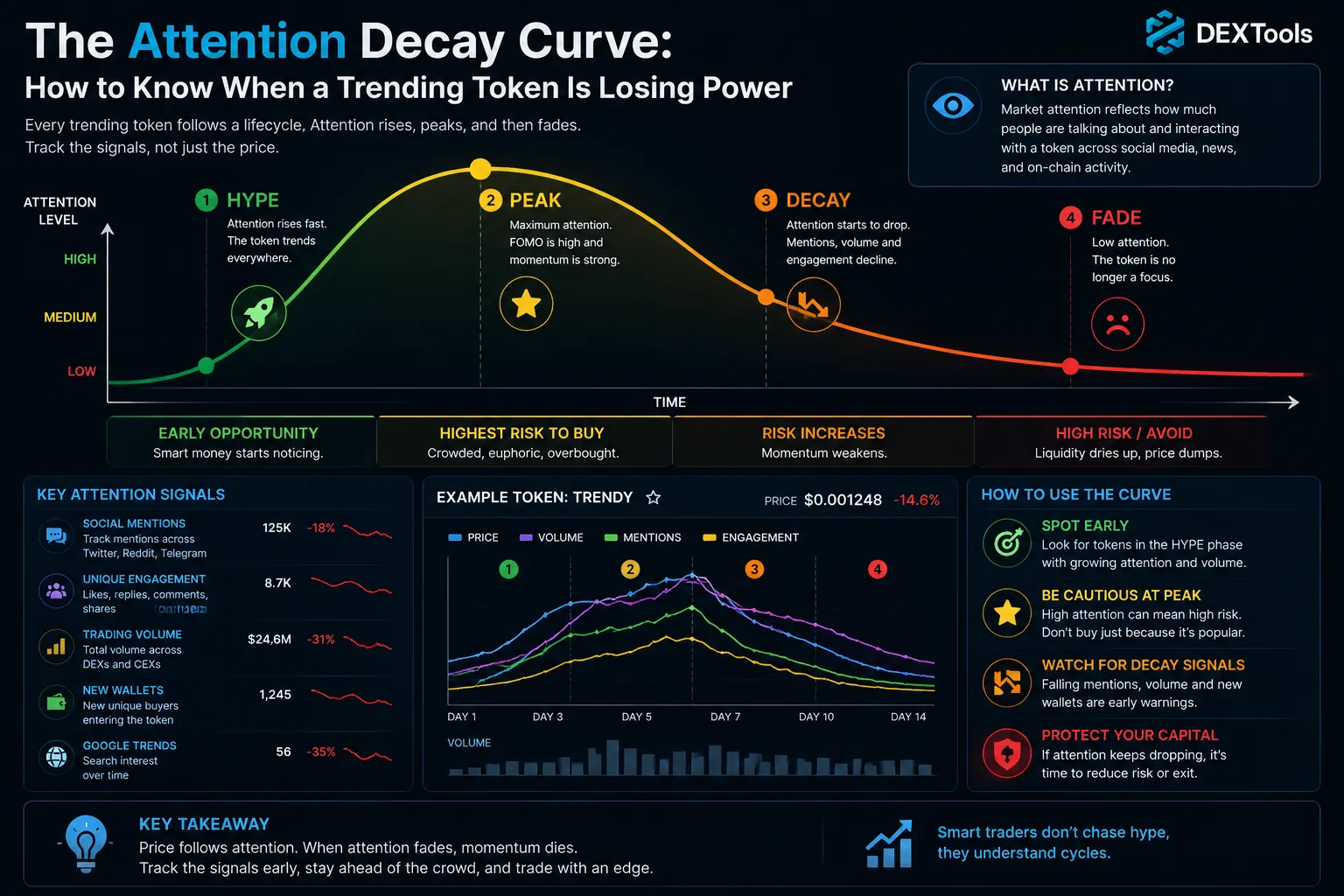
Signal 1: Volume Fades While Mentions Continue
One of the clearest signs of attention decay is a mismatch between social noise and trading volume. If people are still talking about a token but volume keeps declining, attention may be losing its ability to create market action.
This does not mean every volume drop is bearish. Consolidation can be healthy. But if social activity remains loud while trading activity fades, the market may be getting tired.
On DEXTools, traders can monitor whether volume remains consistent or weakens after the first wave. A token that keeps trending socially but cannot generate fresh volume may be entering the decay phase.
Signal 2: New Highs Become Harder to Reach
A strong trend often creates higher highs with strong volume. As attention decays, each new attempt may become weaker. The token may still bounce, but the bounces may fail earlier. Buyers may arrive, but sellers may absorb them quickly.
This creates a pattern where price action looks active but less effective. The token moves, but it struggles to progress.
Traders should watch whether the market is still expanding or only recycling old momentum. If every rally requires more promotion but produces less price movement, the attention curve may be weakening.
Signal 3: Holder Growth Slows
Holder growth can reveal whether new participants are still entering the market. During the early phase of a trend, holder growth may accelerate. During attention decay, growth can slow or flatten.
The most important question is whether new attention brings new holders. If a token keeps appearing across social channels but holder growth stalls, the market may already be saturated.
A strong token does not need holder growth to explode forever. But it should show some evidence that new participants are still willing to enter or stay.
Signal 4: Liquidity Stops Improving
Liquidity often follows confidence. When a token is gaining real strength, liquidity may remain stable or increase. When attention decays, liquidity may stop growing or begin to thin out.
This matters because weaker liquidity makes the token more vulnerable to sell pressure. A token with fading attention and declining liquidity can move down quickly if holders rush to exit.
Traders should monitor whether liquidity supports the narrative. If the story remains loud but liquidity weakens, the market structure may be deteriorating.
Signal 5: The Narrative Becomes Repetitive
Narratives need freshness. A token can trend because it represents something new, funny, useful, or timely. But when the same talking points repeat without new developments, traders may lose interest.
Repetition is not always bad. Consistent messaging can help a project grow. But if the narrative no longer creates new participation, it may be losing power.
A token in the attention decay phase often depends on old screenshots, old gains, old influencer calls, or old memes. The market begins asking what comes next.
How to Use DEXTools to Detect Attention Decay
DEXTools gives traders a real time view of whether attention is becoming market activity. Start by looking at volume over time. Then compare it with price structure and liquidity. If the token is still visible but volume and liquidity are fading, caution is needed.
Recent transactions can also help. Are buyers still entering at meaningful size? Are sellers becoming more aggressive? Is activity distributed across many wallets, or is the market becoming thin?
The best approach is to study conversion. Attention should convert into volume, holders, liquidity, and price strength. When that conversion weakens, the curve is decaying.
Attention Decay vs Healthy Consolidation
Not every slowdown is attention decay. Healthy consolidation can happen after a strong move. In healthy consolidation, volume may cool, but liquidity remains stable, holders stay, and the chart builds structure. The community may become quieter, but the market does not disappear.
Attention decay feels different. The token remains noisy, but the data weakens. Holders lose interest. Liquidity becomes thinner. Every bounce gets sold. Social energy continues, but market response fades.
The difference is not noise. The difference is whether the token still converts interest into action.
Conclusion
The attention decay curve helps traders recognize when a trending token is losing power before the chart fully breaks down. In crypto, attention can move markets, but only when it creates real participation.
By watching volume, price structure, holder growth, liquidity, and narrative freshness, traders can identify whether a token is still gaining strength or simply living on old hype. DEXTools gives traders the market data needed to make that distinction.
A token does not die when people stop talking about it. It starts dying when people keep talking, but the market stops responding.
How to Bridge Crypto Between Chains: Complete Cross-Chain Tutorial 2026 How to Use 1inch for Swaps: Classic, Fusion and Limit Orders (2026) OKX Web3 Wallet Tutorial 2026: Multi-Chain Setup GuideThe Nuances of Liquidity Pool Dynamics and Attention Decay
While price action and social sentiment are crucial indicators, the underlying liquidity pool (LP) dynamics often provide an early warning system for attention decay. A token can appear robust on the surface, maintaining price or even showing slight gains, yet its LP may be quietly signaling an impending decline in interest. This is because smart money and early investors often begin to exit positions by reducing their contributions to the LP, long before a noticeable price drop or a significant shift in social media chatter occurs.
Monitoring LP health involves more than just looking at the total value locked (TVL). It requires understanding the flow of capital in and out of the pool, the depth of liquidity at various price points, and the distribution of LP tokens among holders. A healthy LP is one with consistent, organic growth, a diverse set of providers, and a stable ratio of the underlying assets. Conversely, a declining number of LP providers, an increasing concentration of LP tokens in a few wallets, or a significant imbalance in the asset ratio can all be red flags.
Practical LP Health Indicators
- Number of LP Holders: A steady or increasing number of unique LP token holders suggests broad participation and confidence. A significant drop can indicate large-scale withdrawals.
- LP Token Distribution: Observe if LP tokens are becoming increasingly concentrated in a few wallets. This can signal potential manipulation or a lack of genuine community involvement.
- Liquidity Depth at Key Price Levels: Analyze the order book or equivalent for DEXs to see if there is sufficient liquidity to absorb potential sell-offs without drastic price impact. Shallow liquidity above or below current prices is a concern.
- Asset Ratio Stability: For a typical AMM pool, a significant and sustained imbalance in the ratio of the paired assets can indicate heavy selling pressure on one side, even if the price has not yet fully reflected it.
- LP Fee Generation: While not a direct decay indicator, consistently low or declining fee generation for LP providers can reduce incentives for new liquidity, contributing to long-term decay.
Related Guides
- What Is Hashrate in Crypto? Mining Power Explained
- Meme Coin Attention Economy Explained (2026)
- Ghost Chain vs Dormant Project: Spot Crypto Decay
- Trade Trending Tokens: Strategies & Risk Checks
- The First 30 Minutes After a Token Starts Trending: A DeFi Trader’s Playbook
Frequently Asked Questions
How can I tell if a trending token is losing power before its price drops significantly?
Look for declining social media engagement (mentions, sentiment, unique users discussing it) even if the price is stable or slightly rising. Reduced trading volume on green candles can also signal weakening interest, indicating fewer new buyers are entering the market.
What is 'attention decay' in the context of cryptocurrency trends?
Attention decay refers to the gradual decline in public and investor interest in a particular token or narrative, even when its price might still appear strong or be experiencing minor pumps. It's a precursor to a potential price reversal, as the underlying enthusiasm fades.
Are there specific on-chain metrics that indicate a token is losing power?
Yes, monitor active addresses, transaction count, and new addresses joining the network. A decrease in these metrics, especially when the price is still trending, suggests that fewer new participants are engaging with the token, indicating a potential loss of power.
Why is it important to recognize attention decay early?
Recognizing attention decay early allows investors to make informed decisions before a significant price correction occurs. It helps avoid being caught in a 'dead cat bounce' or holding a token that has lost fundamental support, even if its chart still looks active.