The First 30 Minutes After a Token Starts Trending: A DeFi Trader’s Playbook
— By Whatsertrade in Tutorials

When a token starts trending, everything feels urgent. The chart is moving, volume is rising, social channels are getting louder and traders begin to fear missi
When a token starts trending, everything feels urgent. The chart is moving, volume is rising, social channels are getting louder and traders begin to fear missing out.
But the first 30 minutes after a token starts trending are not only about speed. They are about discipline.
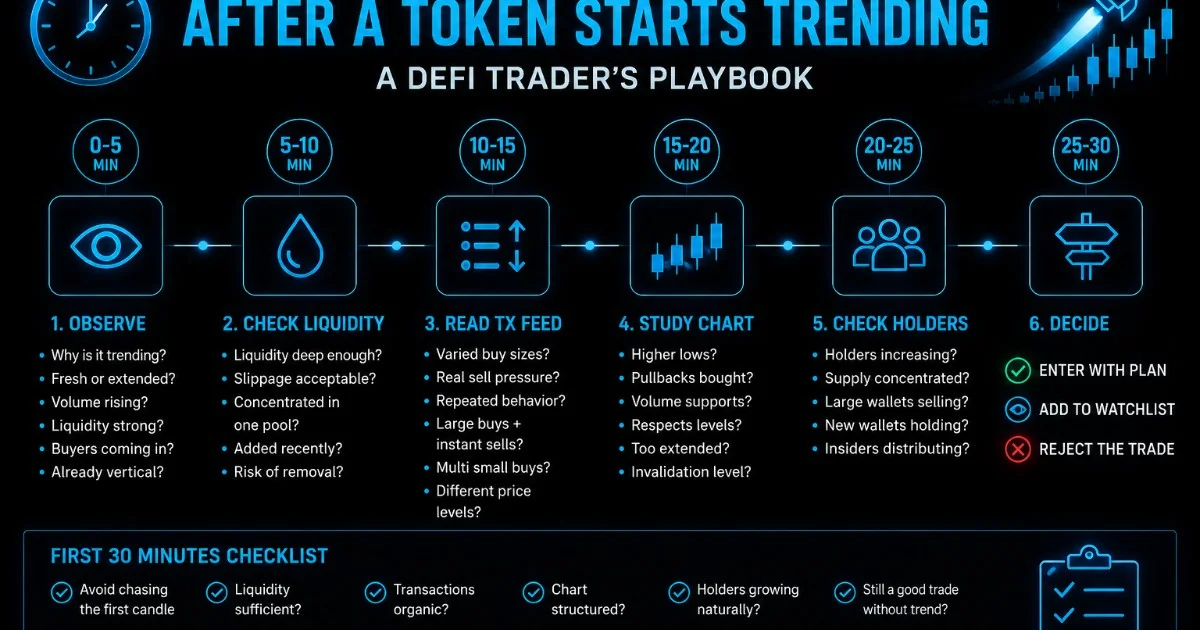
Many traders lose money not because they are late, but because they react without a process. A trending token can be a real opportunity, but it can also be a trap created by fake volume, weak liquidity or coordinated hype.
This playbook gives traders a clear framework for analyzing a trending token before making a decision.
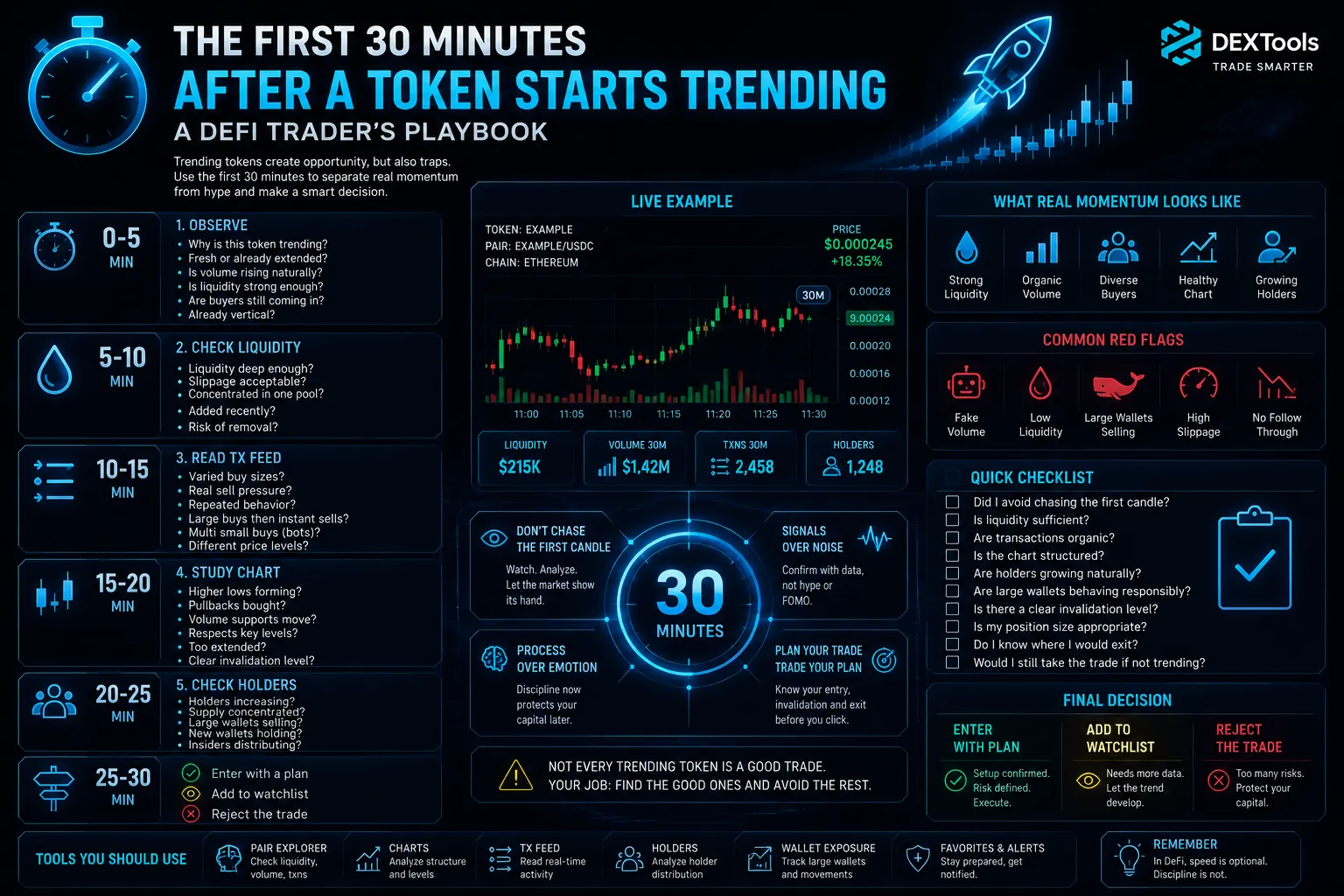
Minute 0 to 5: Do Not Chase the First Candle
The first mistake is buying immediately because the token appears on a trending list. Trending status means the token is getting attention. It does not automatically mean the token is safe, undervalued or ready for continuation.
In the first five minutes, your job is not to enter. Your job is to observe.
Ask yourself:
Why is this token trending?
Is the move fresh or already extended?
Is volume rising naturally?
Is liquidity strong enough?
Are buyers still coming in?
Has the chart already gone vertical?
If the chart has already made a huge move, the best trade may be no trade. Early momentum can continue, but buying without context often means entering during maximum emotion.
Minute 5 to 10: Check Liquidity Quality
Liquidity is one of the most important signals in DeFi trading. Without enough liquidity, even a promising token can become difficult to trade.
Check whether liquidity is growing, stable or decreasing. A token can have impressive volume but still be risky if liquidity is shallow.
Important questions:
Is liquidity deep enough for your position size?
Would your trade create high slippage?
Is liquidity concentrated in one pool?
Has liquidity been added recently?
Is there any sign that liquidity could be removed?
High liquidity does not guarantee safety, but low liquidity increases risk. It can make entries expensive and exits painful.
Minute 10 to 15: Read the Transaction Feed
The transaction feed can reveal what the chart hides. Look at the rhythm of buys and sells.
Healthy activity often includes a mix of transaction sizes, different wallets and steady participation. Suspicious activity may include repetitive buy amounts, rapid microtransactions or sudden waves that look automated.
Look for:
Varied buy sizes
Real sell pressure
Repeated wallet behavior
Large buys followed by immediate sells
Multiple small buys designed to create attention
Wallets buying at different price levels
The goal is to understand whether demand feels organic or manufactured.
A trending token with natural buying pressure is very different from one being pushed by bots.
Minute 15 to 20: Study the Chart Structure
A strong chart does not only go up. It builds structure.
Look for clean impulses, pullbacks, support zones and recovery. If price only moves through sudden spikes, the setup may be unstable.
Ask:
Is the token making higher lows?
Are pullbacks being bought?
Is volume supporting the move?
Is price respecting any clear levels?
Has the token already moved too far too fast?
Where would invalidation be?
If you cannot define a clear invalidation point, you do not have a trade plan. You only have excitement.
Minute 20 to 25: Check Holder and Wallet Behavior
Trending tokens can attract new holders quickly. But holder growth needs context.
A healthy token may show steady growth in holders, better distribution and fewer signs of wallet concentration. A risky token may have a few large wallets controlling a major share of supply.
Review:
Are holders increasing?
Is supply concentrated?
Are large wallets selling into the trend?
Are new wallets buying and holding?
Are insiders or early wallets distributing?
Holder growth can be bullish, but only when it looks organic. If many wallets buy tiny amounts and never interact again, that may not represent real community demand.
Minute 25 to 30: Decide, Wait or Reject
After 30 minutes, you should not be asking, "Should I buy because it is trending?"
You should be deciding between three options:
Option 1: Enter With a Plan
Only consider entering if the setup shows enough confirmation:
Healthy liquidity
Organic volume
Diverse buyers
Manageable slippage
Clear invalidation
Reasonable entry zone
Defined risk
If these conditions are not present, entering may be emotional rather than strategic.
Option 2: Add to Watchlist
Sometimes the best decision is to wait. A trending token may need time to confirm whether demand is real.
Add it to a watchlist if:
The idea is interesting
The move is too extended
Liquidity needs improvement
You want to see a pullback
You need more transaction history
Waiting is not weakness. It is part of disciplined trading.
Option 3: Reject the Trade
Reject the token if you see multiple red flags:
Repetitive bot-like buys
Weak liquidity
Extreme holder concentration
Large wallets selling
No clear chart structure
No real community activity
High slippage
Volume spike with no follow-through
Rejecting bad trades is one of the most underrated skills in DeFi.
The First 30 Minutes Checklist
Before entering a trending token, review this checklist:
Did I avoid chasing the first candle?
Is liquidity sufficient?
Are transactions organic?
Is the chart structured?
Are holders growing naturally?
Are large wallets behaving responsibly?
Is there a clear invalidation level?
Is my position size appropriate?
Do I know where I would exit?
Would I still take the trade if it were not trending?
If the answer to the last question is no, you may be reacting to attention rather than opportunity.
Why Traders Fail With Trending Tokens
Trending tokens create psychological pressure. Traders feel they must act quickly or miss the move.
This often leads to:
Oversized positions
Late entries
Ignoring liquidity
Ignoring sell pressure
Entering without a plan
Holding through obvious invalidation
Confusing hype with demand
The market rewards preparation more than reaction. A simple process can prevent many emotional mistakes.
Final Thoughts
The first 30 minutes after a token starts trending are not just about finding alpha. They are about filtering noise.
A trending token deserves attention, but not automatic trust. Before entering, study liquidity, transaction quality, holder behavior, chart structure and risk.
The goal is not to catch every trending token. The goal is to avoid the weak ones and only act when the setup is clear.
In DeFi trading, speed matters. But process matters more.
How to Read Liquidity Pool Data Before Buying a Token (2026) How to Check Buy and Sell Tax Before Buying a Token (2026) Red Flags Every Crypto Trader Must Know RWA Liquidity Quality: Why Tokenized Assets Can Be Real but Still Hard to TradeBeyond the Hype: Understanding Liquidity Dynamics
While the initial surge of a trending token is captivating, a deeper understanding of its liquidity profile is paramount for sustained trading success. Many new tokens experience a rapid influx of volume, creating a deceptive illusion of robust market depth. However, this can quickly unravel if the underlying liquidity is shallow or concentrated in a few large holders.
Analyzing liquidity goes beyond just looking at total value locked (TVL) or daily volume. It involves scrutinizing the order book depth on decentralized exchanges (DEXes), understanding the distribution of liquidity providers (LPs), and identifying potential risks like concentrated whale positions or the absence of healthy organic trading activity. A token with a broad base of LPs and a well-distributed order book is far more resilient to sudden price swings and manipulation.
Assessing Liquidity Health
- Order Book Spread: Observe the bid-ask spread on DEXes. A wide spread indicates poor liquidity and high slippage for larger trades.
- LP Distribution: Use tools to see how many unique wallets are providing liquidity and the size of their contributions. A few large LPs are a red flag.
- Volume to Liquidity Ratio: Compare daily trading volume against the total liquidity in the pool. Extremely high ratios can signal potential volatility and illiquidity.
- Impermanent Loss Risk: For tokens paired with volatile assets, consider the impact of impermanent loss on LPs. High risk can deter stable liquidity provision.
- Slippage Tolerance: Execute small test trades to gauge actual slippage for various trade sizes, providing a practical measure of liquidity depth.
Related Guides
- The First 60 Minutes After a Token Launch: What to Watch on DEXTools
- The First 72 Hours of a Token Launch: How to Spot Real Survival Signals After the Hype
- When Not to Trade: 12 Red Flags Every DeFi Trader Should Know
- DEXTools Beginner Tutorial: Setup, Navigation and First Trade Checks (2026)
- How to Find New Memecoins Early in 2026: Anti-Rug Playbook
- What Happens 24 Hours After a Token Enters Trending?
Frequently Asked Questions
How do I identify a trending token early?
Monitor real-time data aggregators like DEXTools or GeckoTerminal for unusual volume spikes and new listings. Keep an eye on social media platforms for early mentions and sentiment analysis. Early identification is key to getting ahead of the curve.
What are the immediate risks when trading trending tokens?
High volatility can lead to rapid price swings and significant capital loss. Liquidity can be shallow, making large trades difficult to execute without impacting the price. Be wary of 'pump and dump' schemes where early buyers inflate the price and then sell off quickly.
What tools are essential for quick analysis?
Real-time charting platforms with indicators like RSI and MACD are crucial. Use decentralized exchange (DEX) aggregators to find the best prices and liquidity across different pools. Transaction sniffers can also provide insights into large buys or sells.
How can I protect myself from scams and rug pulls?
Always verify the token's contract address on official sources like Etherscan or BSCScan. Check for locked liquidity and audited contracts, though audits are not foolproof. Avoid tokens with extremely high transaction taxes or suspicious developer activity.