The Attention Volume Gap: When Crypto Hype Fails to Become Real Swaps
— By Whatsertrade in Tutorials
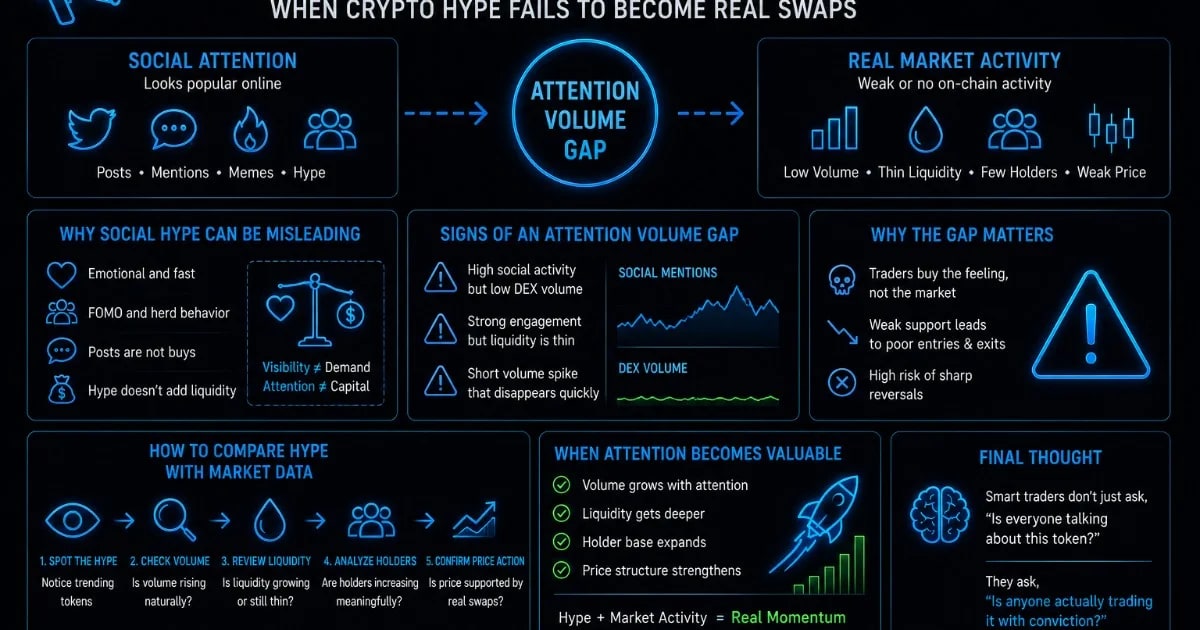
Explore the disconnect between social media hype and actual trading in crypto. Understand the attention volume gap affecting token performance.
In crypto, attention can move fast.
A token can trend on social media, dominate group chats, appear in influencer posts, and create the feeling that everyone is watching. But attention does not always become real trading activity.
Key Takeaways
- In crypto, attention can move fast.
- What Is the Attention Volume Gap?
- Why Social Hype Can Be Misleading
- Signs of an Attention Volume Gap
- Why the Gap Matters for Traders
- How to Compare Hype With Market Data
This disconnect is the attention volume gap.
The attention volume gap happens when a token receives visible hype, but that hype fails to convert into meaningful DEX volume, liquidity, and buyer participation.
For traders, this gap matters because social attention can create confidence before the market confirms it.
What Is the Attention Volume Gap?
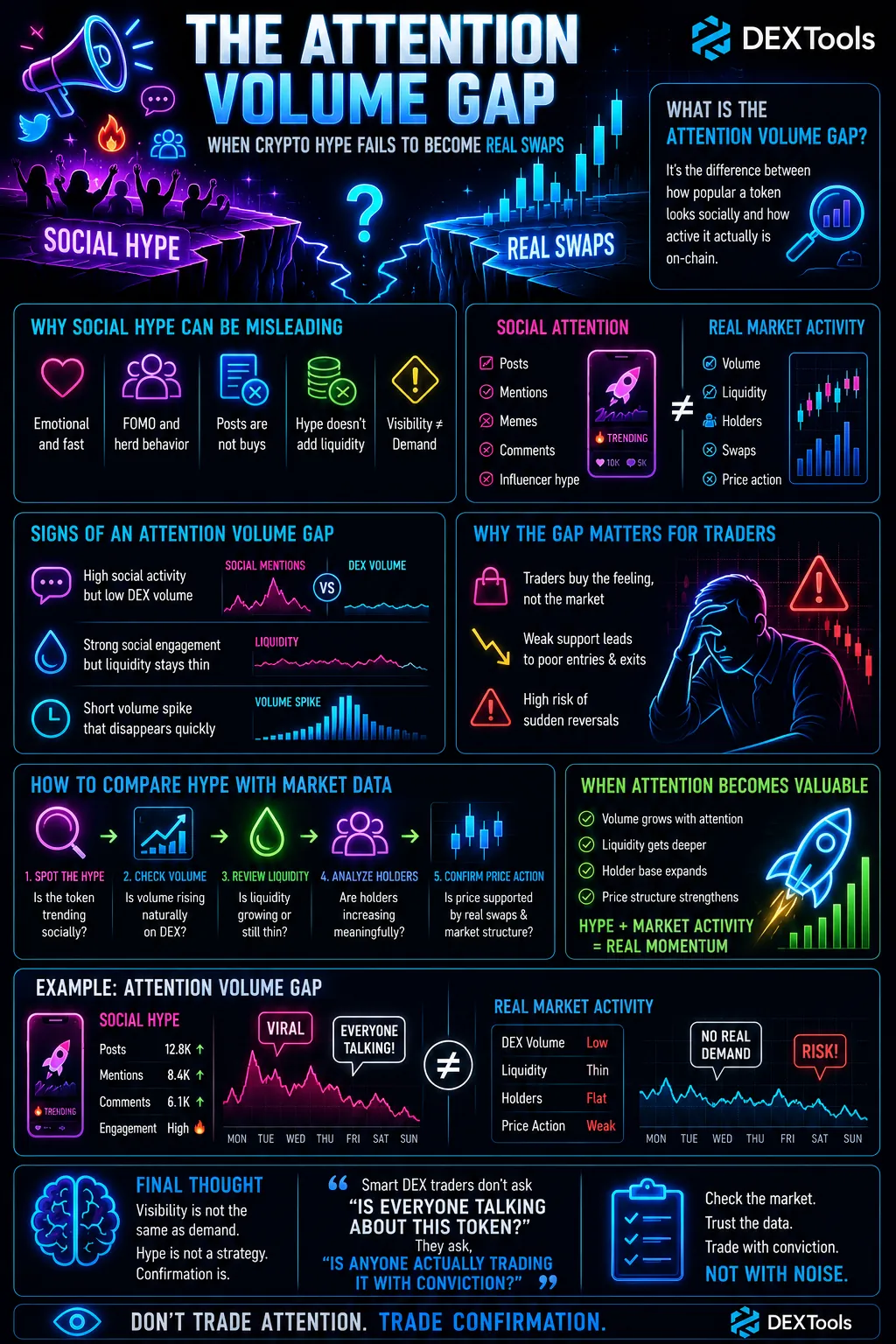
The attention volume gap is the difference between how popular a token looks socially and how active it actually is on chain.
A token may have many posts, mentions, memes, and comments, but low swap activity. It may look viral online while the DEX chart remains weak. It may attract viewers without attracting buyers.
This is especially common in memecoins and narrative driven tokens. Online attention can be loud, but the pool tells traders whether people are actually putting capital to work.
Why Social Hype Can Be Misleading
Social hype is emotional. It spreads through excitement, humor, fear of missing out, and group identity.
But markets require capital. A post is not a buy. A mention is not liquidity. A meme is not sustained demand.
A token can feel popular because it is visible. But visibility does not guarantee that traders are buying, holding, or supporting the market.
This is why DEX data is so important. It helps traders compare social perception with actual behavior.
Signs of an Attention Volume Gap
One sign is heavy social activity with weak DEX volume. If many people are talking about a token but swaps remain low, the hype may not be converting.
Another sign is strong social engagement without liquidity growth. If the community looks active but the pool remains thin, the market may still be fragile.
A third signal is a short volume spike that disappears quickly. This can happen when hype brings a temporary wave of buyers, but the market fails to sustain interest.
DEXTools can help traders check whether attention is supported by volume, liquidity, holders, swaps, and price structure.
Why the Gap Matters for Traders
The attention volume gap can trap traders who buy the feeling instead of the market.
When a token looks popular, traders may assume demand is strong. But if on chain activity is weak, the market may not have enough support. This can lead to poor entries, weak exits, and sudden reversals.
In DeFi, the strongest opportunities often show alignment between attention and market activity.
The risk appears when attention is loud but the market is quiet.
How to Compare Hype With Market Data
Traders should treat social hype as a signal to investigate, not a reason to buy.
If a token is trending, check whether volume is rising naturally. Look at whether liquidity is growing. Watch whether holders are increasing in a meaningful way. Study whether price action is supported by repeated swaps or only by one short burst.
A real trend usually leaves footprints on chain.
If those footprints are missing, the hype may be weaker than it appears.
When Attention Becomes Valuable
Attention is not useless. In crypto, attention can be powerful when it converts into participation.
The best case happens when social attention leads to stronger volume, deeper liquidity, broader holder growth, and a more stable market structure.
That is when hype becomes market energy.
But without conversion, attention remains only noise.
Final Thoughts
The attention volume gap reminds traders that visibility is not the same as demand.
A token can look popular online while failing to become active on chain. It can dominate conversations without building a real market.
Smart DEX traders do not only ask, "Is everyone talking about this token?"
They ask, "Is anyone actually trading it with conviction?"
That question can help separate real momentum from empty hype.
Community vs Hype: Spot Real Token Support The Attention Decay Curve: How to Know When a Trending Token Is Losing Power Liquidity Incentive Traps: When Rewards Attract Farmers, Not Real Buyers High Volume, Low Conviction: Detecting Inflated DEX ActivityFrequently Asked Questions
What is 'attention volume' in crypto?
Attention volume in crypto refers to the level of public interest and discussion surrounding a particular cryptocurrency or project. It can be measured through metrics like social media mentions, news coverage, and search trends.
How does attention volume relate to crypto price?
Increased attention volume can sometimes precede or coincide with price movements, as greater awareness may lead to increased demand. However, it does not guarantee price appreciation and can also be associated with speculative bubbles.
What is the 'attention volume gap'?
The 'attention volume gap' describes a situation where a cryptocurrency receives significant public attention but fails to translate that into substantial trading volume or sustained price action. This suggests a disconnect between hype and actual market participation.
Why might a crypto project have a large attention volume gap?
A large attention volume gap can occur if the project lacks fundamental value, has poor tokenomics, faces regulatory uncertainty, or if the initial hype is not sustained by tangible development or adoption.
Can attention volume be manipulated?
Yes, attention volume can be manipulated through various means, including bot activity on social media, coordinated shilling campaigns, and misleading news or influencer promotions. Investors should be wary of artificially inflated attention.