The Dead Candle Theory: Why Some Tokens Stop Being Markets Before They Stop Trading
— By Whatsertrade in Tutorials

Some tokens do not die in one dramatic crash. They fade. The chart keeps printing candles. Small swaps continue. The pair still exists. But something important
Some tokens do not die in one dramatic crash. They fade.
The chart keeps printing candles. Small swaps continue. The pair still exists. But something important has changed. The token no longer behaves like a real market.
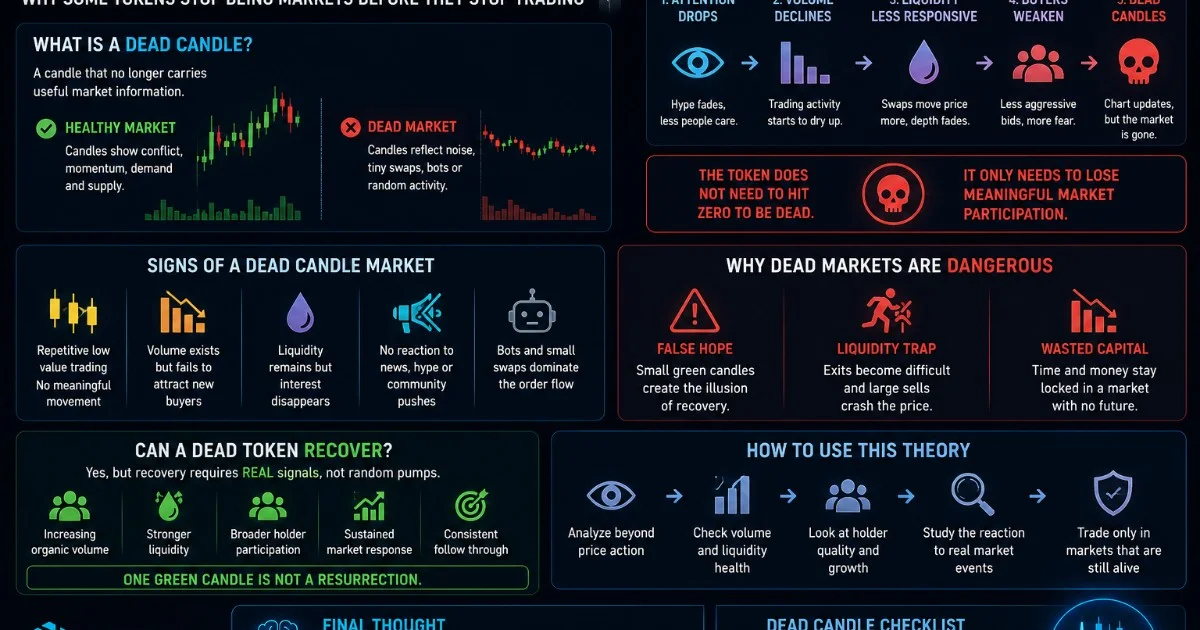
This is the idea behind the Dead Candle Theory.
A token can continue trading long after meaningful market activity has disappeared.
What Is a Dead Candle?
A dead candle is not just a red candle or a low volume candle. It is a candle that no longer carries useful market information.
In a healthy market, candles reflect conflict between buyers and sellers. They show momentum, reaction, hesitation, demand, and supply. In a dying token, candles may simply reflect mechanical swaps, tiny trades, bots, or random noise.
The chart is still alive visually, but the market behind it is fading.
How Tokens Become Dead Markets
Many weak tokens follow a similar path. First, attention drops. Then volume declines. Then liquidity becomes less responsive. Buyers become less aggressive. Sellers accept worse exits. Eventually, the chart still updates, but price action loses meaning.
This does not always happen after a rug pull. Sometimes it happens after hype disappears. Sometimes it happens when a community moves on. Sometimes it happens because early traders already extracted most of the opportunity.
The token does not need to hit zero to become functionally dead.
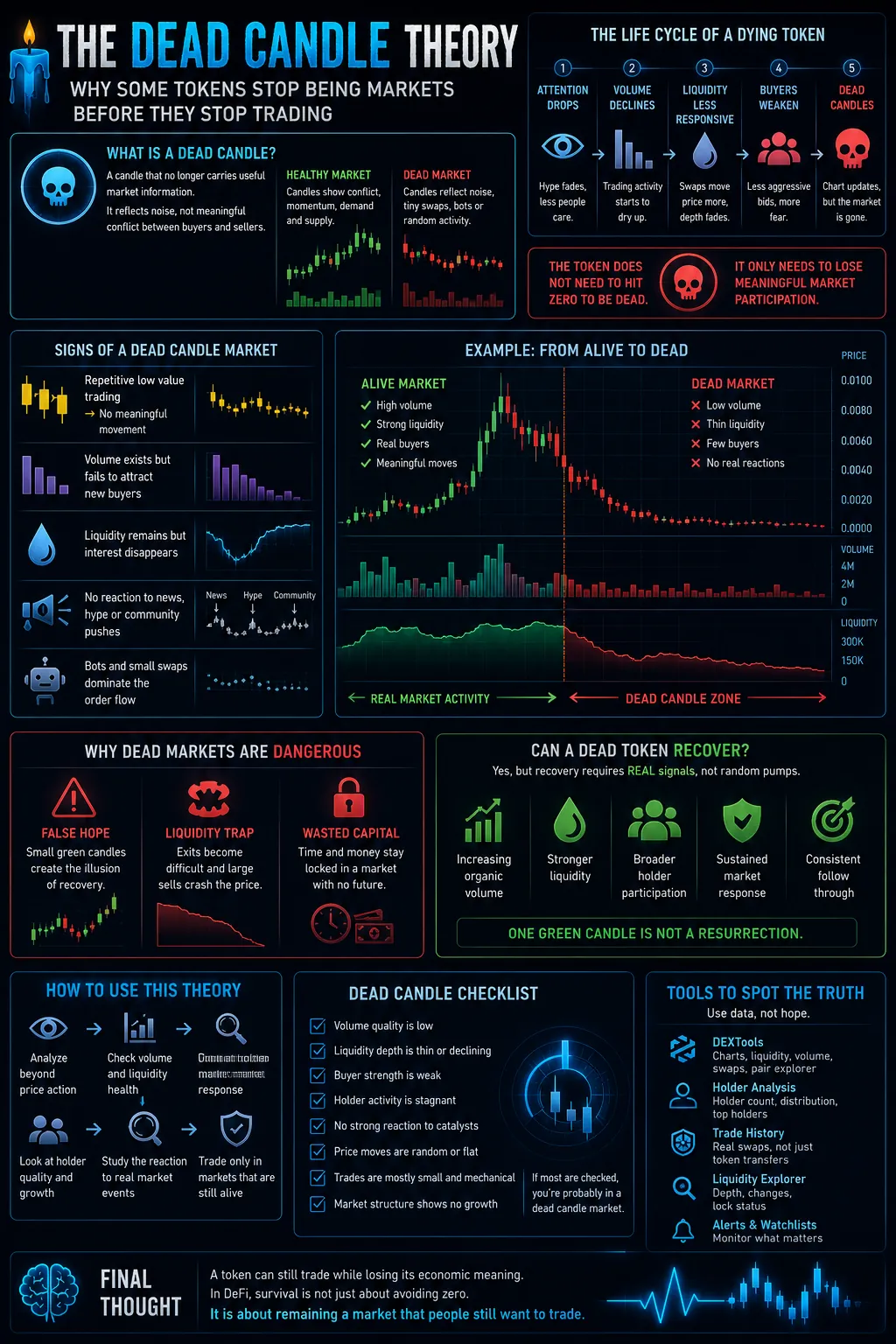
Signs of a Dead Candle Market
One sign is repetitive low value trading that does not create meaningful movement. Another sign is volume that appears present but fails to attract new buyers. Liquidity may remain in the pool, but interest disappears.
A token may also show weak reactions to bullish catalysts. If good news, community pushes, or social attention no longer move the market, the chart may be losing relevance.
DEXTools can help traders study this by comparing volume, liquidity, swaps, holders, and price behavior over time.
Why Dead Markets Are Dangerous
Dead markets are dangerous because they can create false hope. A trader may see the chart moving and assume recovery is possible. But movement alone is not enough.
A token needs active buyers, meaningful liquidity, and renewed attention to recover. Without those elements, small green candles may only be noise.
Dead markets can also trap traders. If liquidity is thin and buyers are scarce, exiting a position can become difficult without damaging the price.
Can a Dead Token Recover?
Sometimes, yes. A token can recover if attention returns, liquidity improves, and new buyers enter with conviction. But recovery requires more than a random pump.
Traders should look for signs of real revival: increasing organic volume, stronger liquidity, broader holder participation, and sustained market response.
One green candle is not a resurrection.
Final Thoughts
The Dead Candle Theory helps traders understand that not all active charts represent active markets.
A token can still trade while losing its economic meaning. It can still print candles while attention, liquidity, and conviction disappear.
In DeFi, survival is not just about avoiding zero.
It is about remaining a market that people still want to trade.
Median Trade Size vs Trade Count: Why Small Swaps Can Inflate DEX Activity Fake Volume vs Real Demand: How to Spot Artificial Momentum in DeFi Trading When Not to Trade: 12 Red Flags Every DeFi Trader Should Know Dead Liquidity: Why Some Pools Look Alive but Are Practically UntradeableFrequently Asked Questions
What is a crypto candle?
A crypto candle, or candlestick, is a chart element showing a cryptocurrency's price movement over a specific timeframe. It displays the opening, closing, high, and low prices for that period.
How do you read a crypto candle?
The body of the candle represents the opening and closing prices. Wicks (or shadows) extend from the body to show the high and low prices reached during the period.
What does a green candle mean?
A green (or bullish) candle typically indicates that the closing price was higher than the opening price for that period. This suggests upward price movement.
What does a red candle mean?
A red (or bearish) candle typically indicates that the closing price was lower than the opening price for that period. This suggests downward price movement.
What is a 'dead candle' in crypto?
While not a standard technical analysis term, a 'dead candle' could metaphorically refer to a token's price action becoming stagnant or disappearing. This might indicate a lack of trading activity or market interest.