The Zero to Liquidity Window: When a New DEX Pair Becomes Actually Tradable
— By Whatsertrade in Tutorials

A new DEX pair can appear on a chart before it becomes a real market. This is one of the most misunderstood moments in DeFi trading. Many traders see a fresh pa
A new DEX pair can appear on a chart before it becomes a real market.
This is one of the most misunderstood moments in DeFi trading. Many traders see a fresh pair, a green candle, and a few early swaps, then assume the opportunity is already live. In reality, the first stage of a token launch is often chaotic, unstable, and difficult to read.
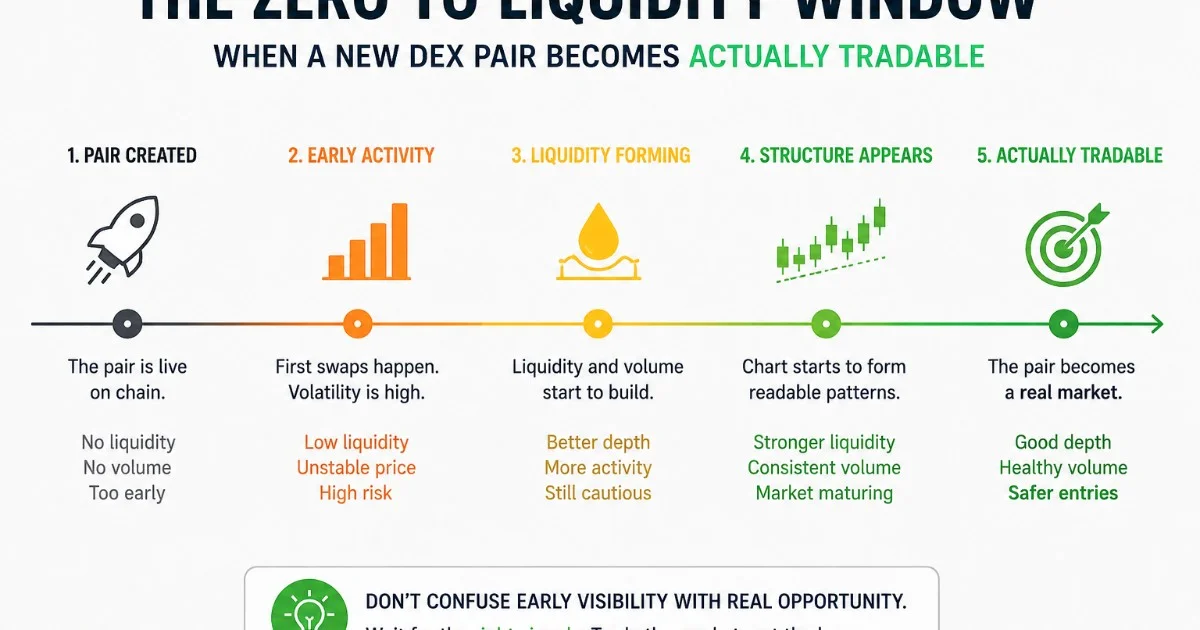
The gap between pair creation and real tradability is what we can call the zero to liquidity window.
During this window, the token exists on chain, but the market around it is not mature enough to support reliable decisions. There may be a chart, but not enough history. There may be swaps, but not enough volume. There may be liquidity, but not enough depth for safe entries and exits.
Why New DEX Pairs Are Hard to Read
Fresh DEX pairs often attract bots, snipers, insiders, early community members, and curious traders at the same time. This creates distorted price action. One large buy can create a huge candle. One sell can erase the entire move. The chart may look exciting, but the market can still be fragile.
This is why traders should avoid judging a new token by price action alone. The real question is not whether the token is moving. The better question is whether the pair has enough structure to be analyzed.
What Makes a Pair Actually Tradable
A new DEX pair becomes more tradable when several signals start to align.
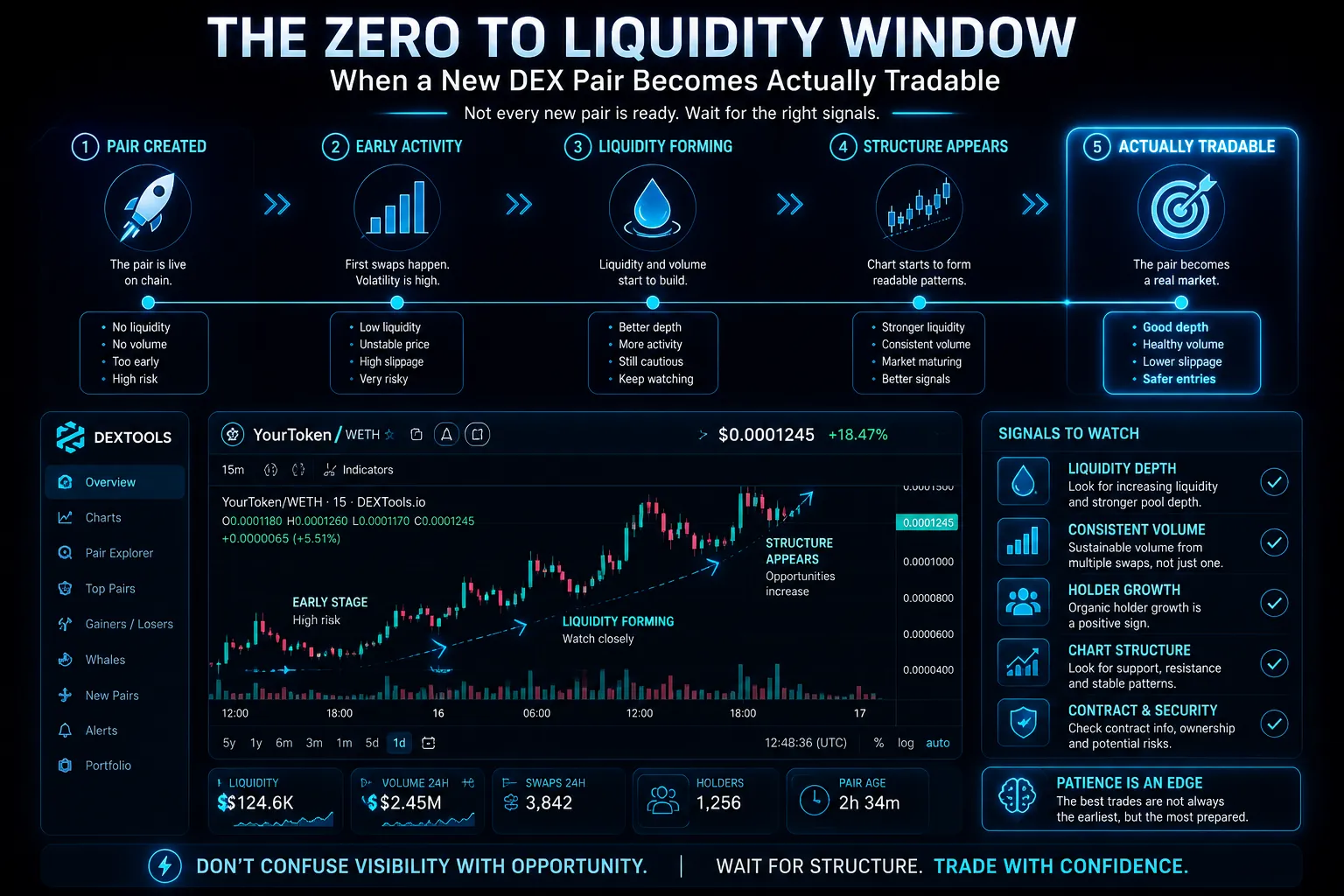
Liquidity should be deep enough to support normal position sizes. Volume should come from repeated activity, not just one or two dramatic swaps. The holder count should grow in a way that looks organic. The chart should begin to form readable patterns instead of random vertical spikes.
DEXTools can help traders observe this transition by combining chart data, liquidity, swaps, volume, pair age, contract information, and holder behavior in one place.
The Danger of Entering Too Early
Being early is not always an advantage. In DeFi, being too early can mean entering before the market has enough information. Traders who buy during the zero to liquidity window often face extreme slippage, unpredictable candles, and unclear exit conditions.
A token may look cheap because it is new, but that does not mean it is ready. Early entries can be profitable, but they require a higher tolerance for uncertainty.
How to Approach the Zero to Liquidity Window
Instead of rushing into every new pair, traders can treat the early stage as an observation period. Watch how liquidity changes. Watch how buyers and sellers behave. Watch whether volume continues after the first burst of attention.
A healthy pair does not need to look perfect immediately. It needs to show signs that a real market is forming.
Final Thoughts
The zero to liquidity window is where many traders confuse visibility with opportunity. Just because a token appears on a DEX chart does not mean it is ready to trade.
The smartest traders do not only ask, "Is this token early?"
They ask, "Has this pair become a real market yet?"
That question can make the difference between entering a promising launch and becoming exit liquidity for a market that never fully formed.
Healthy vs Unstable Token Launch Patterns: Key Insights The First 60 Minutes After a Token Launch: What to Watch on DEXTools Median Trade Size vs Trade Count: Why Small Swaps Can Inflate DEX Activity Exit Liquidity Mapping: Who Might Sell Into You Before You Buy?Frequently Asked Questions
What is a trading pair in cryptocurrency?
A trading pair consists of two different cryptocurrencies that can be exchanged for each other on a decentralized exchange (DEX). For example, ETH/USDT allows users to trade Ethereum for Tether.
How does a new DEX pair become tradable?
A new DEX pair becomes tradable once a liquidity pool is created for it. This pool contains reserves of both tokens in the pair, allowing users to swap between them.
Who provides liquidity for a new trading pair?
Liquidity providers (LPs) supply both tokens of a pair to the liquidity pool. In return, they earn a portion of the trading fees generated by that pair.
What is the significance of liquidity for a trading pair?
Sufficient liquidity ensures that trades can be executed smoothly and efficiently, with minimal price impact. Low liquidity can lead to higher slippage and difficulty in completing large trades.
How does a DEX determine the price of a trading pair?
DEXs typically use an automated market maker (AMM) model to determine prices. The price of a token in a pair adjusts based on the ratio of the two tokens in the liquidity pool.