Token Vesting Schedules: How to Read a Cliff & Linear Unlock

Instant token liquidity creates severe misaligned incentives that often destroy Web3 protocols. We break down the automated smart contract lockups needed to audit inflation curves safely.
The Alignment Protocol: Mitigating the Chaos of Instant Liquidity
- In the open-source coliseum of Web3 development, the launch of a native network token represents a monumental operational milestone. The Token Generation Event (TGE) marks the exact moment a protocol's abstract economic design manifests as a live, tradeable asset on decentralized ledger networks. For early-stage venture capital firms, founding core engineers, and decentralized community participants, the TGE can spark intense market euphoria. However, if the underlying distribution architecture is poorly constructed, that initial excitement can rapidly degrade into a terminal, irreversible valuation collapse.
- In a conventional business framework, equity ownership is tethered to strict legal constraints, corporate non-compete agreements, and multi-year employment milestones. In the permissionless Web3 landscape, if early insiders, advisory teams, and large institutional backers receive one hundred percent of their allocated token holdings in a completely liquid format on day one, a dangerous game-theoretic failure occurs. The immediate temptation to realize massive capital gains creates an intense, emotional race to exit the project. Insiders begin dumping their massive size directly into early secondary market order books, completely exhausting the available liquidity pool, tanking the spot price, and abandoning the project before a single line of product code is fully finalized.
- To insulate a protocol's economic foundation from this predatory "pump-and-dump" meta, token engineers deploy Vesting Schedules. Powered by immutable smart contracts, a vesting schedule acts as a cryptographic safety belt. It programmatically locks up specific allocations of the token supply, forcing them to remain completely illiquid and un-tradeable over predetermined horizons. This mechanism establishes a non-negotiable structural buffer, filtering out short-term speculative actors and ensuring that project founders, institutional capital allocators, and active users remain deeply aligned for multiple years.
- Understanding how to read the finer details of these token vesting distribution contracts, deciphering the operational mechanics of cliffs versus linear unlocks, and auditing milestone triggers is a critical requirement for evaluating the long-term survival probability of any digital asset.
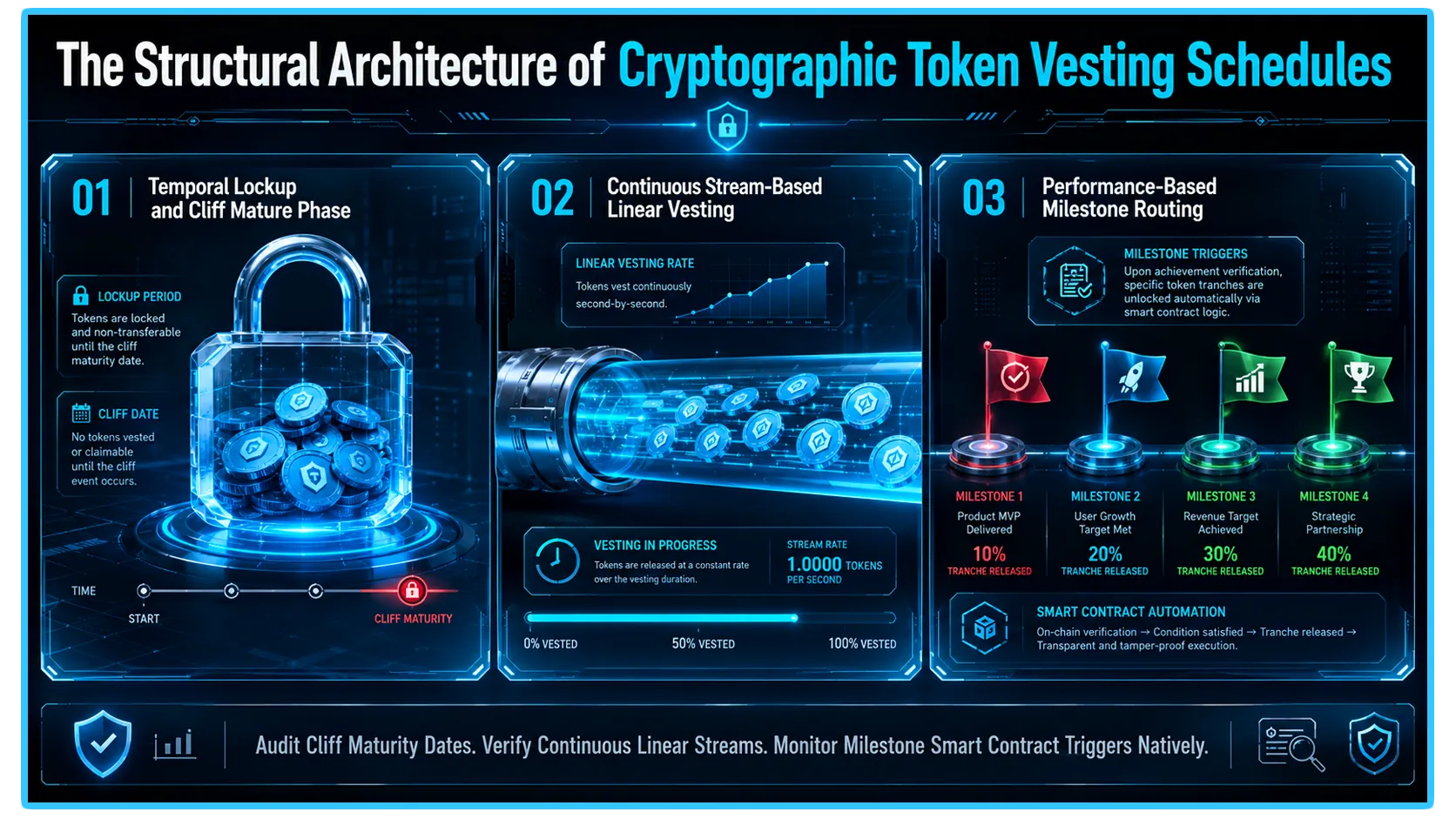
1. The Cliff Period: The Waiting Room of Token Economies
- To analyze a protocol's inflation curve associated with token vesting with genuine structural rigor, you must first master the architectural anatomy of the cliff period. The cliff operates as a hardcoded temporal quarantine zone. It defines a specific window of time post-TGE during which an allocation bucket remains entirely frozen and unclaimable.
- When a participant checks their distribution dashboard during an active cliff window, the interface will display a clear paradox: they officially own a substantial quantity of tokens on paper, but their available, claimable, and liquid balance reads exactly zero. The tokens sit quietly inside a non-custodial lockup contract, entirely isolated from the circulating supply.
- The structural purpose of the cliff is to enforce long-term commitment and weed out bad actors. For core team members, a standard one-year cliff ensures that an engineer cannot join a project, collect an upfront token grant, quit after three weeks of work, and walk away with highly liquid capital funded by the community. They must actively contribute to the protocol's development for a full consecutive twelve-month cycle simply to cross the threshold of initial token maturity.
- The critical structural event occurs on the exact calendar day the cliff period matures. On this day, a pre-set percentage of the total token allocation instantly unlocks and transitions from a frozen state into a liquid format. This sudden transition represents a significant structural event for secondary market venues. If a venture firm has a twelve-month cliff that releases twenty percent of their total position instantly upon maturity, a massive influx of liquid token supply hits the market simultaneously. Sophisticated market participants track these cliff maturity dates closely, preparing for potential localized volatility expansions as insiders receive their first taste of real-world liquidity.
2. The Linear Unlock: The Gradual Release Pipeline
- Once an allocation bucket successfully crosses its cliff maturity date, the remaining locked tokens enter the Linear Unlock phase. The linear unlock represents a programmatic transition from absolute, frozen isolation to smooth, gradual market circulation.
- Rather than dumping massive chunks of supply into the market on a single calendar day (a clumsy distribution method that routinely creates heavy price distortions) a linear unlock distributes the asset slowly and evenly over an extended time horizon. This unlocking duration typically ranges from twenty-four months for early investors to forty-eight or sixty months for core team founders and foundational ecosystems.
The technical execution of a linear unlock can be structured through two distinct operational models:
Discrete Linear Unlocks
- Under a discrete model, tokens are released in fixed, repetitive chunks at standardized chronological intervals, such as on the first day of every month or at the closing of each quarterly business cycle. While this structure is easy to display on a static corporate roadmap, it introduces a severe psychological vulnerability known as the Unlock Front-Running Loop.
- Because secondary market day traders and automated short-selling algorithms know the exact calendar day a massive discrete unlock will land in insider wallets, they will aggressively market-sell the token days in advance to build a short position, driving the spot price down ahead of the event and trapping regular spot holders.
Continuous Streaming Unlocks
- To permanently dismantle this front-running loophole, modern quantitative Web3 protocols deploy continuous, streaming linear unlocks. Leveraging advanced token-streaming smart contract primitives, continuous vesting calculates and streams token maturity second by second or block by block.
- When an insider views their vesting vault, they can watch their claimable token balance steadily tick upward in real time, like a running digital stopwatch. The asset trickles into circulation smoothly and gradually, eliminating artificial calendar shocks and allowing secondary market liquidity pools to absorb the expanding supply without experiencing sudden visual gaps on the candlestick chart.
3. Milestone-Based Vesting: Performance-Driven Value Capture
- While cliffs and linear unlocks rely strictly on the linear progression of time, Milestone-Based Token Vesting completely discards chronological calendars. Instead, it anchors token distribution to the actual, verifiable execution of major product or ecosystem achievements.
- Milestone token vesting treats token distribution as a performance-driven optimization loop. It ensures that insiders can only access their allocations when they successfully deliver real-world value and utility to the underlying protocol network. This methodology is heavily utilized within development grants, ecosystem expansion funds, and technical advisory allocations.
Standard operational milestones within Web3 architectures include:
The Mainnet Launch: Releasing a specified percentage of the development team's token pool only when the protocol successfully transitions from a safe testnet sandbox to a live, fully operational public mainnet layer.
Smart Contract Security Audits: Unlocking a tranche of capital allocations only after multiple independent, tier-one cybersecurity firms completely audit the protocol's source code and publish a clean security rating.
Ecosystem Volume & User Metrics: Triggering automated token releases when the decentralized application crosses defined utility thresholds, such as sustaining a specific amount of Total Value Locked (TVL) inside its liquidity pools or logging a set number of active, non-sybil daily transacting wallets.
- By combining temporal vesting parameters with milestone-based triggers, a protocol constructs a highly resilient economic shield. If a project team falls behind on their development promises, misses their target deadlines, or stalls product execution, the smart contracts automatically halt further token inflation, preventing insiders from extracting value from a stagnant or dying network.
4. Practical Scenario Analysis: Reading a Master Vesting Schedule
- To synthesize these concepts into a cohesive, actionable analytical framework, let us dissect a comprehensive real-world example of an institutional tokenomics vesting schedule.
- Imagine a decentralized data storage protocol that launches its native utility token with a maximum supply cap of one hundred million tokens. A top-tier venture capital fund participates in the early seed investment round and is granted a total allocation of exactly twelve million tokens. The protocol's tokenomics documentation outlines the following structural vesting rules for the Seed Round bucket: 10% Unlock at TGE, followed by a 1-year Cliff, and a subsequent 36-month Linear Continuous Unlock.
Let us map out the precise chronological lifecycle of this institutional allocation:
Phase 1: The Token Generation Event (TGE)
On the exact day the token launches on decentralized venues, the initial ten percent unlock trigger executes immediately. The venture fund receives exactly one million two hundred thousand tokens in a fully liquid, tradeable format. They can immediately stake these tokens to secure the network, deploy them into automated market maker pools to harvest protocol fees, or sell them to realize early capital returns. The remaining ten million eight hundred thousand tokens are routed straight into the locked vesting contract.
Phase 2: The One-Year Cliff Horizon
For the next twelve months following the TGE, the venture fund's claimable balance is frozen. Even if the token's spot price pumps thousands of percent due to market euphoria, or crashes severely during a macro market drawdown, the fund cannot touch a single locked token. Their capital is completely immobilized, forcing them to take a long-term interest in the protocol's fundamental survival.
Phase 3: The Linear Streaming Era
- The exact millisecond the one-year calendar anniversary hits, the cliff matures, and the continuous linear unlock engine activates. The remaining ten million eight hundred thousand tokens are divided evenly across the thirty-six-month unlocking window.
- This results in exactly three hundred thousand tokens transitioning from a locked state to a liquid state every single month. Because the protocol utilizes a continuous block-by-block streaming primitive, this monthly allocation breaks down further to roughly ten thousand tokens unlocking every single day, streaming smoothly into the fund's available balance second by second. This predictable, constant drip continues for three full years until the venture fund's allocation is fully distributed, completing their vesting lifecycle.
Token Vesting Architecture Typologies
| Vesting Classification | Distribution Metric Trigger | Primary Economic Utility | Market Volatility Impact |
| The Cliff Period | Fixed Chronological Calendar | Enforces long-term team commitment | High risk of volatility on maturity day |
| Discrete Linear | Fixed Periodic Increments | Standardized corporate mapping | High exposure to front-running dips |
| Continuous Linear | Second-by-Second / Block Stream | Smooths out network inflation curves | Minimal; eliminates supply shocks |
| Milestone-Based | Product / Protocol Achievements | Ties value capture to real utility | Non-inflationary during delays |
5. Sourcing On-Chain Vesting Telemetry via DEXTools
- Even when keeping your private keys safe offline with robust cold storage backups, maintaining visibility over the decentralized landscape remains vital. DEXTools delivers real-time analytics to track token dynamics, smart contract configurations, and pool activities across alternative blockchains.
- By leveraging diagnostics like the Pair Explorer, Live New Pairs tracker, Big Swap Explorer, and Top Traders boards, participants can seamlessly analyze transactional volumes, monitor large whale reallocations, and run automated contract audits before executing on-chain swaps. This ensures your hardened cryptographic setup interacts exclusively with legitimate, highly liquid trading venues while your foundational assets rest fully protected.
Disclaimer: This article is for informational purposes only and does not constitute investment advice, financial advice, trading advice, or any other kind of advice. DEXTools does not recommend buying, selling, or holding any cryptocurrency or token. Users should conduct their own research and consult with a qualified financial advisor before making any investment decisions. Cryptocurrency investments are volatile and high-risk. DEXTools is not responsible for any losses incurred.