Top 5 estrategias de ingresos pasivos crypto 2026
— By Tony Rabbit in Tutorials

Las 5 mejores estrategias de ingresos pasivos con crypto en 2026.
Imagine waking up every morning to find your crypto portfolio has grown overnight - not from price speculation, but from predictable, compounding yield. In 2026, decentralized finance (DeFi) has matured into a robust ecosystem where earning passive income on your digital assets is more accessible, more secure, and more profitable than ever before.
Whether you hold ETH, SOL, stablecoins, or a diversified crypto portfolio, there are battle-tested strategies that let you put your assets to work around the clock. This guide breaks down the top five crypto passive income strategies for 2026, complete with real APY data, step-by-step instructions, risk assessments, and everything you need to start earning while you sleep.
We will cover staking, lending, liquidity providing, yield aggregators, and restaking - ranked by accessibility and risk-adjusted returns. Each strategy includes expected yields, minimum investments, difficulty ratings, and concrete steps to get started today.
Table of Contents
- APY Comparison Table
- 1. Staking
- 2. Lending
- 3. Liquidity Providing
- 4. Yield Aggregators
- 5. Restaking
- Risk Assessment Matrix
- Compound Interest Calculator
- Tax Implications
- FAQ
- Related Tutorials
APY Comparison Table: All 5 Strategies at a Glance
Before we dive deep into each strategy, here is a side-by-side comparison so you can quickly identify which approach fits your goals, risk tolerance, and available capital.
Note: APY figures are approximate ranges based on Q1-Q2 2026 market data. Actual yields fluctuate based on market conditions, protocol utilization, and token prices. Always verify current rates directly on each protocol before depositing funds.
1. Staking: The Foundation of Crypto Passive Income
Staking is the simplest and most reliable way to earn passive income on your crypto. When you stake tokens on a Proof-of-Stake (PoS) blockchain, you lock up your assets to help secure the network and validate transactions. In return, the network rewards you with newly minted tokens and transaction fees.

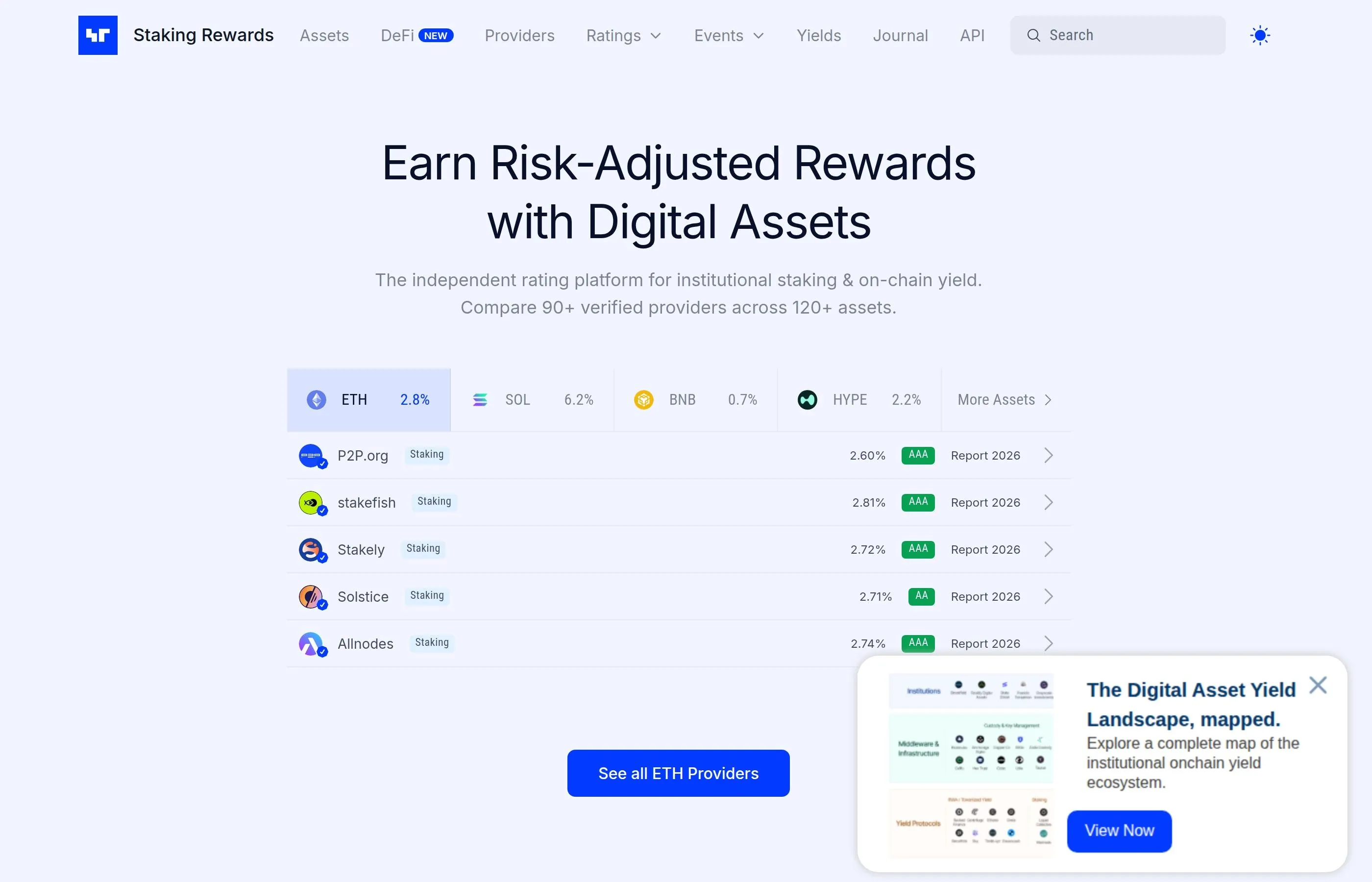
Think of it like earning interest on a savings account - except instead of a bank, a decentralized network pays you for participating in its security. In 2026, staking has become incredibly user-friendly, with liquid staking protocols letting you earn yield while keeping your assets flexible.
Top Staking Opportunities in 2026
Ethereum (ETH) Staking - 3% to 4% APY
Ethereum staking is the gold standard for conservative crypto income. After years of maturation since The Merge, ETH staking offers predictable, low-risk returns backed by the most valuable smart contract platform in existence.
- Lido (stETH): The largest liquid staking protocol with approximately 3.2% APY. You deposit ETH and receive stETH, which automatically accrues staking rewards. stETH can be used across DeFi for additional yield.
- Rocket Pool (rETH): A more decentralized alternative offering around 3.0-3.5% APY. Rocket Pool uses a network of independent node operators, reducing centralization risk.
- Solo Staking: Running your own validator with 32 ETH earns approximately 3.5-4.0% APY. Higher returns come from MEV rewards and tips, but require technical expertise and dedicated hardware.
Solana (SOL) Staking - 6% to 7% APY
Solana staking delivers higher yields than Ethereum, reflecting the network's faster block times and higher inflation schedule. SOL stakers can choose from hundreds of validators directly through wallets like Phantom or use liquid staking via Marinade Finance (mSOL) or Jito (jitoSOL).
- Native Staking: 6.5-7.0% APY through validators like Helius, Triton, or Everstake.
- Marinade Finance: ~6.3% APY with mSOL liquid staking token.
- Jito: ~6.8% APY including MEV rewards redistributed to stakers.
Cosmos (ATOM) Staking - 15% to 20% APY
Cosmos offers some of the highest staking yields among established Layer 1 chains. The 21-day unbonding period and higher inflation rate contribute to elevated APYs. ATOM stakers also receive airdrops from new Cosmos ecosystem chains, adding significant bonus value.
- Native Staking via Keplr: 17-20% APY depending on validator commission.
- Stride (stATOM): ~16% APY with liquid staking flexibility.
- Airdrop Eligibility: Staking ATOM qualifies you for ecosystem airdrops worth hundreds to thousands of dollars per year.
Step-by-Step: How to Start Staking
- Set up a wallet. Install MetaMask for Ethereum or Phantom for Solana. For maximum security, use a Ledger hardware wallet.
- Purchase your tokens. Buy ETH, SOL, or ATOM on a centralized exchange (Coinbase, Kraken, Binance) and withdraw to your wallet.
- Choose a staking method. For beginners, liquid staking (Lido, Marinade) is simplest. Visit the protocol's website and connect your wallet.
- Deposit and stake. Approve the transaction in your wallet. For Lido, swap your ETH for stETH. For native staking, select a validator with low commission (under 10%) and strong uptime (99%+).
- Monitor your rewards. Rewards accrue automatically. For liquid staking tokens, your balance value increases over time. For native staking, claim rewards periodically.
- Compound your earnings. Re-stake claimed rewards to benefit from compound interest. Some protocols auto-compound for you.
Risks and Mitigation
Risks
- Slashing: Validators can lose a portion of staked funds for misbehavior or extended downtime.
- Lock-up Periods: Native staking often requires unbonding periods (7 days for SOL, 21 days for ATOM).
- Smart Contract Risk: Liquid staking protocols carry contract vulnerability risk.
- Token Price Decline: Your staking rewards are denominated in the staked token, which can lose value.
Mitigation
- Choose established validators with proven track records and insurance.
- Use liquid staking to maintain flexibility and instant exit options.
- Stick to audited protocols with significant total value locked (TVL).
- Only stake tokens you plan to hold long-term regardless of price.
Pros and Cons
Pros
- Simplest passive income strategy
- Low technical barrier to entry
- Supports network decentralization
- Liquid staking tokens enable composability
- Relatively low risk compared to other DeFi strategies
Cons
- Lower APY compared to riskier strategies
- Returns denominated in volatile assets
- Unbonding periods limit liquidity
- Validator selection requires research
- Slashing risk (though rare with good validators)
2. Lending: Earn Interest on Your Crypto Like a Bank
DeFi lending lets you supply your crypto assets to decentralized protocols and earn interest from borrowers - all without intermediaries. Protocols like Aave, Compound, and MakerDAO have processed billions in loans and represent some of the most battle-tested smart contracts in the industry.
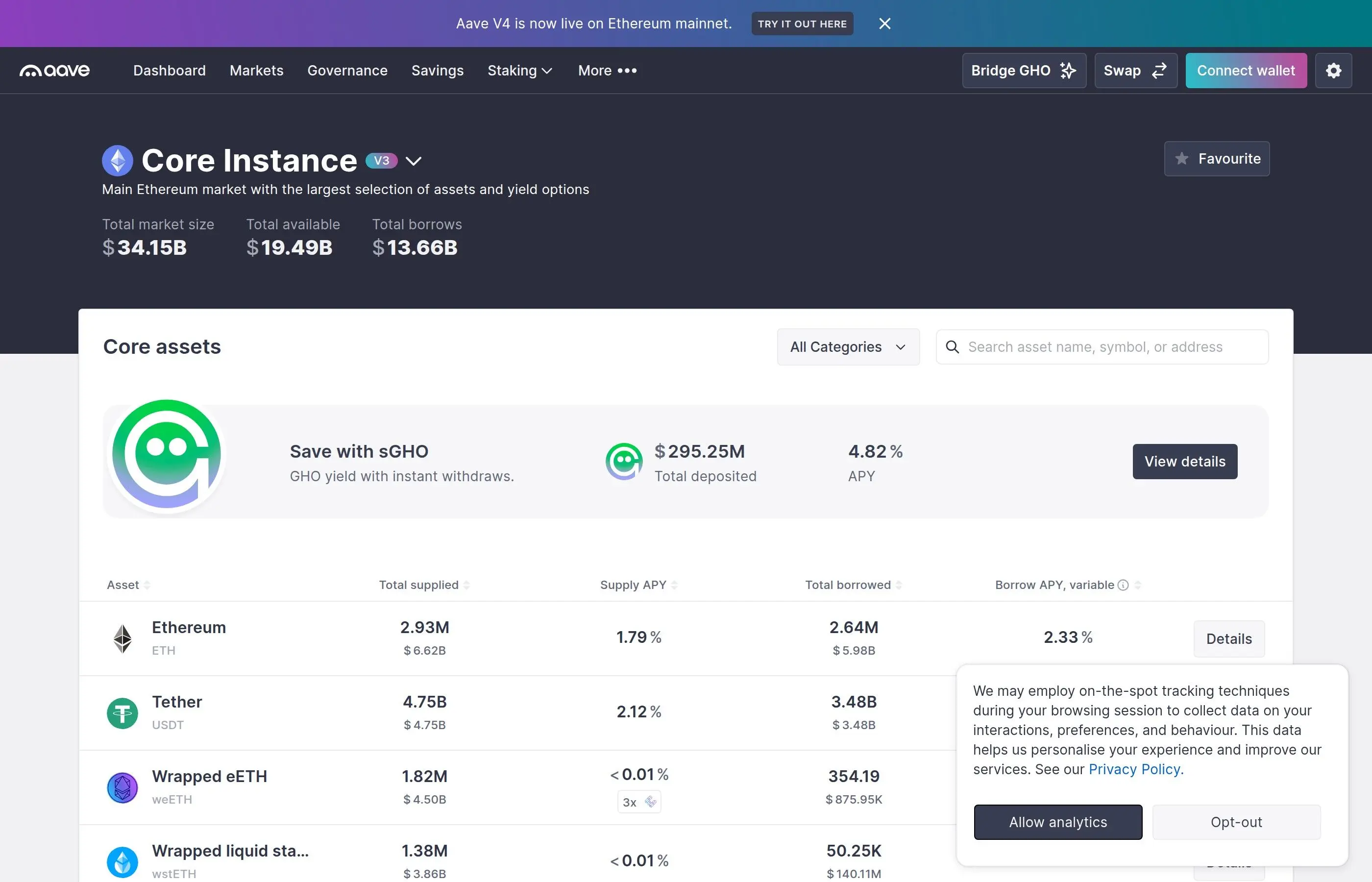
Lending is particularly attractive for stablecoin holders who want to earn yield without exposure to crypto price volatility. If you hold USDC, USDT, or DAI, lending is arguably the best risk-adjusted passive income strategy available.
Top Lending Protocols in 2026
Aave V4 - 2% to 8% APY
Aave remains the dominant lending protocol across Ethereum, Arbitrum, Optimism, Base, and Polygon. Aave V4 introduced improved risk management, dynamic interest rates, and cross-chain lending capabilities.
- USDC Supply APY: 4-6% on Ethereum mainnet, 5-8% on Layer 2s during high demand.
- ETH Supply APY: 1.5-3% base rate, with additional AAVE token incentives on select markets.
- DAI Supply APY: 4-7% depending on market utilization.
- GHO (Aave stablecoin): Staking stkAAVE provides discounted GHO borrow rates and additional yield.
Compound V3 - 2% to 7% APY
Compound pioneered DeFi lending and continues to innovate with its V3 architecture. The single-asset market design simplifies risk management and offers competitive rates.
- USDC Market: 3-5% supply APY plus COMP token rewards.
- ETH Market: 1-2.5% supply APY.
- Supported Chains: Ethereum, Base, Arbitrum, Polygon, Optimism.
MakerDAO / Sky Protocol - 5% to 12% APY
MakerDAO (rebranded to Sky Protocol) offers the DAI Savings Rate (DSR) at approximately 5-8% APY, funded by protocol revenue. The Enhanced DAI Savings Rate (EDSR) can push yields to 10-12% during periods of high protocol income.
- sDAI: Simply deposit DAI into the savings contract and receive sDAI, which appreciates in value.
- No Minimum: Any amount of DAI can be deposited.
- Instant Withdrawal: No lock-up period - exit anytime.
Step-by-Step: How to Start Lending
- Prepare your wallet. Set up MetaMask and fund it with the tokens you want to lend (USDC, ETH, DAI). Consider using a Layer 2 like Arbitrum to reduce gas costs.
- Navigate to the protocol. Visit Aave (app.aave.com), Compound (app.compound.finance), or Sky Protocol (app.sky.money).
- Connect your wallet. Click "Connect Wallet" and approve the connection in MetaMask.
- Select "Supply" or "Deposit." Choose the asset you want to lend and enter the amount.
- Approve the token. First transaction: approve the protocol to spend your tokens. This is a one-time gas fee per token.
- Confirm the supply transaction. Second transaction: deposit your tokens into the lending pool. You will receive aTokens (Aave) or cTokens (Compound) representing your deposit plus accruing interest.
- Watch your balance grow. Interest accrues every block (approximately every 12 seconds on Ethereum). Your aToken or cToken balance increases automatically.
Understanding Liquidation Risk
While supplying assets to lending protocols is relatively safe, understanding liquidation is critical if you also borrow against your deposits. Here is how it works:
- Health Factor: A number above 1.0 means your position is safe. Below 1.0 triggers liquidation.
- Loan-to-Value (LTV): Each asset has a maximum LTV. ETH on Aave has an LTV of ~80%, meaning you can borrow up to 80% of your collateral value.
- Liquidation Penalty: If liquidated, you lose 5-10% of your collateral as a penalty to liquidators.
- Supply-Only Strategy: If you only supply and never borrow, you face zero liquidation risk. This is the recommended approach for passive income seekers.
Risks and Mitigation
Risks
- Smart Contract Exploits: Protocol bugs could result in loss of deposited funds.
- Utilization Spikes: When utilization hits 100%, you temporarily cannot withdraw.
- Stablecoin Depeg: USDC or DAI could lose their peg, affecting your deposit value.
- Oracle Failures: Price feed errors could cause cascading liquidations.
Mitigation
- Use only protocols with extensive audit histories and bug bounties.
- Diversify across multiple protocols and chains.
- Supply only and avoid borrowing for a purely passive approach.
- Monitor protocol health dashboards and set withdrawal alerts.
Pros and Cons
Pros
- Earn yield on stablecoins with minimal price risk
- No lock-up periods on most protocols
- Battle-tested protocols with years of operation
- Simple to use - just deposit and earn
- Can be combined with staking for layered yield
Cons
- Variable APY that fluctuates with market demand
- Smart contract risk remains present
- Gas fees on Ethereum mainnet can eat into small deposits
- Temporary withdrawal restrictions during high utilization
- Regulatory uncertainty around DeFi lending
3. Liquidity Providing: Earn Trading Fees as a Market Maker
Liquidity providing (LP) turns you into a decentralized market maker. You deposit pairs of tokens into automated market maker (AMM) pools, and traders pay fees every time they swap through your pool. This is the backbone of decentralized exchanges like Uniswap, Raydium, and Curve Finance.
LP yields can be significantly higher than staking or lending, but they come with a unique risk: impermanent loss. Understanding this trade-off is essential before committing capital.
Top LP Opportunities in 2026
Uniswap V4 - 5% to 40%+ APY
Uniswap V4 introduced hooks - customizable smart contract modules that let pool creators add features like dynamic fees, limit orders, and automated rebalancing. This has created entirely new yield opportunities.
- ETH/USDC (0.05% fee tier): 5-15% APY on concentrated liquidity positions.
- ETH/USDC (0.3% fee tier): 10-25% APY with wider price ranges.
- Exotic Pairs: 20-50%+ APY on newer or less liquid pairs, but with higher impermanent loss risk.
- Hook-Enhanced Pools: Auto-rebalancing hooks can significantly reduce impermanent loss and optimize fee capture.
Raydium (Solana) - 10% to 50%+ APY
Raydium is Solana's leading AMM, offering concentrated liquidity and integration with the Openbook order book for deeper liquidity. Low transaction costs on Solana make LP positions practical even for smaller portfolios.
- SOL/USDC: 15-30% APY depending on price volatility.
- Stablecoin Pairs: 8-15% APY with minimal impermanent loss.
- Memecoin Pairs: 50-200%+ APY but with extreme risk.
Curve Finance - 3% to 20% APY
Curve Finance specializes in stablecoin and like-asset swaps (stETH/ETH, USDC/USDT/DAI). Because the paired assets move in correlation, impermanent loss is minimal, making Curve the safest LP option.
- 3pool (USDC/USDT/DAI): 3-6% base APY plus CRV rewards.
- stETH/ETH: 2-5% base APY plus CRV and additional incentives.
- Boosted Pools: Lock CRV as veCRV to boost rewards up to 2.5x, pushing APY to 10-20%.
Impermanent Loss Explained
Impermanent loss (IL) is the most misunderstood concept in DeFi. Here is a simple breakdown:
What it is: Impermanent loss occurs when the price ratio of your deposited tokens changes relative to when you deposited them. The pool automatically rebalances your position, selling the appreciating token and buying the depreciating one.
Example: You deposit $5,000 worth of ETH and $5,000 worth of USDC (50/50 split). If ETH price doubles, a simple hold strategy would give you $15,000. But your LP position would be worth approximately $14,142 - an impermanent loss of about 5.7%.
When it becomes permanent: IL is "impermanent" because it reverses if prices return to the original ratio. It becomes a real loss only when you withdraw at a different ratio than when you deposited.
How to minimize it:
- Provide liquidity for correlated pairs (stETH/ETH, USDC/USDT) on Curve.
- Use concentrated liquidity with tighter ranges on high-volume pairs where fees outpace IL.
- Choose auto-rebalancing hooks on Uniswap V4 that dynamically adjust your position.
- Focus on pairs with high trading volume to maximize fee income that offsets IL.
Step-by-Step: How to Provide Liquidity
- Choose your pair and protocol. For beginners, start with stablecoin pairs on Curve to minimize impermanent loss. Intermediate users can try ETH/USDC on Uniswap.
- Prepare equal-value amounts of both tokens. For a 50/50 pool, you need equal dollar amounts of each token. For example, $2,500 of ETH and $2,500 of USDC.
- Connect your wallet. Visit the protocol and connect MetaMask or your preferred wallet.
- Navigate to the Pool or Liquidity section. Click "New Position" or "Add Liquidity."
- Select the fee tier (Uniswap). Lower fee tiers (0.05%) suit stablecoin pairs. Higher fee tiers (0.3% or 1%) suit volatile pairs.
- Set your price range (concentrated liquidity). A tighter range earns more fees but requires more active management. A full-range position is simpler but earns less.
- Approve tokens and confirm. Approve each token, then confirm the deposit transaction.
- Monitor and collect fees. On Uniswap V4, fees accrue in your position and can be collected anytime. On Curve, claim CRV rewards periodically.
Pros and Cons
Pros
- Highest potential yield among these strategies
- Earn real revenue from trading fees
- Stablecoin pairs offer high APY with low IL
- Uniswap V4 hooks enable sophisticated strategies
- Low minimum investment on L2s and Solana
Cons
- Impermanent loss can exceed fee earnings
- Concentrated liquidity requires active management
- Higher complexity than staking or lending
- Smart contract risk across multiple protocols
- Gas costs on Ethereum mainnet can be significant
4. Yield Aggregators: Auto-Compounding Vaults for Maximum Returns
Yield aggregators are the "set it and forget it" solution for crypto passive income. These protocols automatically find the best yields across DeFi, deposit your funds, harvest rewards, and re-invest them - all without you lifting a finger. Think of them as robo-advisors for yield farming.
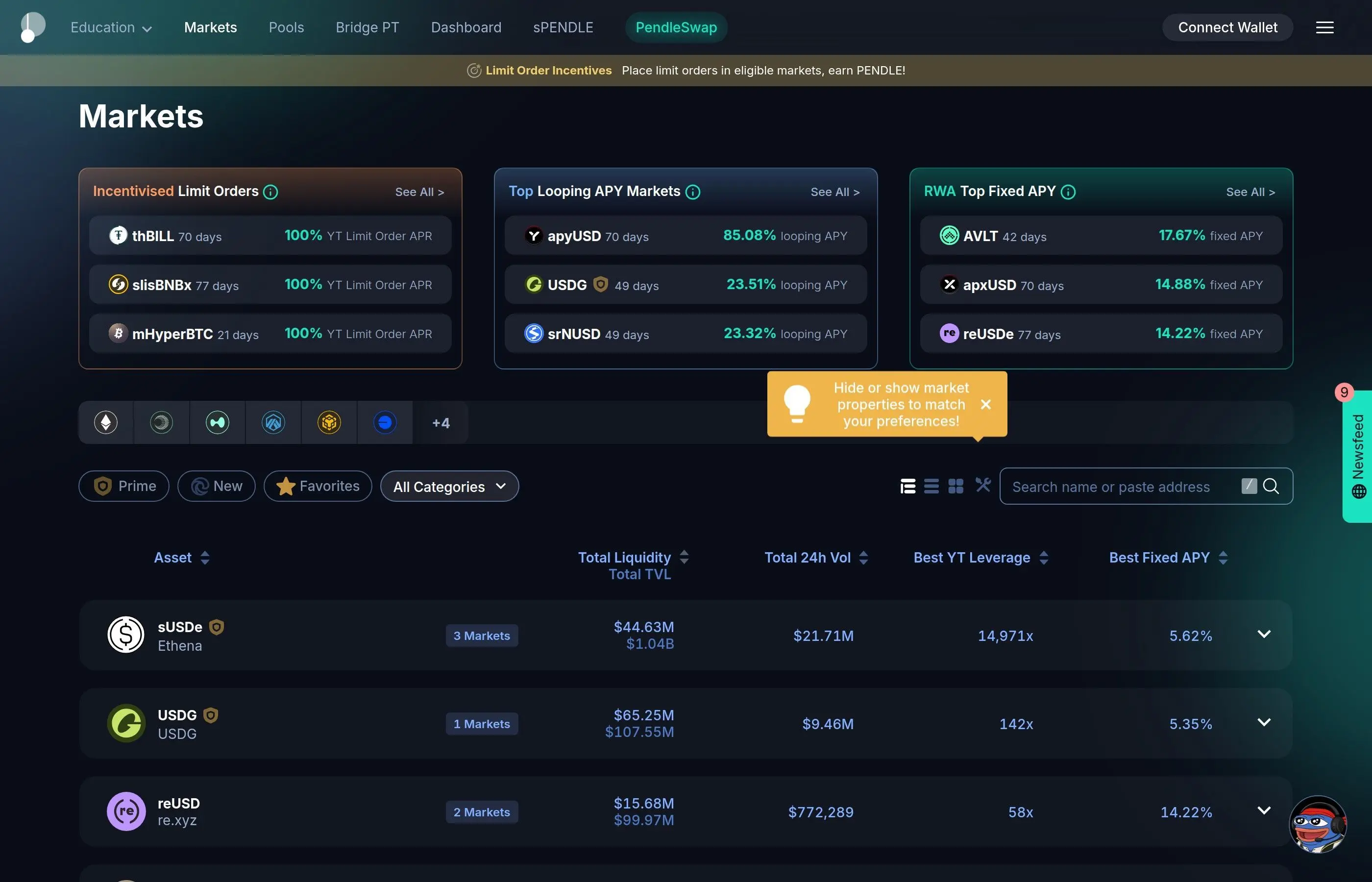
The key advantage is auto-compounding. Instead of manually claiming rewards and re-depositing them (which costs gas each time), aggregators batch these operations across all vault depositors, making compounding cost-effective even for small positions.
Top Yield Aggregators in 2026
Yearn Finance V3 - 4% to 15% APY
Yearn is the OG yield aggregator, known for its sophisticated strategies and strong security track record. Yearn V3 introduced modular vault architecture where multiple strategies compete for allocation within a single vault.
- yvUSDC Vault: 5-8% APY through a mix of Aave, Compound, and MakerDAO strategies.
- yvETH Vault: 4-7% APY combining staking yield with lending optimization.
- yvDAI Vault: 6-10% APY leveraging the DAI Savings Rate and lending protocols.
- Performance Fees: 10% of yield, 2% management fee - factored into displayed APY.
Beefy Finance - 5% to 25% APY
Beefy is the most widely deployed yield aggregator, operating across 25+ blockchains. Its single-asset vaults and LP vaults auto-compound rewards from various farming opportunities.
- Multi-Chain Coverage: Ethereum, Arbitrum, Optimism, Base, Polygon, BSC, Avalanche, Solana, and many more.
- Safety Scores: Each vault receives a safety rating based on audit status, TVL, platform risk, and strategy complexity.
- Auto-Compound Frequency: Harvests and reinvests every few hours for optimal compounding.
- LP Vaults: Auto-compounds LP farming rewards, turning 15% APR into 16-18% APY.
Pendle Finance - 5% to 20%+ APY
Pendle is unique. It separates yield-bearing tokens into their principal component (PT) and yield component (YT), letting you lock in fixed yields or speculate on future yield rates.
- Fixed Yield (PT): Buy Principal Tokens at a discount and redeem at face value at maturity. Lock in 5-15% fixed APY on stETH, sDAI, or eETH.
- Yield Speculation (YT): Buy Yield Tokens to bet on rising yields. If yields increase, YT holders profit significantly. Higher risk, higher reward.
- LP on Pendle: Provide liquidity to PT/underlying pools for 8-20%+ APY with minimal impermanent loss (since PT approaches underlying value at maturity).
- Points Markets: Pendle hosts markets for tokenized points (EigenLayer, EtherFi), allowing fixed-rate exposure to airdrop rewards.
Step-by-Step: How to Use Yield Aggregators
- Choose your aggregator and chain. Yearn for Ethereum blue-chip strategies. Beefy for multi-chain variety. Pendle for fixed yields and yield trading.
- Connect your wallet. Visit the protocol and connect MetaMask. Ensure you are on the correct network.
- Browse vaults and compare. Sort by APY, TVL, and safety score. Read the vault strategy description to understand where your funds will be deployed.
- Check the risk tier. On Beefy, look for "Safety Score." On Yearn, check TVL and strategy age. Higher TVL and older strategies generally indicate lower risk.
- Deposit your tokens. Approve the token, then deposit into the vault. You receive vault tokens (yvTokens, mooTokens) representing your share.
- Let it compound. The vault automatically harvests rewards and reinvests them. Your vault token balance stays the same, but each token is worth more over time.
- Withdraw when ready. Swap your vault tokens back for the underlying asset plus accumulated yield. No lock-up on most vaults.
Understanding Vault Risk Tiers
Pros and Cons
Pros
- Fully automated - true passive income
- Auto-compounding maximizes returns
- Gas savings from batched harvests
- Access to complex strategies without technical knowledge
- Pendle enables fixed-rate yields
Cons
- Performance fees reduce net yield
- Additional smart contract risk (aggregator + underlying protocols)
- Strategy changes may alter your risk profile
- Less transparency into underlying positions
- Pendle has maturity dates that require attention
5. Restaking: Double-Dip Yield on Your Staked ETH
Restaking is the newest and most innovative passive income strategy in crypto. Pioneered by EigenLayer, restaking lets you take your already-staked ETH (via liquid staking tokens like stETH) and pledge it as security for additional services called Actively Validated Services (AVS). In return, you earn stacking rewards on top of your base staking yield - hence "double-dip yield."
This is the highest-yield and highest-risk strategy on our list. The technology is cutting-edge, the reward mechanisms are still evolving, and the risks are less understood than more established strategies. But for those willing to accept the risk, restaking offers some of the most compelling yields in the Ethereum ecosystem.
Top Restaking Protocols in 2026
EigenLayer - 5% to 12%+ APY (Base Staking + AVS Rewards)
EigenLayer is the foundational restaking protocol on Ethereum. It allows stakers to opt-in to securing additional services (oracles, bridges, data availability layers) beyond just the Ethereum base chain.
- Base Layer: 3-4% ETH staking APY from Ethereum validation.
- AVS Rewards: Additional 2-8% from securing Actively Validated Services like EigenDA, Omni Network, AltLayer, and others.
- EIGEN Token: Restakers earn EIGEN tokens as additional incentives, adding to total returns.
- Operator Selection: Choose operators that run specific AVS combinations to customize your risk-reward profile.
EtherFi - 5% to 15%+ APY
EtherFi simplifies restaking by combining liquid staking and EigenLayer restaking into a single token: eETH (and its wrapped version, weETH). You deposit ETH, receive eETH, and automatically earn staking yield plus EigenLayer restaking rewards plus EtherFi loyalty points.
- eETH: Rebasing liquid restaking token that accrues all rewards automatically.
- weETH: Non-rebasing wrapper that appreciates in value, ideal for DeFi composability.
- Stacked Yield: ETH staking (3-4%) + EigenLayer AVS rewards (2-5%) + EtherFi loyalty points (variable) + potential use in DeFi for additional yield.
- DeFi Integration: weETH is accepted as collateral on Aave, Pendle, and other major protocols, enabling even more yield stacking.
How Restaking Yield Stacks Up
Yield Stack Example (EtherFi weETH):
Step-by-Step: How to Start Restaking
- Set up your wallet. You need MetaMask connected to Ethereum mainnet with ETH for gas fees. For large positions, use a Ledger hardware wallet.
- Choose your restaking method. For simplicity, use EtherFi (app.ether.fi). For more control, use EigenLayer directly (app.eigenlayer.xyz).
- EtherFi Method: Visit app.ether.fi, connect your wallet, and deposit ETH. You receive eETH instantly. Wrap to weETH if you plan to use it in DeFi.
- EigenLayer Direct Method: First obtain a liquid staking token (stETH from Lido, rETH from Rocket Pool). Then deposit it into EigenLayer through a restaking operator.
- Select your operator (EigenLayer). Research operators on the EigenLayer dashboard. Look for operators with high delegation, multiple AVS registrations, and strong track records.
- Delegate to operator. Approve and delegate your LST to your chosen operator. They will manage AVS selection and validation on your behalf.
- Optional: Deploy weETH in DeFi. Deposit weETH into Pendle for fixed yield, or supply it on Aave as collateral to borrow stablecoins and farm additional yield (advanced, leveraged strategy).
- Monitor your position. Check your rewards on the protocol dashboards. Be aware of slashing events and operator performance.
Risks and Mitigation
Risks
- Double Slashing: Your restaked ETH can be slashed by both Ethereum and the AVS protocol. This is the primary risk unique to restaking.
- Smart Contract Complexity: Multiple protocol layers (Ethereum + EigenLayer + AVS + liquid restaking) compound smart contract risk.
- Operator Risk: Operators who underperform or act maliciously can cause slashing events for delegators.
- Immature Technology: Restaking is newer than staking or lending, with less time-tested security.
- Point System Uncertainty: Points-based rewards may not convert to expected token values.
Mitigation
- Start with a small allocation (under 10% of portfolio) until the ecosystem matures.
- Choose operators with the highest reputation and longest track records.
- Use EtherFi for simplified exposure with professional operator management.
- Diversify across multiple operators if using EigenLayer directly.
- Keep your cold wallet as the ultimate security backstop.
Pros and Cons
Pros
- Highest yield potential in the ETH ecosystem
- Stacked rewards from multiple layers
- Liquid restaking tokens (eETH/weETH) maintain flexibility
- Contributes to Ethereum security and ecosystem growth
- DeFi composability with weETH as collateral
Cons
- Most complex and newest strategy on this list
- Double slashing risk is a real concern
- Smart contract risk compounded across multiple layers
- Points-based rewards carry uncertainty
- Requires ongoing monitoring of operators and AVS health
Risk Assessment Matrix
Not all passive income strategies carry the same risks. Use this matrix to understand the specific risk factors for each strategy and make informed allocation decisions.
Compound Interest Calculator: See Your Potential Earnings
The power of crypto passive income lies in compounding. Even modest APY rates generate significant returns over time when rewards are reinvested. Here are concrete examples to illustrate the impact of different strategies on a $10,000 initial investment.
Compound Interest Formula: A = P(1 + r/n)^(nt), where P = principal ($10,000), r = annual rate, n = compounding frequency (365 for daily), and t = years. Yield aggregators compound daily or multiple times per day, maximizing returns compared to manual compounding.
Notice how the difference between 3.5% and 15% APY is dramatic over time. After 5 years, the restaking strategy generates over 5x more yield than basic ETH staking. However, remember that higher yields come with higher risks - the numbers above assume consistent APY with no losses, which is an optimistic scenario for riskier strategies.
Tax Implications of Crypto Passive Income
Earning passive income on crypto creates taxable events in most jurisdictions. Understanding the tax treatment of each strategy is critical to avoiding surprises at filing time. Below is a general overview - always consult a qualified tax professional for your specific situation.
General Tax Principles
- Staking Rewards: In the US, staking rewards are generally treated as ordinary income at the fair market value when received. This means you owe income tax on every reward, even if you do not sell. The IRS has provided guidance confirming this treatment.
- Lending Interest: Interest earned from DeFi lending is typically classified as ordinary income, similar to interest from a traditional savings account.
- LP Fees and Farming Rewards: Trading fees earned as an LP and farming token rewards are generally ordinary income. Entering and exiting LP positions may also trigger capital gains events if the token ratio changes.
- Yield Aggregator Returns: The tax treatment of vault tokens (like yvUSDC) is less clear. Some tax professionals treat the appreciation as capital gains realized upon withdrawal, while others classify it as ordinary income.
- Restaking Rewards: Restaking rewards follow similar treatment to staking - ordinary income when received. Points-based systems may have different treatment depending on whether and when points convert to tokens.
Tax Optimization Tips
- Track everything. Use portfolio trackers like Koinly, CoinTracker, or TokenTax that integrate with DeFi protocols and automatically classify transactions.
- Harvest losses. If any of your positions are at a loss, consider selling to offset gains from passive income.
- Consider the jurisdiction. Some countries (Portugal, UAE, Singapore) have more favorable crypto tax treatment. If you are location-independent, this may factor into your planning.
- Use tax-advantaged structures. In some jurisdictions, holding crypto through an LLC, trust, or retirement account may provide tax benefits.
- Keep records of cost basis. For every token received as a reward, record the fair market value at the time of receipt. This becomes your cost basis for future capital gains calculations.
Disclaimer: This is not tax advice. Crypto tax law varies significantly by jurisdiction and is evolving rapidly. Consult a qualified tax professional who specializes in cryptocurrency before making any tax-related decisions. Failure to report crypto income can result in penalties, interest, and legal consequences.
Frequently Asked Questions
Staking ETH through Lido or lending USDC on Aave are the two safest entry points. Both protocols are battle-tested with billions in TVL, and the risk of total loss is very low. Stablecoin lending is arguably the safest because your principal is not exposed to crypto price volatility. Start with one of these before exploring higher-yield strategies.
2. How much money do I need to start earning passive income on crypto?On Layer 2 networks (Arbitrum, Base, Optimism) and Solana, you can start with as little as $10-50. On Ethereum mainnet, gas fees make it impractical to deposit less than $500-1,000. For yield aggregators and LP positions, $200+ is a reasonable starting point on L2s. The key is ensuring your yield exceeds gas and transaction costs.
3. Can I lose all my money with these strategies?While extremely unlikely with established protocols, it is theoretically possible through a catastrophic smart contract exploit. The 2022-2023 era saw several DeFi hacks. To minimize this risk, use only audited protocols with significant TVL and insurance funds, diversify across multiple protocols, and never invest more than you can afford to lose. Using a cold wallet adds an extra security layer.
4. What is impermanent loss and how can I avoid it?Impermanent loss occurs when the price ratio of tokens in a liquidity pool changes from when you deposited. To minimize it: provide liquidity for correlated pairs (stETH/ETH, USDC/USDT) on Curve, use stablecoin-only pools, or choose high-volume pairs where fee income exceeds the IL. Alternatively, avoid LP entirely and use staking or lending instead.
5. Are the APY rates guaranteed?No. APY rates in DeFi are variable and fluctuate based on supply and demand, protocol utilization, token prices, and market conditions. The rates mentioned in this article are approximate ranges based on Q1-Q2 2026 data. Always check current rates directly on each protocol. The only exception is Pendle Principal Tokens, which offer fixed yields if held to maturity.
6. Should I use a hardware wallet for DeFi passive income?Absolutely, especially for larger positions. A Ledger hardware wallet or other cold wallet adds critical security by keeping your private keys offline. You can still interact with DeFi protocols through MetaMask connected to your hardware wallet. For positions over $1,000, a hardware wallet is strongly recommended.
7. Can I combine multiple strategies for higher yields?Yes, and this is one of DeFi's greatest strengths - composability. For example: stake ETH on Lido (3.5% APY), restake stETH on EigenLayer (additional 3-5%), and deposit the resulting token into a Pendle pool for even more yield. However, each additional layer adds smart contract risk. The more protocols you stack, the larger the potential attack surface.
8. What is the difference between APR and APY?APR (Annual Percentage Rate) is the simple interest rate without compounding. APY (Annual Percentage Yield) includes the effect of compound interest. For example, 10% APR compounded daily equals approximately 10.52% APY. Yield aggregators like Beefy and Yearn auto-compound, converting the base APR into a higher effective APY. Always compare APY to APY when evaluating strategies.
9. Do I need to pay gas fees to earn passive income?Yes, you pay gas fees for initial deposits, approvals, claiming rewards (for non-auto-compounding strategies), and withdrawals. On Ethereum mainnet, these fees can range from $5-50+ per transaction depending on network congestion. Layer 2s (Arbitrum, Optimism, Base) reduce fees to $0.01-1.00 per transaction, and Solana fees are fractions of a cent. For small portfolios, always use L2s or Solana to ensure gas costs do not eat your yield.
10. How do I know if a DeFi protocol is safe to use?Look for these safety indicators: multiple independent security audits (check on Code4rena, Sherlock, or the protocol's docs), significant total value locked ($100M+ for established protocols), a functioning bug bounty program ($1M+), transparent team with a strong track record, open-source code, active governance, and protocol insurance options. Avoid protocols offering unsustainably high APYs (100%+) without clear revenue sources, as these often rely on token emissions that dilute value.
11. What happens to my passive income if the crypto market crashes?This depends on your strategy. Stablecoin lending yields remain relatively stable during market downturns (though rates may drop as borrowing demand decreases). Staking rewards continue but the dollar value of your staked tokens and rewards decreases. LP positions suffer from impermanent loss if the crash is asymmetric. Restaking yields may be affected by reduced protocol activity. The key protection is diversification - allocating a portion to stablecoin strategies that are not exposed to price volatility.
12. Is crypto passive income truly passive, or does it require active management?It depends on the strategy. Staking through liquid staking tokens and lending on Aave are nearly 100% passive after the initial deposit. Yield aggregators are also highly passive thanks to auto-compounding. Concentrated liquidity positions on Uniswap require the most active management - you may need to rebalance your price range regularly. Restaking requires monitoring operator performance. For a truly hands-off experience, stick to staking, lending, and yield aggregator vaults.
Related Tutorials
Ready to take action? These in-depth tutorials walk you through each strategy and tool mentioned in this guide:
Complete Crypto Passive Income Guide
A comprehensive overview of every way to earn passive income with cryptocurrency in 2026.
How to Stake Ethereum (ETH)
Step-by-step guide to staking ETH through Lido, Rocket Pool, and solo validation.
How to Use Aave for DeFi Lending
Learn how to supply, borrow, and manage positions on Aave V4 across multiple chains.
What is Yield Farming?
Complete guide to yield farming strategies, protocols, and risk management in DeFi.
What is Impermanent Loss?
Understand impermanent loss with visual examples and learn strategies to minimize it.
How to Use Pendle Finance
Tutorial on yield trading, fixed-rate strategies, and PT/YT mechanics on Pendle.