Tornado Cash Explained: Privacy, Regulations & On-Chain Risk
— By AliceOnChain in Tutorials

An advanced analytical breakdown of Tornado Cash's architecture, the compliance catalyst that reshaped DeFi privacy, and how on-chain analysts track mixed liquidity pools.
Tornado Cash Explained: How It Worked and Why It Was Sanctioned
The intersection of financial privacy and regulatory compliance remains one of the most volatile friction points in decentralized finance (DeFi). At the center of this debate sits Tornado Cash, a decentralized, non-custodial privacy protocol built on Ethereum. While designed to provide users with transactional anonymity, it ultimately became the target of unprecedented international sanctions.
For retail traders and DeFi participants, understanding the rise and restriction of Tornado Cash is not just a history lesson. It serves as a foundational case study in how regulatory frameworks impact market sentiment, asset liquidity, and the way we analyze smart contract risks on-chain.
The Architecture of Privacy: How Tornado Cash Worked
To understand why Tornado Cash drew the attention of global regulators, one must first understand its technical mechanics. By default, blockchains like Ethereum are public ledgers. Every transaction, wallet balance, and smart contract interaction is completely visible to anyone with an internet connection.
Tornado Cash broken this deterministic link between sender and receiver addresses. It achieved this by utilizing Zero-Knowledge Succinct Non-Interactive Arguments of Knowledge, commonly known as zk-SNARKs.
The Deposit and Cryptographic Note
When a user deposited funds into a Tornado Cash smart contract (such as a fixed pool of 1 ETH, 10 ETH, or 100 ETH), the protocol generated a cryptographic "note." This note acted as a private key proving ownership of the deposited funds without revealing which specific wallet deposited them.
The Mixing Pool
Deposited assets were mingled together inside a monolithic smart contract pool. This pool effectively obfuscated the history of the tokens, breaking the linear chain of custody that traditional on-chain analysis relies upon.
The Withdrawal Process
To reclaim the assets, the user submitted the cryptographic note to a new, completely unrelated withdrawal address. The zk-SNARK proof allowed the smart contract to verify that the withdrawal request was legitimate and backed by a valid prior deposit, without exposing the original deposit wallet. Users often utilized decentralized "relayers" to pay for gas fees during withdrawal, ensuring the new wallet had no prior on-chain history tied to centralized exchanges.
The Sanctions Catalyst: Why the Protocol Was Targeted
In August 2022, the U.S. Department of the Treasury’s Office of Foreign Assets Control (OFAC) officially sanctioned Tornado Cash. The regulatory body added the protocol's website domains and dozens of specific smart contract addresses to its Specially Designated Nationals (SDN) list.
The primary catalyst for this aggressive regulatory action was the protocol’s frequent use by malicious actors. According to regulatory reports, cybercriminal organizations—including state-sponsored groups like the North Korean Lazarus Group—historically used Tornado Cash to launder hundreds of millions of dollars worth of crypto assets stolen in high-profile DeFi exploits.
Because Tornado Cash lacked any built-in identity verification or compliance layer, it operated indiscriminately. For regulators, the protocol had transcended its identity as a mere privacy utility and had become a critical piece of infrastructure for global illicit finance.
The Structural Ripples Across the DeFi Ecosystem
The enforcement of these sanctions triggered an immediate structural shift across the entire cryptocurrency landscape, altering liquidity dynamics and developer compliance standards overnight.
Centralized Infrastructure Compliance
Almost immediately following the OFAC announcement, major centralized infrastructure providers, such as Infura and Alchemy, began blocking RPC requests to Tornado Cash. Similarly, decentralized frontend platforms and code repositories like GitHub restricted access to the protocol’s open-source repositories. Even major stablecoin issuers like Circle acted swiftly, freezing millions of dollars worth of USDC held in wallets interacting with sanctioned smart contracts.
The Fragmentation of Liquidity
The enforcement of these restrictions fractured deep liquidity pools across major automated market makers (AMMs). Assets that had touched Tornado Cash were suddenly classified as "tainted" or high-risk by compliance firms. This caused institutional market makers to pull capital from pools exposed to mixed funds, leading to sudden spikes in volatility and widening bid-ask spreads across the ecosystem.
Advanced On-Chain Analysis: Identifying and Managing Smart Contract Risk
In the post-sanctions era, evaluating a token's structural integrity, holder distribution, and liquidity health is paramount for retail traders managing volatility. When conducting a deep dive into new or existing trading pairs, analysts utilize specific frameworks to isolate compliance and security risks.
Using advanced monitoring platforms like DEXTools, traders can evaluate these structural variables in real time to avoid being caught on the wrong side of a sudden regulatory or liquidity event.
1. Monitoring Liquidity Health and Capital Flows
Before entering any DeFi position, analyzing the depth and permanence of a pair's liquidity is essential. Sudden contractions in total value locked (TVL) or unexpected capital flight can signal a broader underlying problem, such as team wallet migration or regulatory pressure.
Through the DEXTools Pair Explorer, users can actively track live liquidity additions and removals. A sudden, unexplained withdrawal of liquidity by a major liquidity provider often serves as a leading indicator of an impending price correction or an incoming smart contract vulnerability disclosure.
2. Auditing Holder Distribution and Whale Activity
A highly concentrated token distribution introduces significant systemic risk. If a small group of wallets controls a dominant percentage of the circulating supply, their individual market actions can trigger cascades of liquidations or severe price action.
Advanced traders mitigate this risk by examining a token’s Holder Analysis and utilizing visual tools like Bubblemaps. These features allow you to identify whether top holders are organically distributed or if multiple seemingly independent wallets are actually connected via an underlying smart contract or previous mixing history. If a large wallet frequently interacts with unverified smart contracts or obfuscated addresses, it may indicate heightened smart contract or compliance risk.
3. Evaluating Technical Health and Smart Contract Integrity
Beyond the distribution of tokens, the smart contract code itself must be thoroughly vetted. Malicious or poorly designed code can contain hidden mint functions, hardcoded transfer limits, or blacklisting features that can paralyze trading activity.
The DEXTools Token Audit framework aggregates security data from multiple independent smart contract auditors. This automated analysis checks for:
Honeypot risks: Smart contracts designed to let users buy but prevent them from selling.
Blacklist functionality: The ability for a contract creator to freeze specific user wallets, a feature that grew exponentially following the Tornado Cash sanctions.
Proxy contracts: Contracts that can alter their underlying logic without user consent, creating a hidden vector for exploit or rug pulls.
4. Detecting Volume and Volatility Anomalies
Real market demand leaves a distinct footprint on volume and price action. Conversely, wash trading or artificial volume expansion often displays highly repetitive transaction sizes and perfectly timed execution intervals.
By evaluating live candlestick charts alongside volume bars, traders look for RSI divergences—where the token price makes a new high but the Relative Strength Index prints a lower high. This technical signal often coincides with a exhausting buying momentum, warning disciplined traders that a reversal may be approaching. Setting up customized Price Alerts allows market participants to react swiftly when an asset breaks critical structural support or resistance levels without needing to stare at charts all day.Conclusion: Balancing Privacy with Risk Management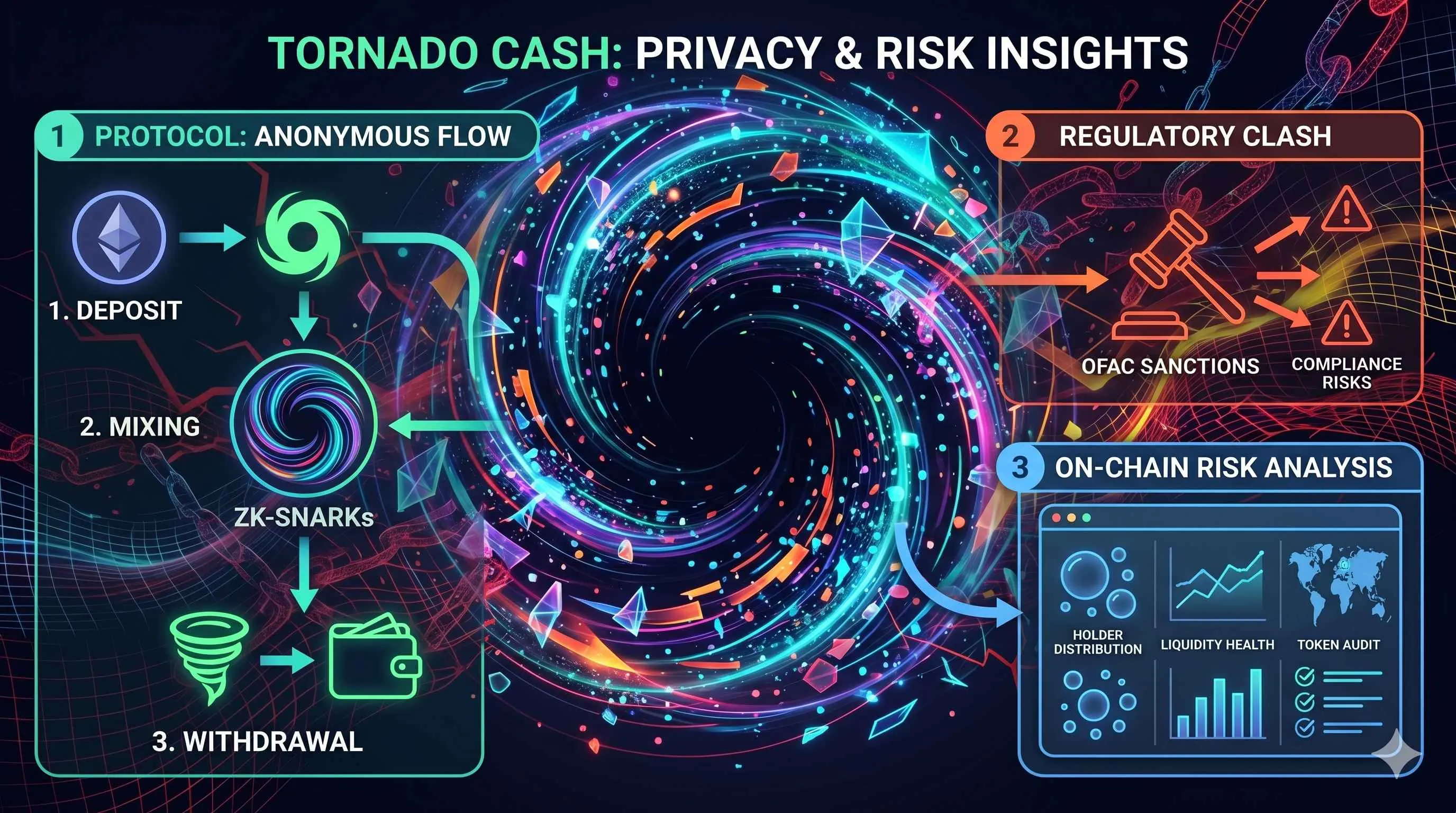
The Tornado Cash sanctions changed the trajectory of decentralized finance forever. It demonstrated that code is not entirely immune to real-world legal frameworks and that on-chain privacy carries a distinct premium and risk profile.
In this evolving landscape, the most effective tool a trader possesses is objective, real-time data. By consistently auditing smart contracts, tracking whale distributions, and keeping a close eye on liquidity health via DEXTools, market participants can navigate market volatility safely while maintaining a strict, non-negotiable approach to risk management.
Best Free Tools to Analyze Smart ContractsSmart Contract Audit Guide: How to Read an Audit Report
How to Use TokenSniffer: Contract Risk Checks and Honeypot Clues
RWA Risks Explained: Custody, Legal and Regulatory Guide
Disclaimer: This article is for informational purposes only and does not constitute investment advice, financial advice, trading advice, or any other kind of advice. DEXTools does not recommend buying, selling, or holding any cryptocurrency or token. Users should conduct their own research and consult with a qualified financial advisor before making any investment decisions. Cryptocurrency investments are volatile and high-risk. DEXTools is not responsible for any losses incurred.