ETH vs ETH2 Explained in 2026: Upgrades, Staking and Fees
Understand ETH vs ETH2 in 2026, including Ethereum upgrades, staking changes, fees and what still matters for users today.
The Great Ethereum chain Myth
As of today, April 6, 2026, Ethereum (ETH) continues its upward trajectory, currently trading at $2,136.21. However, even four years after the most significant upgrade in blockchain history, a ghost continues to haunt the hallways of crypto forums and newcomer guides: the term "ETH 2.0."
If you are looking to trade, stake, or simply understand the asset, the distinction between "ETH" and "ETH 2.0" is perhaps the most misunderstood concept in the industry. Let’s clear the fog once and for all, breaking down the general evolution, the technical nuances of trading, and the mechanics of staking in the modern era.
Intent split
- This page targets the ETH vs ETH2 explainer intent.
- For the Ethereum vs Solana swap comparison, read Ethereum vs Solana for Cross-Chain Swaps.
1. The General Difference: It’s an Evolution, Not a Replacement
The first thing every investor needs to know in 2026 is that ETH 2.0 does not exist as a separate token. Back in the early 2020s, "Ethereum 2.0" was a marketing term used to describe a series of upgrades designed to make the network more scalable, secure, and sustainable. The most famous of these was "The Merge" in 2022, where Ethereum retired its "Proof of Work" (mining) system and merged with the "Proof of Stake" (staking) Beacon Chain.
To avoid confusion, the Ethereum Foundation officially deprecated the terms "ETH 1.0" and "ETH 2.0." Instead:
ETH 1.0 is now the Execution Layer (where the smart contracts and rules live).
ETH 2.0 is now the Consensus Layer (where the validators agree on the state of the network).
When you see ETH trading at $2,136 today, you are looking at the same Ethereum that has existed since 2015, just running on a vastly superior engine. There is no "new coin" to buy, and any site offering to "swap your old ETH for ETH 2.0" is almost certainly a scam.
2. Technical Differences in Trading: Liquidity and Layers
From a trader's perspective, the transition to what was once called "2.0" changed the game's underlying math, though not the ticker symbol.
The Tokenomics Shift
Before the upgrades, Ethereum chain was inflationary-miners were constantly rewarded with new coins, which they often sold to cover electricity costs. In 2026, Ethereum’s trading profile is "Ultra Sound Money." Thanks to the EIP-1559 burn mechanism and the reduced issuance of Proof of Stake, ETH often becomes deflationary during periods of high activity. For a trader, this means that every time the network is busy, the total supply of the asset you are holding is actually shrinking.
The Rise of Layer 2s (L2s)
In 2026, "trading Ethereum" often doesn't happen on the Ethereum mainnet. Because the "2.0" roadmap focused on Rollups, most retail trading occurs on Layer 2 networks like Arbitrum, Optimism, or Base. These networks settle their transactions on Ethereum. When you trade on these layers, you are still trading the same ETH, but with technical advantages:
Speed: Near-instant execution.
Cost: Transaction fees are now measured in cents rather than dollars.
Security: You retain the underlying security of the Ethereum Consensus Layer.
3. The Staking Revolution: The True "ETH 2.0" Experience
The real technical divide between the old and new Ethereum lies in Staking. This is the process of locking up ETH to support the network's operations in exchange for rewards.
How Staking Works in 2026
In the old "1.0" days, you needed expensive hardware (GPUs) to "mine" ETH. Today, you use your capital. To be a full independent validator, you need 32 ETH. However, most users utilize Liquid Staking Protocols.
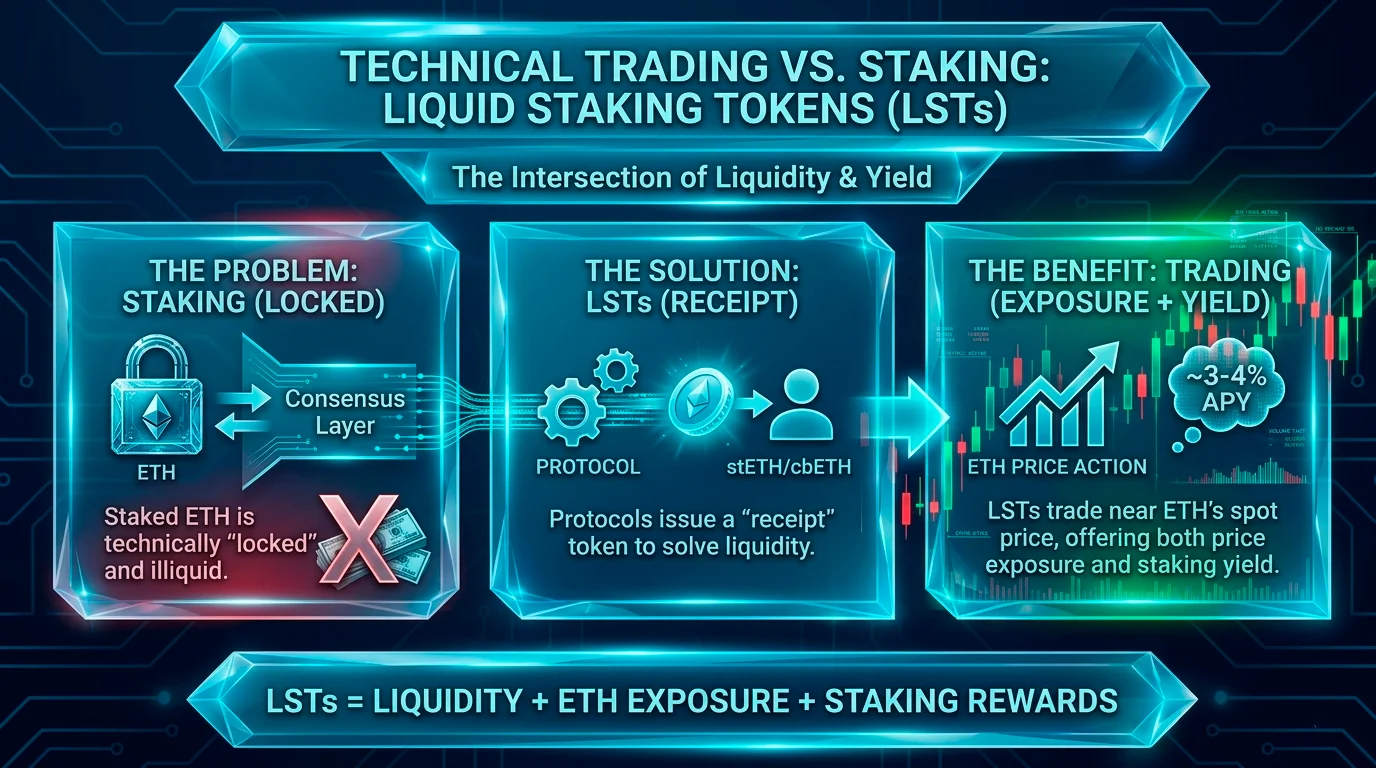
Technical Trading vs. Staking
There is a technical intersection here that often confuses people: Liquid Staking Tokens (LSTs).
When you stake your ETH, it is technically "locked" in the Consensus Layer.
To solve the liquidity problem, protocols give you a "receipt" token, like stETH or cbETH.
Trading Difference: These tokens often trade at a slight variance to the spot price of ETH. If you are a trader, you can buy these tokens to get exposure to ETH price action plus the staking yield (currently averaging 3-4% annually).
4. Ethereum’s 2026 Performance: A Year in Review
As we stand on April 6, 2026, Ethereum chain has had a fascinating journey so far this year. Let’s look at the numbers that brought us to today’s $2,136.21 price point:
Q1 Momentum: ETH started the year at $1,890, buoyed by the approval of several institutional staking funds in Asia.
The February Dip: We saw a temporary drop to $1,850 as the market reacted to global interest rate shifts. This was a "shakeout" that cleared out over-leveraged long positions.
March Consolidation: The price spent most of last month hovering between $1,950 and $2,100. This was a healthy period of "re-accumulation" where long-term holders increased their positions.
Today’s Move: The 1.30% gain we are seeing today is the result of ETH breaking out of that March range. The technical indicators suggest that the "2.0" fundamentals (low supply, high staking demand) are finally exerting upward pressure.
5. Summary: Navigating the New Ethereum
Whether you call it ETH 2.0 or just Ethereum, the reality in 2026 is that the network has never been stronger. The confusion between the two versions is largely a relic of the past. If you are trading, you are buying the same asset; if you are staking, you are participating in the new security model that replaced mining.
The current price of $2,136.21 reflects a mature asset that has moved past its experimental "2.0" phase and into a role as the world’s most used programmable ledger.
Keypoints
Terminology: "ETH 2.0" is a legacy term; the market now simply uses ETH. There is no new token to buy.
Price Status: As of April 6, 2026, ETH is at $2,136.21 (+1.30%), showing strong recovery from its March range.
Trading Tech: Most trading now happens on Layer 2s, offering lower fees while utilizing Ethereum's "2.0" security.
Staking: Replaced mining. You can earn passive yield (~3-4%) by staking ETH, either directly (32 ETH) or through liquid staking providers.
Deflationary Pressure: High network usage now burns ETH, making it a scarcer asset over time-a key technical change from the "1.0" era.
2026 Outlook: After a steady climb from $1,890 in January, ETH is currently testing a major resistance level at $2,150.
Optimize Your Ethereum Strategy
Navigating the difference between ETH, L2 tokens, and Liquid Staking derivatives requires the best tools available.
Don't get lost in the "ETH 2.0" confusion: see the real-time data for yourself. Use the DEXTools App dashboard to track Ethereum’s price action, monitor pool liquidity, and discover the top-performing tokens within the ETH ecosystem. Whether you are a spot trader or a DeFi staker, everything you need is at your fingertips.
Explore the Ethereum Dashboard on DEXTools today!
Disclaimer: This article is for informational purposes only and does not constitute investment advice, financial advice, trading advice, or any other kind of advice. DEXTools does not recommend buying, selling, or holding any cryptocurrency or token. Users should conduct their own research and consult with a qualified financial advisor before making any investment decisions. Cryptocurrency investments are volatile and high-risk. DEXTools is not responsible for any losses incurred.
Related Guides
- How to Stake and Unstake ETH on Coinbase: cbETH, Exit Paths and Fees (2026)
- What Is Ethereum Staking? How It Works, Rewards and Risks (2026)
- ETH Staking Calculator: Estimate Ethereum Rewards Live (2026)
- What is ETH? A Comprehensive Ethereum chain 2026 Guide
- Spot ETH vs. Sepolia ETH: Understanding the Difference
Frequently Asked Questions
What is the difference between ETH and ETH 2.0?
ETH and ETH 2.0 refer to the same asset; ETH is the current token while ETH 2.0 was a marketing term for upgrades that improved Ethereum's scalability and security. The Ethereum Foundation has deprecated the terms, with ETH now representing the Execution Layer and ETH 2.0 the Consensus Layer.
Is ETH 2.0 a separate token?
No, ETH 2.0 is not a separate token; it was a term used to describe upgrades to the Ethereum network. As of 2026, ETH remains the same asset that has existed since 2015, now operating on improved technology.
How does staking work in Ethereum 2026?
In 2026, staking involves locking up ETH to support network operations in exchange for rewards. Users can become validators with 32 ETH or utilize Liquid Staking Protocols for more flexibility.
What are Layer 2 networks in Ethereum?
Layer 2 networks, such as Arbitrum and Optimism, are built on top of the Ethereum mainnet to enhance trading speed and reduce transaction costs while maintaining the security of the Ethereum Consensus Layer.
What is the current trading profile of Ethereum in 2026?
As of 2026, Ethereum's trading profile is described as 'Ultra Sound Money,' often becoming deflationary during high activity due to the EIP-1559 burn mechanism and reduced issuance from Proof of Stake.