Ethereum vs Solana for Cross-Chain Swaps in 2026
Compare Ethereum vs Solana for cross-chain swaps in 2026, including costs, liquidity paths, bridge friction and chain-selection tradeoffs.
Ethereum chain and Solana in 2026
- As of April 3, 2026, the long standing rivalry between Ethereum and Solana has evolved from a zero sum game into a sophisticated, multi chain synergy.
- Following the pivotal Pectra and Fusaka upgrades for Ethereum and the full implementation of Firedancer and the Alpenglow consensus for Solana, both networks have cemented their roles in the global financial stack.
- Ethereum remains the institutional bedrock of decentralized security, while Solana has become the high frequency engine for retail and real world assets. Navigating between these two giants is now a standard requirement for any modern investor.
The 2026 Network Profiles: Pectra vs. Alpenglow
The technical landscape of early 2026 has redefined what we expect from a blockchain. Both networks have undergone "heart surgery" to improve performance without sacrificing their core identities.
Ethereum chain: The Modular Fortress
- With the completion of the Pectra Phase 2 and Fusaka upgrades, Ethereum chain has shifted its focus to hardening the Layer 1 (L1) while supercharging Layer 2s (L2). The introduction of PeerDAS (Peer Data Availability Sampling) and expanded blob capacity has made transacting on L2s like Base or Arbitrum virtually free.
- On the L1, the block gas limit has been pushed toward 100 million, allowing for massive institutional settlement. Ethereum is where the world’s most valuable assets are stored and secured.
Solana: The High-Speed Monolith
- Solana in 2026 is defined by Firedancer, its second independent validator client, which has effectively eliminated network outages. The Alpenglow upgrade has replaced the old Proof of History scheduling with the "Votor" and "Rotor" systems, reducing block finality to a staggering 150 milliseconds.
- Solana is no longer just for "meme coins," it is now the "Nasdaq of the blockchain," hosting high frequency trading firms and global payment systems that require millisecond precision.
Comparison Table: ETH vs. SOL in 2026
The following table highlights the core differences as they stand in today's market.
Intent split
- This page targets Ethereum vs Solana for cross-chain swapping.
- For the ETH vs ETH2 explainer, read ETH vs ETH2 Explained in 2026.
| Feature | Ethereum (L1 + L2) | Solana (Firedancer) |
| Primary Goal | Economic Security & Decentralization | Throughput & Ultra-low Latency |
| Architecture | Modular (Settlement + Execution layers) | Monolithic (Single high-speed layer) |
| Block Finality | ~13 minutes (L1) / ~2 seconds (L2) | ~150 - 400 milliseconds |
| Staking Cap | Up to 2,048 ETH per validator | No fixed maximum cap |
| Typical Fees | $0.01 (L2) / $5.00 (L1) | < $0.001 |
| Institutional Use | Sovereign Bonds, Real Estate, RWA | Payments, Gaming, HFT Trading |
Why Swap Between the Two?
- In 2026, investors often move funds between these ecosystems to capitalize on their unique strengths. You might keep your long term savings in ETH for the maximum security of the Pectra hardened L1, but swap a portion to SOL to interact with a high speed gaming metaverse or to participate in a "DePIN" (Decentralized Physical Infrastructure) project that requires thousands of micro transactions per second.
- Swapping is also common for "yield arbitrage." For instance, a lending protocol on Solana might offer a higher return on stablecoins during a period of high network activity, prompting users to move their ETH based capital over to the Solana ecosystem.
ETH chain vs. SOL Swaps: A Step-by-Step Guide
- The process of moving value between Ethereum chain and Solana (especially in the context of ETH vs. Solana) has become significantly more streamlined in 2026. We no longer rely on clunky, manual bridging processes; instead, we use "Intent-Based" cross-chain swaps.
Method 1: The Cross-Chain DEX (The 2026 Standard)
Platforms like Jupiter or UniswapX now support "Native Cross-Chain Swaps." You do not need to bridge the tokens yourself. You simply sign a permission in your wallet, and the protocol handles the rest.
Connect your wallets: You will need both an Ethereum wallet (like MetaMask) and a Solana wallet (like Phantom) connected to the platform.
Select your pair: Choose "ETH" on Ethereum as your source and "SOL" on Solana as your target.
Review the Quote: In 2026, these protocols use solvers to find the cheapest route, often using "Atomic Swaps" to ensure your funds are never at risk in a bridge.
Approve and Sign: Once you sign the transaction, the protocol locks your ETH and releases the equivalent SOL into your Solana wallet. The process usually takes less than 2 minutes.
Method 2: Traditional Bridges (Wormhole and LayerZero)
If you are moving a very large amount of capital, you might still use a dedicated bridge like Wormhole.
Lock Assets: You send your native ETH to the Wormhole contract on Ethereum.
Mint Wrapped Assets: The bridge verifies the lock and mints "Wormhole-Wrapped ETH" (WETH) on Solana.
Swap for Native SOL: Once you have WETH on Solana, you can use a local DEX like Jupiter to swap that WETH for native SOL.
Method 3: Centralized Exchanges (The Beginner Route)
For those who prefer a custodial experience, the process remains unchanged:
Deposit ETH into your exchange account (Coinbase, Kraken, or Binance).
Trade ETH for SOL on the exchange's spot market.
Withdraw the SOL to your personal Solana wallet.
The Role of Bridges and Wrapped Assets
Bridges are the "tunnels" that connect these two massive islands of capital. In 2026, we frequently use Wrapped Assets to represent value from one chain on another.
Wrapped ETH on Solana (WETH): This allows you to use your "Ethereum value" inside Solana’s DeFi apps without actually leaving the Solana network.
Wrapped SOL on Ethereum (WSOL): Similarly, you can hold SOL exposure on the Ethereum L1, allowing you to use it as collateral in Ethereum based lending protocols like Aave.
By April 2026, the security of these bridges has improved through "ZK-Bridges" (Zero Knowledge Bridges). These use mathematical proofs to verify that funds were locked on one chain before they are released on another, removing the need to trust a central group of "guardians" or "validators."
Risks and Security Checklist
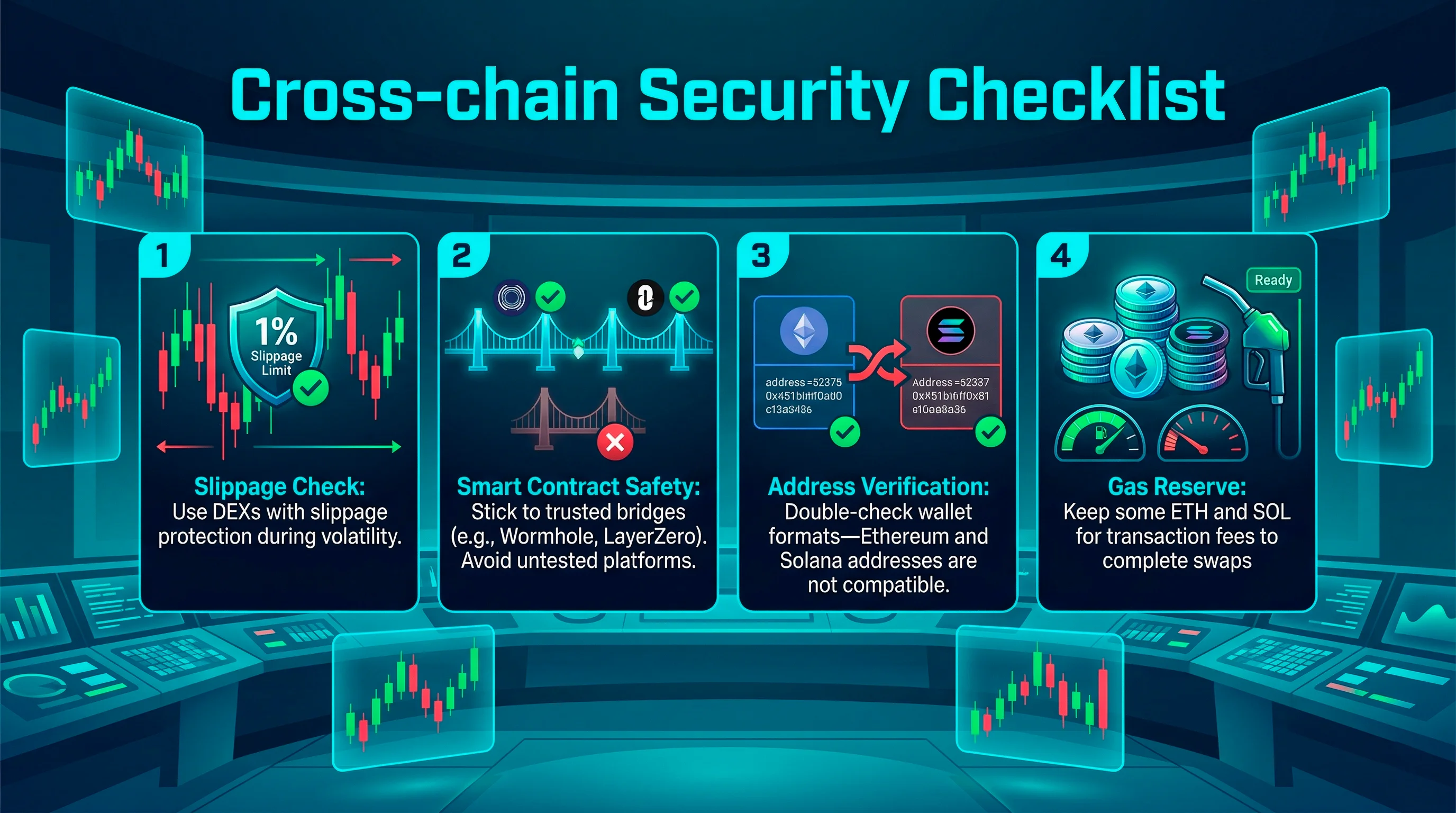
Even with the advancements of 2026, cross chain movement carries specific risks. Before you swap, ensure you follow this checklist:
Slippage Check: During times of high volatility, the price of SOL might move significantly while your ETH is "in flight." Always use a DEX that offers slippage protection.
Smart Contract Audit: Only use established bridges like Wormhole or LayerZero. Avoid new, "high-yield" bridges that have not been battle tested.
Address Verification: Ensure your Solana wallet address is correct. Unlike some L2s, Solana uses a different address format than Ethereum. Sending ETH to a Solana address directly (or vice versa) without a bridge will result in a permanent loss of funds.
Gas Reserve: Always keep a small amount of native ETH in your Ethereum wallet and a small amount of SOL in your Solana wallet to pay for the transaction fees. You cannot complete a swap if you do not have the "gas" to authorize it.
Summary of Key Points
Ethereum (2026) is the fortress of institutional security, enhanced by the Pectra and Fusaka upgrades.
Solana (2026) is the high throughput engine for global finance, powered by Firedancer and Alpenglow.
Cross-Chain Swaps are now largely automated through intent based protocols, making the process nearly instant.
Bridges like Wormhole and LayerZero act as the infrastructure for moving billions in capital between ecosystems.
Wrapped Assets (WETH and WSOL) allow you to use the value of one chain within the ecosystem of the other.
Finality Times differ greatly, with Solana reaching settlement in milliseconds while Ethereum L1 provides the ultimate "mathematical finality" in about 13 minutes.
Whether you are seeking the unparalleled security of Ethereum or the lightning speed of Solana, mastering the art of the cross chain swap is essential for the modern digital economy. To stay ahead of market trends and ensure you are trading your ETH or wrapped tokens with the highest security, we invite you to use the Ethereum and Solana dashboard on DEXTools.
-You can access Ethereum dashboard on DEXTools here.
-And you can also trade Solana tokens on DEXTools dashboard here.
DEXTools platform provides real time data, security audits, and deep market insights, helping you to trade safely across the entire decentralized landscape.
Disclaimer: This article is for informational purposes only and does not constitute investment advice, financial advice, trading advice, or any other kind of advice. DEXTools does not recommend buying, selling, or holding any cryptocurrency or token. Users should conduct their own research and consult with a qualified financial advisor before making any investment decisions. Cryptocurrency investments are volatile and high-risk. DEXTools is not responsible for any losses incurred.
Related Guides
- What Is an Atomic Swap? How Cross-Chain Swaps Work
- Memecoins on Solana vs Ethereum: Which Chain to Use
- How to Trade on Raydium: Solana Swaps, Entries and Execution Guide (2026)
- How to Use Raydium on Solana: Swaps, Liquidity Pools and CLMM Guide (2026)
- Wormhole vs LayerZero: Cross-Chain Messaging Compared 2026
Frequently Asked Questions
What are the main differences between Ethereum and Solana in 2026?
In 2026, Ethereum focuses on economic security and decentralization with a modular architecture, while Solana emphasizes throughput and ultra-low latency with a monolithic design. Ethereum's block finality is around 13 minutes for L1 and 2 seconds for L2, whereas Solana achieves finality in 150-400 milliseconds.
How have Ethereum and Solana upgraded their networks in 2026?
Ethereum has completed the Pectra and Fusaka upgrades to enhance Layer 1 and Layer 2 performance, while Solana has implemented Firedancer and Alpenglow to eliminate outages and improve block finality.
Why would investors swap between ETH and SOL?
Investors swap between ETH and SOL to leverage their unique strengths, such as using ETH for long-term savings and security, while utilizing SOL for high-speed transactions in gaming or DePIN projects.
What is the process for swapping ETH to SOL in 2026?
Swapping ETH to SOL in 2026 is streamlined using 'Intent-Based' cross-chain swaps on platforms like Jupiter or UniswapX, where users connect their wallets and select their token pair without manual bridging.
What types of assets are typically associated with Ethereum and Solana?
Ethereum is commonly associated with sovereign bonds, real estate, and decentralized applications, while Solana is recognized for hosting high-frequency trading and global payment systems.