Whale Watching: How to Track Big Wallets Like a Pro
— By AliceOnChain in Tutorials

Tracking large-scale wallet movements provides crucial context for DeFi traders. Discover how to spot institutional accumulation, decode distribution phases, and analyze volume spikes using professional on-chain data frameworks.
Whale Watching: How to Track Big Wallets Like a Pro
The transparency of decentralized networks introduces an asset class where market participants can observe the behavior of its largest stakeholders in real time. In traditional finance, institutional positioning is obscured behind dark pools and delayed regulatory filings. In decentralized finance (DeFi), every transaction—regardless of size—is recorded on an immutable ledger. This unique transparency has made whale watching crypto one of the most valuable frameworks for understanding capital allocation in decentralized ecosystems.
For retail traders, monitoring these large-scale entities is a practical approach to sentiment analysis. Understanding how to filter out market noise, analyze wallet behavior, and interpret liquidity shifts can help traders transition from reactive speculation to data-driven, probabilistic analysis. Rather than viewing whale actions as definitive blueprints for immediate profit, professional on-chain analysts treat whale activity signals as one of several confluent indicators. This guide provides a structural framework for identifying, tracking, and contextualizing large wallet movements using professional analytics.
1. Defining the Crypto Whale: Size, Structure, and Intent
Before diving into whale watching crypto techniques, it is necessary to define what constitutes a large holder within a specific ecosystem. A wallet containing 500 ETH represents a substantial market participant in most liquidity pools, whereas a wallet holding an equivalent dollar value in a micro-cap token might control a dangerous percentage of the circulating supply.
Absolute vs. Relative Supply Ownership
Whale status is relative to the total market capitalization and the available decentralized token liquidity of a specific asset. When performing a holder distribution analysis, look for entities controlling more than 1% to 5% of the circulating supply. High concentration risk occurs when a small cluster of independent wallets holds a dominant share of an asset, as their individual liquidation decisions can cause significant downward price action.
Identifying Wallet Typologies
Not all large wallets share the same operational intent. Distinguishing between different types of entities prevents misinterpreting routine operational movements as definitive whale activity signals:
Exchange and Protocol Wallets: These are cold and hot storage units managed by centralized platforms or decentralized smart contracts (e.g., automated market maker pools or lending platforms). These wallets represent structural infrastructure rather than speculative intent.
Deployer and Team Wallets: Wallets tied to the project’s originators. Large allocations moving from a deployer wallet to an active trading pool may indicate upcoming marketing expansions, development funding, or potential distribution phases.
Early Private Investors and VCs: Wallets that acquired tokens during seed or private rounds. These entities often operate under strict vesting schedules, though their unlock periods can lead to systematic distribution.
Active Speculative Whales: High-net-worth individuals or trading desks executing strategies based on technical indicators, fundamental shifts, or yield opportunities. These are the primary targets for advanced wallet tracking strategies.
2. Setting Up Your Infrastructure for Tracking Big Wallets
Raw blockchain data is unstructured and difficult to read. To build an efficient whale watching crypto system, analysts use advanced DeFi analytics platforms to visualize liquidity, cluster holders, and receive real-time updates.
Liquidity and Holder Analysis via DEXTools
The first step in tracking an asset's ownership structure involves evaluating how distributed the token is among its community. Using the Pair Explorer and Holder Analysis features on DEXTools allows traders to audit a token's top address metrics before executing trades.
[Token Smart Contract] │ ├──► Holder Analysis (Audits top 100 wallets for concentration risk) ├──► Bubblemaps Integration (Visualizes hidden transfers between wallets) └──► Pair Explorer (Filters real-time transactions by transaction size)
A healthy holder distribution typically features a gradual decline in percentage ownership from the top holders down to retail wallets. If the top ten holders control an overwhelming majority of the non-pool supply, the token exhibits structural fragility.
To dig deeper, the integrated Bubblemaps feature on DEXTools assists in uncovering artificial distribution. Often, a single large entity will split their holdings across twenty separate wallets to hide their true exposure. Bubblemaps visualizes the on-chain data interactions between these addresses, exposing whether seemingly independent wallets are actually connected by historical transfers.
Setting Parameters for Price Alerts
Advanced wallet tracking requires timing; monitoring screens continuously is inefficient. Setting up smart Price Alerts and configuring token alerts ensures you are notified when an asset breaks out of a defined consolidation range, which frequently points to institutional accumulation or distribution.
3. On-Chain Signals: Accumulation vs. Distribution
Understanding the lifecycle of an asset requires distinguishing between the accumulation phase and the distribution phase. Whales cannot buy or sell their massive positions all at once without causing unfavorable slippage, so they execute their strategies over days, weeks, or months.
Spotting Accumulation Formations
Accumulation often occurs during periods of low volatility and negative or stagnant market sentiment.
On-Chain Data Indicator: A steady migration of tokens away from decentralized exchange (DEX) liquidity pools into private, non-custodial storage wallets.
Volume and Price Action: The price remains bounded within a strict horizontal support and resistance zone, but the overall trading volume begins to rise subtly. This suggests that large buyers are absorbing organic selling pressure without driving the price upward prematurely.
Technical Divergence: Analysts often look for a bullish RSI divergence during this period. The token price may print flat or slightly lower lows, while the Relative Strength Index (RSI) begins forming higher lows, indicating that selling momentum is exhausting.
Decoupling Distribution Signs
Distribution is the process where large holders slowly unload their positions to retail buyers, frequently during periods of heightened market excitement or positive news cycles.
On-Chain Data Indicator: Large inflows of tokens moving out of private wallets and into active trading pools or centralized exchange deposit addresses. This serves as one of the clearest whale activity signals indicating an intent to liquidate.
Volume Anomalies: A sharp spike in trading volume accompanied by minimal upward price progress. If a token registers its highest volume day in months but closes with a long upper wick or a flat candlestick, it may signal that whale sell orders are capping the price.
The Top Traders Feature: Utilizing tools like the Top Traders tab on DEXTools allows you to filter the addresses generating the highest historical returns on a specific pair. If these high-performing wallets are consistently reducing their positions while retail transaction counts increase, it often coincides with a macro trend reversal.
4. Integrating Technical Analysis with On-Chain Flow
No whale watching crypto framework is complete without cross-referencing on-chain flows with established technical analysis patterns.
Volume and Token Liquidity Confluence
When a whale executes a large swap, its impact depends entirely on the available token liquidity locked within the pair's smart contract. A $50,000 sell order in a pool with $1,000,000 in locked liquidity creates roughly a 5% price impact, whereas the same order in a shallow pool could collapse the price by 30%.
Always cross-reference the transaction size against the total pool liquidity visible on DEXTools Charts. True institutional expansion occurs when price breaks above established resistance levels accompanied by institutional-sized buy orders and expanding daily volume.
Support and Resistance Validation
Whale accumulation zones historically transform into long-term support levels. If historical records show that multiple high-net-worth wallets concentrated their purchasing power around a specific price floor, that level may act as an institutional defense zone during future market pullbacks. Conversely, massive clusters of whale distribution form stiff overhead resistance barriers that require substantial buying volume to invalidate.
5. Mitigating Risks and Avoiding Common Tracker Pitfalls
While whale watching crypto is a sophisticated DeFi analytics framework, it is highly susceptible to exploitation by sophisticated actors who understand that retail traders are actively watching public addresses.
Counter-Trading and Wallet Spoofing
Bad actors frequently exploit blockchain transparency to engineer false market signals. A malicious developer or a coordinated group may deploy a token and systematically "airdrop" large quantities of the asset directly into known high-profile investor wallets.
To an inexperienced trader monitoring basic holder lists, it appears as though a major institutional player has bought into the asset. In reality, the wallet owner had no interaction with the smart contract. Always verify the transaction history to confirm whether the wallet actively purchased the tokens via a swap or if they were transferred unilaterally without consent.
Managing Volatility and Slippage
Following whale transactions blindly exposes retail traders to severe execution risks. If you attempt to copy-trade a whale swap immediately after it registers on the ledger, you are purchasing after the initial price impact has already occurred. In fast-moving, low-liquidity DeFi markets, this can lead to buying the local top of a volatile wick.
Managing risk requires implementing defensive position-sizing rules and factoring in execution slippage. Never risk more capital on an individual position than your broader portfolio risk management framework allows, regardless of how many whales are active in the pool.
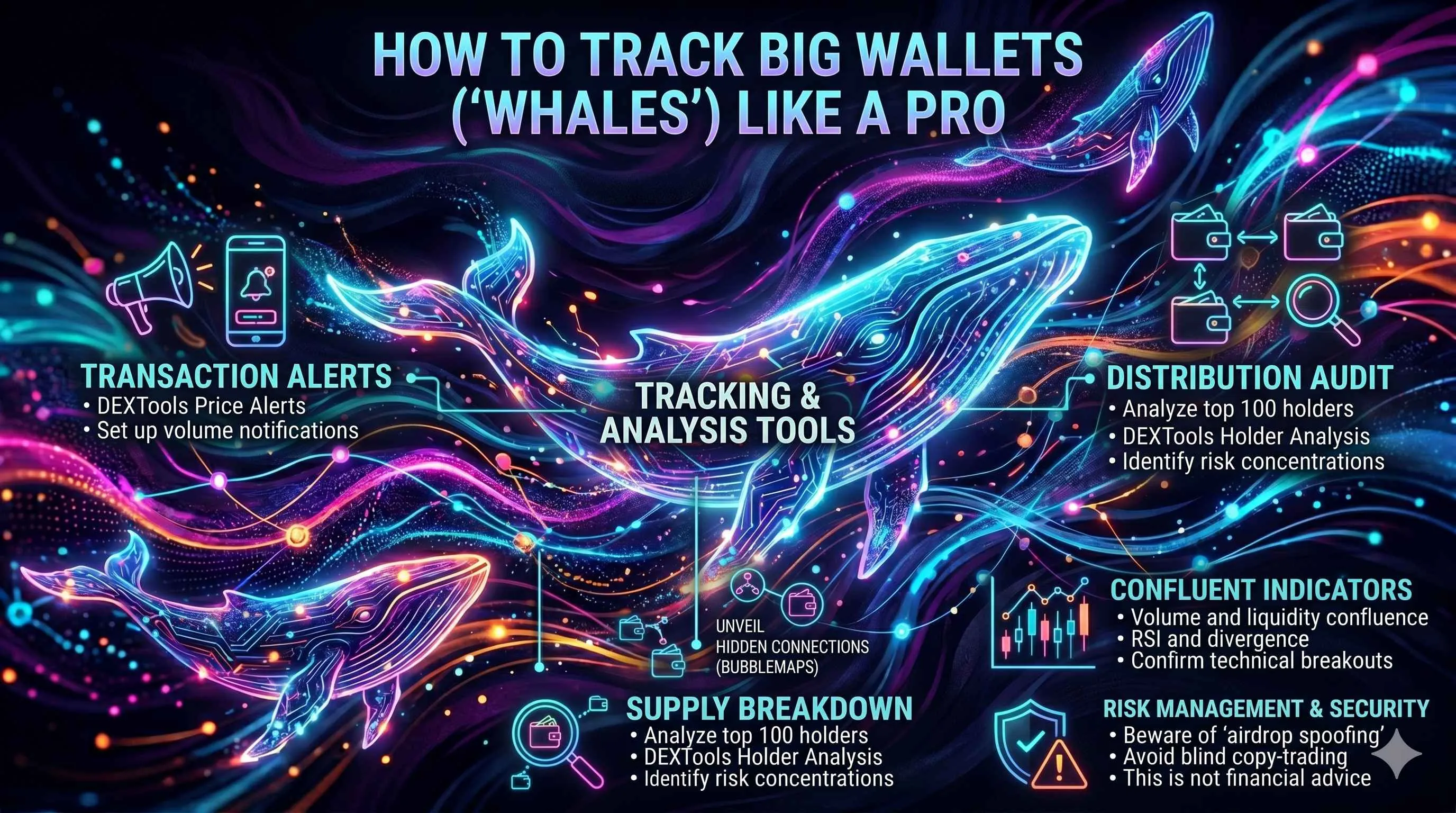
Summary of Professional Whale Watching Checklist
To practice whale watching crypto systematically, integrate these steps into your daily analytical routine:
Audit Ownership Structure: Review the token's top 100 addresses via DEXTools Holder Analysis to rule out dangerous supply concentration.
Visualize Internal Connections: Run the contract through Bubblemaps to ensure a single whale hasn't artificially split their supply across multiple wallets.
Monitor Real-Time Swaps: Keep the DEXTools Pair Explorer active to classify whether large block trades represent strategic accumulation or systematic distribution.
Establish Price Anchors: Use DEXTools Price Alerts around major structural support and resistance lines to identify when large entities are triggering volatile market movements.
Cross-examine Technical Data: Ensure on-chain asset transfers align with volume indicators, RSI trajectories, and liquidity health.
How to Read Big Swaps
The Whale Shadow: How Large Wallets Distort Retail Interpretation
How to Use Cielo Finance: Wallet Tracking and Smart Money Alerts
Disclaimer: This article is for informational purposes only and does not constitute investment advice, financial advice, trading advice, or any other kind of advice. DEXTools does not recommend buying, selling, or holding any cryptocurrency or token. Users should conduct their own research and consult with a qualified financial advisor before making any investment decisions. Cryptocurrency investments are volatile and high-risk. DEXTools is not responsible for any losses incurred.