What Are Option Greeks in Crypto Trading? 2026 Guide
— By Tony Rabbit in Tutorials
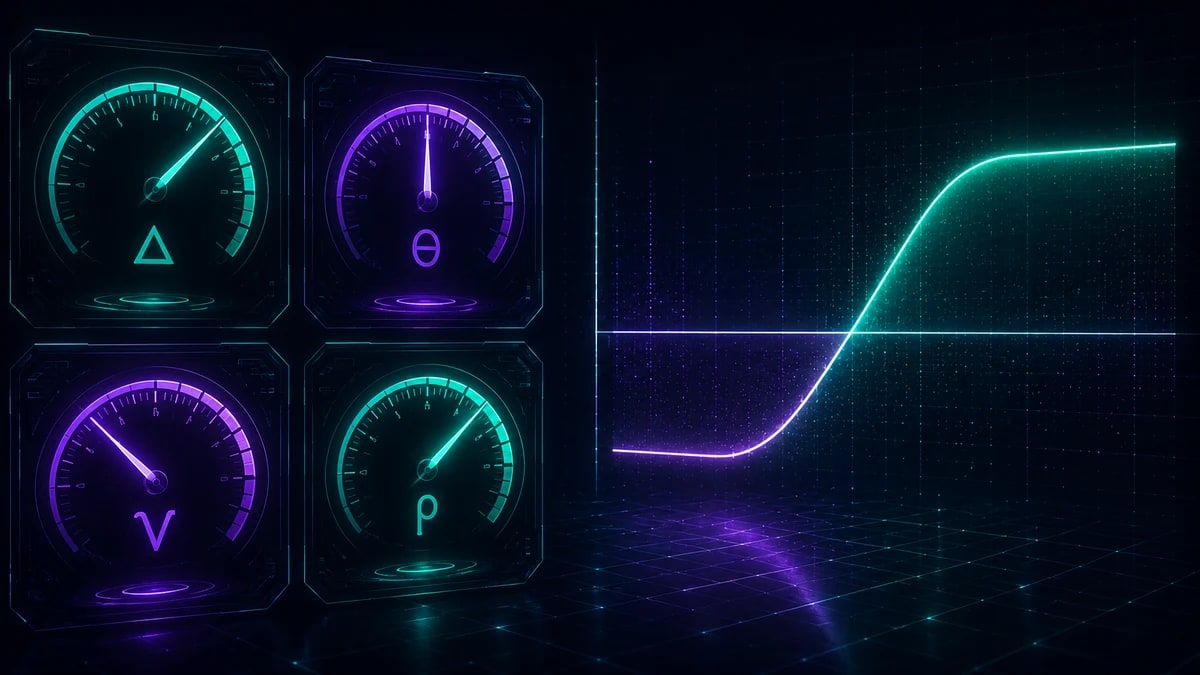
Learn what option Greeks are and how delta, gamma, theta, vega, and rho help crypto options traders measure risk and manage their positions.
If you have ever looked at a crypto options chain on a venue like Deribit, you have probably seen a row of figures labeled with Greek letters. These are the option Greeks, a set of risk measures that show how the price of an option reacts to different market factors. Instead of guessing how a contract will behave, traders use the Greeks to put a number on each source of risk and to plan around it.
Crypto options behave much like traditional options, so the same Greeks apply. The main five are delta, gamma, theta, vega, and rho. Each one isolates a single influence on the option price, such as the move in the underlying asset, the passage of time, or a shift in implied volatility. This guide explains each Greek in plain language, shows how calls and puts differ, and describes how traders read them to manage risk. None of this is financial advice.
Delta: Sensitivity to the Underlying Price
Delta measures how much an option price is expected to change when the underlying asset moves by one dollar. If a Bitcoin call option has a delta of 0.50, then a one dollar rise in BTC should lift the option value by roughly fifty cents, all else equal. Delta is the first Greek most traders learn because price direction is usually the largest risk in any position.
Call options have positive delta that ranges from 0 to 1, since calls gain value as the underlying rises. Put options have negative delta that ranges from 0 to -1, because puts gain value as the underlying falls. Delta also doubles as a rough estimate of the probability that an option finishes in the money. A delta of 0.30 suggests an option with about a 30 percent chance of expiring in the money, which is a handy shortcut when comparing strikes.

Gamma: The Rate of Change of Delta
Gamma measures how fast delta itself changes as the underlying moves. Delta is not fixed, so a position that starts with a delta of 0.50 can quickly become more or less sensitive after a sharp price swing. Gamma tells you the speed of that shift. High gamma means delta can move a lot with a small change in the underlying, which makes the position more reactive.
Gamma is highest for options near the money and close to expiry, where small price moves can flip a contract from out of the money to in the money. Both calls and puts carry positive gamma for buyers. Traders watch gamma closely because it explains why a position that looked balanced one moment can suddenly carry far more directional risk the next. Managing gamma is a core part of keeping a delta hedge stable.
Theta: Time Decay
Theta measures how much value an option loses with each passing day as expiry approaches, assuming everything else stays the same. Options are wasting assets, so their time value erodes steadily until expiration. A theta of -15 means the contract is expected to lose about fifteen dollars of value per day from time decay alone.
For option buyers, theta is usually negative because time works against them. For sellers, theta is effectively positive, since they collect that decaying value over time. Theta accelerates as expiry nears, which is why short dated crypto options can lose value quickly in calm markets. Traders who buy options need the underlying to move enough to overcome this daily drag, while sellers aim to profit from it.
Vega: Sensitivity to Implied Volatility
Vega measures how much an option price changes when implied volatility rises or falls by one point. Implied volatility reflects the market expectation of how much the underlying will move, and crypto is famous for sharp swings in this figure. If a contract has a vega of 8, then a one point increase in implied volatility should raise the option value by about eight dollars.
Both calls and puts have positive vega for buyers, because higher expected volatility makes large moves in either direction more likely, which raises the value of optionality. Vega is largest for longer dated, at the money options. Crypto traders pay particular attention to vega around major events, since implied volatility can spike before a catalyst and collapse afterward, a pattern that can move option prices even when the underlying barely budges.

Rho: Sensitivity to Interest Rates
Rho measures how much an option price changes when interest rates move by one percentage point. Calls generally have positive rho, since higher rates tend to increase call values, while puts generally have negative rho. Rho is the least watched Greek for most crypto traders because short dated options have little time for rate changes to matter.
Rho becomes more relevant for longer dated contracts, where the cost of carry over months can have a measurable effect. For the typical weekly or monthly crypto option, though, the impact of rho is small compared to delta, gamma, theta, and vega. Many traders monitor it only loosely and focus their attention on the four Greeks that drive most of the daily profit and loss.
How Traders Use the Greeks Together
No single Greek tells the whole story. Experienced traders look at the full set to understand the complete risk profile of a position. They might check delta to gauge directional exposure, gamma to see how stable that exposure is, theta to measure the daily cost of holding, and vega to judge sensitivity to volatility shifts. Combining them turns a vague feeling about risk into a clear picture.
For example, an option seller might collect positive theta but accept negative gamma, meaning the position earns money slowly in quiet markets yet can suffer if the underlying moves sharply. A buyer faces the reverse trade off. Traders often adjust strikes, expiries, and position sizes to shape these exposures toward the profile they want. When researching tokens and market context before placing such trades, many traders cross check data on platforms like DEXTools to stay informed on the broader market.
Conclusion
The option Greeks give crypto traders a structured way to measure and manage the risks hidden inside every contract. Delta captures direction, gamma captures how that direction shifts, theta captures time decay, vega captures volatility sensitivity, and rho captures interest rate effects. Calls and puts carry these measures with different signs, which is why understanding each one matters before opening a position.
Learning to read the Greeks takes practice, but it transforms options from a black box into a set of measurable risks you can plan around. Whether you buy or sell, keeping an eye on the Greeks helps you size positions sensibly and avoid surprises. Always do your own research and remember that nothing here is financial advice.
The Interplay of Greeks: Beyond Isolated Metrics
While understanding each Greek in isolation is fundamental, a truly sophisticated options trader recognizes their dynamic interplay. Delta, gamma, theta, and vega are not static figures but rather constantly shifting variables that influence each other and a portfolio's overall risk profile. Ignoring these complex relationships can lead to unexpected exposure, especially in the highly volatile crypto markets where underlying asset prices can swing dramatically, and implied volatility can spike or crash.
For instance, a significant move in the underlying asset (amplified by high gamma) will drastically alter delta, requiring immediate re-evaluation of directional exposure. Simultaneously, this price movement might also impact implied volatility, subsequently changing vega's contribution to your portfolio's sensitivity. Effective risk management in crypto options demands a holistic view, where adjustments to one Greek often have ripple effects across the others.
Practical Applications for Advanced Traders
- Gamma Hedging Strategies: Actively managing gamma to maintain a delta-neutral or desired directional bias as the underlying asset moves, often involving frequent rebalancing of options or spot positions.
- Volatility Skew and Vega: Analyzing the implied volatility smile or skew across different strike prices to identify potential mispricings or opportunities to capitalize on anticipated volatility changes with specific vega exposures.
- Theta Decay Optimization: Structuring spreads or combinations that strategically leverage theta decay on out-of-the-money options while mitigating its impact on in-the-money positions, especially in range-bound or low-volatility environments.
- Scenario Analysis with Greek Sensitivities: Running "what-if" scenarios to project how a portfolio's Greeks would behave under various market conditions, such as a sharp price drop, a sudden volatility spike, or extended sideways trading, allowing for proactive adjustments.
Related Guides
- What Is Wash Trading in Crypto? Beginner Guide (2026)
- Wash Trading in Crypto: Red Flags Explained
- What Is Trading Volume in Crypto? How to Read It (2026)
- What Is the Supertrend Indicator in Crypto Trading? 2026 Guide
- What Is the Keltner Channel in Crypto Trading? 2026 Guide
Frequently Asked Questions
What are option Greeks?
Option Greeks are a set of measures that show how an option's price is expected to change in response to different factors. The main ones are delta, gamma, theta, vega, and rho.
What does delta measure in options?
Delta estimates how much an option's price is expected to move for a small change in the underlying asset's price. Gamma in turn measures how much delta itself changes as the price moves.
What is theta in option trading?
Theta measures how much value an option is expected to lose as time passes, all else equal. This is often called time decay and tends to accelerate as expiration approaches.
How do vega and rho affect options?
Vega measures sensitivity to changes in implied volatility, so options gain value when expected volatility rises. Rho measures sensitivity to changes in interest rates, which usually has a smaller effect in many crypto markets.