What Does Same-Block Sniping by the Deployer Mean

On-chain token launches are a battle for supply. We break down how malicious deployers use atomic transactions and block-zero bundles to hijack their own launches.
Same-Block Sniping
- The initial state of an on-chain token launch is a raw battle for supply allocation. In the hyper-velocity arenas of decentralized exchanges (DEXs), the very first block of a token's existence (frequently referred to as Block Zero) is where the ultimate fate of the asset is decided. For everyday market participants tracking automated launch scanners, a brand-new token pair can appear to be an open, permissionless opportunity to buy in early.
- However, behind the user interface, sophisticated developers often rig the deck before external participants can even parse the contract bytecode.
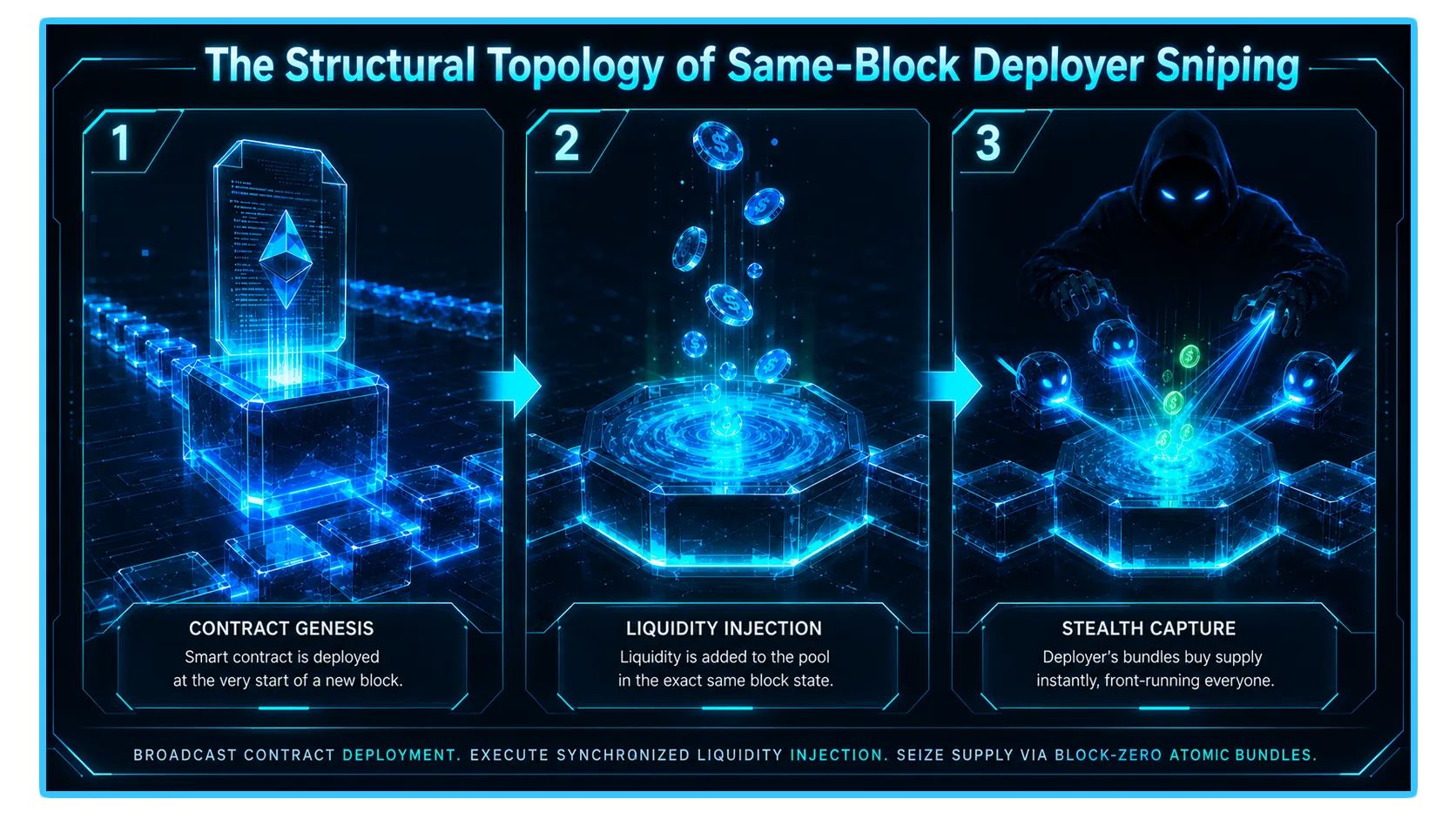
- When on-chain analysts or trading desks refer to "Same-Block Sniping by the Deployer," they are identifying a highly calculated, often predatory launch mechanism. It means the creator of the token has structurally engineered the token deployment, the liquidity pool injection, and a massive purchase of the token supply to occur within the exact same blockchain block.
- Let's be completely direct: if a deployer executes this tactic, the narrative of a "fair launch" is entirely dead. This guide breaks down the block-level mechanics, MEV infrastructure, and diagnostic warning signs of same-block deployer snipes.
1. The Technical Mechanics of Block Zero
- To evaluate same-block sniping with professional engineering precision, you must understand how transactions are sequenced inside a single block. In standard blockchain operations, transactions are ordered by validators based on gas fee priority or specific MEV (Maximal Extractable Value) auction protocols.
When a malicious deployer prepares a launch, they do not broadcast these steps manually across multiple minutes. Instead, they use specialized developer scripts to package three distinct actions into a single atomic transaction bundle via MEV infrastructure like Flashbots (on Ethereum) or Jito (on Solana):
Transaction 1 (Genesis): The smart contract code is written to the ledger, creating the token tokenomics.
Transaction 2 (Liquidity): The deployer injects stablecoins or native assets paired with the new token into an AMM pool, turning the asset market active.
Transaction 3 (The Snipe): The deployer's main wallet (or a cluster of pre-funded, programmatically linked sub-wallets) executes a massive buy order.
Because these three transactions are bundled together, they are verified by the validator concurrently. The deployer's buy order lands at index positions immediately following the liquidity injection within the same block, completely front-running the rest of the world.
2. Why Deployers Snipe Their Own Launches
Executing a same-block snipe requires technical overhead, but it grants the deployer absolute, structural control over the asset's lifecycle. Malicious actors leverage this framework to achieve three primary tactical goals:
Complete Supply Monopolization
By buying the token the exact millisecond liquidity is initialized, the deployer captures a massive percentage of the total circulating supply at the absolute lowest possible price on the bonding curve. It is common for a sniping deployer to secure 50% to 90% of the tradeable tokens for a nominal capital fee.
Neutralizing Competitive Public Bots
The micro-cap market is populated by highly aggressive, automated public sniper bots that monitor the mempool for liquidity additions. If a deployer launches a token normally, these public bots will instantly buy up the supply. Same-block sniping acts as an architectural shield, allowing the deployer to front-run the public front-runners.
The Illusion of a Stealth Cabal
Instead of purchasing the tokens using the visible "Deployer" wallet address, sophisticated actors distribute their block-zero buy orders across dozens of clean, seemingly unrelated target addresses. This creates a highly deceptive on-chain footprint. When retail users audit the token ledger later, the supply appears to be healthily distributed among independent community members, masking the reality that a single entity holds the master keys.
3. The Structural Matrix: Fair vs. Sniped Architecture
To maintain a clean overview when parsing real-time token launches, use this standardized data matrix to differentiate authentic liquidity provisioning from same-block developer ambushes:
| Launch Dimension | True Fair Launch Configuration | Same-Block Deployer Snipe |
| Block Zero Composition | Features deployment and pool initialization only | Contains contract creation, liquidity injection, and immediate buys |
| Initial Supply Capture | Distributed across multiple, unique public addresses | Highly concentrated within the deployer's hidden wallet cluster |
| Pricing Vector | Moves smoothly along organic order book demand | Suffers an instant, vertical gap-up before public access |
| MEV Bundle Dependency | Broadcasted transparently to the open mempool | Routed privately via direct validator execution channels |
4. The Strategic Fallout: Tracking the "Slow Rug"
- When a deployer successfully executes a same-block snipe, they are not setting up the project for long-term fundamental expansion; they are preparing an extraction runway. Because they own the vast majority of the supply at a near-zero cost basis, they do not need to execute a violent, single-block liquidity removal (a classic rug pull) to lock in massive profits.
- Instead, they deploy a more deceptive strategy known as a Slow Rug. As unsuspecting retail traders discover the token on social monitoring feeds and inject fresh capital into the pool, the deployer gradually sells off fractions of their sniped tokens across hours or days.
- Because the sales are distributed across alternative stealth wallets, the automated safety scanners do not always flag the distribution event. The price line is systematically suppressed, slowly bleeding out organic participants until the pool is entirely drained of its stablecoin backing.
5. Real-Time Telemetry and Risk Diagnostics via DEXTools
- Defending your digital wealth from the predatory nature of same-block deployer snipes requires absolute, block-level analytical transparency. While a project's promotional landing page promises an open, community-driven launch paradigm, cross-referencing live transaction indices, historical wallet funding origins, and structural pool health logs on an independent data grid is the only method to confirm genuine ledger integrity.
- DEXTools provides the vital data infrastructure needed to perform these diagnostic verifications in real-time. By utilizing advanced pair explorers, look-through transaction logs, and comprehensive wallet telemetry, market participants can instantly inspect Block Zero of any asset.
- By clicking on the earliest transaction records, you can audit whether the very first buy orders occurred within the exact same block timestamp as the liquidity injection. If the data telemetry reveals a cluster of top holders who all acquired their balances at block-zero index positions, you are looking at a sniped architecture, allowing you to intercept a dangerous capital trap before deploying your portfolio.
You can access DEXTools here and start trading today!
What Is a Block Zero Sniper at Token Launch? What Is MEV in Crypto? Maximal Extractable Value Explained Token Analysis: First 48 Hours Checklist The Zero to Liquidity Window: When a New DEX Pair Becomes Actually Tradable
Disclaimer: This article is for informational purposes only and does not constitute investment advice, financial advice, trading advice, or any other kind of advice. DEXTools does not recommend buying, selling, or holding any cryptocurrency or token. Users should conduct their own research and consult with a qualified financial advisor before making any investment decisions. Cryptocurrency investments are volatile and high-risk. DEXTools is not responsible for any losses incurred.